
Your complete New York study guide — plain language, no jargon.
📘 Prefer pictures? Flip through the visual deck
This whole guide as 15 slides — swipe or scroll sideways through them. The rules of the road in New York — including the traps that cost points.







Take it with you: Download the deck as a PDF (3.8 MB) → — free to share.
Why this matters
Traffic laws are the rules that keep thousands of strangers moving past each other safely every day. New York has its own fingerprint: two default speed limits (25 mph in New York City, 55 mph where nothing is posted elsewhere), a Move Over law that since 2024 protects every stopped vehicle, seat belts required in the back seat too, and signs that separate “parking,” “standing,” and “stopping” into three different legal acts. This guide covers the everyday laws the permit test loves most.
Part 1: New York’s two speed defaults
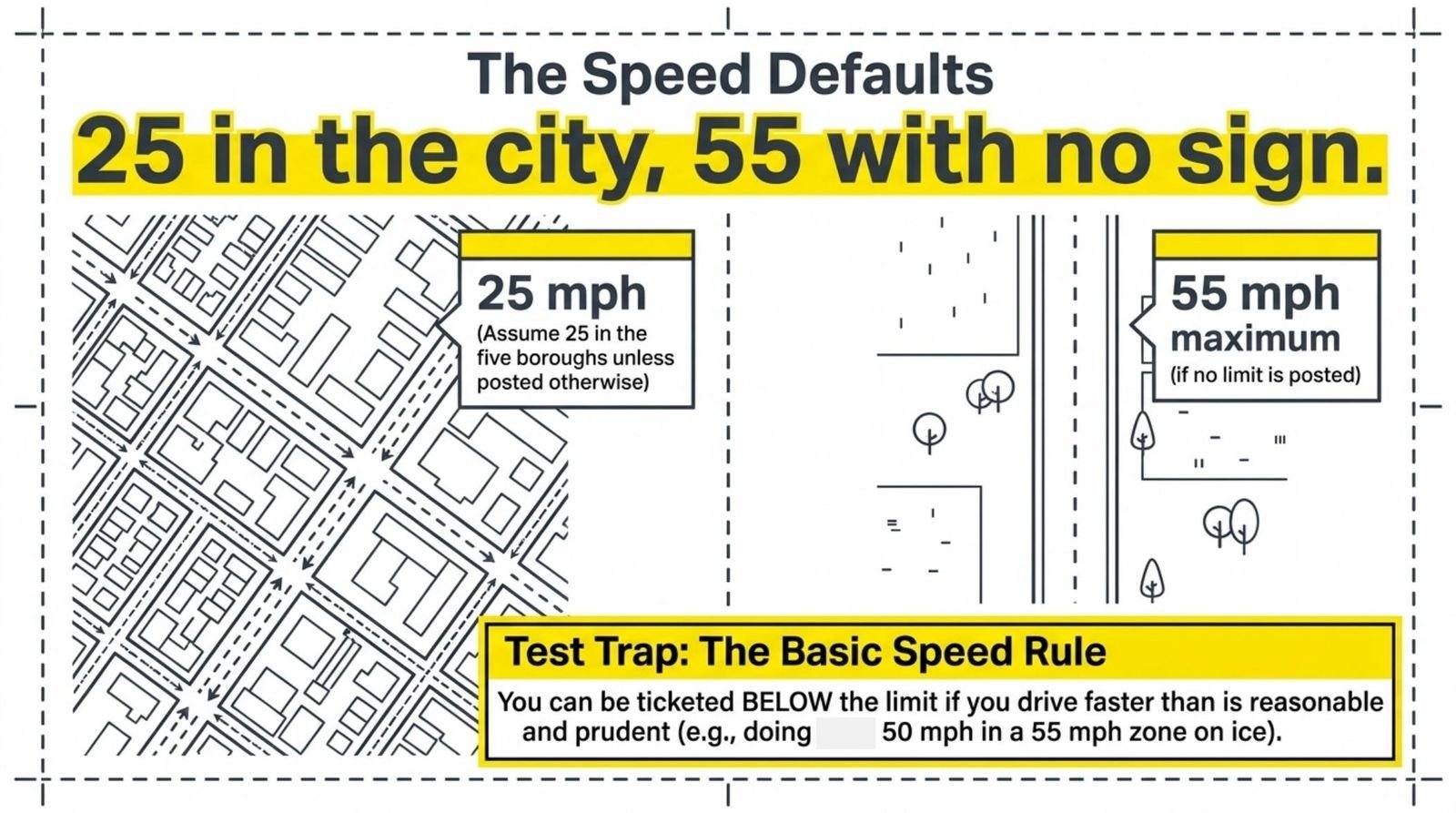
Unless a sign posts a different limit, New York’s default speed limits are:
| Where | Limit |
|---|---|
| New York City, unless another limit is posted | 25 mph |
| Anywhere else in the state, if no limit is posted | 55 mph maximum |
| Expressways | Normally 55 mph; 65 mph posted in some rural areas |
Memory aid: 25 in the city, 55 with no sign. City limits below 55 aren’t always posted, so in the five boroughs, assume 25.
The basic speed rule sits above every number: never drive faster than is reasonable and prudent for the conditions. You can be ticketed for “speed not reasonable” even below the posted limit — doing 50 in a 55 zone on an icy road can still be a violation.
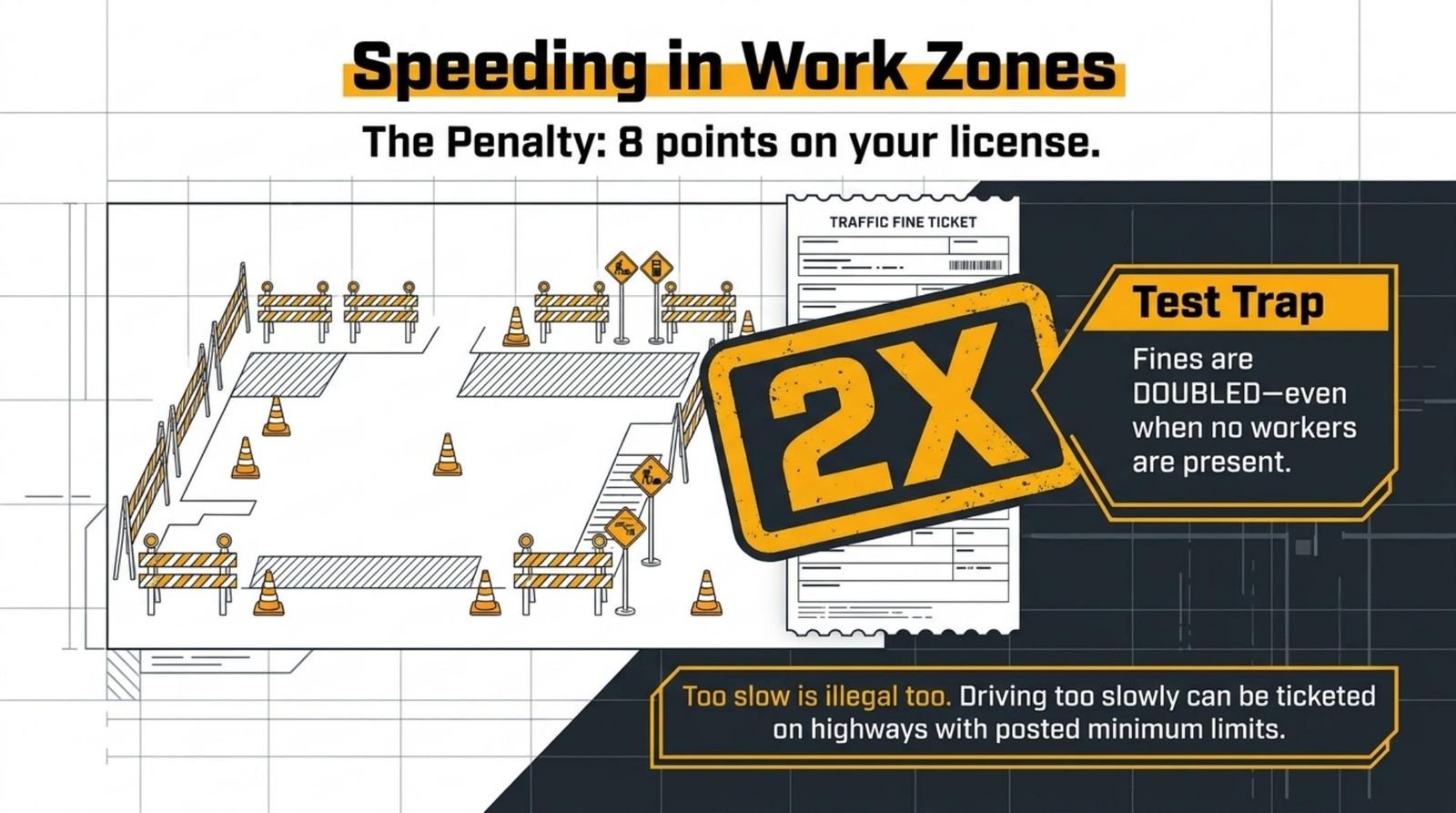
Work zones. Speeding fines in a work zone are doubled — even when no workers are present, and work-zone speeding carries 8 points.
Too slow is also illegal. Minimum limits are posted on some highways, and driving too slowly can be dangerous and ticketable.
Check yourself: You’re upstate on a road with no posted limit. What’s the maximum — and what could still make driving at that speed illegal?
Part 2: Cell phones and texting
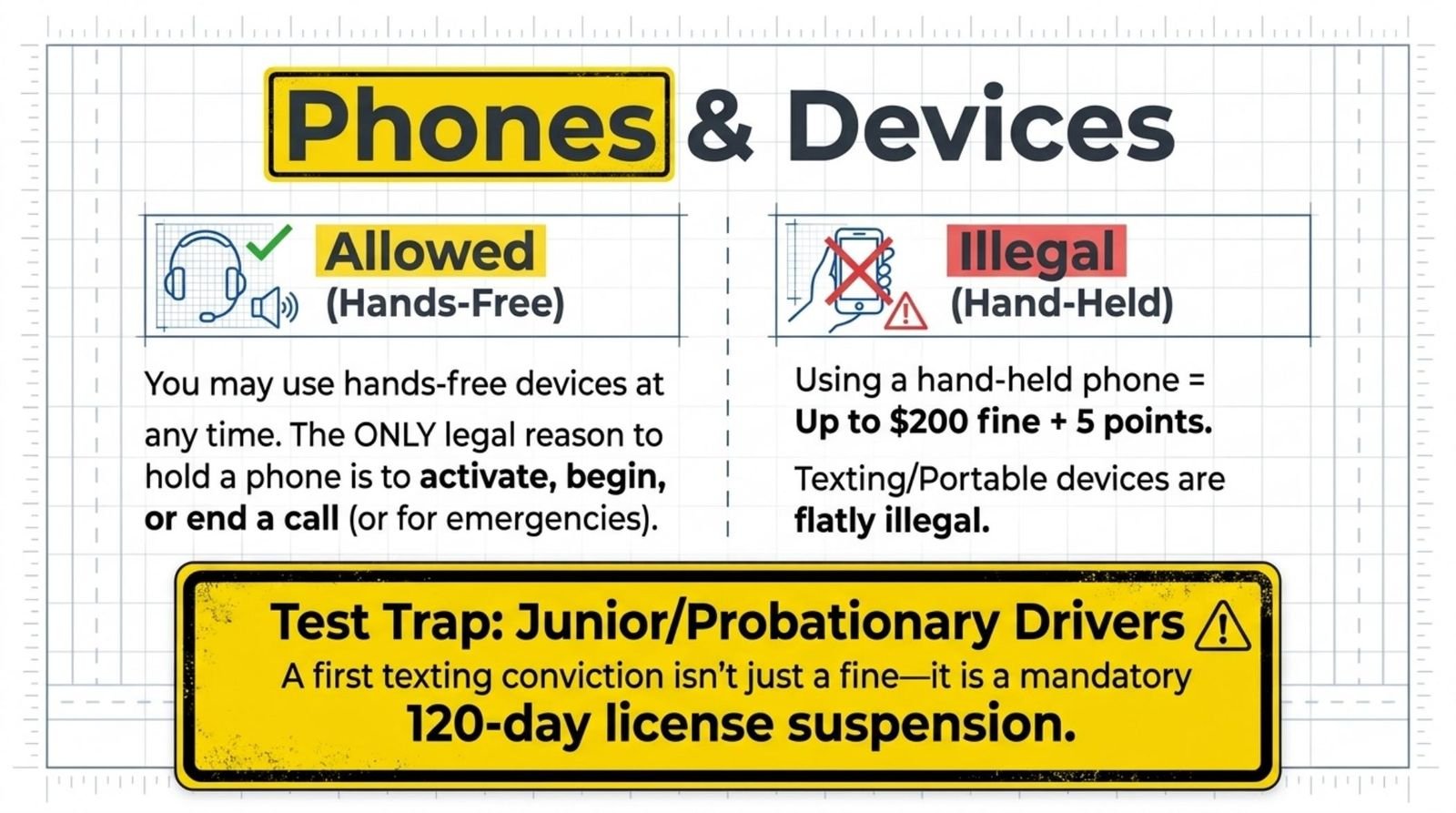
- Hand-held phone use is a traffic infraction. Using a hand-held phone while driving is illegal; a first offense carries up to $200 plus 5 points.
- The only legal reason to hold the phone is to activate, begin, or end a call. Emergency calls are exempt, as are on-duty police, fire, and emergency-vehicle operators.
- Hands-free use is allowed at any time — the legal way to take a call in New York.
- Texting and portable-electronic-device use are flatly illegal.
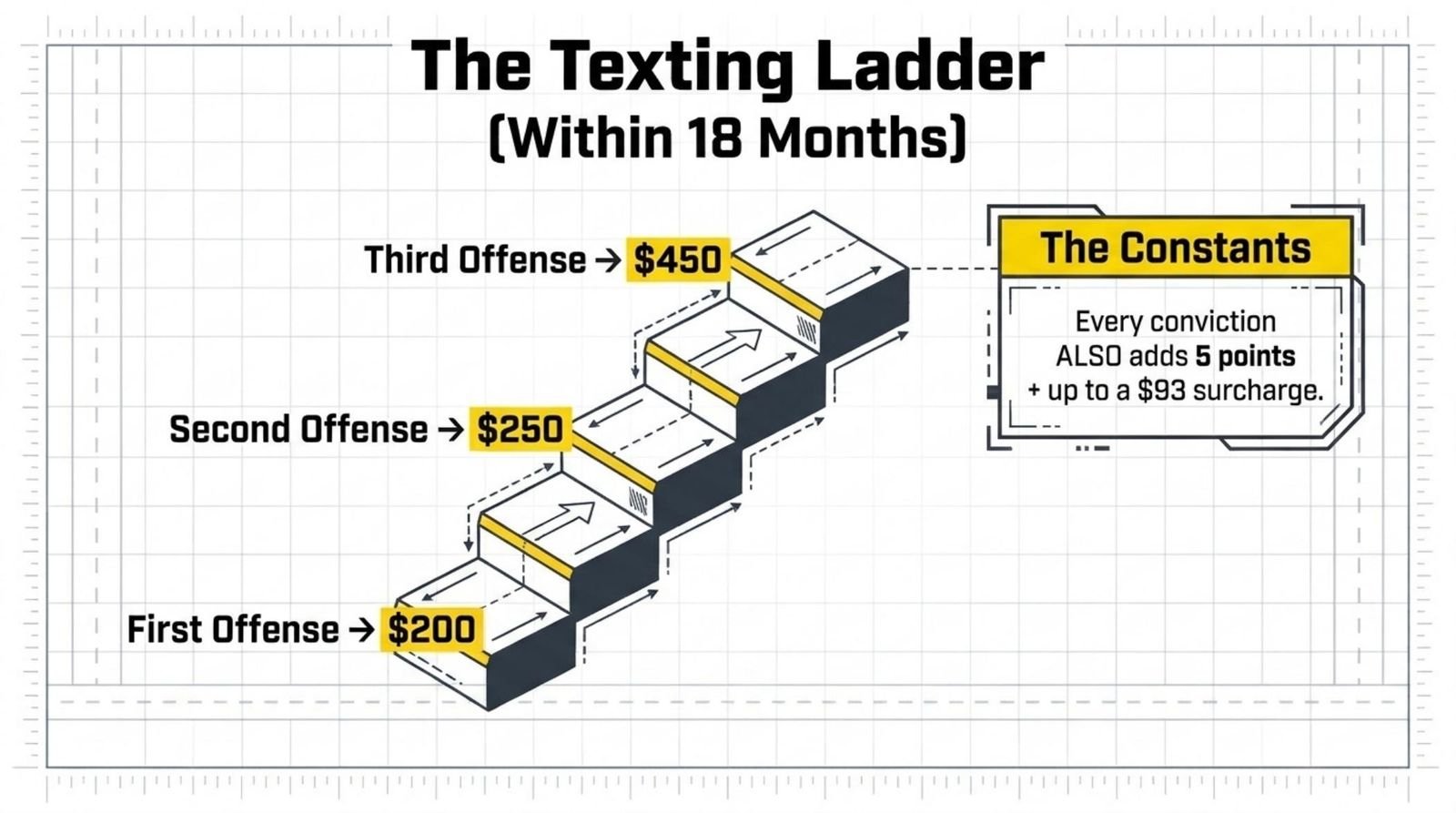
The texting fine ladder (each step counts offenses within 18 months):
| Offense | Fine |
|---|---|
| First offense | $200 |
| Second offense (within 18 months) | $250 |
| Third or later offense (within 18 months) | $450 |
Every texting conviction also adds 5 points, and the surcharge can run up to $93. For junior and probationary drivers the punishment targets the license, not the wallet: a 120-day suspension for a first conviction, and revocation of at least one year for another within six months of getting the license back.
Check yourself: A junior driver is convicted of texting. A friend with a full license briefly holds her phone to start a hands-free call. Who broke the law, and what happens to each?
Part 3: Seat belts and child restraints
Seat belts. New York is a primary-enforcement state: an officer may stop you solely for a seat-belt violation — visitors included. The driver must be belted (fine up to $50), and every passenger age 16 or older must be belted — front seat and back seat alike, one person per belt — each facing a fine of up to $50. The driver is responsible for every passenger under 16: a violation costs the driver $25–$100 plus 3 points.
Child passenger law — learn it as a ladder by age:
- Under age 4: a federally approved child safety seat (belt or LATCH) — rear-facing until age 2, or until the child outgrows the seat’s rear-facing weight or height limit.
- Ages 4 through 7: a federally approved child restraint system (such as a booster) used with a lap AND shoulder belt — the vehicle’s belts alone do not count. Exception: a child over 4’9″ AND over 100 lbs may use a seat belt.
- Ages 8 through 15: a seat belt, one person per belt. (A restraint is still recommended under 4’9″ or 100 lbs.)
- Never place a rear-facing seat in front of a passenger airbag.
Check yourself: Your 6-year-old is 4 feet 6 inches tall and weighs 70 pounds. Can she ride using just the car’s seat belt?
Part 4: Headlights, passing, and the Move Over Law
Headlights. Required from one-half hour after sunset to one-half hour before sunrise, when visibility is less than 1,000 feet, and whenever your wipers are on for rain, snow, or sleet. Daytime running lights do not count. Dim high beams within 500 feet of an oncoming vehicle and 200 feet of one ahead — low beams light only about 350 feet, so drive within your headlights.
Passing and turning.
- Signal at least 100 feet before a turn or an expressway exit.
- Never pass within 100 feet of a railroad crossing, a bridge, or a tunnel.
- Railroad crossings: stop at least 15 feet from the tracks when signals are active, never go around lowered gates, and cross only when you can clear all the tracks completely.
- U-turns are illegal where visibility is under 500 feet, in NYC business districts, where NO U-TURN signs are posted, on limited-access expressways, and in school zones.
- Studded tires are allowed only October 16 through April 30; tires need at least 2/32 inch of tread.
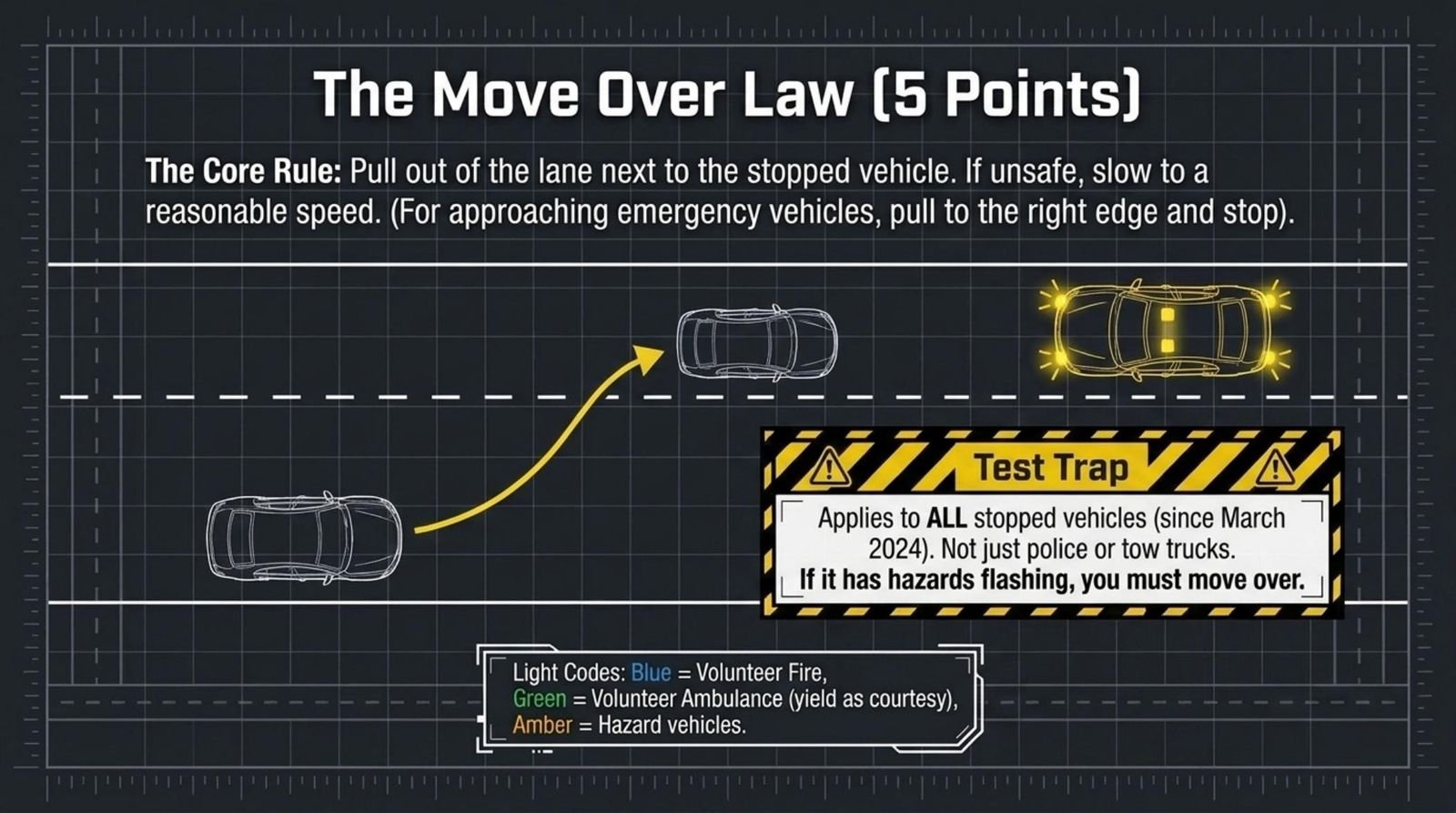
The Move Over Law. For an approaching emergency vehicle, pull to the right edge and stop — even on a two-way road; in an intersection, clear it first. For stopped vehicles: since March 27, 2024, Move Over covers ALL stopped vehicles — police car, tow truck, or private sedan with hazards on. Move out of the lane next to it; if that’s unsafe, slow to a reasonable speed. Violation: “failure to exercise due care,” 5 points. Light colors: blue = volunteer firefighters, green = volunteer ambulance/rescue (yield as a courtesy), amber = hazard vehicles.
Check yourself: Ahead on the shoulder is an ordinary sedan, hazards flashing — no police, no tow truck. Does Move Over apply, and what must you do?
Part 5: Parking rules — three different signs
New York separates parking, standing, and stopping into three distinct legal acts. NO PARKING: stop only to load or unload merchandise or passengers. NO STANDING: stop only to receive or discharge passengers — the driver may not leave. NO STOPPING: stop only to obey a sign, signal, or officer, or to avoid a conflict with traffic. After parallel parking, wheels must be within 1 foot of the curb. Never park, stand, or stop:
- Within 15 feet of a fire hydrant (unless a licensed driver stays with the vehicle)
- Double-parked; on a sidewalk or in a crosswalk; in an intersection; on railroad tracks; on a bridge or in a tunnel
- Within 30 feet of a pedestrian safety area, or next to road work blocking traffic
And never park or stand: in front of a driveway; within 20 feet of a crosswalk at an intersection; within 30 feet of a traffic light, STOP, or YIELD sign; within 20 feet of a fire-station driveway (75 feet opposite); within 50 feet of a railroad crossing; or along a lowered curb.
Parking on a hill: set the brake, leave the transmission in Park (first gear for a manual), and turn the wheels toward the curb or road edge.
Check yourself: Rank from smallest to largest parking distance: railroad crossing, fire hydrant, STOP sign, crosswalk.
Part 6: Points — a first look
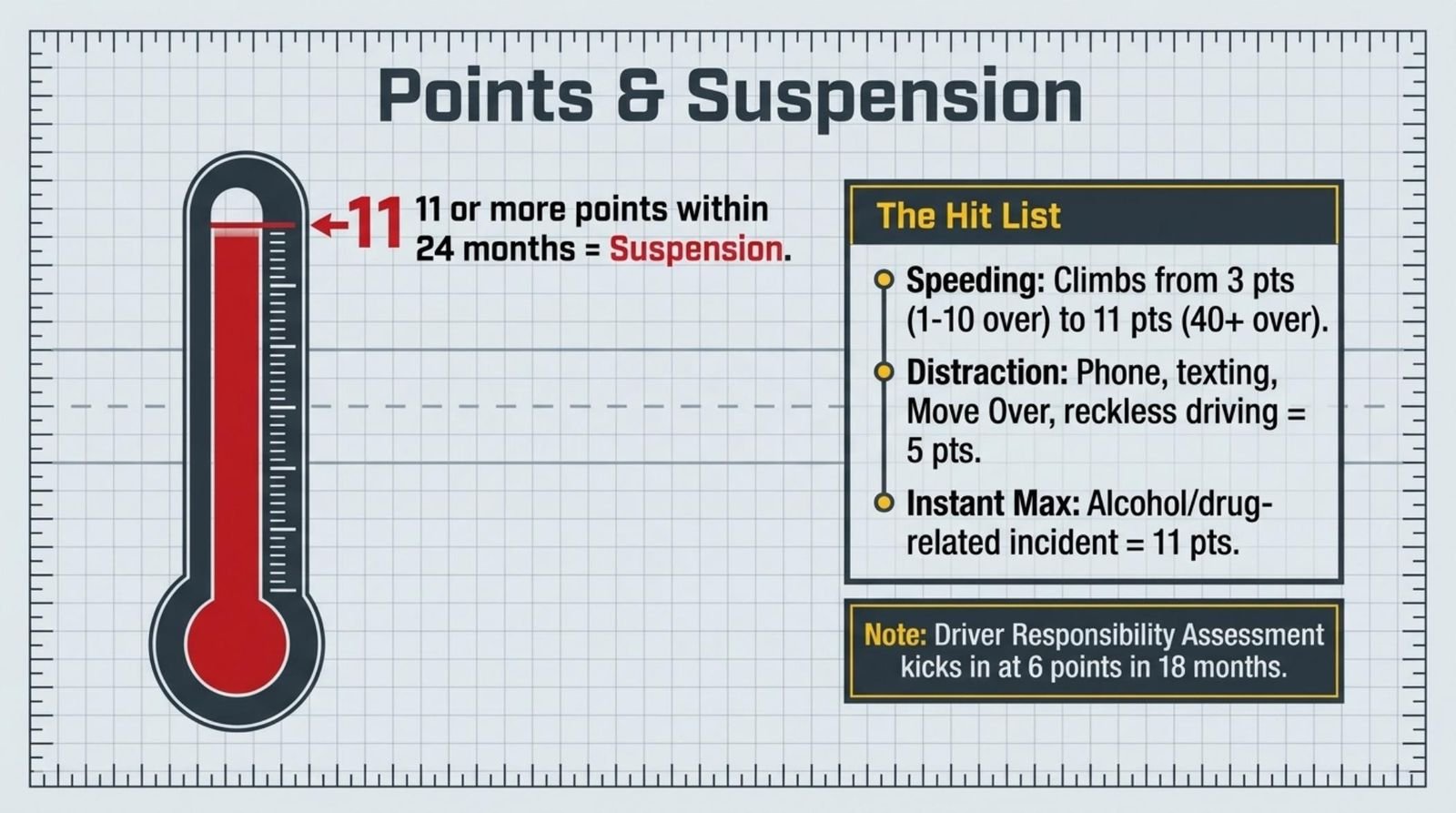
New York runs a point system: convictions add points, counted from the date of the violation, and 11 or more points within 24 months brings a notice of suspension. Speeding climbs a steep ladder — 3 points for 1–10 mph over, 4 for 11–20 over, 6 for 21–30 over, 8 for 31–40 over, 11 for more than 40 over. Phone and texting convictions carry 5 points each, as do reckless driving and a Move Over violation. And note the contrast with New Jersey: an alcohol- or drug-related incident carries 11 points here. Points can cost money a second way — the Driver Responsibility Assessment kicks in at 6 points within 18 months. The full chart, the DRA, and the PIRP course (up to 4 points off) are in the Licensing & Registration guide.
Key numbers to memorize
| Fact | Remember |
|---|---|
| Default limits: NYC / unposted elsewhere | 25 mph / 55 mph maximum |
| Work-zone speeding | Fines doubled (workers or not); 8 points |
| Hand-held phone, first offense | Up to $200 plus 5 points; hold it only to start or end a call |
| Texting fines | $200 → $250 → $450 (within 18 months), plus 5 points, surcharge up to $93 |
| Junior / probationary phone conviction | 120-day suspension; a repeat can bring revocation of 1 year or more |
| Seat belts | Everyone belted, back seat too; up to $50 each; under-16 violation: $25–$100 plus 3 points for the driver |
| Child restraints | Under 4: safety seat, rear-facing until 2; ages 4–7: restraint system; ages 8–15: seat belt |
| Headlights | ½ hr after sunset to ½ hr before sunrise; visibility under 1,000 ft; wipers on; dim at 500 ft / 200 ft |
| Move Over | Every stopped vehicle since March 27, 2024; violation = 5 points |
| No passing / parking distances | No passing within 100 ft of a crossing, bridge, or tunnel; park 15/20/30/50 ft from hydrant/crosswalk/sign/crossing |
| Studded tires / points threshold | October 16 – April 30 / 11 points within 24 months = suspension |
5-question self-check
- You’re driving in Queens and haven’t seen a speed limit sign in miles. What’s the limit?
- A driver is convicted of texting for the third time within 18 months. What’s the fine, and how many points?
- Your 5-year-old is 4 feet 3 inches tall and weighs 60 pounds. Can she ride with just the car’s seat belt?
- Rain starts at noon and you turn on your wipers. Must your headlights be on too?
- You approach a delivery van stopped on the shoulder, hazards flashing. What does Move Over require?
Answer key
- 25 mph — the New York City default unless another limit is posted. (The 55 mph default applies only outside the city.)
- A $450 fine, plus 5 points — the ladder is $200, then $250, then $450 for offenses within 18 months; the surcharge can add up to $93.
- No. Ages 4–7 need a child restraint system (such as a booster) with a lap AND shoulder belt. The seat-belt-only exception requires over 4’9″ AND over 100 lbs — she is neither.
- Yes — headlights are required whenever wipers are on for rain, snow, or sleet, and daytime running lights don’t count.
- Since March 27, 2024, Move Over covers all stopped vehicles: change into a lane not next to the van if safe; if not, slow to a reasonable speed. Ignoring it costs 5 points.
Keep practicing
- Take the Traffic Laws practice quiz
- Flip through the Traffic Laws flashcards
- Watch the Traffic Laws video lesson
- Ready for the whole thing? Take the full 20-question New York practice test
More study guides: Signs & Signals Study Guide · Right of Way Study Guide · Safe Driving Study Guide · Alcohol, Drugs & Driving Conditions Study Guide · Licensing & Registration Study Guide