Your complete New York study guide — plain language, no jargon.
📘 Prefer pictures? Flip through the visual deck
This whole guide as 13 slides — swipe or scroll sideways through them. Who goes first — intersections, pedestrians, emergency vehicles and school buses in New York.


Take it with you: Download the deck as a PDF (3.1 MB) → — free to share.
Why this matters
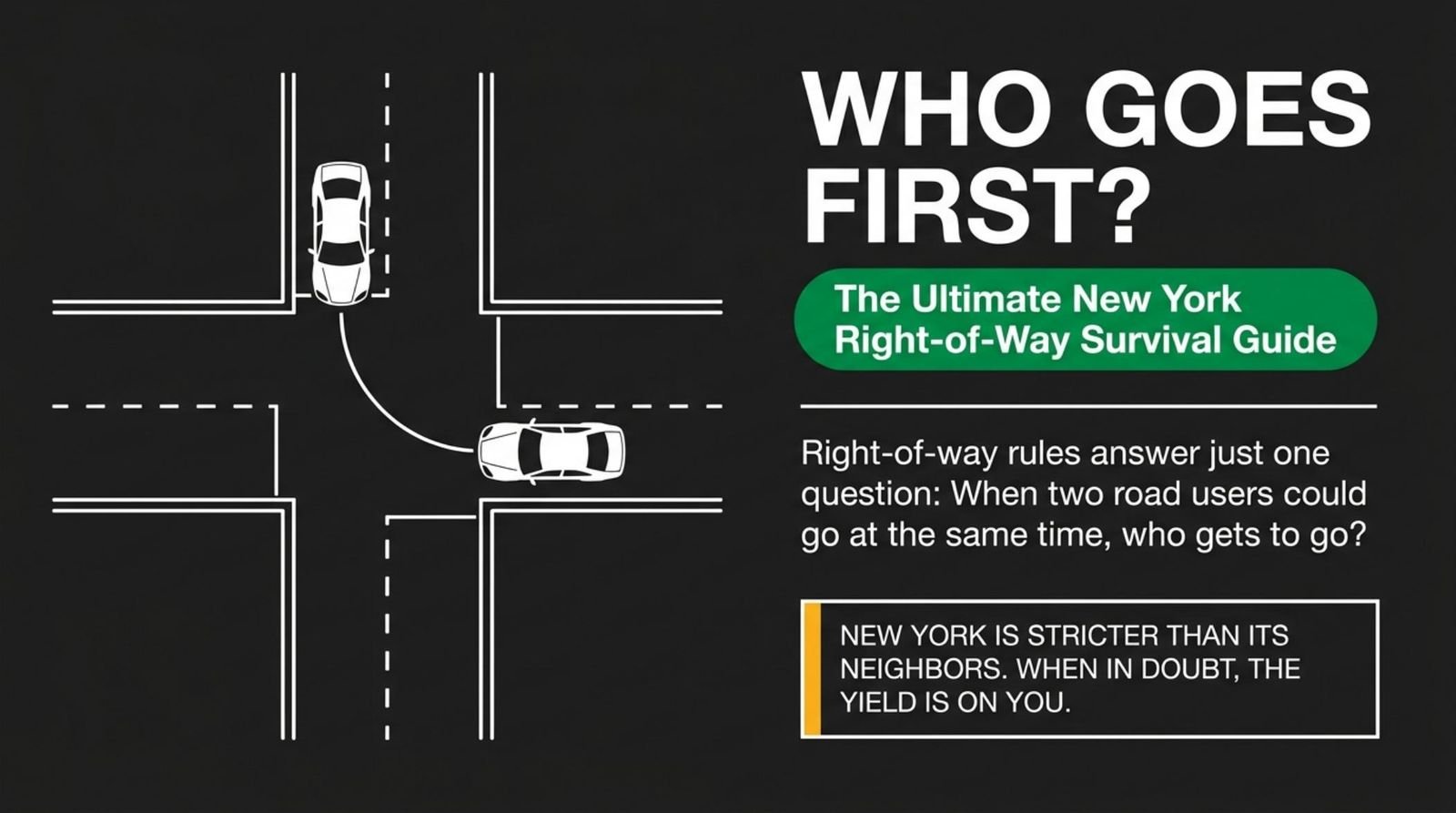
Right-of-way rules answer one question: when two road users could go at the same time, who goes first? New York’s answers are stricter than its neighbors’. Coming from another state? Two rules will trip you up: traffic facing a stopped school bus must stop from both directions — even on a divided highway, with no exception at all; and inside New York City, turning right on red is banned unless a sign permits it — the opposite of the rule in the rest of the state. The mistakes are expensive, too: failing to yield is 3 points, a railroad-crossing violation is 5, and passing a stopped school bus is 8.
Part 1: Intersections — the basics
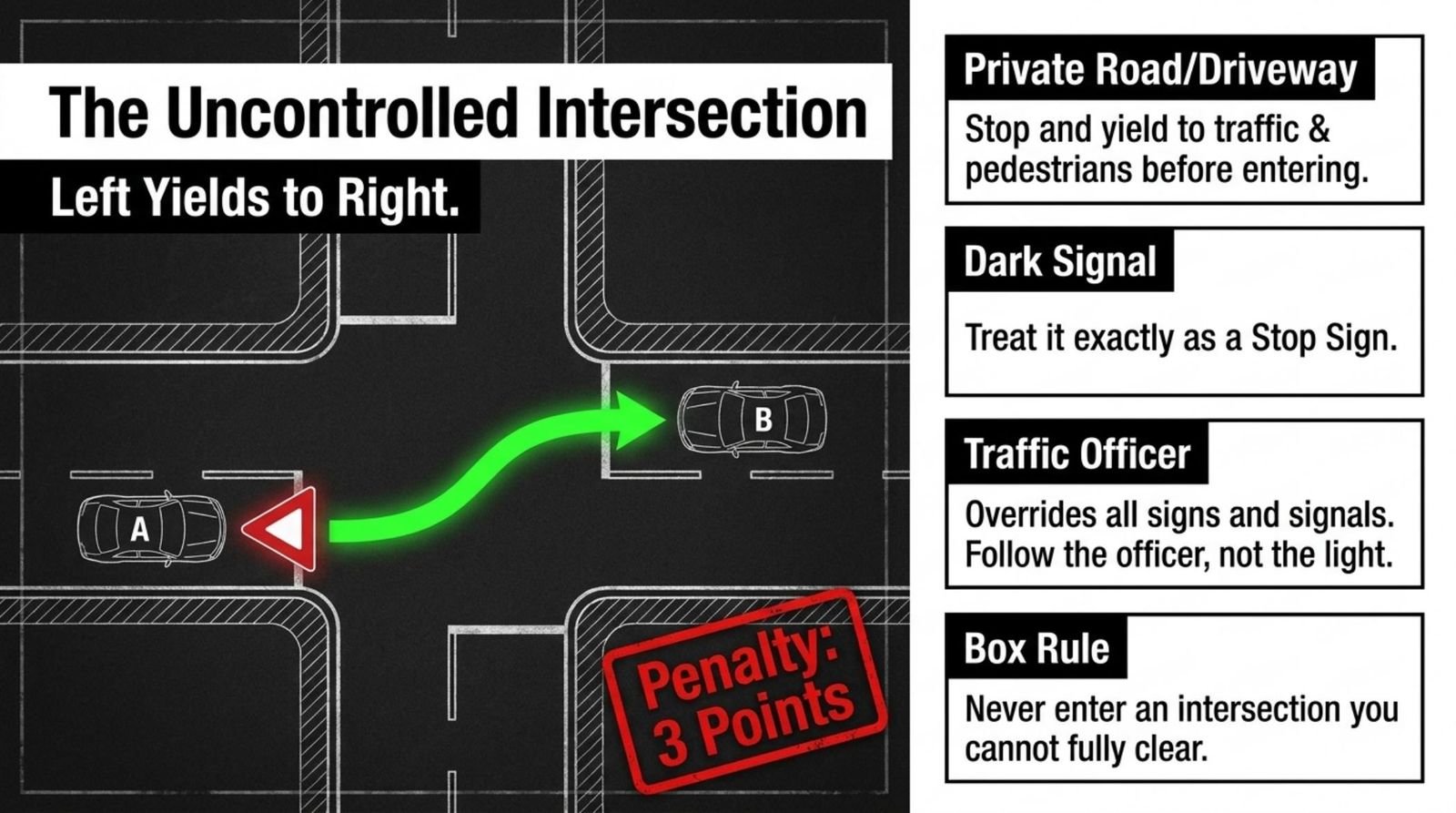
- Uncontrolled intersection (no signs or signals): if two drivers arrive at the same time, the driver on the left yields to the driver on the right. If the other driver is on your right, they go first.
- Entering from a driveway or private road: you must stop and yield to traffic already on the road — and to pedestrians — before joining it.
- Dark signal = stop sign. If a traffic signal is dark or not working, treat the intersection as a stop-sign intersection. And a traffic officer’s directions override signs and signals — follow the officer, not the light.
- Don’t block the box. Never enter an intersection you cannot fully clear — wait behind the line instead of getting trapped in the middle.
- Failing to yield the right-of-way costs 3 points — the same as running a red light or disobeying a STOP or YIELD sign.
Check yourself: You and another car reach an uncontrolled intersection at the same moment. The other car is on your right. Who goes first?
Part 2: Roundabouts — the yield is on you
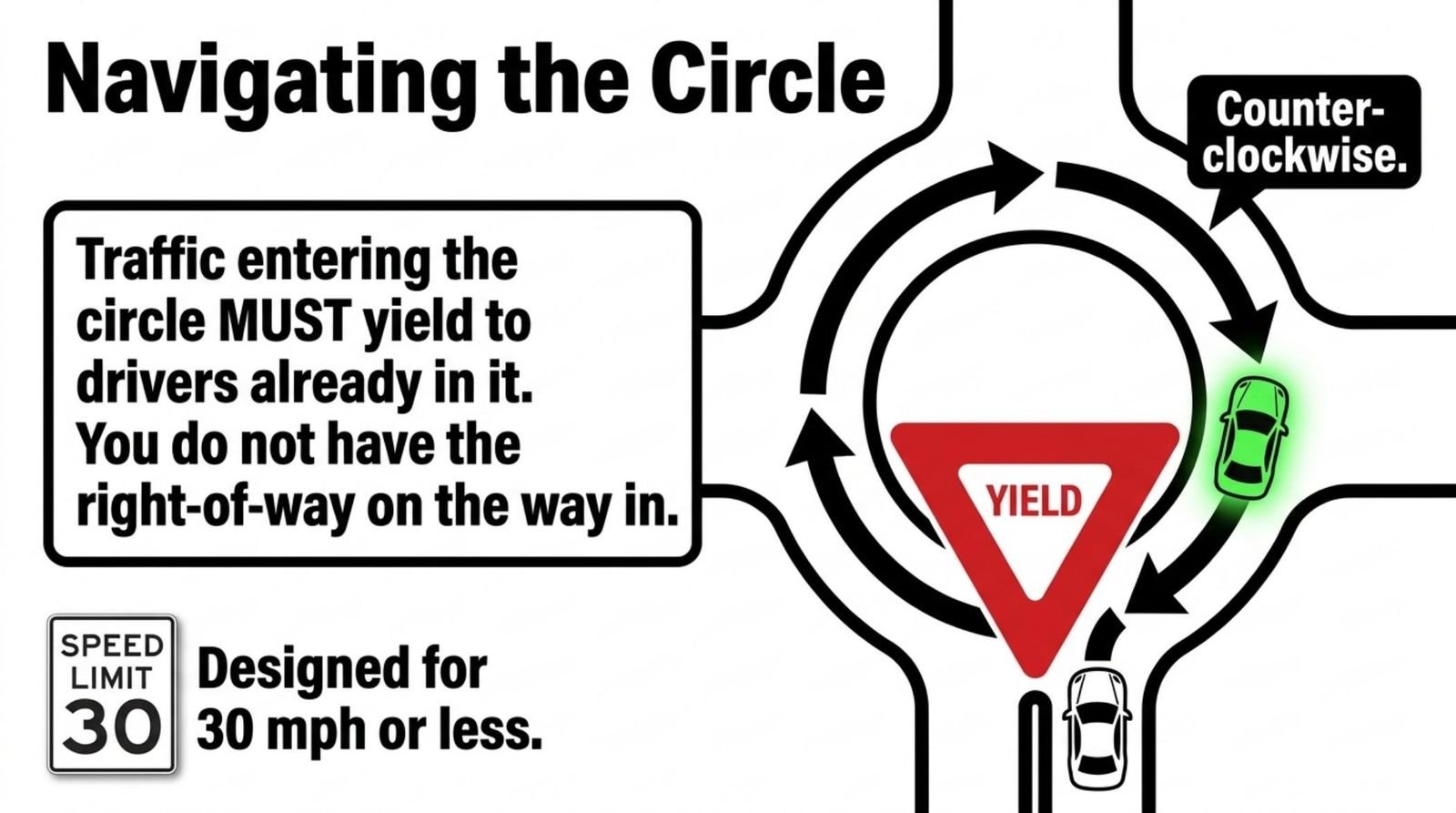
New York’s roundabout rule is short and absolute: traffic entering the circle yields to drivers already in it. You do not have the right-of-way on the way in. Once inside, traffic circulates counter-clockwise, and roundabouts are designed for speeds of 30 mph or less — so slow down, yield at the entrance, and merge into the moving flow.
Part 3: Turning — left yields, and right-on-red has a New York City flip
- Left turns yield to oncoming traffic. Wait for a safe gap — oncoming drivers going straight have the right-of-way over your turn. Your yield also covers pedestrians crossing the street you’re turning into.
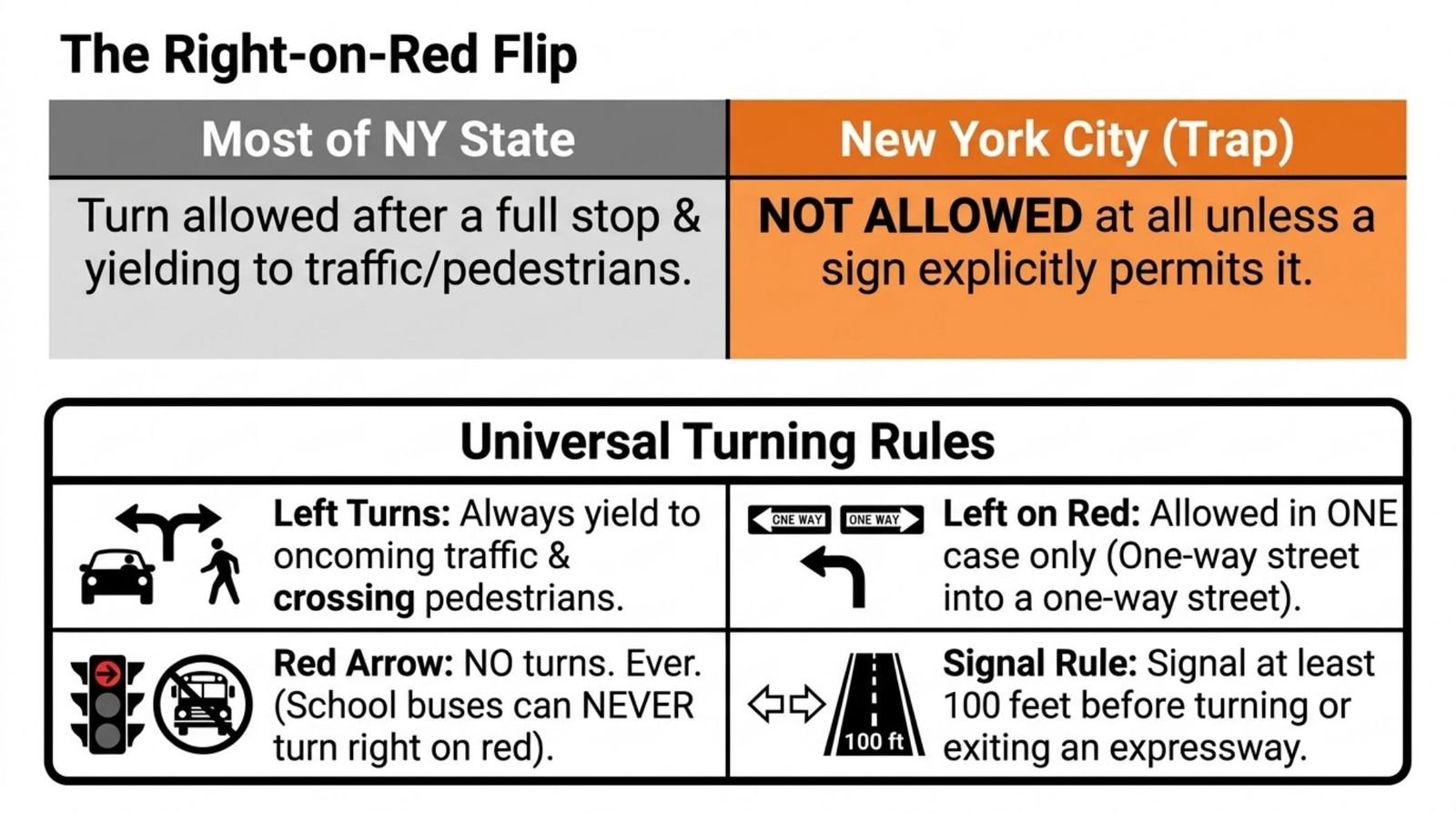
- Right on red (most of New York): after a full stop, and after yielding to traffic and pedestrians, you may turn right on a steady red light where it is not prohibited.
- Left on red is allowed in one case only: from a one-way street into a one-way street, after stopping and yielding.
- No turn on red at a red arrow — ever. And a school bus carrying students can never turn right on red.
- The New York City exception (this is the trap): in the five boroughs, you are not allowed to turn on a red light at all unless a sign posted there permits it. The city’s default is the reverse of the rest of the state’s.
- Signal early: signal at least 100 feet before every turn — and at least 100 feet before an expressway exit, too.
Check yourself: You’re at a steady red light in Queens. No sign is posted either way. After a full stop, may you turn right?
Part 4: U-turns — the 500-foot rule
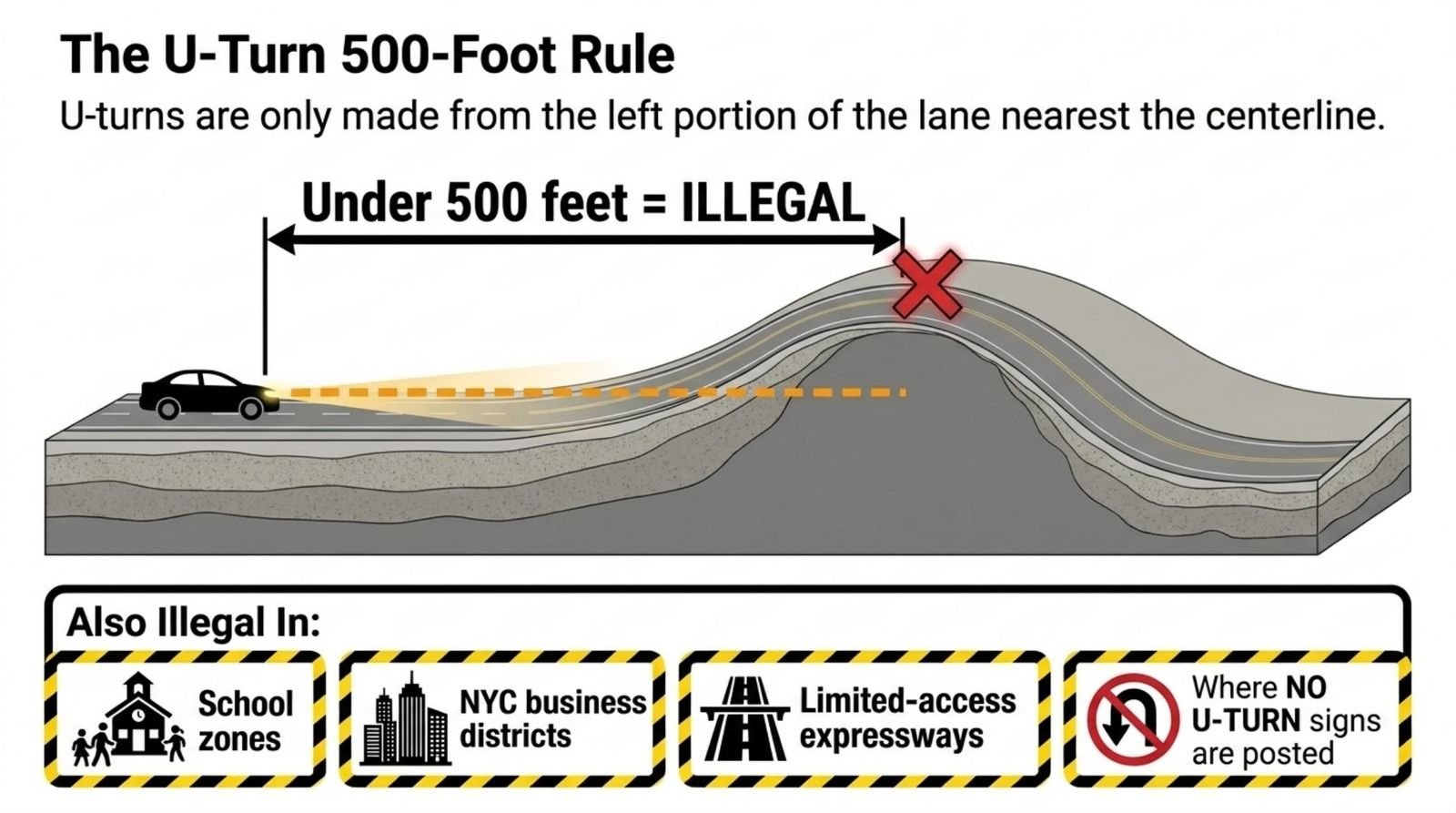
A U-turn in New York is made only from the left portion of the lane nearest the centerline — start from the far-left position, never from a right lane or the shoulder. And a U-turn is illegal in each of these situations:
- Where your visibility is under 500 feet in either direction — near hills and curves are the classic examples.
- In a school zone.
- In a New York City business district.
- Wherever NO U-TURN signs are posted.
- On a limited-access expressway.
Memorize the 500-foot figure: if you can’t be seen from at least 500 feet in either direction, the U-turn is off the table.
Check yourself: You’re just below the crest of a hill and traffic coming over it can’t see you until it’s close. Is a U-turn legal here?
Part 5: Pedestrians — every crosswalk counts
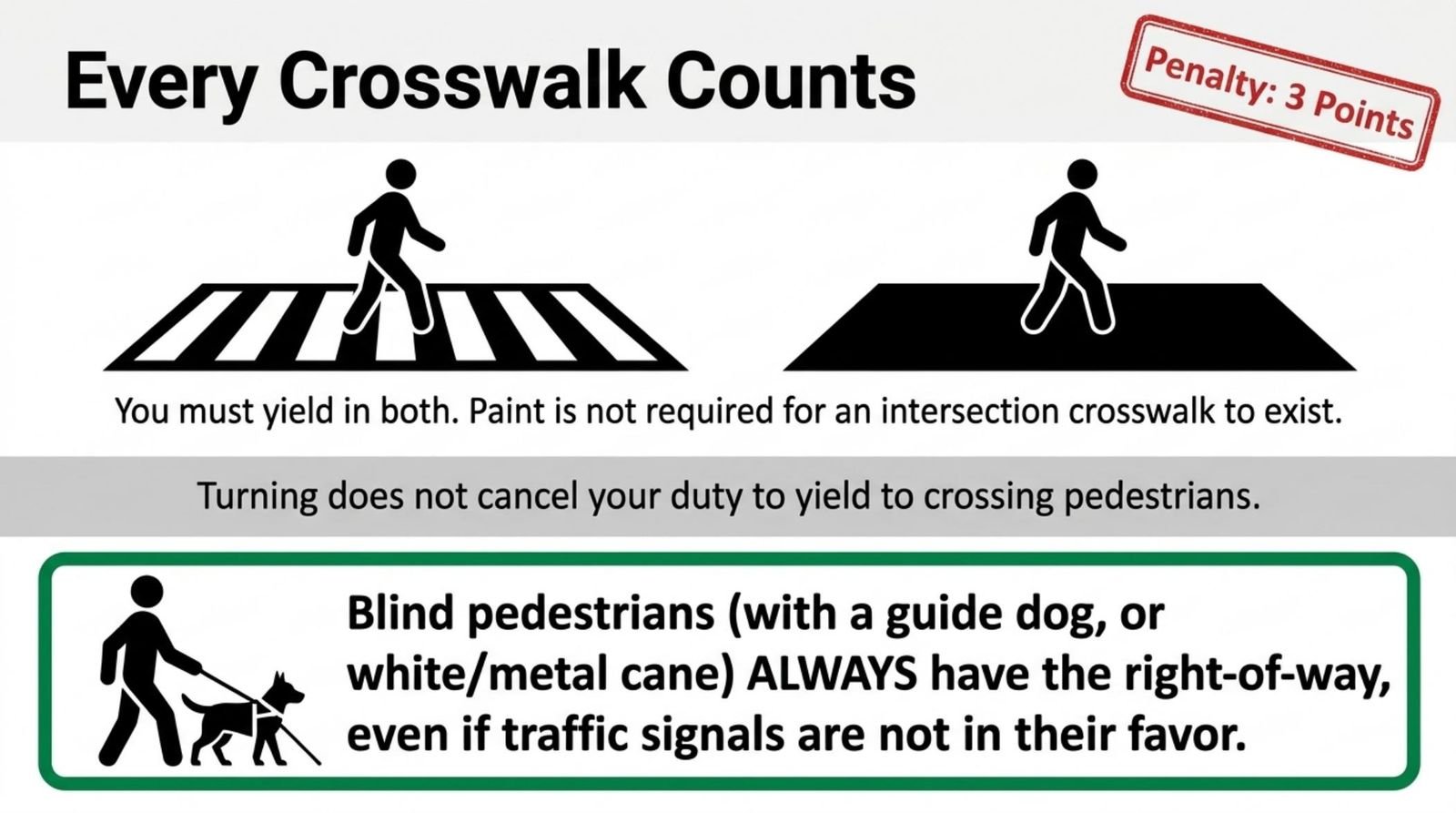
- Marked crosswalks: you must yield to pedestrians crossing in one.
- Unmarked crosswalks: the same duty applies. An intersection crosswalk does not need painted lines to be a crosswalk — yield to pedestrians in marked and unmarked crosswalks alike.
- Turning doesn’t cancel the duty. When you turn, yield to pedestrians crossing the street you are turning into — and when entering from a driveway, yield to pedestrians as well as to traffic.
- Blind pedestrians always have the right-of-way. A special right-of-way law protects a blind pedestrian crossing with a guide dog or a white or metal cane: you must yield to them at a marked or unmarked crosswalk even if the traffic signals or other right-of-way rules are not in their favor.
- Failing to yield the right-of-way — to a pedestrian or to another driver — is a 3-point violation.
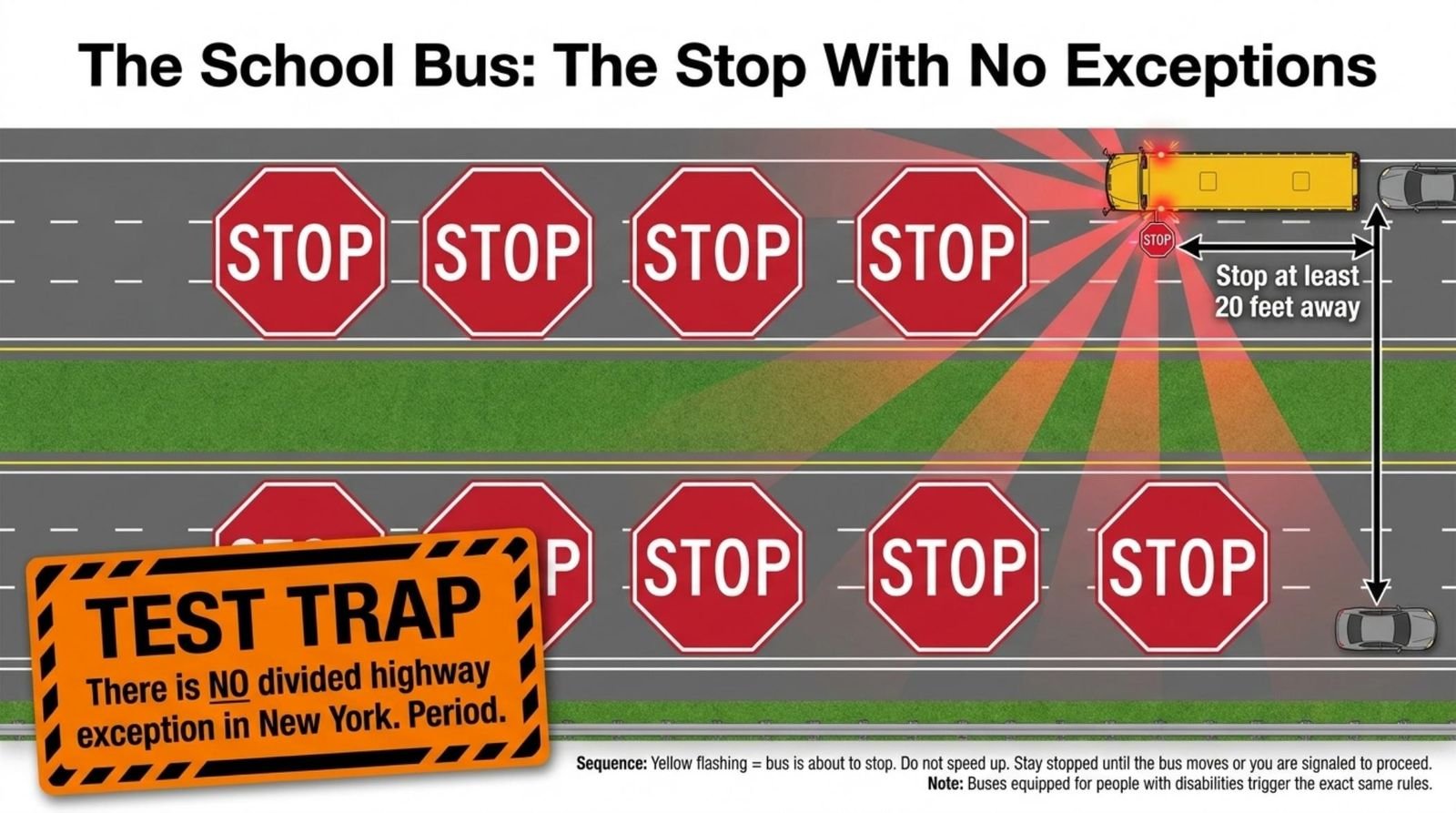
Part 6: School buses — the stop with no exceptions
This is the single most state-specific rule set on the New York test, and the one where other states’ habits will actively hurt you. Learn it exactly:
- Flashing red lights = stop, from both directions. Traffic approaching from either direction must stop — in front of a school and in school parking lots, too.
- There is NO divided-highway exception. Even when the bus is on the opposite side of a divided highway, you stop. California excuses opposite-direction traffic on a divided highway, and New Jersey tells you to slow to 10 mph across a median — both answers are wrong in New York.
- Stop at least 20 feet from the bus.
- Yellow flashing lights come first — the bus is about to stop. Slow down and prepare; don’t speed up to beat the reds.
- Stay stopped until the bus moves again, or the bus driver or a traffic officer signals you to proceed.
- A school bus equipped for people with disabilities triggers exactly the same duty to stop.
- The penalties are the heaviest in this guide: passing a stopped school bus carries 8 points (the printed manual still says 5 — DMV’s current schedule says 8, and 8 governs). Fines run from a $250 minimum up to $1,000 for three violations within three years, and three convictions within three years bring a revocation of at least 6 months.
- Stop-arm cameras penalize the vehicle’s owner separately: $250, then $275, then $300 — on top of the driver’s own penalties.
Check yourself: A school bus stops on the far side of a divided highway, red lights flashing. You’re traveling the opposite direction. Stop, slow to 10 mph, or continue at speed?
Part 7: Railroad crossings
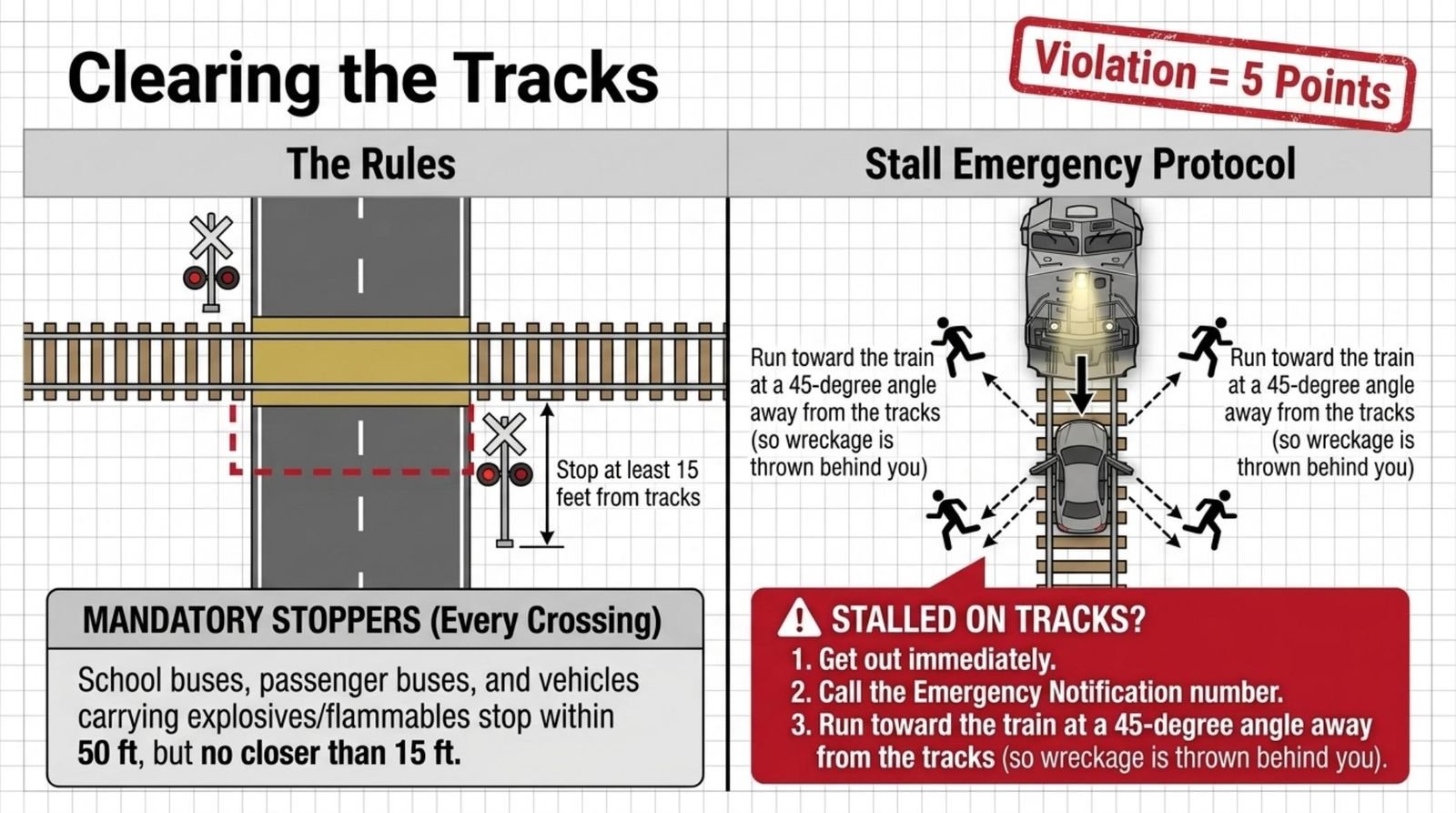
- Stop at least 15 feet from the tracks when signals are active or a train is coming — and never drive around lowered gates.
- Some vehicles must stop at EVERY crossing, train or no train: school buses, other buses carrying passengers, and vehicles carrying explosives or flammable cargo. Under VTL §1171, they stop within 50 feet of the tracks but no closer than 15 feet from the nearest rail.
- Be able to clear all the tracks completely before you start across. If there’s no room on the far side, wait where you are.
- A railroad-crossing violation costs 5 points.
- If your vehicle stalls on the tracks: get everyone out, move away from the tracks, call the number on the blue Emergency Notification System sign at the crossing — and if a train is approaching, run toward it at a 45-degree angle away from the tracks, so wreckage is thrown away from you, not at you.
Check yourself: You’re following a passenger bus as it approaches a railroad crossing with no train in sight and no lights flashing. What will the bus do — and what should you expect?
Part 8: Emergency vehicles and the Move Over Law
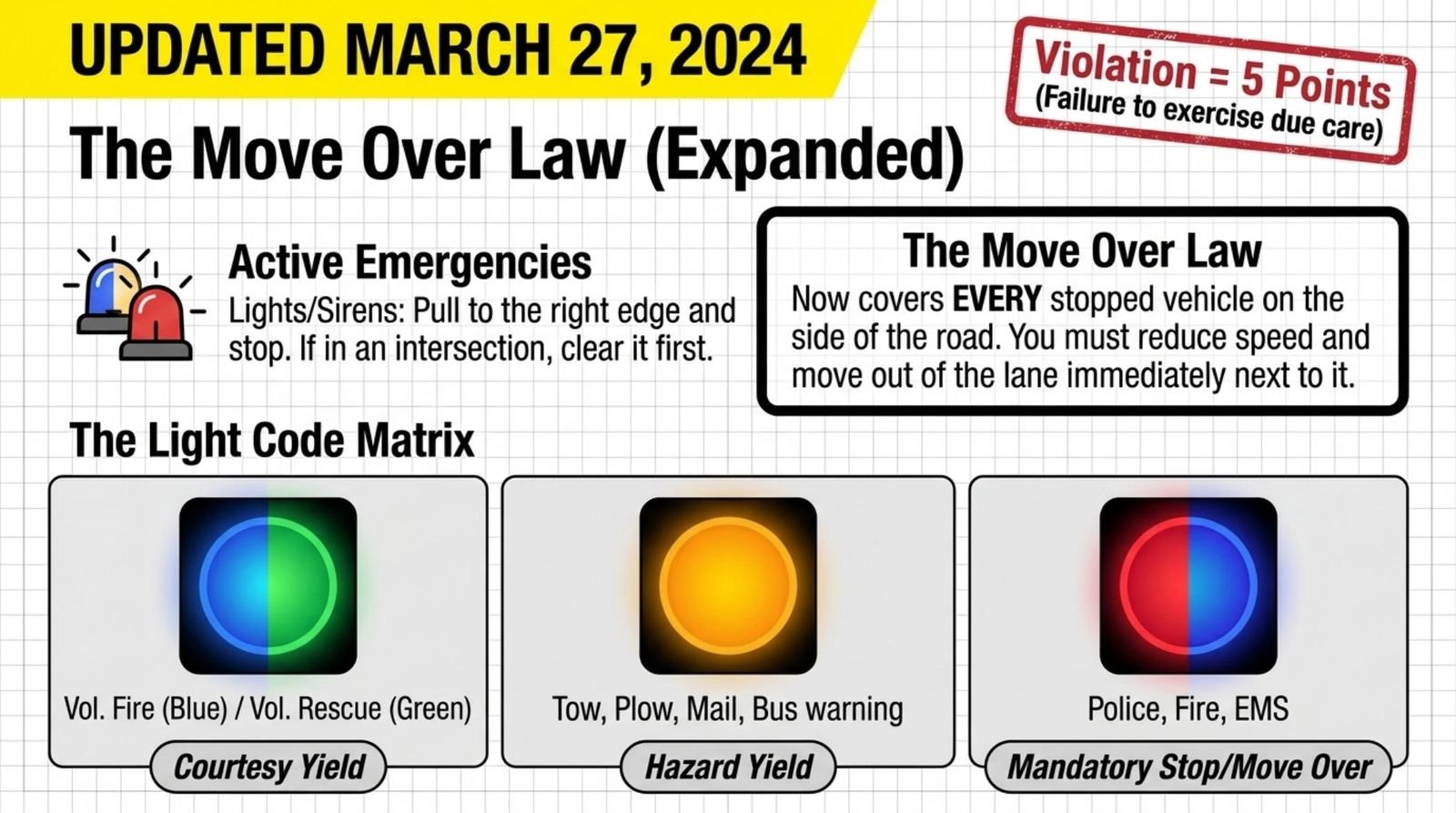
Emergency vehicles approaching with lights and/or sirens: pull to the right edge of the road and stop — even when the emergency vehicle is approaching in the opposite lane of a two-way road. If you’re in an intersection, clear the intersection first, then pull over. If you hear a siren but can’t locate it, pull over and stop until you’re sure.
The Move Over Law covers stopped vehicles. For an emergency or hazard vehicle stopped on the shoulder with its lights on: reduce speed on all roads — and on parkways, interstates, and other multi-lane controlled-access roads, also move out of the lane immediately next to it, unless that isn’t safe.
Since March 27, 2024, the law covers every stopped vehicle — including an ordinary disabled car. Approaching any vehicle stopped along the roadway, change into a non-adjacent lane, or slow to a reasonable speed if a lane change isn’t safe. A Move Over violation is scored as failure to exercise due care: 5 points.
Know the light colors. Blue lights mark volunteer firefighters’ vehicles and green lights mark volunteer ambulance and rescue vehicles — these are courtesy lights, not authorized emergency vehicles, so you yield to them as a courtesy rather than under the emergency-vehicle rule. Amber lights mark hazard vehicles — tow trucks, snow plows, rural mail vehicles — and school-bus warning lights.
Key numbers to memorize
| Fact | Remember |
|---|---|
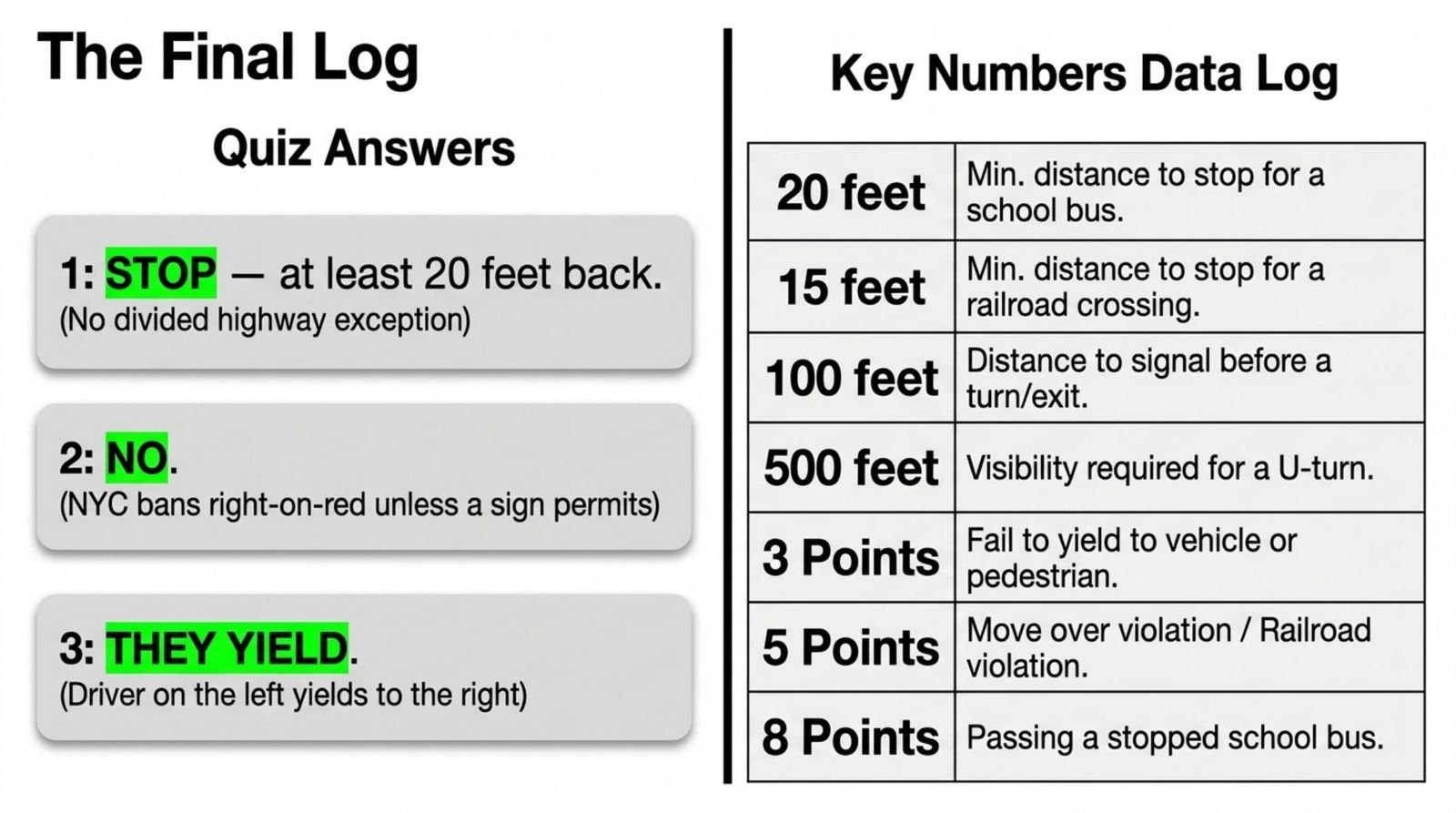
| School bus stop distance | At least 20 feet |
| Bus across a divided highway | STOP — New York has no divided-highway exception |
| Passing a stopped school bus | 8 points |
| School bus passing fines | $250 minimum, up to $1,000 for three violations in three years |
| Three school-bus convictions in three years | Revocation of at least 6 months |
| Railroad crossing stop | At least 15 feet from the tracks |
| Vehicles that stop at every railroad crossing | School buses, passenger buses, and vehicles carrying explosives or flammable cargo |
| Railroad-crossing violation | 5 points |
| Failing to yield the right-of-way | 3 points |
| Move Over violation | 5 points (failure to exercise due care) |
| Move Over covers | Every stopped vehicle — expanded March 27, 2024 |
| U-turn visibility | At least 500 feet in either direction |
| Right on red in New York City | Prohibited unless a sign permits it |
5-question self-check
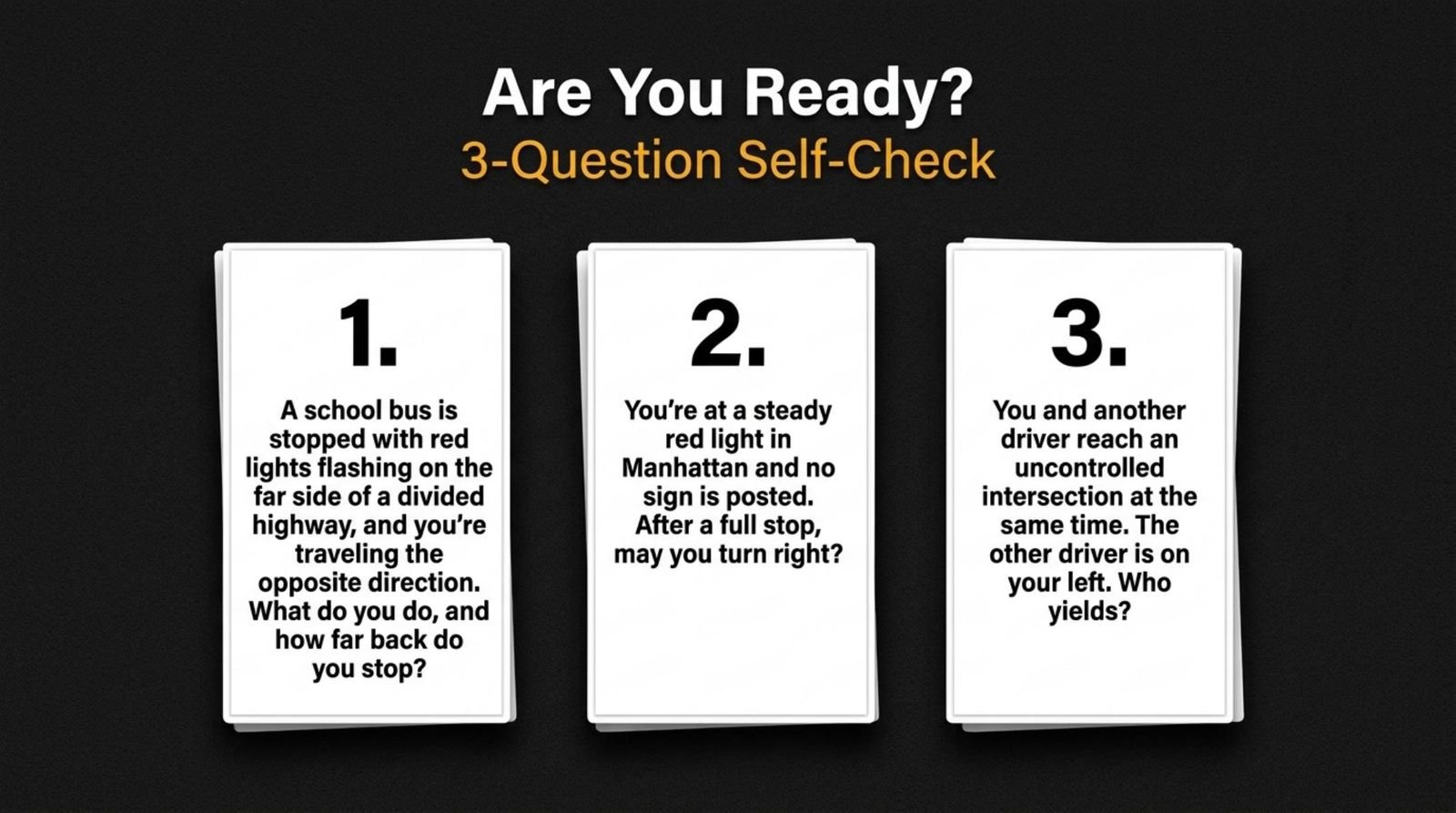
- A school bus is stopped with red lights flashing on the far side of a divided highway, and you’re traveling the opposite direction. What do you do, and how far back do you stop?
- You’re at a steady red light in Manhattan and no sign is posted. After a full stop, may you turn right?
- You and another driver reach an uncontrolled intersection at the same time. The other driver is on your left. Who yields?
- The traffic light ahead goes completely dark. What do you treat the intersection as?
- A private car is stopped on an interstate shoulder with its hazard lights on, and you can safely change lanes. What does the Move Over Law require?
Answer key
- Stop — at least 20 feet back. New York has no divided-highway exception: traffic from both directions stops for a school bus flashing red lights.
- No. In New York City you may not turn on a red light unless a sign posted there permits it.
- The other driver yields. At the same time, the driver on the left yields to the driver on the right — and here, that’s you.
- A stop-sign intersection. A dark or inoperative signal is treated as a stop sign.
- Change lanes so you aren’t in the lane immediately next to it. Since March 27, 2024, Move Over covers every stopped vehicle; if a lane change weren’t safe, you’d slow to a reasonable speed instead.
Keep practicing
- Take the Right of Way practice quiz
- Flip through the Right of Way flashcards
- Watch the Right of Way video lesson
- Ready for the whole thing? Take the full New York practice test
More study guides: Signs & Signals Study Guide · Traffic Laws Study Guide · Safe Driving Study Guide · Alcohol, Drugs & Driving Conditions Study Guide · Licensing & Registration Study Guide