
Your complete New York study guide — plain language, no jargon.
📘 Prefer pictures? Flip through the visual deck
This whole guide as 12 slides — swipe or scroll sideways through them. How licensing and registration work in New York — permits, points and paperwork.





Take it with you: Download the deck as a PDF (2.8 MB) → — free to share.
Why this matters
In New York, licensing runs through the DMV — the Department of Motor Vehicles — and the system is built differently from anywhere else in the country: a short permit test with two separate pass marks, junior-driver rules that change completely depending on which part of the state you live in, a point system paired with a second money penalty most drivers have never heard of, and an insurance package with a hidden death-benefit split and $50,000 of mandatory no-fault coverage. This guide is the biggest of the six because the test draws on all of it.
Part 1: The permit test itself
- 20 questions. That is the whole test — but it has two gates, and you must clear both.
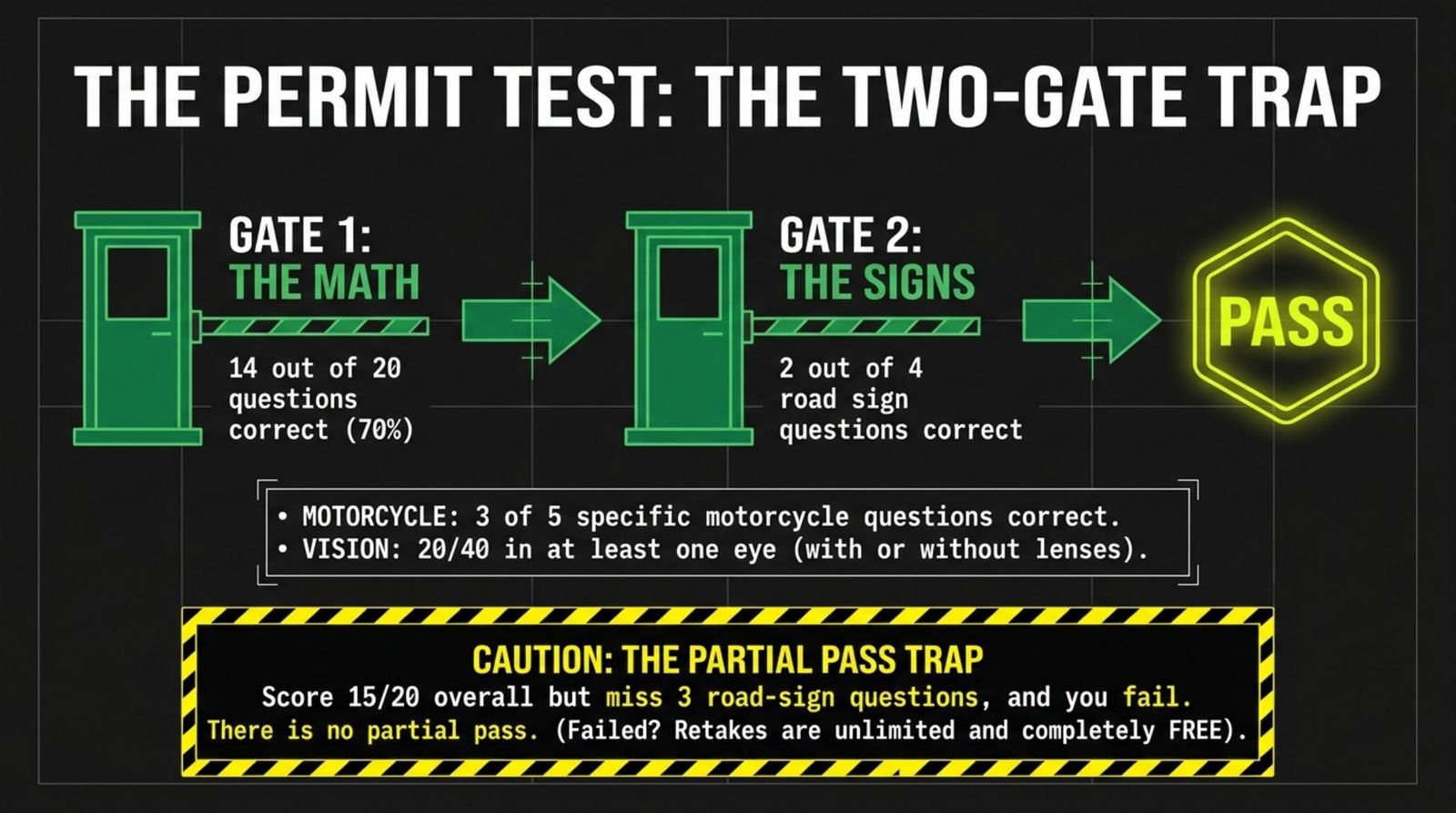
- Gate 1: at least 14 of the 20 questions correct (70%).
- Gate 2: at least 2 of the 4 road-sign questions correct. Score 15 overall but miss three of the four sign questions, and you have still failed. There is no partial pass.
- The same 20-question, two-gate format applies to the Class D, DJ, M, MJ and E tests. Motorcycle applicants face one extra gate: at least 3 of the 5 motorcycle questions.
- Vision standard: 20/40 in at least one eye, with or without corrective lenses.
- Fail? It costs nothing to try again. There is no additional fee to retake the written test and no limit on the number of attempts.
- Test material comes from the Driver’s Manual — DMV names Chapters 4 through 11 as the study chapters — and DMV publishes free practice tests for each chapter.
- Students aged 15 years 11 months or older can take the test online at participating high schools through the Online Knowledge Test Application (OKTA), in English or Spanish.
Check yourself: A student answers 16 of 20 questions correctly — comfortably above 14. One problem: only one of her four road-sign answers is right. Did she pass?
Part 2: License classes, documents, and fees
The everyday license is Class D: minimum age 18, or 17 with a driver-education certificate (MV-285), and it covers vehicles up to 26,000 lbs GVWR. The junior license, Class DJ, starts at 16 and covers vehicles up to 10,000 lbs GVWR, towing up to 3,000 lbs. Around them: Class E for taxi and livery work (18), Class M for motorcycles (18, or 17 with driver education), and Class MJ, the junior motorcycle license (16). Commercial vehicles run on the separate CDL system, with its own classes and tests.
The senior-license exchange: a DJ holder who earns the MV-285 driver-education certificate can exchange the junior license for a full Class D at a motor vehicle office at 17. The catch — the exchange has to actually happen. Carry the certificate but never make the exchange, and the junior restrictions keep applying until you turn 18.
Three document types: a Standard license (not valid for federal ID purposes), a REAL ID, and an Enhanced Driver License (EDL). The EDL costs an additional $30 and doubles as a travel document for land and sea border crossings to Canada, Mexico, Bermuda and the Caribbean, as well as domestic air travel. A REAL ID application must be made in person at a DMV office, with proof of identity, Social Security number or ineligibility, date of birth, lawful status, and two proofs of NY residence.
Fees. New York charges one total fee up front — it bundles the application fee, the written test and the license fee — and the amount depends on your age and whether you live in the Metropolitan Commuter Transportation District (MCTD):
| Age when you apply (Class D or DJ) | Total fee (standard / MCTD) |
|---|---|
| 16 to 16½ | $80.00 / $90.00 |
| 16½ to 17 | $76.75 / $85.75 |
| 17 to 17½ | $92.50 / $102.50 |
| 17½ to 18 | $89.25 / $98.25 |
| 18 to 18½ | $80.00 / $90.00 |
| 18½ to 21 | $76.75–$80.00 / $85.75–$90.00 |
| 21 and older | $64.25–$67.50 / $73.25–$77.50 |
Yes, the most expensive moment to get licensed in New York is 17 to 17½. Replacing a license or permit costs $17.50, and amending one costs $17.50 as well.
Part 3: The road to a license
You can apply for a learner permit at 16. The permit is valid for approximately five years, and while you hold it you may drive only under the immediate supervision of a driver who is at least 21, holds a license valid for the class of vehicle you are driving, and sits in the front seat. (Junior permit holders face stricter regional rules — Part 4.)
Between the permit and the road test, every new driver must complete the same three steps:
- 50 hours of supervised practice, including at least 15 hours after sunset. DMV recommends that 10 of the hours be in moderate-to-heavy traffic. New York’s after-sunset number is 15 — other states use 10, and the test knows the difference.
- Certify the hours on form MV-262 (Certification of Supervised Driving), signed by a parent or guardian and presented at the road test.
- Hold the pre-licensing credential: either a 5-hour Pre-Licensing Course certificate (form MV-278, valid one year) or a driver-education Student Certificate of Completion (MV-285). An online version of the pre-licensing course is available to applicants 18 or older.
A junior permit must also be held in valid status for a minimum of six months before its holder can take the road test — and time spent under suspension or revocation does not count toward those six months.
The course trap: the defensive-driving course known as PIRP does not satisfy the pre-licensing requirement. The 5-hour course (MV-278) happens before licensing; PIRP is a points-and-insurance tool for people who are already licensed. The two are legally different courses, and mixing them up is a classic test trap.
On the road test itself: a three-point turn may be required. Parking-assist and adaptive-cruise systems may not be used, though warning systems — back-up camera, blind-spot monitor, lane-departure warning — are allowed.
Check yourself: A 17-year-old has held her permit for six months and finished the 5-hour course last week. At the road test, her mother hands the examiner a signed form. Which form is it, and what exactly does it certify — including the after-dark number?
Part 4: Junior permits — three regions, three rulebooks
A permit held by anyone under 18 is a junior learner permit, and New York does not give it one statewide rulebook — it gives it three. Two rules apply everywhere: the only passenger allowed in the front seat is the supervising driver, you may carry no more than one passenger under 21 (unless they are immediate family, or the supervisor is a parent, guardian or instructor), and every occupant must be belted.
New York City (the five boroughs), 5 a.m.–9 p.m.: your supervisor must be your parent, guardian, a person in loco parentis, a driver-education teacher, or a driving-school instructor — or someone your parent or guardian has designated in writing — and must be 21 or older and properly licensed. The car must have dual controls (dual brakes).
Long Island (Nassau and Suffolk), 5 a.m.–9 p.m.: the same family-and-teachers list of supervisors — parent, guardian, person in loco parentis, driver-ed teacher or driving instructor, each 21 or older.
Upstate (every other county), 5 a.m.–9 p.m.: the general rule applies — any licensed driver 21 or older may supervise.
At night, 9 p.m.–5 a.m.: in New York City and on Long Island you must not drive at all on a junior permit — a supervisor sitting beside you does not cure it. Upstate, you may drive at night only under the supervision of a parent, guardian, person in loco parentis, driver-ed teacher, or driving instructor.
Places no permit holder may ever drive: in a DMV road test area; on any street within a park in New York City; on any bridge or tunnel under Triborough Bridge and Tunnel Authority (TBTA) jurisdiction; and, in Westchester County, on the Cross County, Hutchinson River, Saw Mill River, or Taconic State parkways.
Check yourself: It’s 10 p.m. A junior permit holder on Long Island wants one last practice drive with her mother riding beside her. Across the state, her cousin in Syracuse wants the same drive with his father. Who can legally go, and who cannot?
Part 5: The junior license (Class DJ) — and the NYC rule
Pass the road test before 18 and you hold a junior license — and again, where you live decides what it lets you do. Two rules apply statewide: no more than one passenger under 21 unless they are immediate family, and every occupant belted, one person per belt.
New York City: a junior-license holder must not drive at all, at any hour, on a junior license. The only exception is driving accompanied by a licensed parent, guardian, person in loco parentis, driver-education teacher, or driving instructor. There is no solo driving in New York City on a DJ — ever. This is the single most-tested junior rule in New York, and it surprises almost everyone.
Long Island, day and night: solo driving is allowed only directly between home and a job, a work-study program, college, a registered evening high-school course, a driver-education course, or farm employment — nothing else, at any hour. Carry proof: a Certificate of Employment (form MV-58A) or a dated, signed enrollment letter on school letterhead.
Upstate, 5 a.m.–9 p.m.: you may drive unaccompanied. Upstate, 9 p.m.–5 a.m.: solo driving only directly between home and employment or a school course; anything else must be accompanied by a licensed parent, guardian, or person in loco parentis.
Part 6: Points and the Driver Responsibility Assessment
Convictions for moving violations add points to your record. Points are counted from the date of the violation, not the conviction date, and are added only once you are convicted.
| Violation | Points |
|---|---|
| Speeding 1–10 mph over | 3 |
| Speeding 11–20 mph over | 4 |
| Speeding 21–30 mph over | 6 |
| Speeding 31–40 mph over | 8 |
| Speeding more than 40 mph over | 11 |
| Speeding in a work zone | 8 |
| Passing a stopped school bus | 8 |
| Alcohol- or drug-related driving incident | 11 |
| Reckless driving / speed contest / railroad-crossing violation | 5 |
| Improper cell-phone use / texting while driving | 5 |
| Move Over violation (failure to exercise due care) | 5 |
| Following too closely | 4 |
| Failing to yield / running a red light | 3 |
| Most other moving violations (improper turn, failure to signal) | 2 |
One value deserves a warning: DMV’s current point schedule sets passing a stopped school bus at 8 points. The printed 5/23 Driver’s Manual still shows 5 — that figure is outdated, and the current schedule governs.
The two thresholds — learn them as a pair, because their clocks differ:
- 11 or more points within 24 months → suspension. DMV mails you a notice of suspension; a hearing is available only to prove the convictions are not yours.
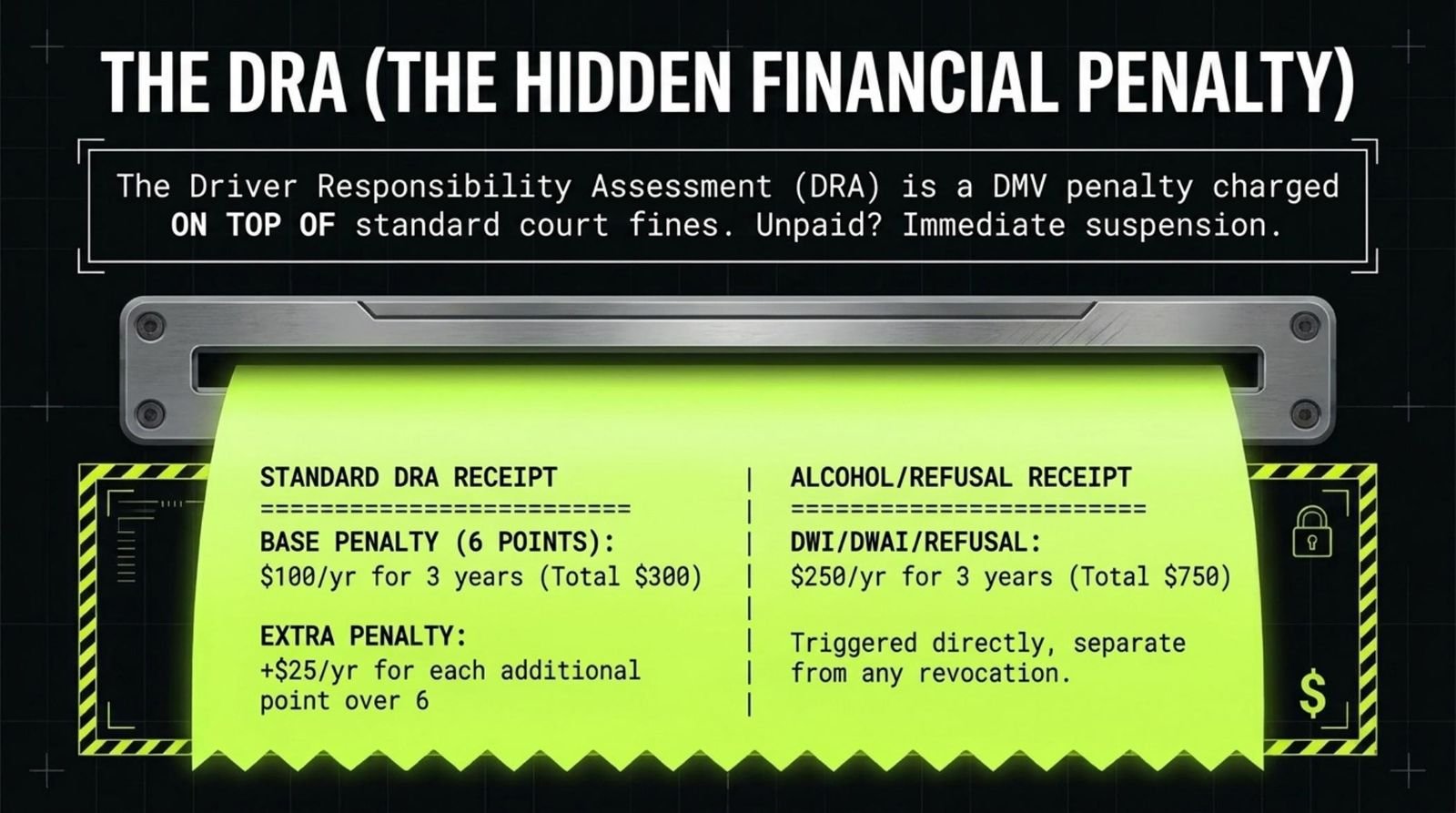
- 6 points within 18 months → the Driver Responsibility Assessment (DRA). The DRA is a second penalty charged by DMV on top of court fines: $100 per year for three years, plus $25 per year for three years for each additional point beyond six in that period. Don’t pay it, and your license is suspended.
- An alcohol conviction or chemical-test refusal triggers the DRA directly: DWI, DWAI, Aggravated DWI, DWAI-drugs or a refusal costs $250 per year for three years — $750 total — separate from fines and separate from the revocation itself.
Digging out: completing a DMV-approved PIRP defensive-driving course can reduce your point total by up to 4 points for suspension purposes, and the course can be repeated every 18 months. It also cuts your liability and collision premiums by at least 10% for three years. Its limits matter just as much: PIRP does not remove convictions from your record, cannot prevent a mandatory suspension or revocation, and does not reduce a DRA.
Check yourself: A driver collects 7 points from convictions within 14 months — nothing alcohol-related. Is the license suspended? Is anything owed, and if so, how much per year and for how long?
Part 7: Insurance — the coverage stack
Every vehicle registered in New York must be insured, and the insurance must stay in force for as long as the vehicle is registered — even if the vehicle is not driven. You receive two insurance ID cards: one is presented at registration and one must be kept in the vehicle, with the name and VIN matching the registration exactly.
| Coverage | New York minimum |
|---|---|
| Bodily injury liability | $25,000 for injury to one person / $50,000 for injury to two or more |
| Death liability | $50,000 for the death of one person / $100,000 for the death of two or more |
| Property damage liability | $10,000 |
| No-fault / Personal Injury Protection (PIP) | At least $50,000 per person |
| Uninsured motorist (UM) | Mandatory — $25,000 / $50,000 |
The shorthand is “25/50/10” — but notice what the shorthand hides. The death limits are different numbers from the injury limits ($50,000/$100,000, not $25,000/$50,000), and on top of the liability figures sit $50,000 of no-fault PIP — which pays your own medical costs and certain economic losses no matter who caused the crash — plus mandatory uninsured-motorist coverage at 25/50.
If your insurance lapses: surrender the plates and get form FS-6T as your receipt, or face a civil penalty for each day the vehicle is uninsured and suspension of the registration. Leave a vehicle uninsured for 90 days without surrendering the plates, and your license is suspended too. Driving uninsured is worse still: operating uninsured, or crashing while uninsured, brings a revocation of at least one year plus a $750 civil penalty.
Part 8: Registration, inspection — and life after licensing
Registration. Apply on form MV-82, with the 6-point proof-of-name standard plus proof of date of birth. Buy a new vehicle from a dealer and the ownership proofs are the Manufacturer’s Certificate of Origin (MCO) and form MV-50; buy used and they are the prior title (MV-999) plus odometer and damage disclosures. Registrations for most vehicles of 18,000 lbs GVW or less are valid for 2 years, with fees based on vehicle weight; a renewal reminder is mailed 45–60 days before expiry, and a registration that expires on a weekend or holiday stays valid until midnight of the next business day. Selling a vehicle? The seller removes the plates and the windshield registration sticker.
Inspection — annual, safety and emissions. A New York inspection covers both safety and emissions, at an official licensed station (look for the yellow-and-black “Official Motor Vehicle Inspection Station” sign), and it comes due at least once a year — before the current certificate expires, and whenever the registrant changes. Buying a car: a dealer must have it inspected within 30 days before selling it; on a private sale, you must inspect it within 10 days after registering — ask for the form VS-1077 ten-day extension sticker at registration. An out-of-state inspection stays valid in New York until it expires or one year from issue, whichever comes first.
New residents face the same 30-day clock twice: apply for a New York license within 30 days of establishing residency (and surrender the out-of-state license) and register your vehicle within 30 days as well. Two warnings ride along: if your out-of-state license has been valid less than 6 months, or expired more than 1 year ago, you must also pass the written test, the road test and the pre-licensing course; and nobody under 16 may drive in New York at all, even holding a valid license from another state.
Keeping the license. A driver license is valid for eight years and expires on your birthday; you can renew up to 1 year before expiry or up to 2 years after — wait longer and you must re-apply and retest. The 20/40 vision standard applies at renewal just as it did on day one. Move house and you must notify DMV of an address change within 10 days (form MV-232), writing the new address on the back of the license.
Probation is not just for teenagers. Every newly licensed driver — adults included, and drivers re-licensed after a revocation — spends their first six months on probation. A conviction during probation for DWAI-alcohol, speeding, reckless driving, following too closely or a speed contest — or any two traffic violations — brings a 60-day suspension, followed by a fresh six months of probation. Do it again during the second probation and the penalty becomes a revocation of at least six months. A texting or cell-phone conviction during probation brings a 120-day suspension instead. Junior drivers face their own ladder — a 60-day suspension for a serious violation (3 or more points) or two other violations, a 120-day suspension for a phone or texting conviction, and revocation of at least a year for a repeat phone offense soon after restoration — and drivers under 21 also answer to the Zero Tolerance Law: a BAC of .02 to .07 means a six-month suspension plus a $125 civil penalty and a $100 suspension termination fee. One last address worth knowing: tickets issued inside the five boroughs are handled not by a criminal court but by DMV’s Traffic Violations Bureau (TVB).
Check yourself: You move to New York with your car. Two 30-day clocks start the day you become a resident — what are they? And once the car is registered here, what inspection rhythm applies for as long as you own it?
Test day in New York — what to expect
A first New York license takes two DMV steps: the written permit test, then the road test. Here is what each one asks of you, before you go:
At the written permit test
- ✓ You must be at least 16. Nobody under 16 may drive in New York at all, even with an out-of-state license.
- ✓ Bring your proofs. Proof of identity and date of birth, your Social Security number, and proof of New York residence. Applying for a REAL ID? It is in person only and needs two proofs of NY residence — check dmv.ny.gov before you go.
- ✓ Your eyes are checked. You need 20/40 vision in at least one eye, with or without glasses or contacts — bring yours if you wear them.
- ✓ Know the two-gate pass rule. The test has 20 questions. To pass you need at least 14 correct overall and at least 2 of the 4 road-sign questions — both gates, not just the total.
- ✓ The fee is paid up front. One fee covers the application, the written test and the license itself; the amount depends on your age and whether you live in the Metropolitan Commuter Transportation District, so there is no single statewide figure.
- ✓ A fail is not the end. There is no extra fee to retake the written test, and no limit on the number of attempts.
At the road test
- ✓ Finish the course first. Before you can even schedule the road test you need the 5-hour Pre-Licensing Course certificate (MV-278, valid 1 year) or a driver-education completion certificate (MV-285).
- ✓ Log your practice. 50 hours of supervised driving, at least 15 of them after sunset, certified by a parent or guardian on form MV-262 — bring it to the road test.
- ✓ Hold the permit six months. A junior permit must be held in valid status for at least six months before the road test (time under suspension does not count).
- ✓ Know what the examiner may ask. A three-point turn may be required. Parking assist and adaptive cruise control may not be used, though warning systems such as a back-up camera or blind-spot monitor are permitted.
Key numbers to memorize
| Fact | Remember |
|---|---|
| Permit test | 20 questions; pass = 14+ correct AND 2+ of the 4 road-sign questions |
| Vision standard | 20/40 in at least one eye |
| Written-test retakes | No fee, no limit on attempts |
| Class D / Class DJ | D: 18 (17 with MV-285), up to 26,000 lbs · DJ: 16, up to 10,000 lbs, tow 3,000 lbs |
| Supervised practice | 50 hours, including 15 after sunset; certified on MV-262 |
| Junior permit hold before the road test | 6 months in valid status |
| Pre-licensing credential | MV-278 (5-hour course, valid 1 year) or MV-285 (driver ed) |
| Junior night window | 9 p.m.–5 a.m. — no permit driving at all in NYC / Long Island |
| Junior license in NYC | No driving at all on a DJ, at any hour — no solo driving, ever |
| License validity | 8 years, expires on your birthday; renew up to 1 year before / 2 years after |
| New resident deadlines | 30 days for the license; 30 days to register the vehicle |
| Address change | Within 10 days (form MV-232) |
| Suspension threshold | 11 points within 24 months |
| DRA thresholds | 6 points within 18 months ($100/yr × 3 + $25/yr per extra point); alcohol/refusal $250/yr × 3 = $750 |
| PIRP | Up to 4 points for suspension purposes; repeat every 18 months; 10%+ insurance cut for 3 years |
| Insurance minimums | 25/50 injury · 50/100 death · 10 property damage · $50,000 PIP · UM 25/50 |
| Registration | 2 years for most vehicles; fees by weight; form MV-82 |
| Inspection | Every year — safety AND emissions |
5-question self-check
- State the full pass standard for the New York permit test — both parts of it.
- List everything a 17-year-old must complete between receiving a learner permit and being allowed to take the road test.
- Your friend holds a Class DJ and lands an after-school job in Manhattan. She plans to drive herself there. What’s wrong with the plan?
- Explain the difference between New York’s 11-point clock and its 6-point clock: the period each one counts, and what each one triggers.
- Recite New York’s minimum insurance stack in full — including the two figures most people get wrong.
Answer key
- At least 14 of the 20 questions correct (70%) AND at least 2 of the 4 road-sign questions correct. Both gates must be met; a high overall score cannot rescue a failed sign gate.
- Complete 50 hours of supervised practice including at least 15 hours after sunset, certified by a parent or guardian on form MV-262; hold the permit in valid status for at least six months; and hold either a 5-hour Pre-Licensing Course certificate (MV-278) or a driver-education certificate (MV-285).
- A junior license allows no driving at all in New York City, at any hour, except accompanied by a licensed parent, guardian, person in loco parentis, driver-education teacher or driving instructor. Solo driving to a job in Manhattan on a DJ is never permitted.
- The 11-point clock: 11 or more points accumulated within 24 months (counted from violation dates) brings a notice of suspension. The 6-point clock: 6 points within 18 months triggers the Driver Responsibility Assessment — $100 per year for three years, plus $25 per year for three years for each additional point — charged on top of court fines.
- Bodily injury $25,000 per person / $50,000 per accident; death $50,000 for one person / $100,000 for two or more (not the same numbers as the injury limits); property damage $10,000; no-fault PIP of at least $50,000 per person; and mandatory uninsured-motorist coverage of $25,000/$50,000.
Keep practicing
- Take the Licensing & Registration practice quiz
- Flip through the Licensing & Registration flashcards
- Watch the Licensing & Registration video lesson
- Ready for the whole test? Take the full 20-question New York practice exam
More study guides: Signs & Signals Study Guide · Traffic Laws Study Guide · Right of Way Study Guide · Safe Driving Study Guide · Alcohol, Drugs & Driving Conditions Study Guide