
Your complete Arizona study guide — plain language, no jargon.
Built from the official manual. Every fact in this Arizona section comes from the Arizona Driver License Manual, published by the Arizona Department of Transportation Motor Vehicle Division (ADOT MVD) — checked against the current edition and verified November 13, 2026. Read the manual itself at azdot.gov.
📘 Prefer pictures? Flip through the visual deck
This whole guide as 15 slides — swipe or scroll sideways through them. Arizona Alcohol & Drugs study guide, practice tests & flashcards: the 0.08, 0.15 and 0.20 lines, the under-21 zero-tolerance rule, implied consent and the interlock ladder.





Take it with you: Download the deck as a PDF (7.7 MB) → — free to share.
Why this matters
Arizona’s DUI law is the strictest material on the test, and the most consequential off it: the state punishes impairment “to the slightest degree,” draws two higher tiers above the standard offense, and takes the license at the arrest — before any conviction. In Arizona, driver licensing is administered by the Arizona Department of Transportation Motor Vehicle Division — ADOT MVD — and the official study book is the Arizona Driver License Manual. Arizona’s knowledge test is 30 multiple-choice questions, and you must score 80% or higher — 24 of 30 — to pass, and this guide’s numbers — 0.08, 0.15, 0.20 — are the three lines the whole system hangs on. Where the Manual’s summary and the Arizona Revised Statutes differ in detail, this guide follows the statute, ARS 28-1381 and 28-1382, and says so.
Part 1: The offense itself — “to the slightest degree”
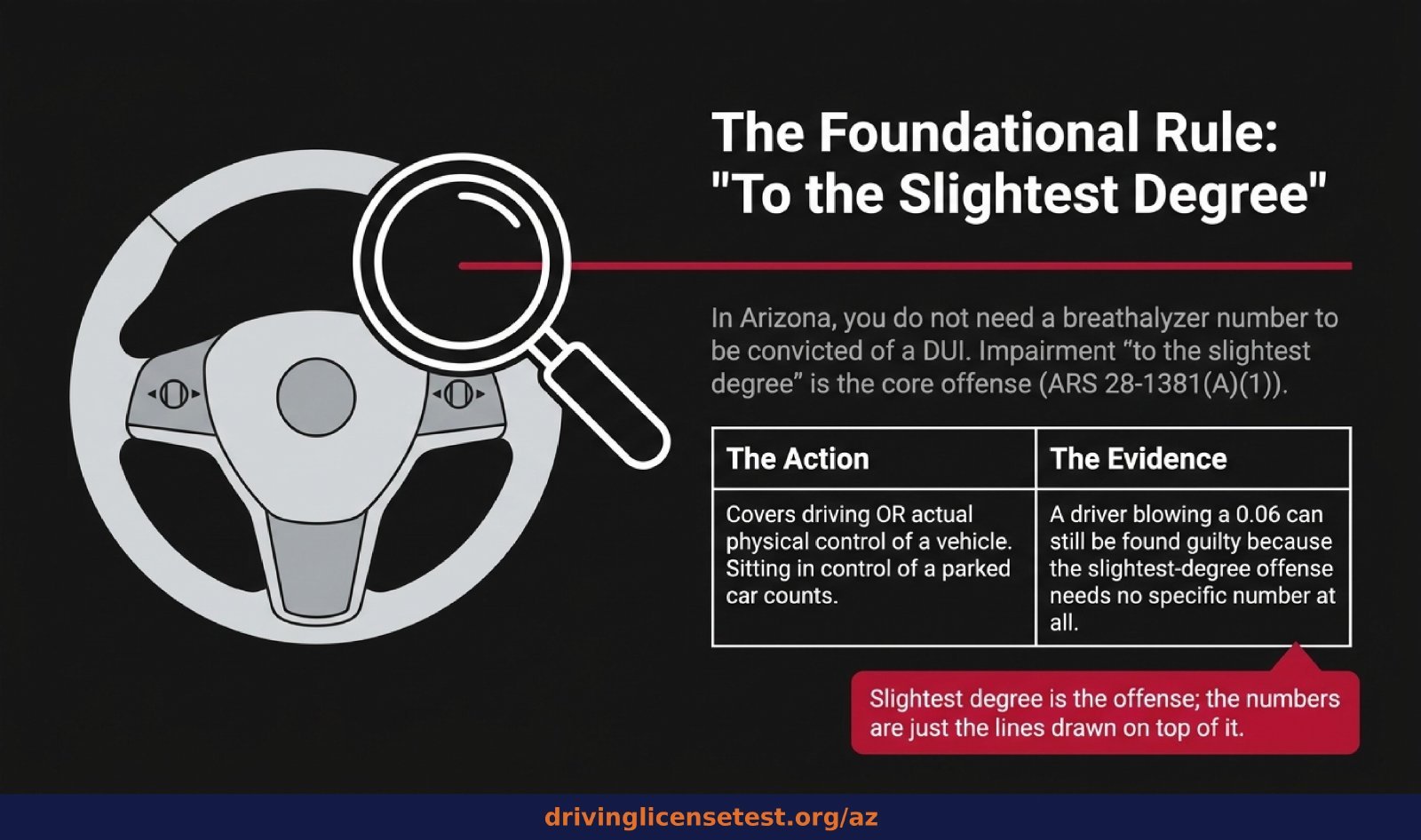
Arizona DUI covers driving or actual physical control of a vehicle while under the influence of alcohol or drugs — sitting in control of the car counts, moving or not. Impairment “to the slightest degree” is enough for the core offense (ARS 28-1381(A)(1)). Layered on it are the per se offenses:
- 0.08 — an alcohol concentration of 0.08 within two hours of driving or actual physical control (age 21+).
- Any drug listed in ARS 13-3401, or its metabolite, in the body is a separate per se offense — no impairment showing required.
- 0.04 — the commercial per se limit, which also applies to vehicle-for-hire and transportation network company (rideshare) drivers.
- Standard DUI is a class 1 misdemeanor.
The statute’s presumptions frame every reading: 0.05 or less — presumed not under the influence; more than 0.05 but less than 0.08 — no presumption either way; 0.08 or more — presumed under the influence. And a driver can still be found guilty below 0.08, because the slightest-degree offense needs no number at all.
Memory aid: Slightest degree is the offense; point-oh-eight is the line; point-oh-four if you drive for hire or freight.
Check yourself: A driver blows 0.06 and argues he is automatically innocent because he is under 0.08. Name two separate reasons Arizona law still convicts drivers below the per se line.
Part 2: Under 21 — zero tolerance, two years
For drivers under 21 there is no line to stay under — there is a ban. Any trace of alcohol or drugs that impairs driving ability results in the license being suspended for 2 years. Zero tolerance means exactly that: the under-21 driver who has “just one drink” has not found a loophole, he has found the suspension. Combined with the adult rules in Part 1, the message of Arizona law to young drivers is simple — the only safe reading under 21 is 0.00.
Check yourself: A 19-year-old with a trace of alcohol in her system asks what the legal limit is “for her age.” Give her Arizona’s real answer, and the consequence attached to it.
Part 3: Extreme and super extreme — 0.15 and 0.20
Above standard DUI, Arizona stacks two higher tiers, each with its own jail floor:
- Extreme DUI: 0.15 or more. First offense: jail of not less than 30 consecutive days, a fine of not less than $2,500, plus screening and treatment, ignition interlock, and possible community service. (Publish the Manual’s $2,500 total — a $250 figure sometimes quoted is only one base component before assessments, never the fine.)
- Super extreme DUI: 0.20 or more. A first offense at 0.20 or more starts at not less than 45 days of jail under the extreme-DUI ladder.
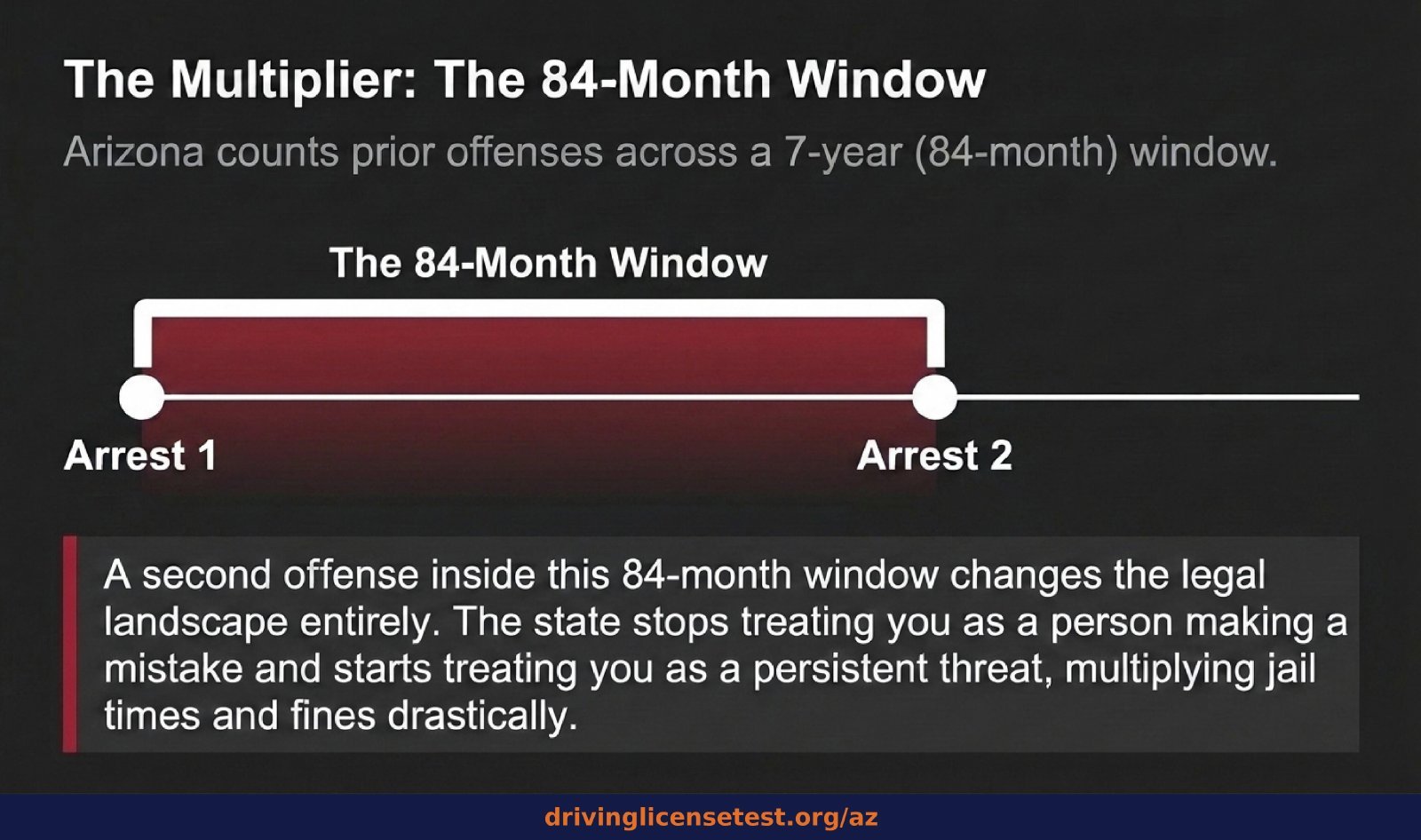
- Second-offense extreme DUI within 84 months (7 years): jail of not less than 120 days, at least 60 of them consecutive.
The 84-month window recurs through this whole guide: Arizona counts priors across 7 years, and a second offense inside that window is a different legal world from a first.
Check yourself: Two first offenders test at 0.16 and 0.21. Name each driver’s tier and each jail floor.
Part 4: Implied consent — the license goes at the arrest
By applying for and accepting the privilege to drive, you consent to blood, breath, urine, or other bodily-substance testing when arrested for DUI — that is implied consent, and it is not optional at the roadside:
- Refusal or failure to complete a test: 12-month suspension. A second refusal within 84 months brings a 24-month suspension.
- Administrative per se: a test result of 0.08 or more (0.04 commercial) means the driving privilege is lost on the spot — the suspension starts at the arrest, not the trial. A restricted permit may be available after 30 days of suspension.
Refusing therefore buys nothing: the test refusal suspends you for a year on its own, and the criminal case proceeds on the other evidence. This is the single most-tested consent rule in Arizona’s system.
Memory aid: Refuse and lose a year — two years the second time. Blow 0.08 and the license goes that night.
Check yourself: A driver arrested for DUI refuses the test entirely, certain that “no result means no case.” What suspension does the refusal itself carry, and what happens on a second refusal within 7 years?
Part 5: Standard DUI penalties — first and second offenses
First-offense standard DUI (statute figures, ARS 28-1381):
- Jail: not less than 10 consecutive days — the judge may suspend all but 1 day if the person completes screening, education, or treatment.
- License: suspended not less than 90 days.
- Fine: not less than $1,250 in total — a $250 base fine plus a $500 prison construction/operations assessment and a $500 public safety equipment assessment.
- Plus alcohol screening, education, or treatment; possible community service; ignition interlock when liquor is involved; and Traffic Survival School.
Second-offense DUI within 84 months:
- Jail: not less than 90 days, at least 30 of them consecutive.
- Fine: not less than $3,000 in total ($500 base plus $1,250 and $1,250 assessments).
- At least 30 hours of community restitution.
- Driving privilege revoked for 1 year; ignition interlock and Traffic Survival School required.
Check yourself: A first offender completes screening and treatment. How much of the 10-day jail floor can the judge suspend — and what is the minimum total fine that remains?
Part 6: Aggravated DUI and the ignition interlock
Aggravated DUI is Arizona’s felony-tier offense. It includes:
- DUI or extreme DUI while the license is suspended, canceled, revoked, or refused, or while under a DUI restriction.
- A third or subsequent DUI within 84 months.
- DUI with a person under 15 in the vehicle.
- DUI while under an ignition interlock requirement.
- DUI while wrong-way driving.
The Manual states the aggravated consequences as prison of not more than 2 years, license revoked 1 year, plus screening and treatment, interlock, and community service.
Ignition interlock durations (ADOT MVD) — memorize the ladder:
- Standard DUI: 12 months (may be reduced to 6 months in some cases; not required for drug-only DUI offenses after January 1, 2017).
- Extreme DUI: 12 months.
- Super extreme, first offense: 18 months.
- Super extreme, second offense within 7 years: 24 months.
- Aggravated DUI: 12 to 24 months.
A Special Ignition Interlock Restricted Driver License (SIIRDL) may let eligible drivers drive with an interlock from the first day of a suspension or revocation. Two closing rules: providing alcohol to a minor can cost the provider’s license — up to 30 days suspended for a first conviction, up to 6 months for a second — and the open-container rule from the Traffic Laws guide (no open spirituous liquor in the passenger compartment; the trunk and the area behind the last upright seat are outside it) is the everyday companion to everything in this guide. The only plan that never meets this system: if you drink, you do not drive — not even “the slightest degree.”
Check yourself: A driver on an ignition-interlock requirement is stopped driving the wrong way while impaired. Name the two separate facts that each make this aggravated DUI.
Key numbers to memorize
| Per se lines | 0.08 standard · 0.04 commercial and vehicle-for-hire · under 21: zero tolerance, any impairing trace → 2-year suspension |
| Extreme / super extreme | 0.15+ extreme · 0.20+ super extreme |
| Presumptions | 0.05 or less: presumed not under the influence · 0.05–0.08: no presumption · 0.08+: presumed under the influence |
| Refusal | 12-month suspension · second refusal within 84 months: 24 months |
| First standard DUI | Jail ≥10 consecutive days · suspension ≥90 days · fine ≥$1,250 total |
| Second DUI within 84 months | Jail ≥90 days (30 consecutive) · fine ≥$3,000 · revoked 1 year |
| First extreme DUI | Jail ≥30 consecutive days (≥45 at 0.20+) · fine ≥$2,500 |
| Interlock | Standard and extreme: 12 months · super extreme first: 18 · super extreme second: 24 · aggravated: 12–24 · not required for drug-only DUI after Jan 1, 2017 |
5-question self-check
- What alcohol concentration is per se DUI for a standard driver, for a commercial driver, and for a driver under 21?
- Where do extreme and super extreme DUI begin, and what jail floor applies to a first offense at each line?
- An arrested driver refuses testing. What suspension follows, and what if it is his second refusal in 84 months?
- State the first-offense standard DUI package: jail, suspension, and total fine.
- How long is the ignition interlock after a standard DUI, a first super extreme DUI, and a second super extreme DUI?
Answer key
- 0.08 for a standard driver age 21 or over; 0.04 for commercial drivers (and vehicle-for-hire/TNC drivers); under 21 is zero tolerance — any trace of alcohol or drugs that impairs driving ability brings a 2-year suspension.
- Extreme DUI begins at 0.15; super extreme at 0.20. A first extreme offense carries not less than 30 consecutive days of jail; at 0.20 or more the floor rises to not less than 45 days.
- A 12-month suspension for the refusal itself. A second refusal within 84 months (7 years) brings a 24-month suspension.
- Jail of not less than 10 consecutive days (all but 1 day may be suspended on completion of screening/education/treatment), a license suspension of not less than 90 days, and a fine of not less than $1,250 in total, plus screening/treatment, possible community service, interlock when liquor is involved, and Traffic Survival School.
- Standard DUI: 12 months (reducible to 6 in some cases). First super extreme: 18 months. Second super extreme within 7 years: 24 months.
Keep practicing
- Take the Alcohol, Drugs & Driving Conditions practice quiz
- Flip through the Alcohol, Drugs & Driving Conditions flashcards
- Run the full Arizona practice test
More study guides: Signs & Signals Study Guide · Traffic Laws Study Guide · Right of Way Study Guide · Safe Driving Study Guide · Licensing & Registration Study Guide