
Your complete Arizona study guide — plain language, no jargon.
Built from the official manual. Every fact in this Arizona section comes from the Arizona Driver License Manual, published by the Arizona Department of Transportation Motor Vehicle Division (ADOT MVD) — checked against the current edition and verified November 13, 2026. Read the manual itself at azdot.gov.
📘 Prefer pictures? Flip through the visual deck
This whole guide as 15 slides — swipe or scroll sideways through them. Arizona Safe Driving study guide, practice tests & flashcards: the 3-second following rule, the 100-foot passing bans, the dust-storm and flash-flood rules and what to do after a crash.
Take it with you: Download the deck as a PDF (9.9 MB) → — free to share.
Why this matters
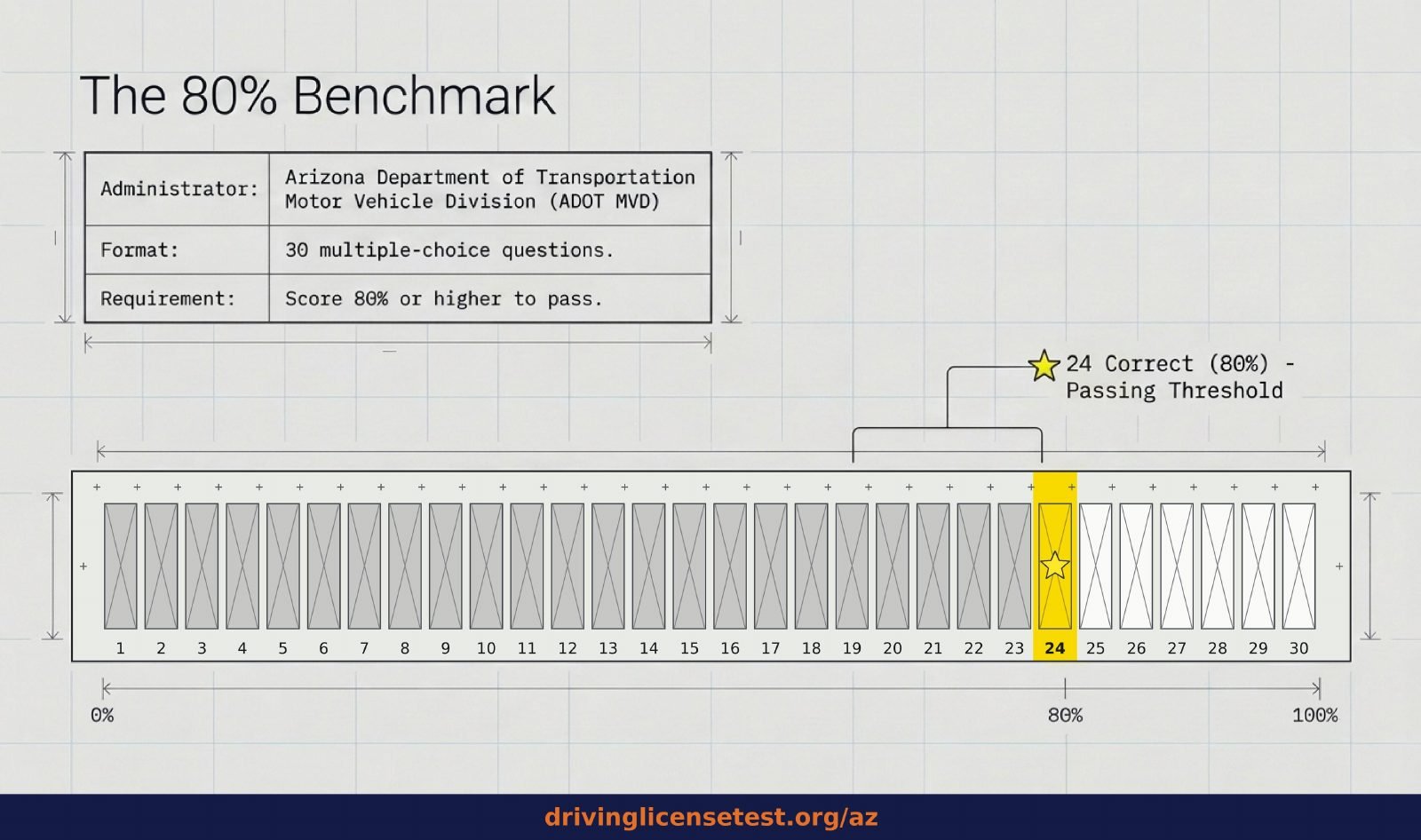
Safe driving is where the rules become judgment: the space you keep, the passes you refuse, and the Arizona weather that can erase the road in minutes. In Arizona, driver licensing is administered by the Arizona Department of Transportation Motor Vehicle Division — ADOT MVD — and the official study book is the Arizona Driver License Manual. Arizona’s knowledge test is 30 multiple-choice questions, and you must score 80% or higher — 24 of 30 — to pass, and this guide carries the Manual’s measured skills — the 3-second rule, the 100-foot signal, the 15-foot railroad stop — plus the two Arizona emergencies no other state teaches quite this way: the dust storm and the flooded wash, including the “stupid motorist law” that bills you for your own rescue.
Part 1: Following distance — three seconds, six when it is slick
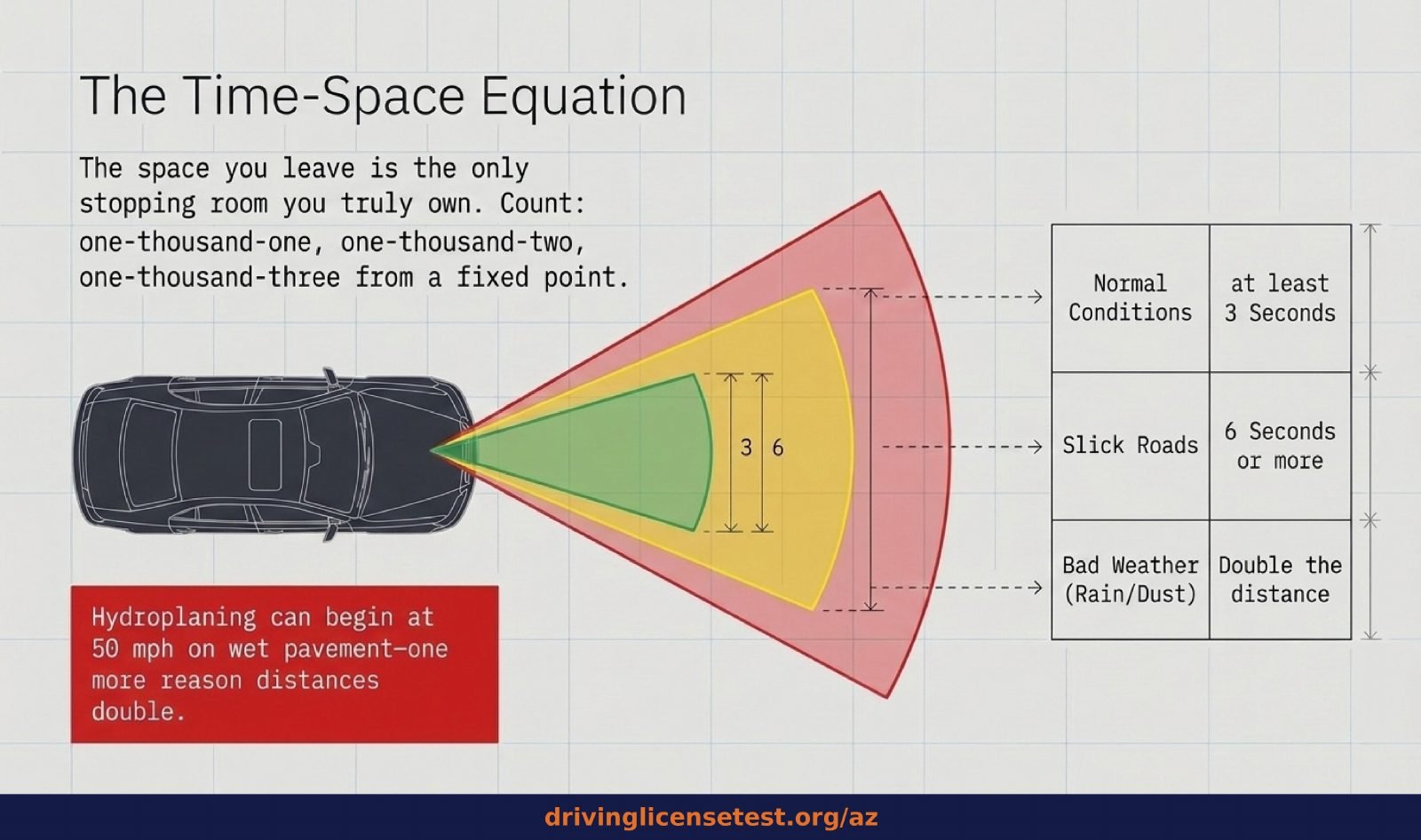
The Manual’s space rule is timed, and Arizona publishes exact figures:
- Allow at least a 3-second following distance in most situations.
- Allow 6 seconds or more on slippery roads.
- Double the following distance in bad weather — rain, dust, or any condition that cuts grip or sight.
The count is simple: when the vehicle ahead passes a fixed point, count “one-thousand-one, one-thousand-two, one-thousand-three” — if you reach the point before the count ends, you are too close. Trucks need more: they take longer to stop than passenger vehicles, and the space you leave is the only stopping room you truly own.
Memory aid: Three seconds normally, six on slick roads, double in bad weather.
Check yourself: Rain starts on a slick desert highway. Your following distance was exactly 3 seconds. What two adjustments does the Manual call for, and what is the minimum count now?
Part 2: Passing — the 100-foot bans and the 3-foot bicycle rule
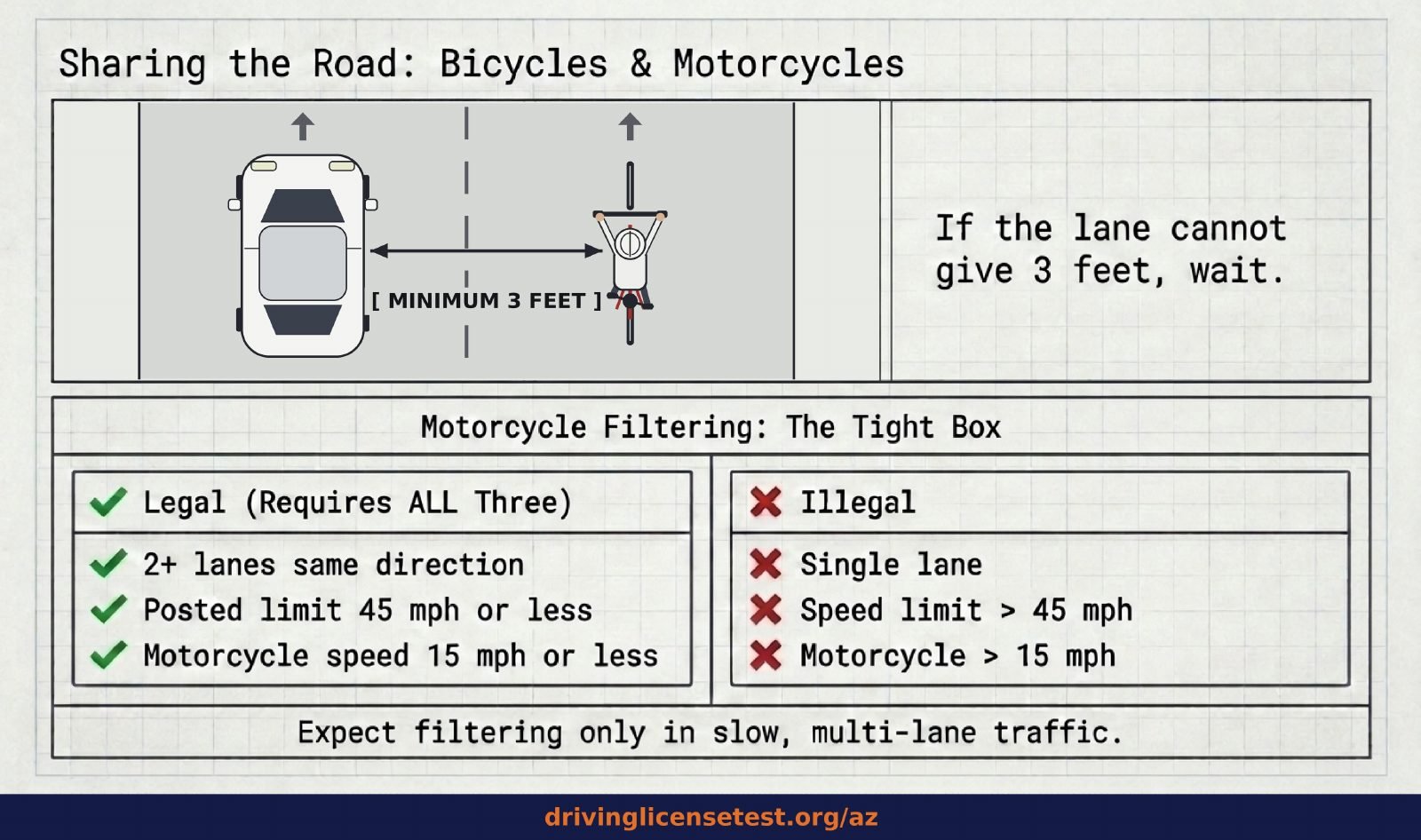
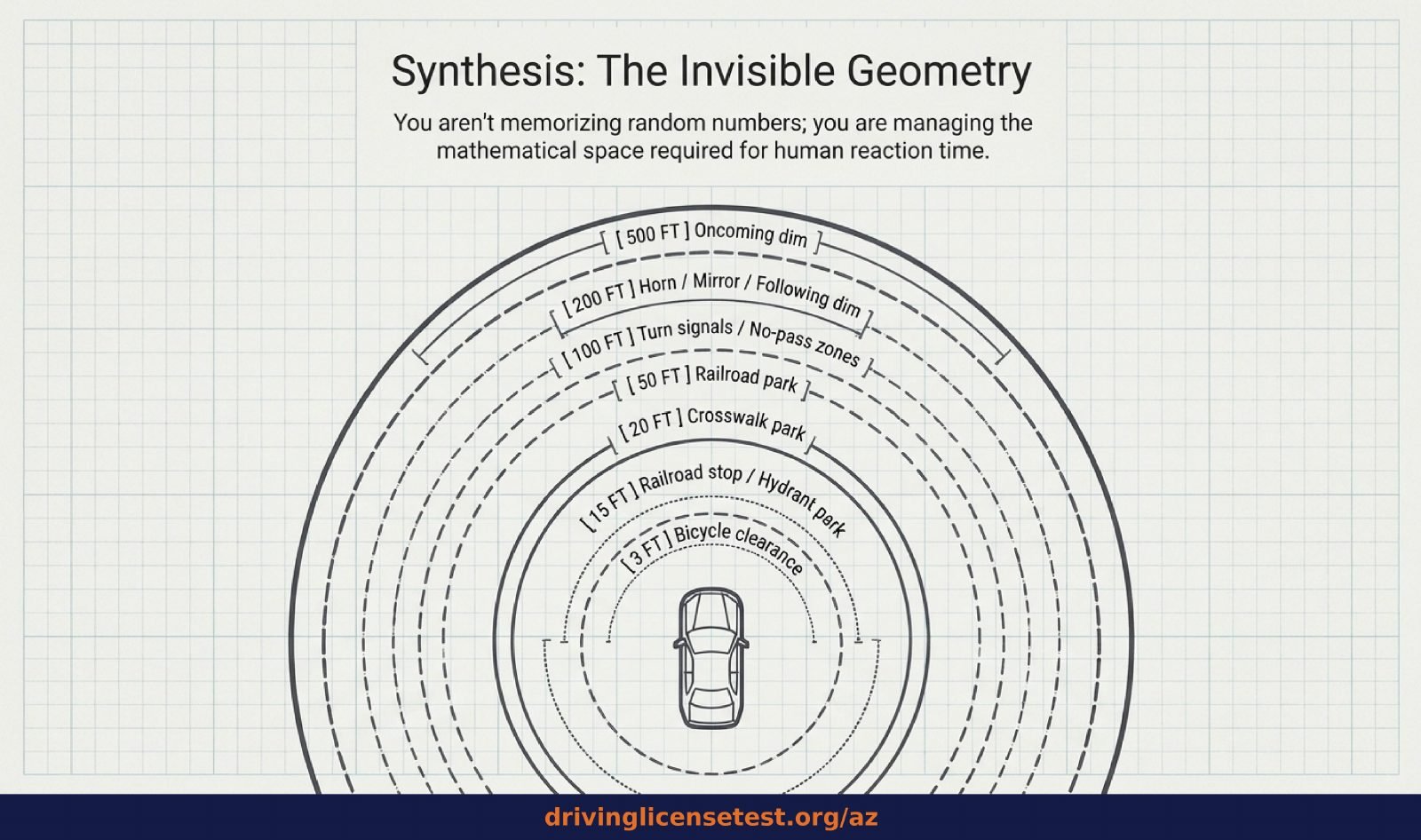
- When passing a bicyclist, allow a minimum of 3 feet of clearance — if the lane cannot give you 3 feet, wait.
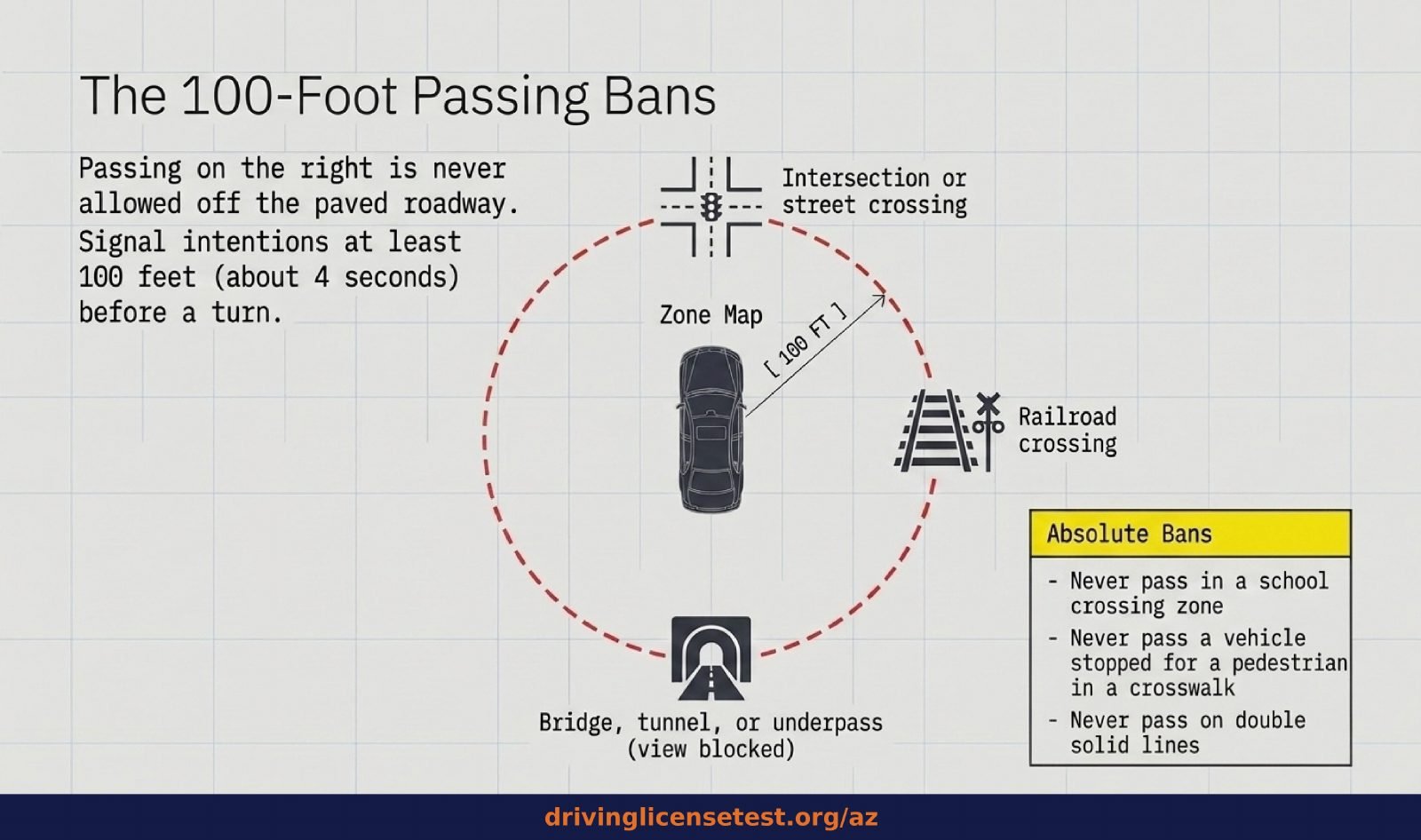
- No passing within 100 feet of an intersection or street crossing, a railroad crossing, or a bridge, tunnel, or underpass where the view is blocked.
- No passing where there are double solid lines.
- Passing on the right is allowed only in the specific safe situations the Manual lists, and never off the paved portion of the roadway — the shoulder is not a passing lane.
- Signal your intentions: at least 100 feet (about 4 seconds) before a turn.
- And from the Traffic Laws guide, the absolute bans: never pass in a school crossing zone, and never pass a vehicle stopped for a pedestrian in a crosswalk.
Memory aid: Hundred-foot signal, hundred-foot no-passing zones, three feet for a bicycle.
Check yourself: You are 80 feet from a railroad crossing, behind a slow truck, with double solid lines on a clear straight road. Count the separate reasons you may not pass.
Part 3: Railroad crossings and parking — the distance table
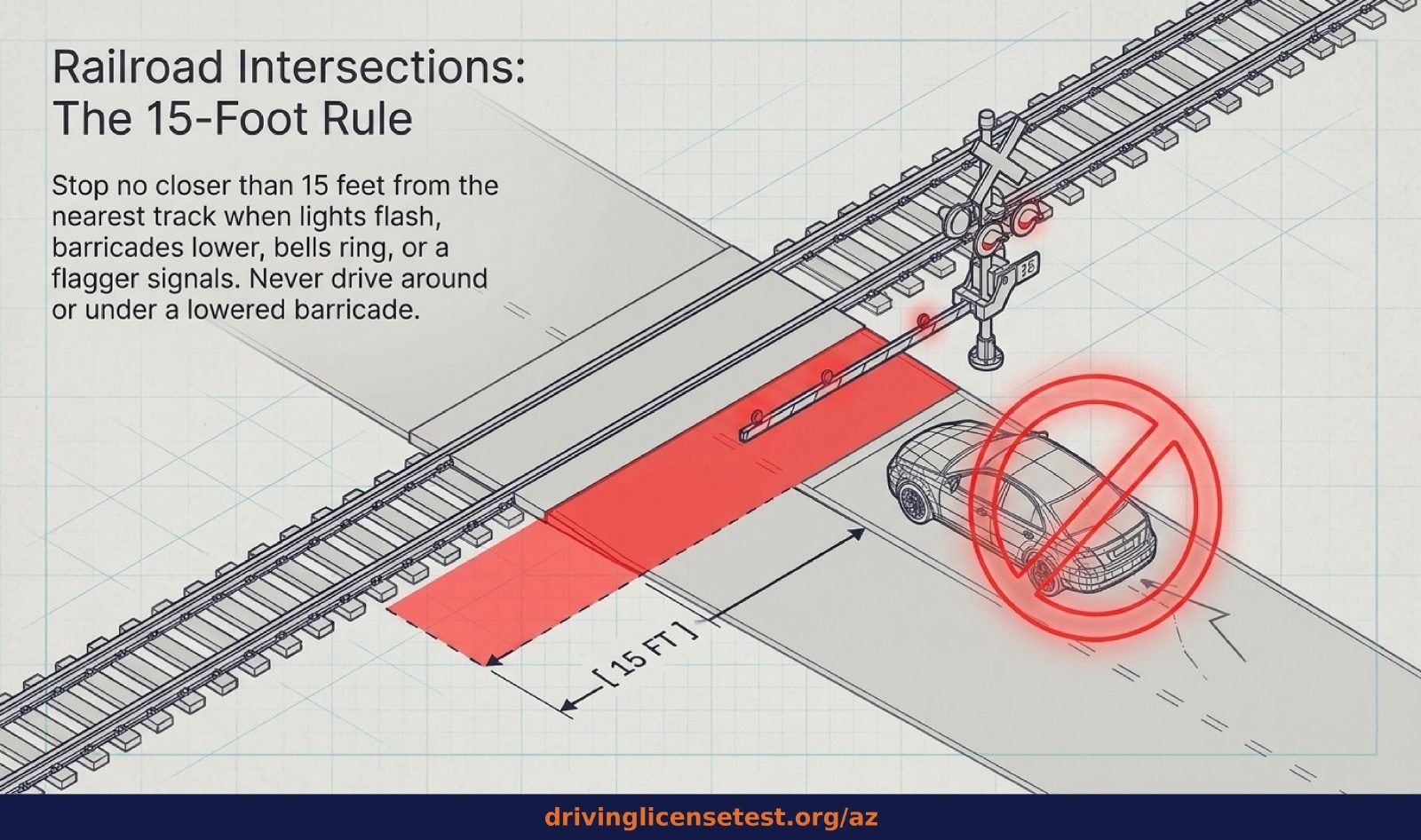
Railroad crossings: stop no closer than 15 feet from the nearest track when lights are flashing, a barricade is lowered, bells are ringing, or a flagger signals — and never drive around or under a lowered barricade.
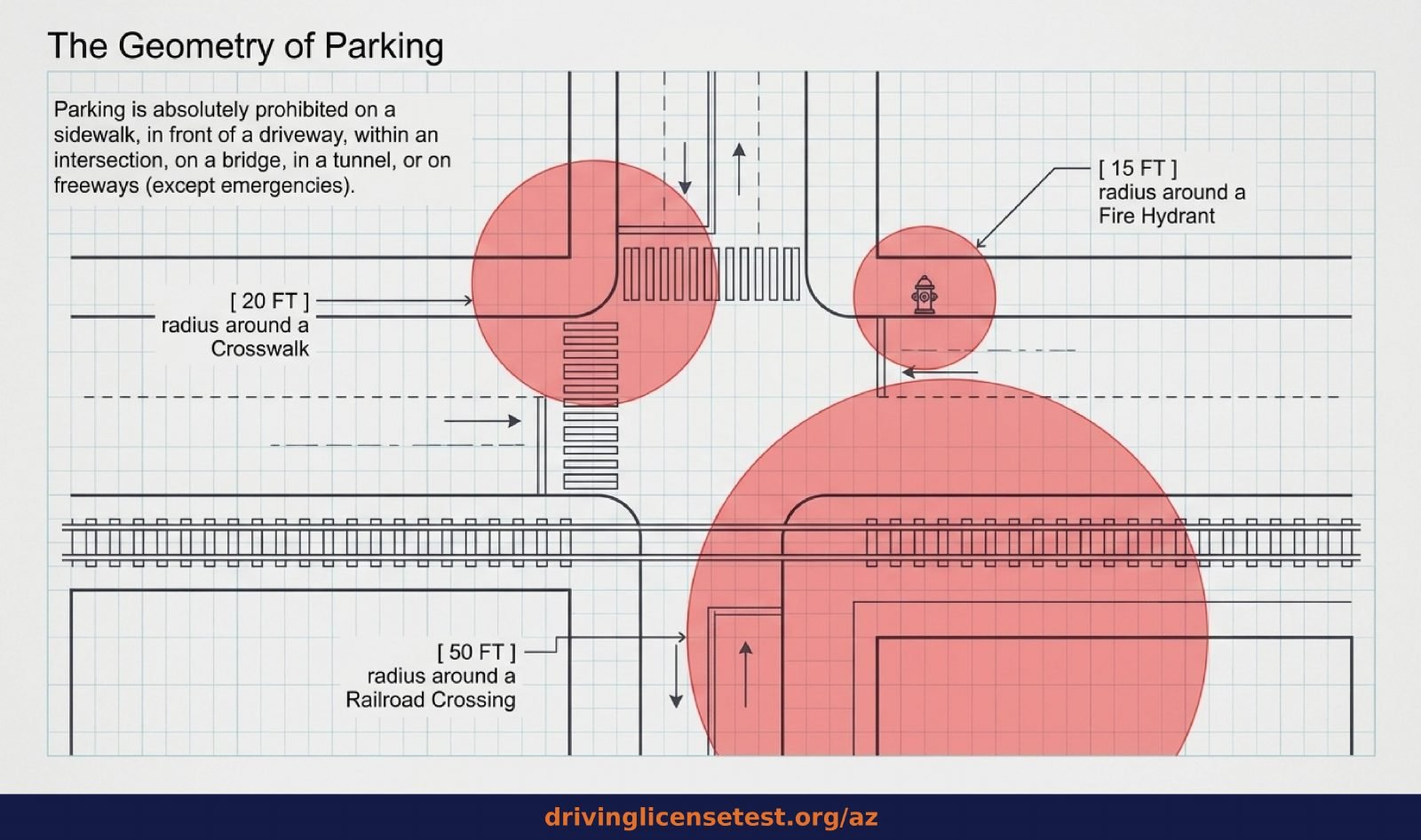
Parking is prohibited:
- On a sidewalk; in front of a driveway; within an intersection.
- On a crosswalk or within 20 feet of a crosswalk at an intersection.
- On any freeway or interstate except in an emergency.
- Within 15 feet of a fire hydrant.
- Within 50 feet of a railroad crossing.
- On a bridge or in a tunnel.
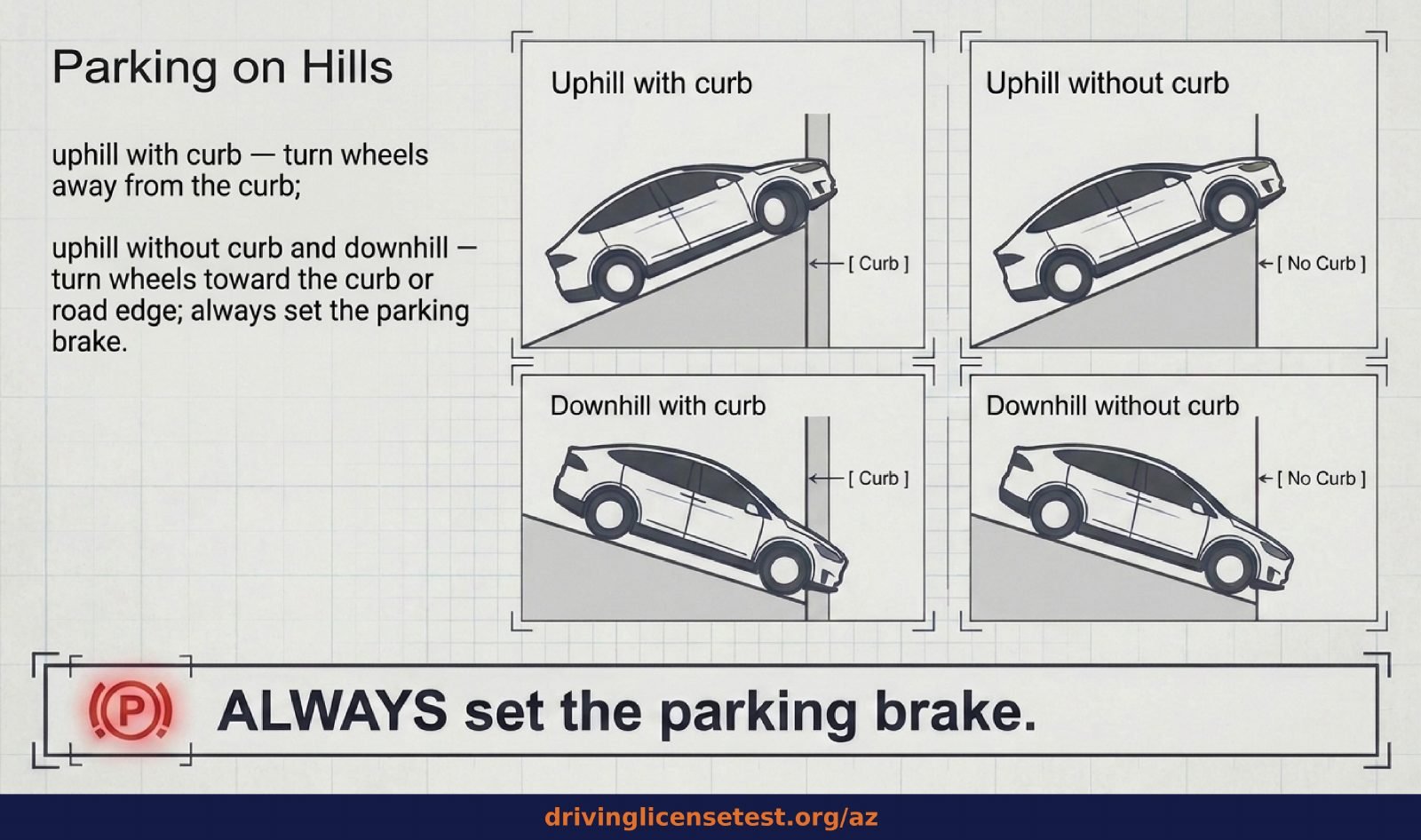
Parking on a hill: turn the wheels as the Manual directs for uphill and downhill, with or without a curb — and always set the parking brake, whichever way you face.
Check yourself: A driver parks 18 feet from a crosswalk, 16 feet from a hydrant, and 55 feet from a railroad crossing. Two of the three distances are illegal. Which two?
Part 4: Lights and equipment — the 500/200 numbers
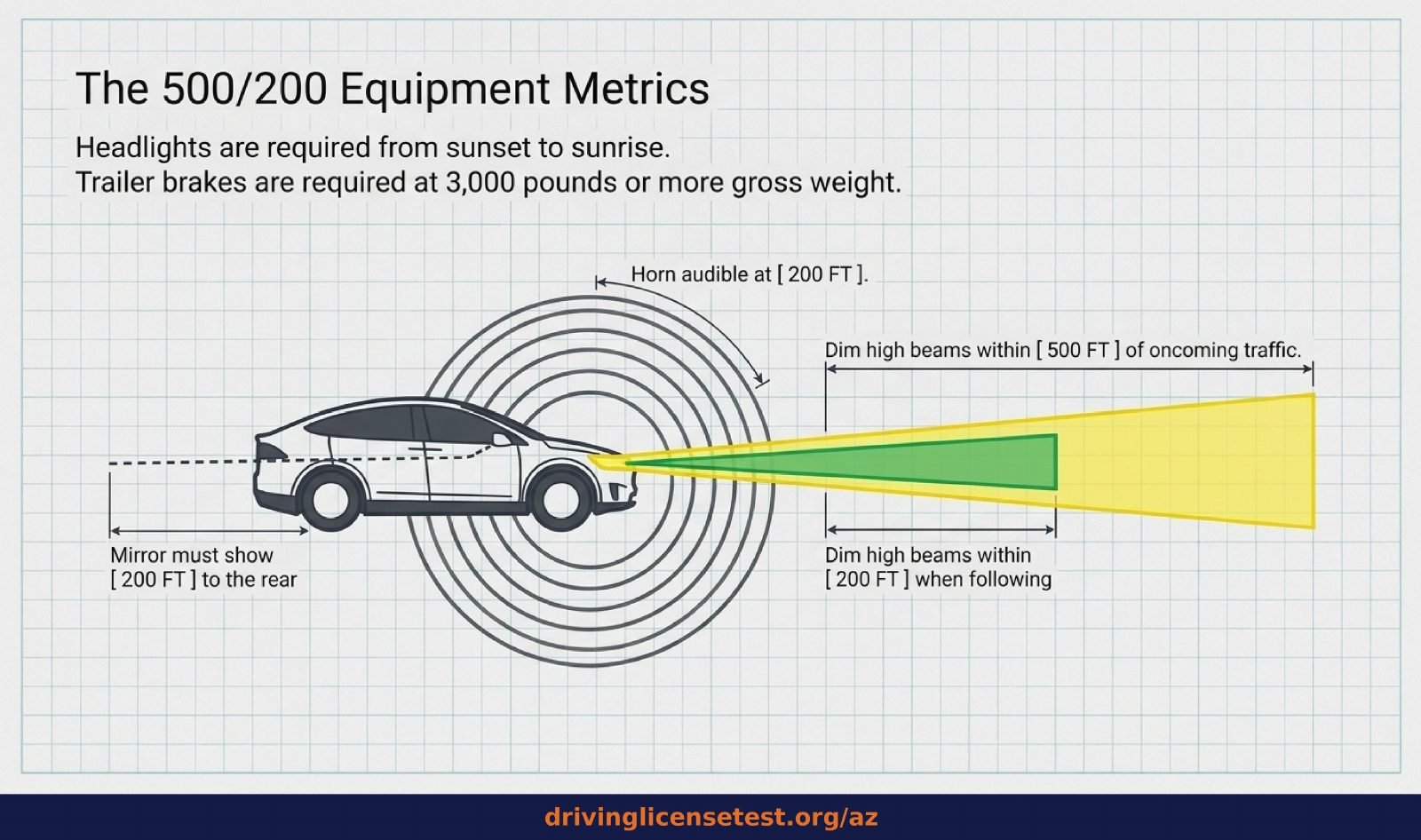
- Use headlights from sunset to sunrise.
- Dim high beams to low beams within 500 feet of oncoming traffic and within 200 feet when following another vehicle.
- Your horn must be audible 200 feet away.
- Your mirror must show 200 feet to the rear.
- Trailer brakes are required at 3,000 pounds or more gross weight.
Memory aid: Five hundred meeting, two hundred following, two hundred for horn and mirror, three thousand for trailer brakes.
Check yourself: At night you are following a car 180 feet ahead with your high beams on, and an oncoming car is 450 feet away. Which dimming rule have you already broken, and which one is about to apply?
Part 5: Dust storms and flash floods — Arizona’s own emergencies
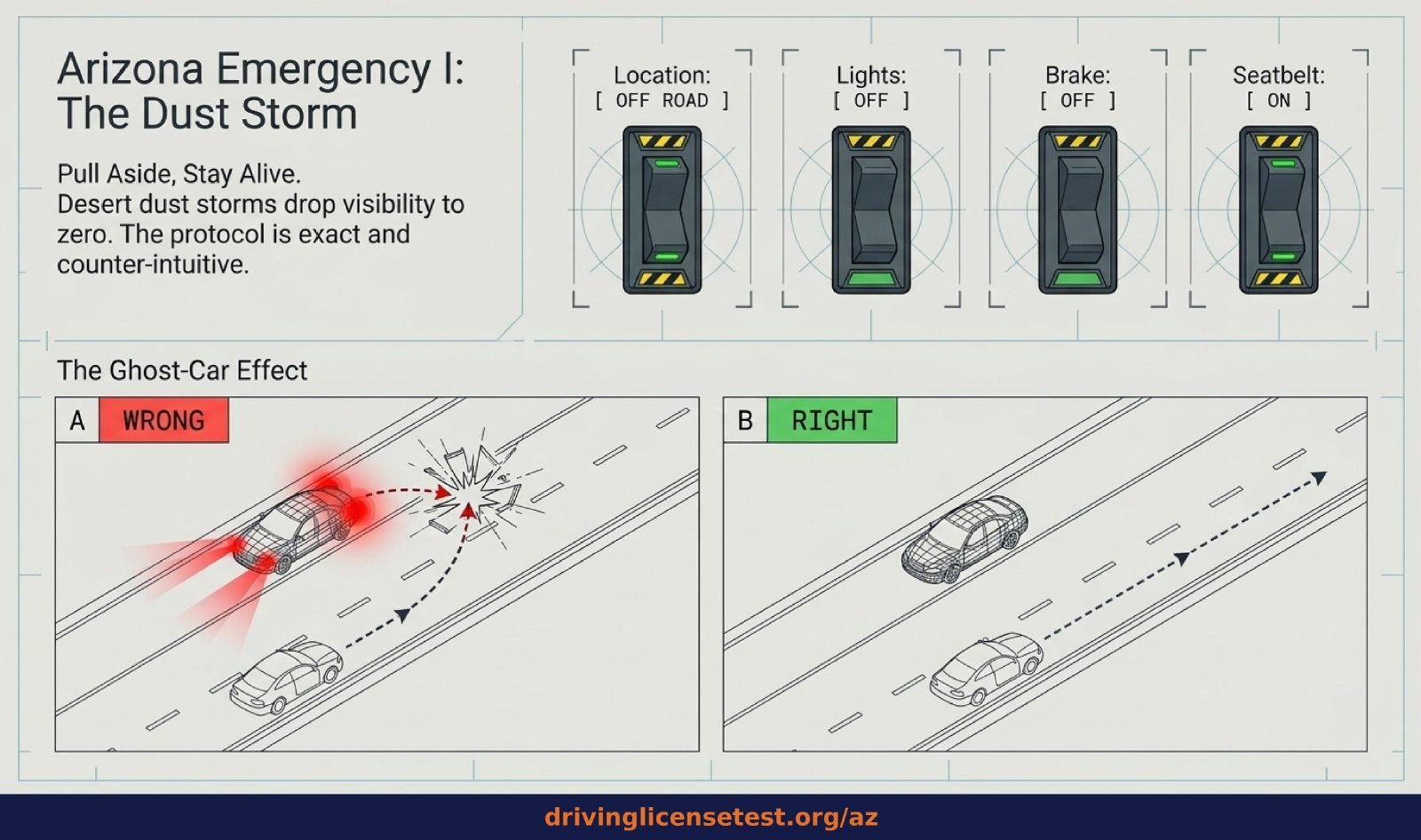
Dust storms — “Pull Aside, Stay Alive.” A desert dust storm can drop visibility to zero. The Manual’s procedure is exact, and one step surprises everyone:
- Slow down immediately and pull completely off the roadway — not into the travel lane or the emergency lane.
- Turn off all lights and take your foot off the brake. Lit tail lights in zero visibility invite a following driver to steer straight into you, mistaking your parked car for a moving one.
- Stay in the vehicle with your seat belt on until the storm passes.
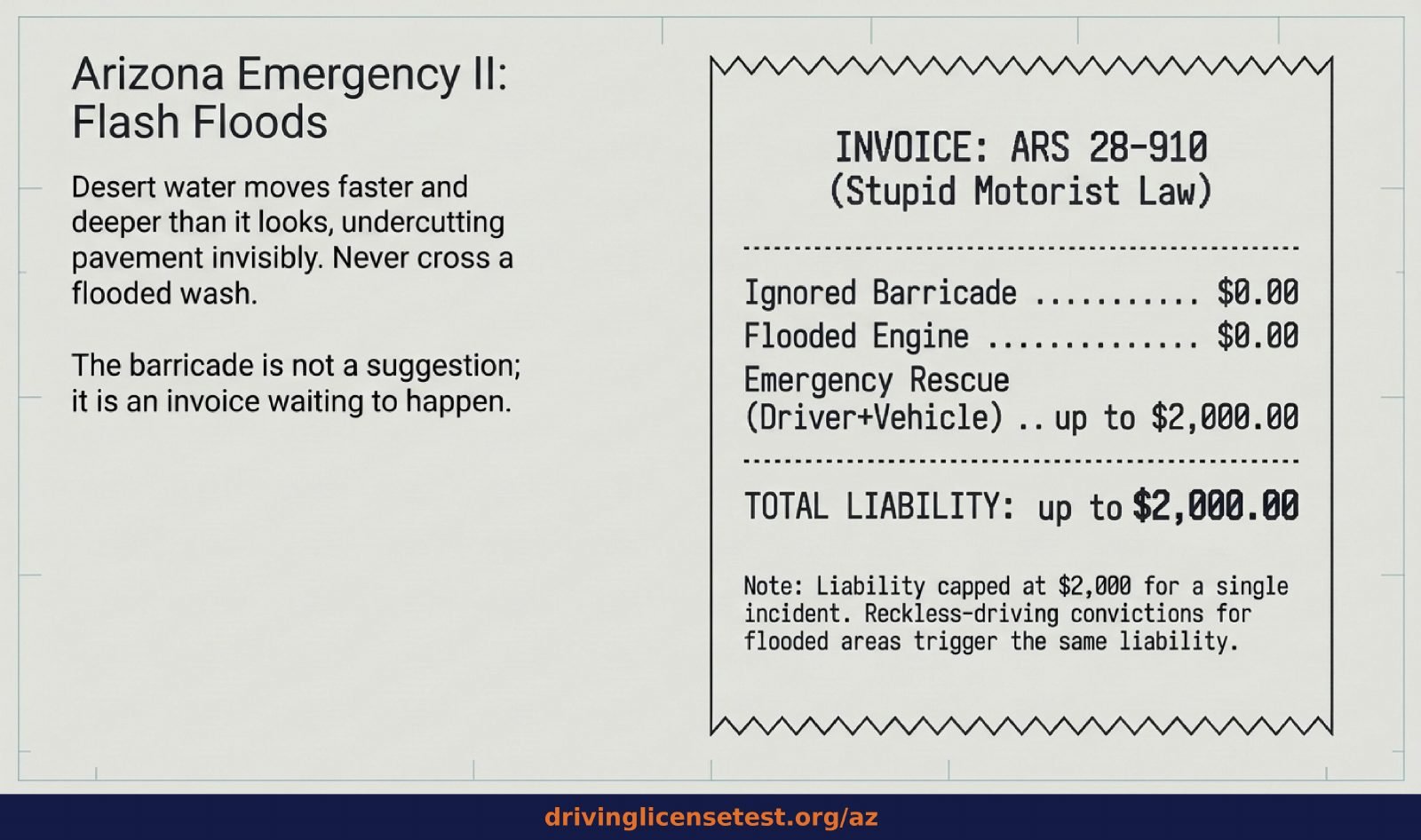
Flash floods: never cross a flooded wash or flooded roadway — desert water moves faster and deeper than it looks, and it undercuts pavement invisibly. And never test a barricade: the “stupid motorist law” (ARS 28-910) makes a motorist who drives on a barricaded public street or highway that is flooded liable for the expenses of the emergency response needed to remove the driver, passengers, and vehicle — liability capped at $2,000 for a single incident. A reckless-driving conviction for driving into a flooded area can trigger the same liability. The barricade is not a suggestion; it is an invoice waiting to happen.
Hydroplaning can begin at speeds of about 50 mph on wet pavement — one more reason the Part 1 distances double in bad weather.
Check yourself: Dust cuts visibility to zero and you pull fully off the roadway. A passenger says to keep the lights and brake lights on “so people can see us.” Why does the Manual order exactly the opposite?
Part 6: Motorcycles filtering, and after a crash — stay, aid, exchange
Motorcycle lane filtering is legal in Arizona only inside a tight box: the street has two or more lanes in the same direction, the posted speed limit is 45 mph or less, and the motorcycle travels 15 mph or less. Outside any one of those conditions, filtering is not allowed — as a driver, expect it only in slow, multi-lane traffic.
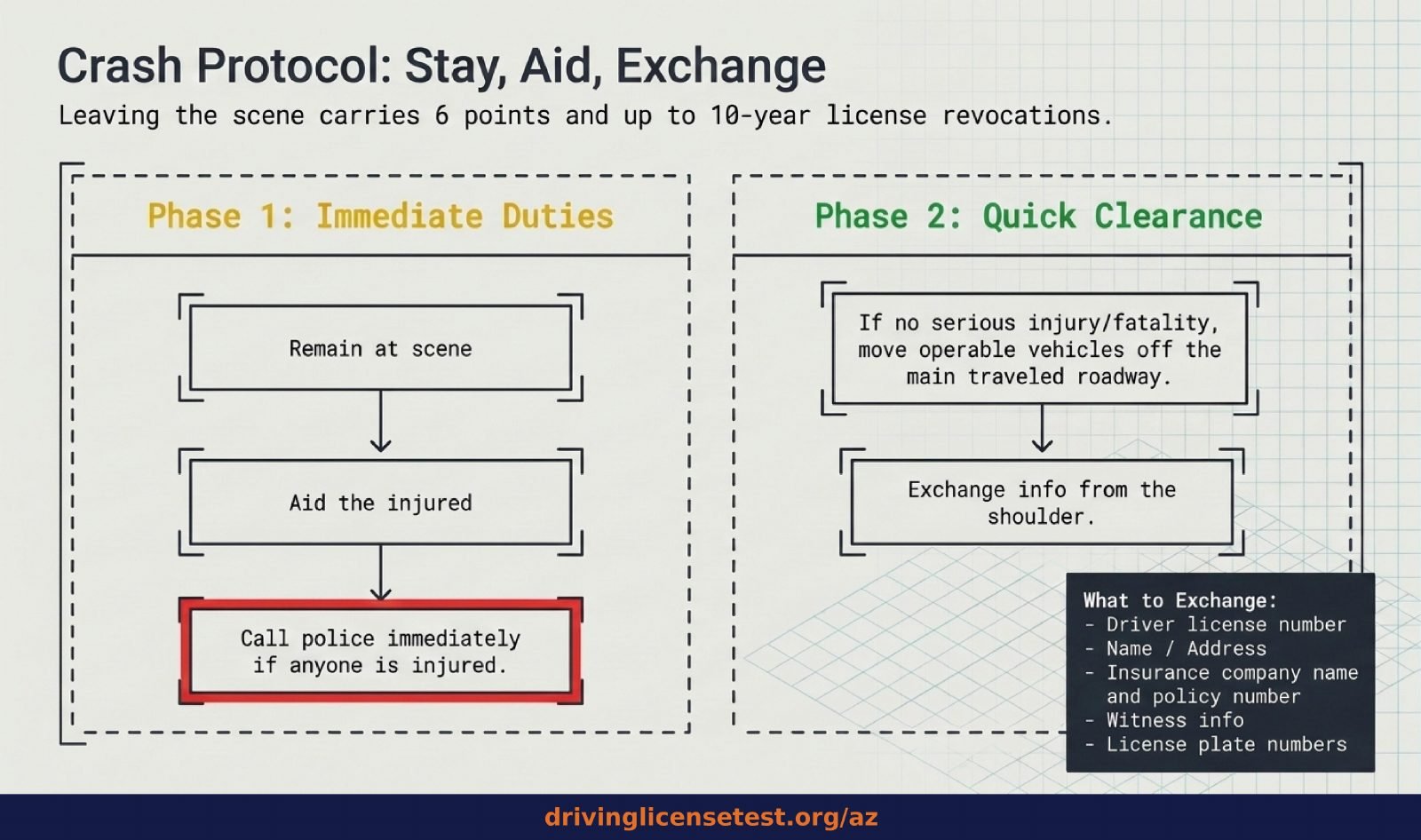
After a crash, Arizona’s duties are immediate:
- Remain at the scene — leaving the scene carries 6 points and license actions that scale with the harm, up to 10-year revocations the Licensing & Registration guide tabulates.
- Aid the injured, and call police immediately if anyone is injured.
- Exchange your driver license number, name and address, insurance company and policy number, witness information, and license plate numbers.
- Quick Clearance: if there is no serious injury or fatality, operable vehicles shall be removed from the main traveled portions of the roadway — exchange details from the shoulder, not the travel lane.
Check yourself: In a minor crash with no injuries, both cars run fine but the drivers stay in the travel lane for twenty minutes exchanging information. What does Quick Clearance require instead — and what must still be exchanged?
Key numbers to memorize
| Following distance | 3 seconds in most situations · 6 seconds or more on slippery roads · double in bad weather |
| Signals and passing | Signal 100 feet before a turn · bicycle clearance 3 feet · no passing within 100 feet of intersections, railroad crossings, or view-blocked bridges/tunnels/underpasses |
| Railroad crossings | Stop no closer than 15 feet from the nearest track; never go around or under a lowered barricade |
| Parking bans | Within 20 feet of a crosswalk · within 15 feet of a hydrant · within 50 feet of a railroad crossing |
| Lights | Headlights sunset to sunrise · dim within 500 feet oncoming and 200 feet following |
| Stupid motorist law (ARS 28-910) | Driving a barricaded flooded road makes you liable for rescue costs, capped at $2,000 |
| Lane filtering | 2+ lanes same direction · posted limit 45 mph or less · motorcycle at 15 mph or less |
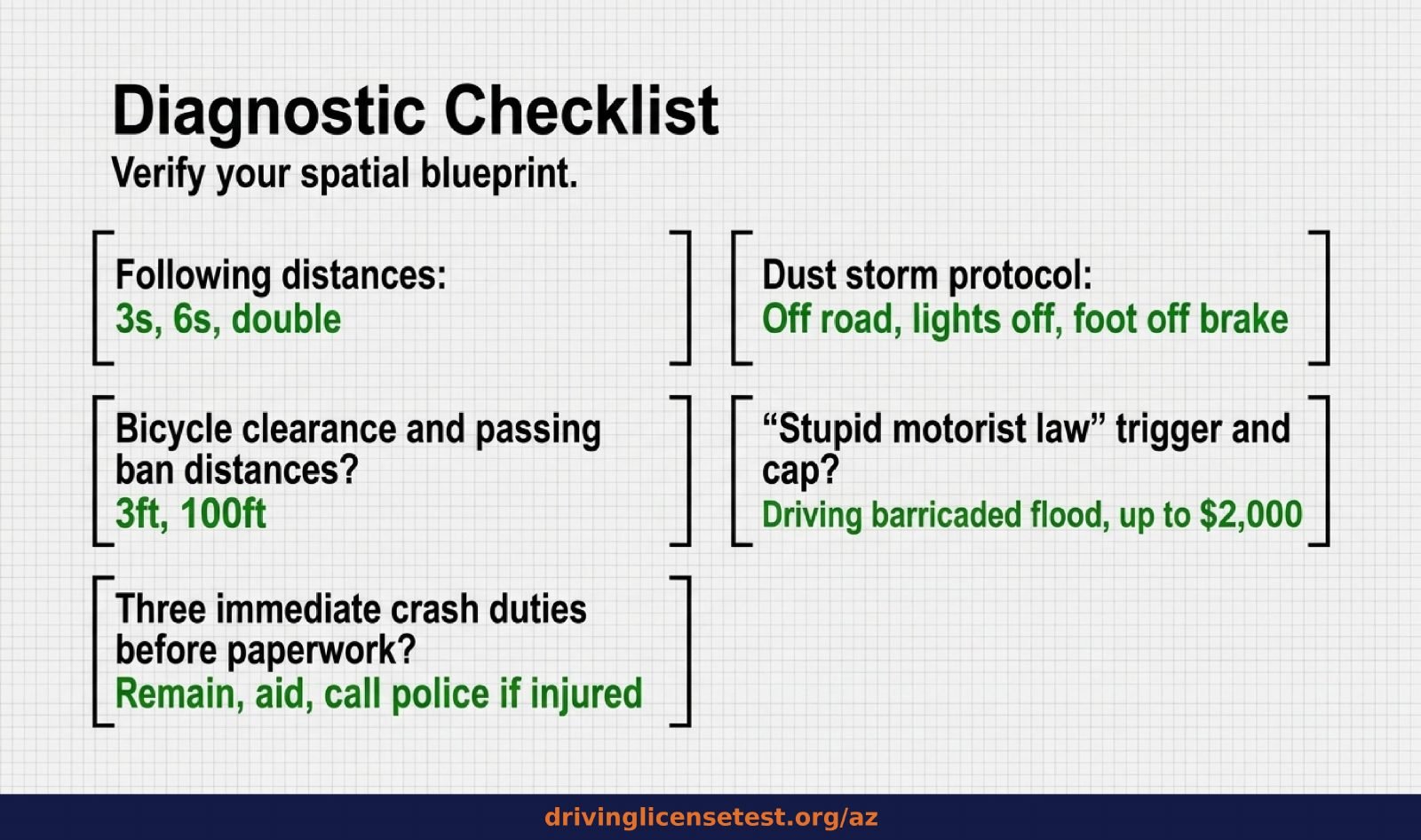
5-question self-check
- What following distance applies in most situations, on slippery roads, and in bad weather?
- How much clearance must you give a bicyclist, and where is passing banned within 100 feet?
- In a dust storm, where do you stop the car, what do you do with your lights and brake, and where do you wait?
- What does the stupid motorist law make a driver pay, what triggers it, and what is the cap?
- After a crash with injuries, name your three immediate duties before any paperwork is exchanged.
Answer key
- At least 3 seconds in most situations; 6 seconds or more on slippery roads; double the distance in bad weather.
- A minimum of 3 feet for a bicyclist. No passing within 100 feet of an intersection or street crossing, a railroad crossing, or a bridge, tunnel, or underpass where the view is blocked — and never where there are double solid lines.
- Pull completely off the roadway — not into the travel or emergency lane. Turn off all lights and take your foot off the brake, so no one mistakes your stopped car for a moving one. Stay in the vehicle with your seat belt on until the storm passes.
- The expenses of the emergency response needed to remove the driver, passengers, and vehicle. It is triggered by driving on a barricaded public street or highway that is flooded (a reckless-driving conviction for entering a flooded area can also trigger it). The cap is $2,000 for a single incident.
- Remain at the scene, aid the injured, and call police immediately if anyone is injured. Then exchange license numbers, names and addresses, insurance company and policy numbers, witness information, and plate numbers.
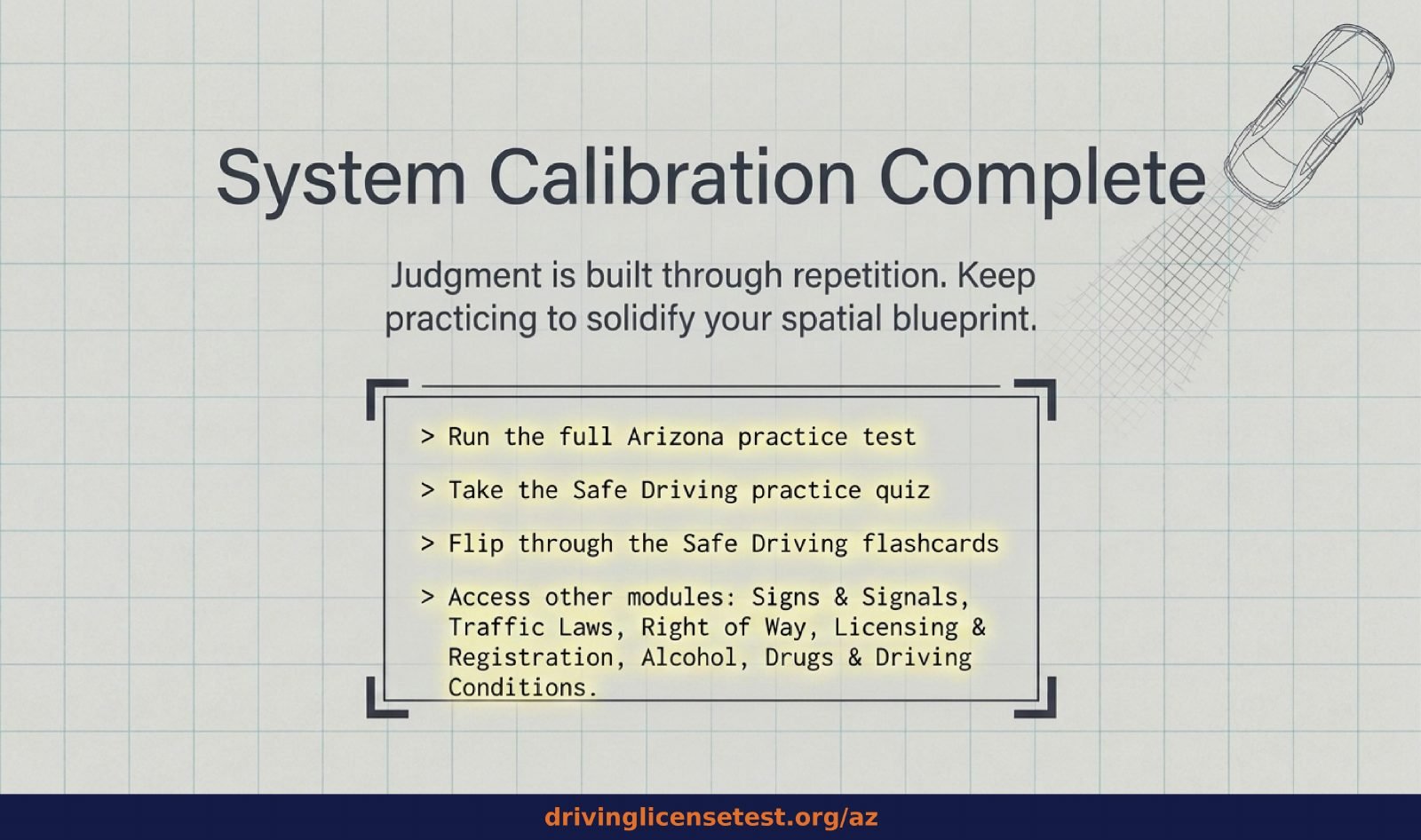
Keep practicing
- Take the Safe Driving practice quiz
- Flip through the Safe Driving flashcards
- Run the full Arizona practice test
More study guides: Signs & Signals Study Guide · Traffic Laws Study Guide · Right of Way Study Guide · Alcohol, Drugs & Driving Conditions Study Guide · Licensing & Registration Study Guide