
Your complete Arizona study guide — plain language, no jargon.
Built from the official manual. Every fact in this Arizona section comes from the Arizona Driver License Manual, published by the Arizona Department of Transportation Motor Vehicle Division (ADOT MVD) — checked against the current edition and verified November 13, 2026. Read the manual itself at azdot.gov.
📘 Prefer pictures? Flip through the visual deck
This whole guide as 15 slides — swipe or scroll sideways through them. Arizona Traffic Laws study guide, practice tests & flashcards: the speed defaults, the 15 mph school-crossing rule, the hands-free device ban and the belt and child-restraint ages.




Take it with you: Download the deck as a PDF (9.3 MB) → — free to share.
Why this matters
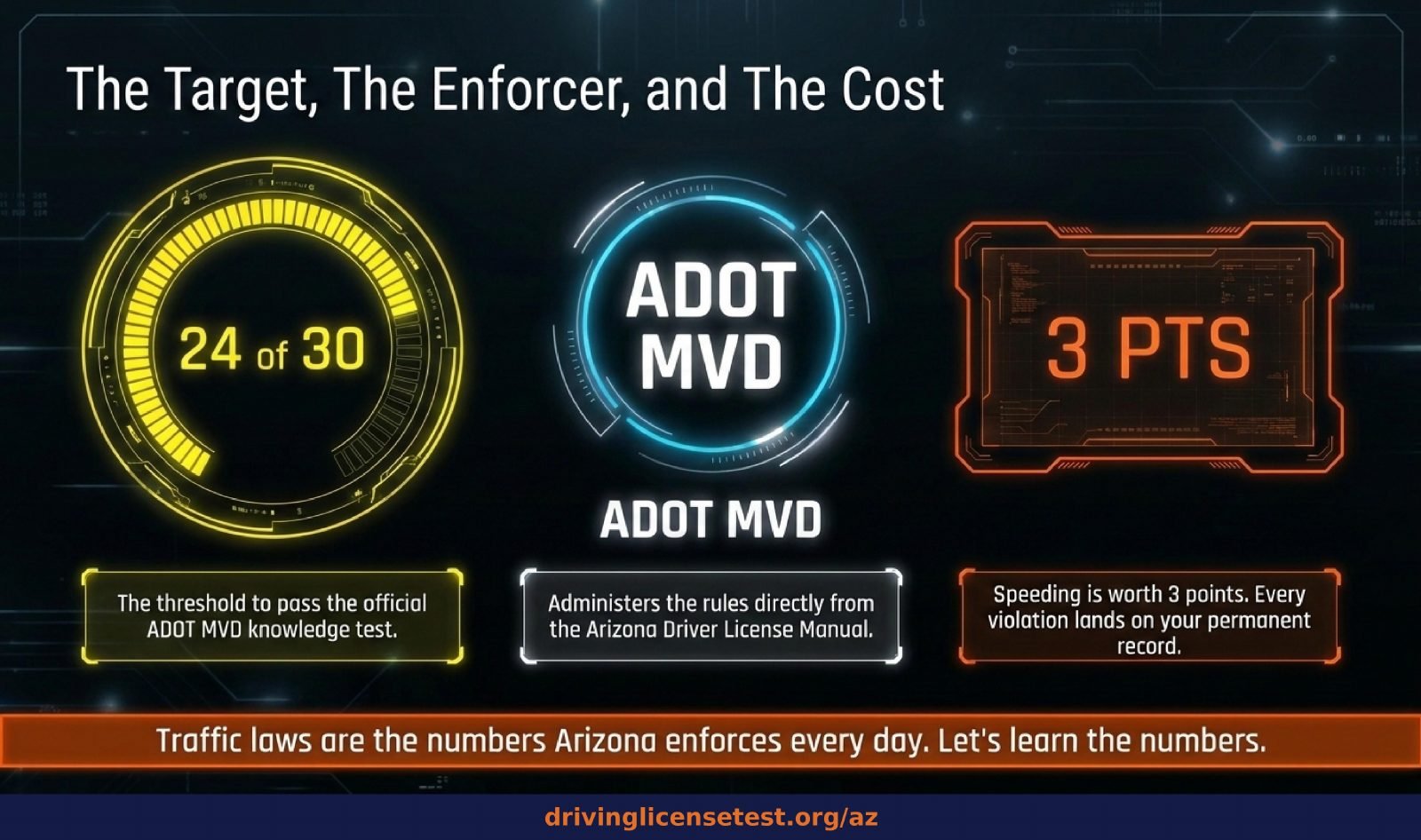
Traffic laws are the numbers Arizona enforces every day: how fast, where you stop, who must be belted, and what a phone may never do in your hand. In Arizona, driver licensing is administered by the Arizona Department of Transportation Motor Vehicle Division — ADOT MVD — and the official study book is the Arizona Driver License Manual. Arizona’s knowledge test is 30 multiple-choice questions, and you must score 80% or higher — 24 of 30 — to pass, and this guide carries the densest cluster of testable numbers in Arizona law: the speed defaults, the 15 mph school-crossing rule with its no-passing ban, and the belt and device rules that protect the people inside the car. Arizona also runs a real points system — every violation in this guide lands on your permanent record at a price the Licensing & Registration guide tabulates.
Part 1: Speed — the posted sign rules, and the defaults when there is none
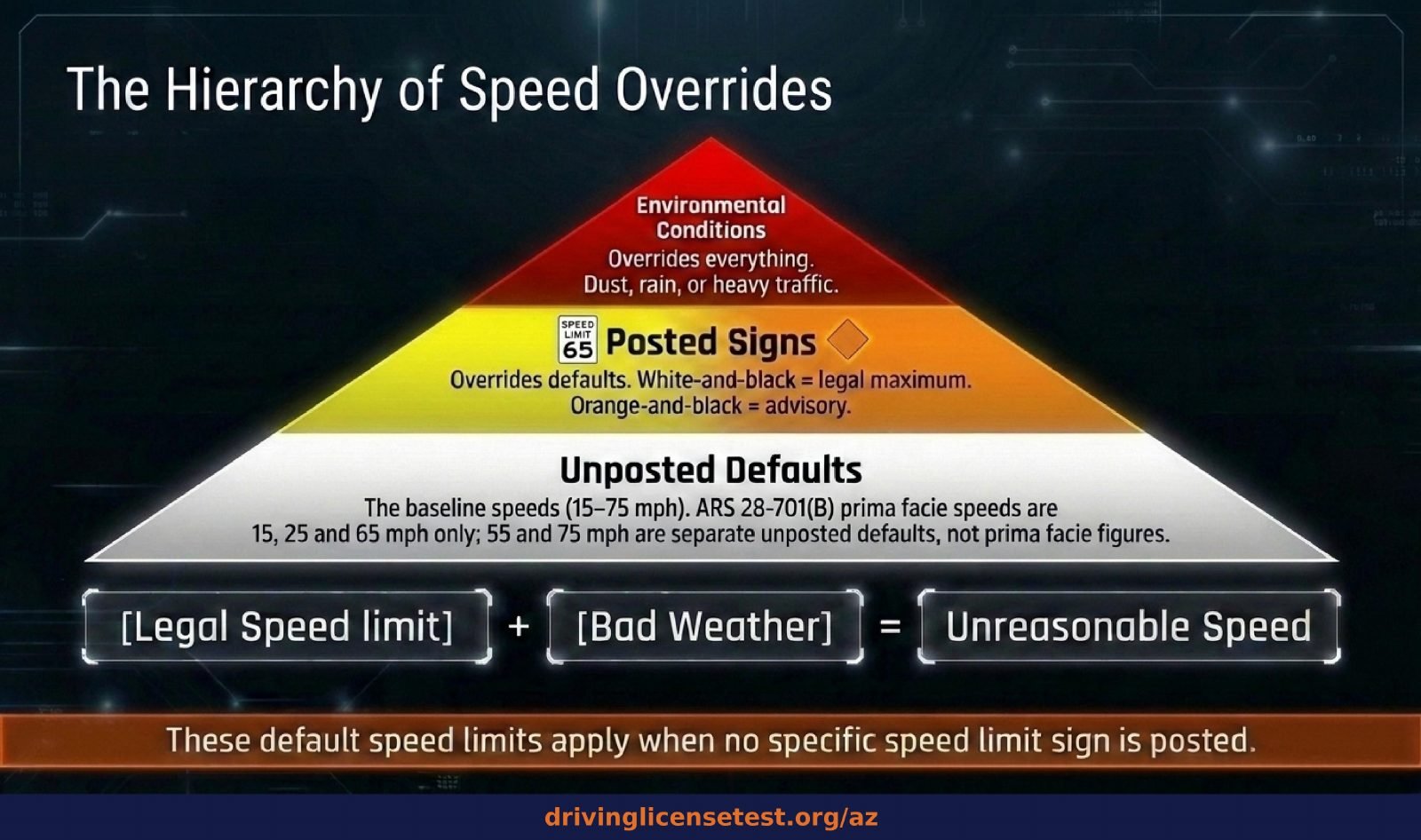
Arizona’s speed law has two layers. The first is prima facie: ARS 28-701(B) makes any speed above these figures prima facie evidence that the speed is unreasonable and imprudent:
- 15 mph approaching a school crossing.
- 25 mph in a business or residential district.
- 65 mph in other locations.
The second layer is the Manual’s list of limits that apply when no limit is posted:
- 15 mph approaching a school crosswalk.
- 25 mph in any business or residential district.
- 55 mph on open highways or city freeways.
- 65 mph on designated open highways.
- 75 mph on rural freeways.
Posted signs override every default — remember the Signs & Signals guide’s color line: a white-and-black speed sign states the legal maximum, an orange-and-black one advises. And conditions always rule: a legal speed on a clear day can be an unreasonable speed in dust, rain, or traffic. Speeding is worth 3 points on your record, and in a work zone the money side doubles — Part 6 below.
Memory aid: Fifteen for schools, twenty-five where people live and work, fifty-five on open highways, sixty-five designated, seventy-five on rural freeways.
Check yourself: No speed limit is posted on a rural freeway, then none is posted on the open highway after your exit, then none in the residential street at the end. Name the three defaults in order.
Part 2: School crossings — 15 mph, a complete stop, and no passing
Arizona’s school-crossing rules are stricter than most drivers expect, and the Manual states them as hard duties:
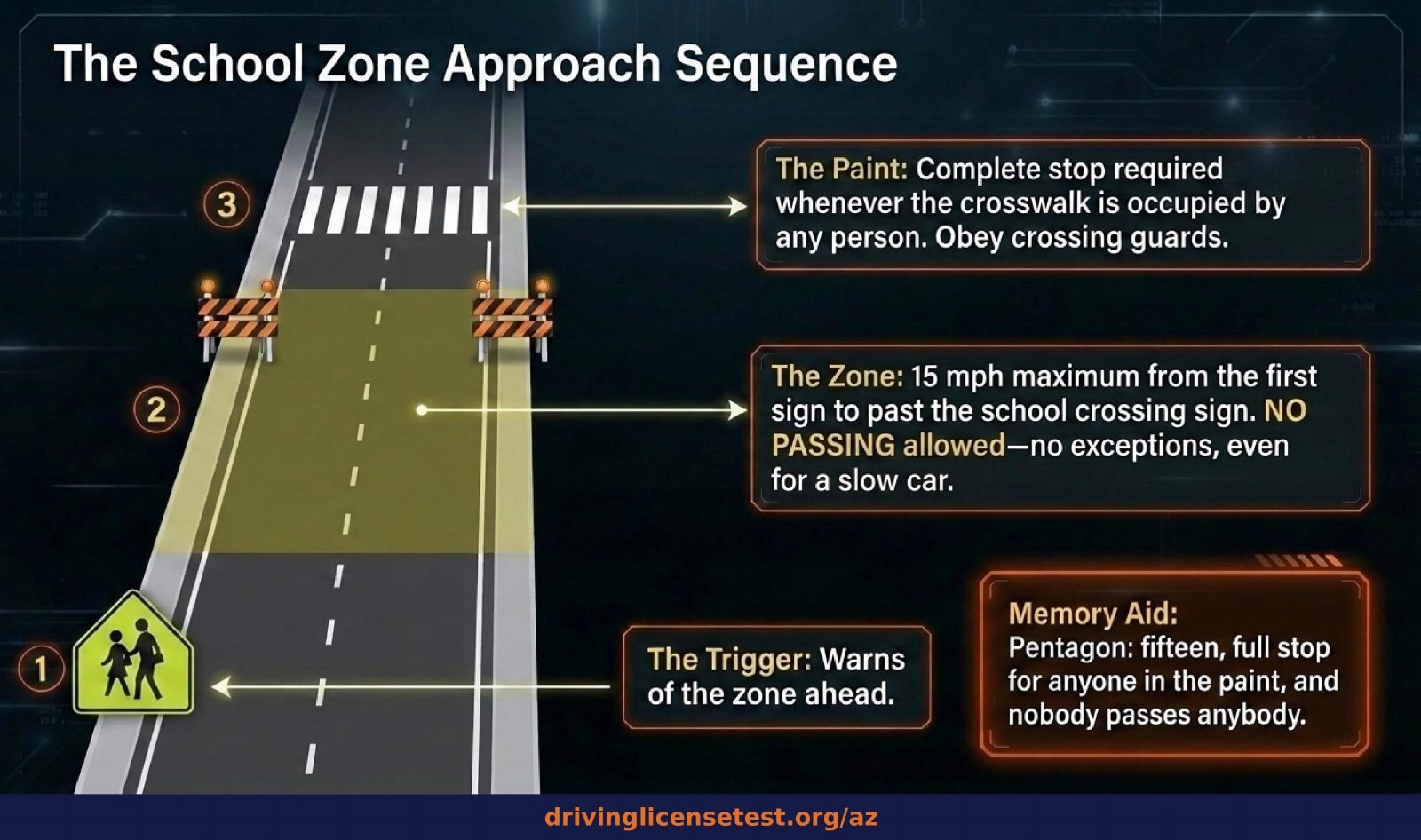
- At a school crossing, a vehicle must come to a complete stop whenever the crosswalk is occupied by any person — one person in the crosswalk stops traffic, and drivers must obey crossing guards.
- Where portable school-crossing signs are in place, the maximum speed from the first sign to past the school crossing sign is 15 mph.
- Passing another vehicle in a school crossing zone is prohibited — no exceptions for a slow car ahead of you.
- Everywhere, on every road: a driver may not pass a vehicle stopped for a pedestrian in a crosswalk. The stopped car may be hiding the person you cannot see.
The sign itself is the permanent five-sided pentagon in yellow or yellow-green from the Signs & Signals guide. Put the pieces together the way the exam will: pentagon ahead → 15 mph maximum while the portable signs are up → complete stop if anyone is in the crosswalk → never pass.
Memory aid: Pentagon: fifteen, full stop for anyone in the paint, and nobody passes anybody.
Check yourself: Portable school-crossing signs are in place and the car ahead of you is crawling at 10 mph with the crosswalk empty. May you pass it inside the zone — and may you drive 20 mph once you clear it but before the last sign?
Part 3: Devices — Arizona bans the hand, not the call
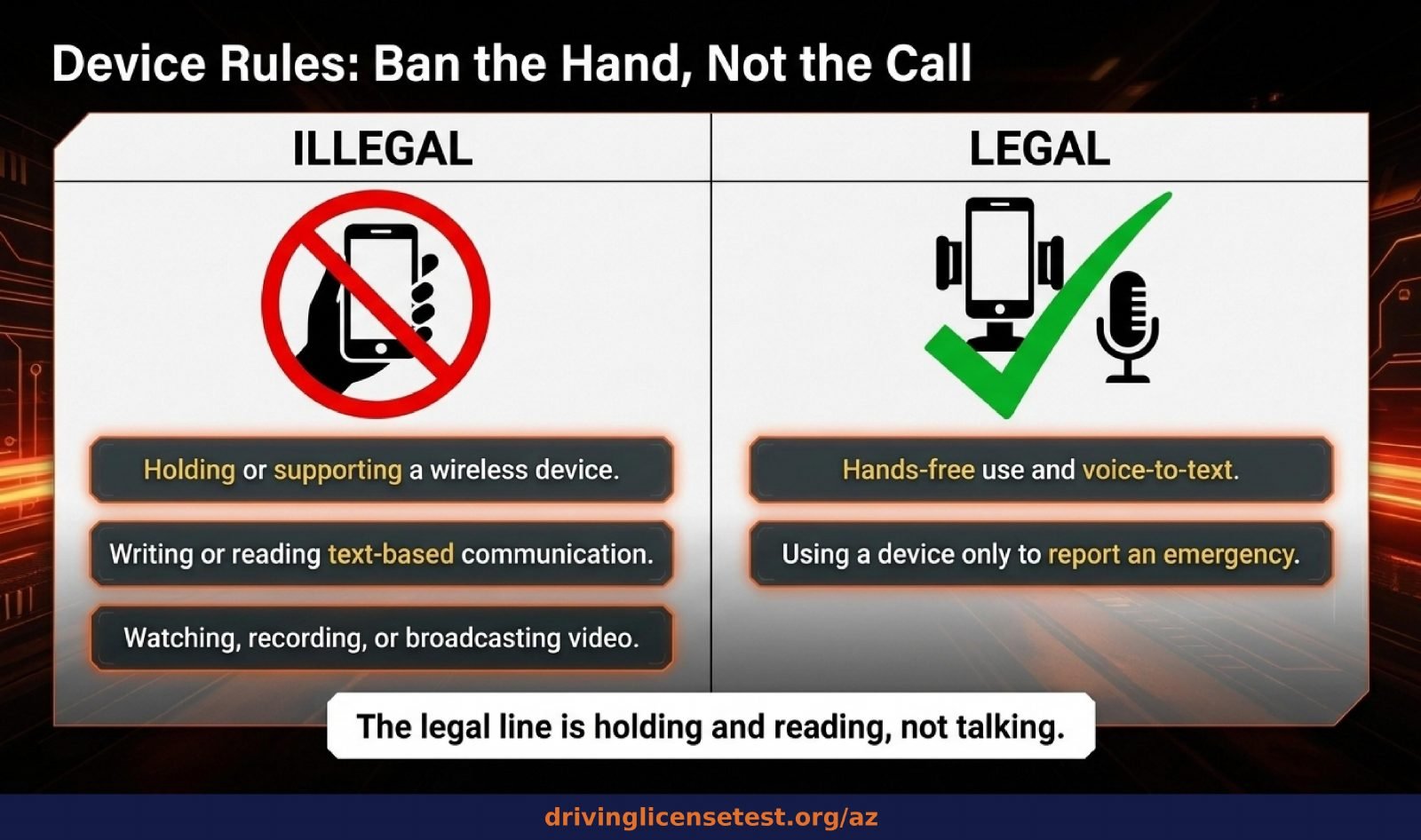
Arizona law prohibits holding or supporting a wireless communication device while driving. The ban is about the device in your hand and your eyes on its screen:
- Drivers may not write or read text-based communication on a device while driving.
- Drivers may not watch, record, or broadcast video on a device while driving.
- While driving, a device may be used only to report an emergency.
- Hands-free and voice-to-text use is allowed — the legal line is holding and reading, not talking.
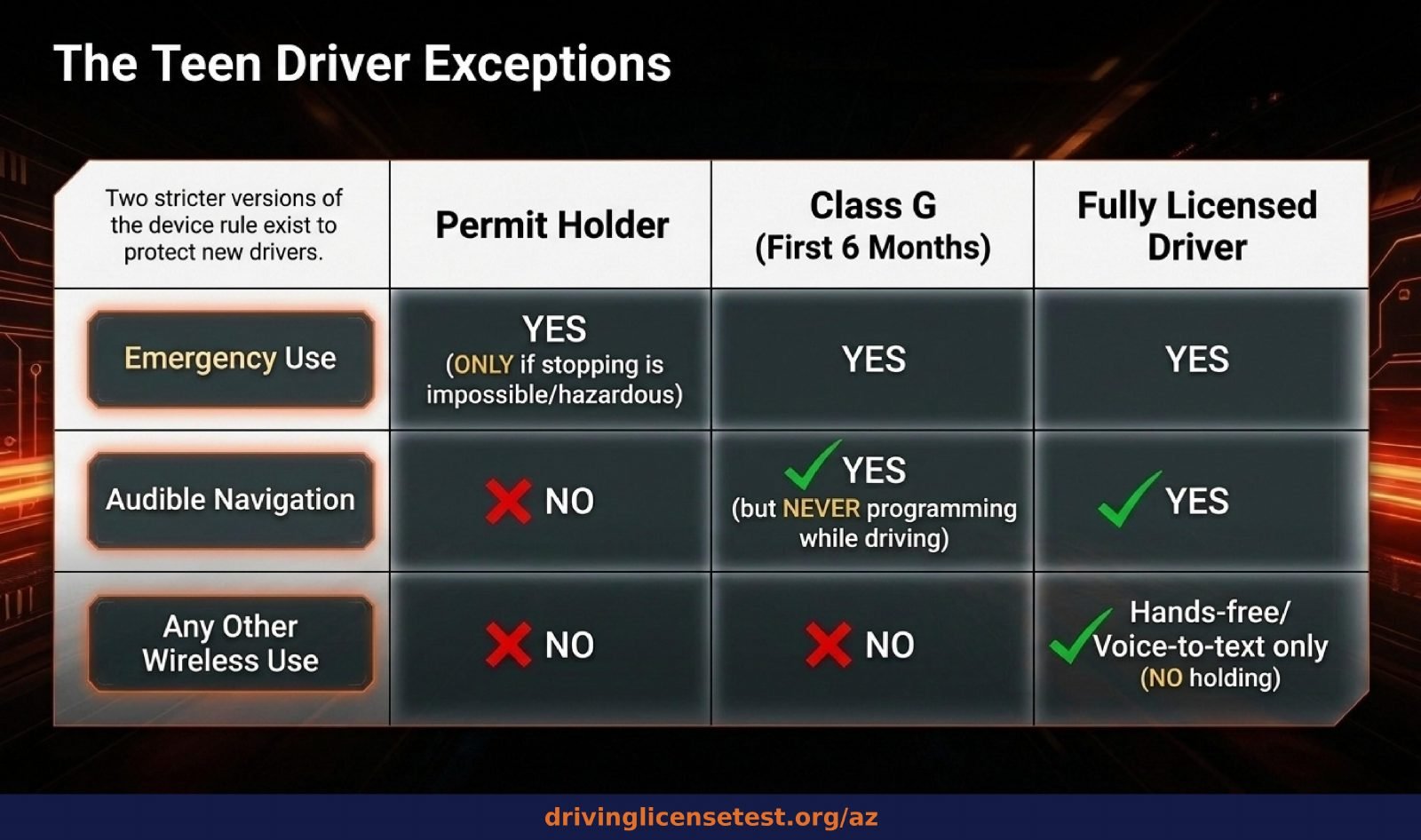
Two stricter versions of this rule exist for new drivers: a permit holder may not use a wireless device for any reason while driving except an emergency in which stopping is impossible or would create an additional hazard, and a Class G license holder in the first 6 months may use a device only in an emergency or for audible turn-by-turn navigation — never programming it while driving. The Licensing & Registration guide states both in full.
Check yourself: A driver holds the phone in one hand, dictating a message by voice-to-text, while watching the road. A second driver has the phone mounted and does the same. Who is breaking Arizona’s device law, and why?
Part 4: Seat belts and child restraints — Arizona’s exact ages
The Manual states the belt rules occupant by occupant. Note what it does not do: it never labels the enforcement type of the belt law, so this guide doesn’t either — learn the duties themselves:
- Each front-seat occupant must have a lap and shoulder belt properly adjusted and fastened while the vehicle is in motion (a lap belt alone suffices where that is what is installed).
- The operator must require all passengers under 16 to buckle up.
- Children under age 5 must be properly secured in a child restraint system.
- Children ages 5 through 8 must ride in a child restraint system until they are at least 4 feet 9 inches tall — the age band ends at the height line, not at a birthday alone.
- Child restraint systems must meet U.S. Department of Transportation standards and be used per the manufacturer’s instructions.
- Children 12 and under should never ride in the front seat because of air-bag risk.
Memory aid: Under 5: a restraint, always. Five through eight: a restraint until 4-foot-9. Under 16: the driver makes them buckle. Twelve and under: never the front seat.
Check yourself: A tall 7-year-old is 4 feet 10 inches; her brother is 6 and 4 feet 6 inches. Which child still must ride in a child restraint system, and what measurement decides it?
Part 5: Open containers and HOV lanes — two cabin rules
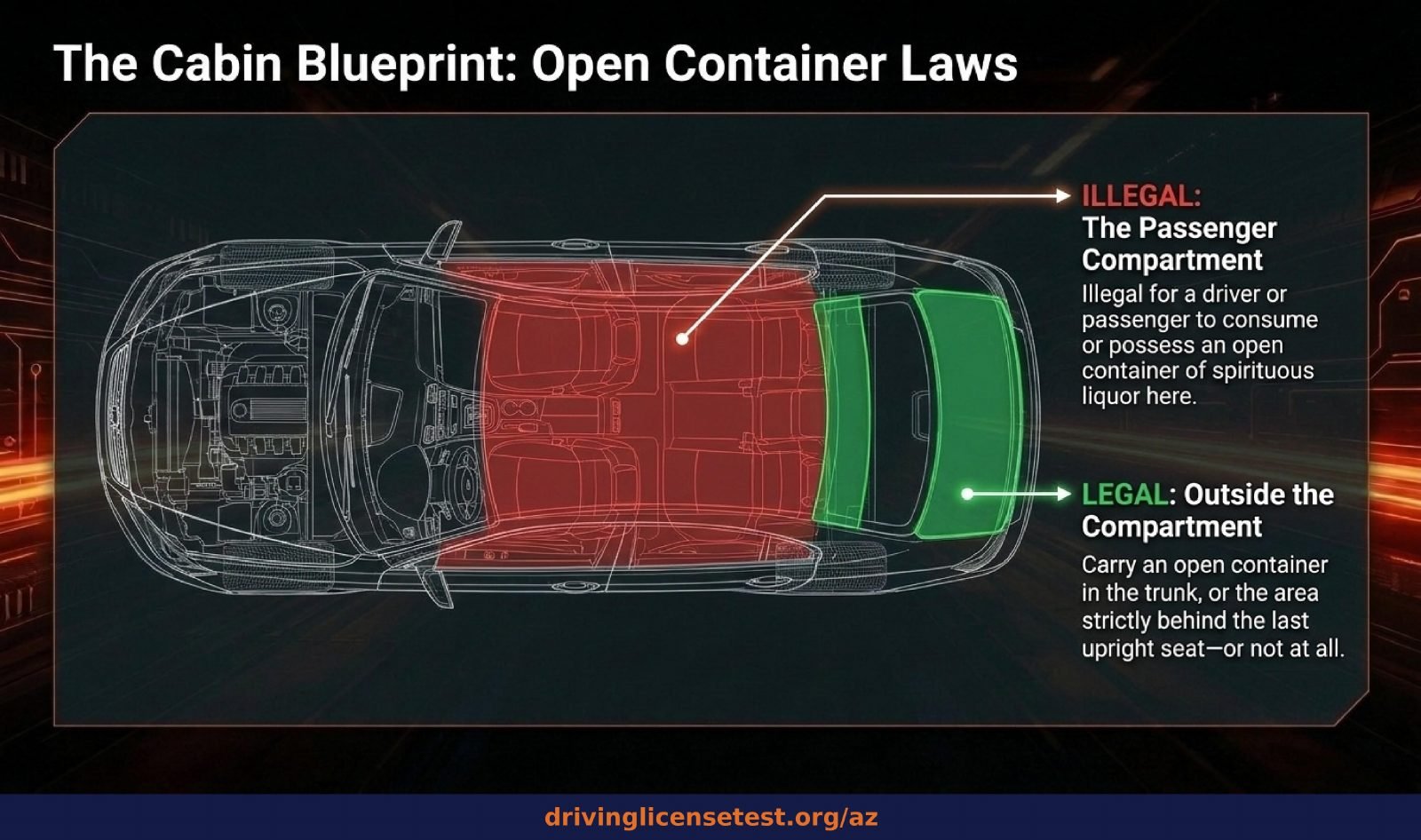
Open container: it is illegal for a driver or passenger to consume or possess an open container of spirituous liquor in the passenger compartment on any public roadway. The exemptions are specific: buses, limousines, and taxis, and the living quarters of a motor home. And two places are not part of the passenger compartment: the trunk, and the area behind the last upright seat — carry an open container there or not at all. The Alcohol & Drugs guide picks this rule up again where it belongs, next to the DUI law itself.
HOV lanes are marked with a diamond. Monday through Friday at posted times, vehicles carrying fewer than two persons including the driver may not use them; at those times they are restricted to carpool vehicles, motorcycles, and buses. Outside the posted weekday hours, the diamond lane opens to everyone.
Check yourself: At a posted HOV time on a Tuesday, a solo driver, a motorcyclist, and a driver with one passenger approach the diamond lane. Who may use it?
Part 6: Work zones — double fines
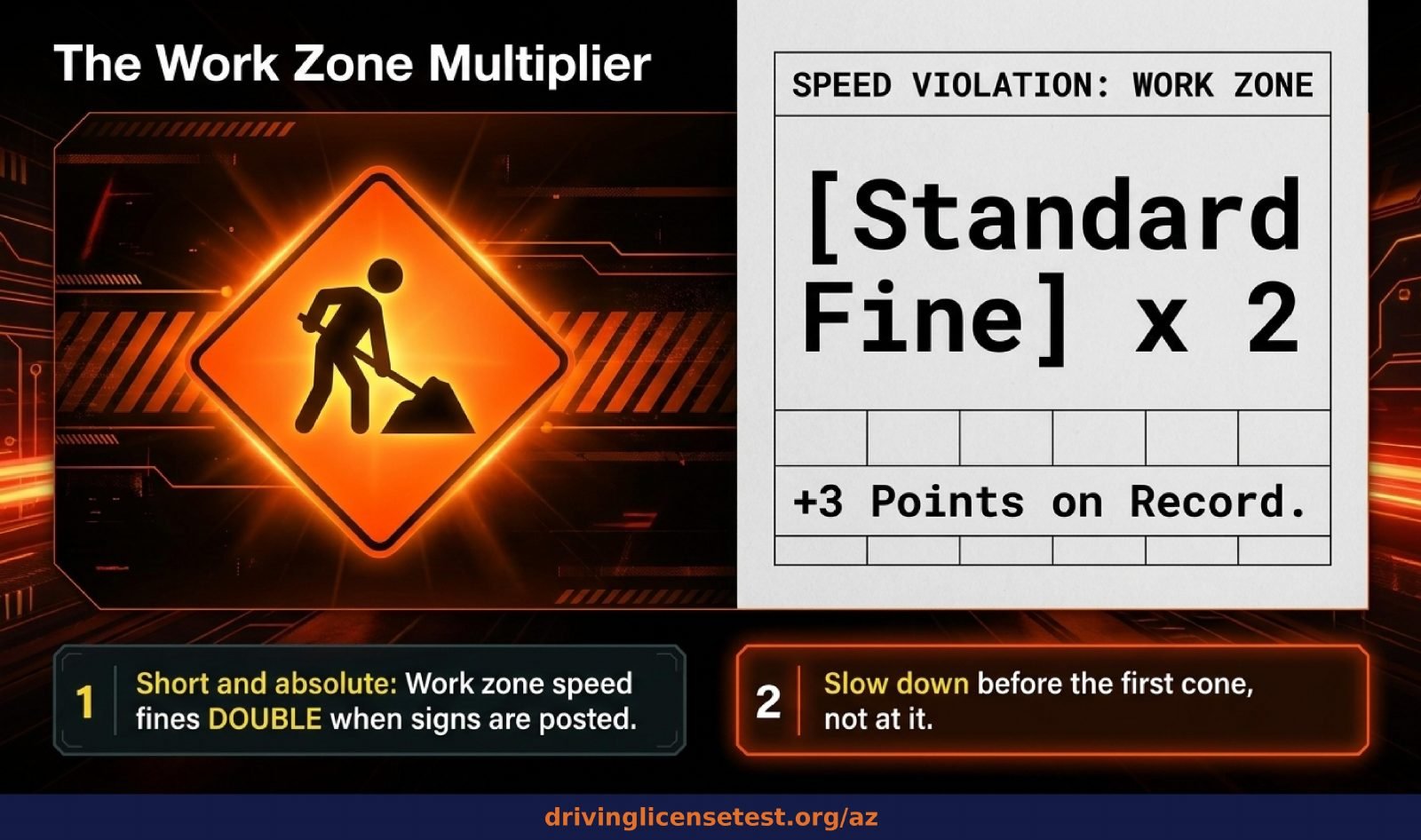
Short and absolute: in work zones, fines are double for speed violations when signs are posted. The orange diamonds from the Signs & Signals guide are warning you about people working feet from live traffic; Arizona prices speed there at twice the standard fine, and speeding still adds its 3 points. Slow down before the first cone, not at it.
Check yourself: A driver speeds through a signed work zone and argues the fine should be standard because no worker was in his lane. What does Arizona law do to speed-violation fines in a signed work zone?
Key numbers to memorize
| School crossings | 15 mph maximum with portable signs up · complete stop when the crosswalk is occupied · no passing in the zone |
| Unposted defaults | 25 mph business/residential · 55 mph open highways and city freeways · 65 mph designated open highways · 75 mph rural freeways |
| Speeding | 3 points; work-zone speed fines doubled when signs are posted |
| Devices | Holding a device is banned; hands-free and voice-to-text allowed; on a device only to report an emergency |
| Child restraints | Under 5: restraint required · Ages 5–8: restraint until 4 feet 9 inches · Under 16: driver must require buckling · 12 and under: never the front seat |
| HOV lanes | Diamond-marked; Mon–Fri at posted times, restricted to vehicles with 2+ persons, motorcycles, and buses |
| Open container | Banned in the passenger compartment; the trunk and the area behind the last upright seat are outside it |
5-question self-check
- What is the maximum speed through a school crossing zone while portable signs are in place, and when must you stop completely?
- No limit is posted. What speed applies in a residential district, on an open highway, and on a rural freeway?
- A driver reads a text on a phone held in her hand at a red light. Her passenger uses voice-to-text hands-free. Who is violating Arizona law?
- A 6-year-old who is 4 feet 7 inches tall rides without a child restraint system. Legal or not — and until what point must the restraint be used?
- It is a posted HOV time on a Thursday. A car carries only the driver. May it use the diamond lane?
Answer key
- 15 mph from the first portable sign to past the school crossing sign. You must come to a complete stop whenever the crosswalk is occupied by any person — and you may never pass another vehicle in the zone.
- 25 mph in a residential district, 55 mph on an open highway, and 75 mph on a rural freeway.
- The driver holding the phone. Arizona bans holding or supporting a device and reading text-based communication while driving; hands-free and voice-to-text use is allowed.
- Not legal. Children ages 5 through 8 must ride in a child restraint system until they are at least 4 feet 9 inches tall.
- No. At posted times Monday through Friday, HOV lanes are restricted to vehicles carrying two or more persons including the driver, plus motorcycles and buses.
Keep practicing
- Take the Traffic Laws practice quiz
- Flip through the Traffic Laws flashcards
- Run the full Arizona practice test
More study guides: Signs & Signals Study Guide · Right of Way Study Guide · Safe Driving Study Guide · Alcohol, Drugs & Driving Conditions Study Guide · Licensing & Registration Study Guide