
Your complete Ohio study guide — plain language, no jargon.
📘 Prefer pictures? Flip through the visual deck
This whole guide as 15 slides — swipe or scroll sideways through them. Speed limits, the basic speed law, hands-free rules and Ohio’s points system, in pictures.


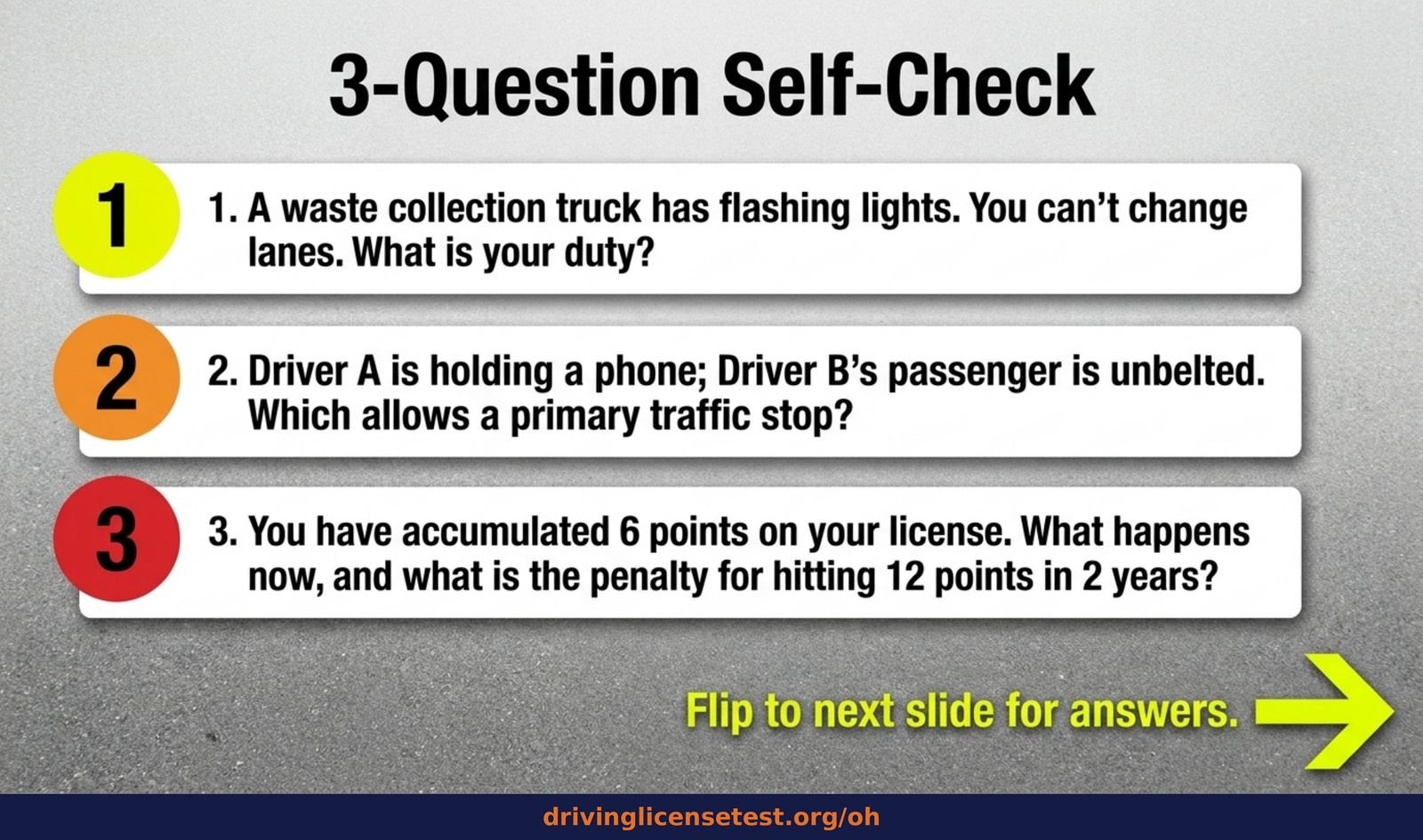
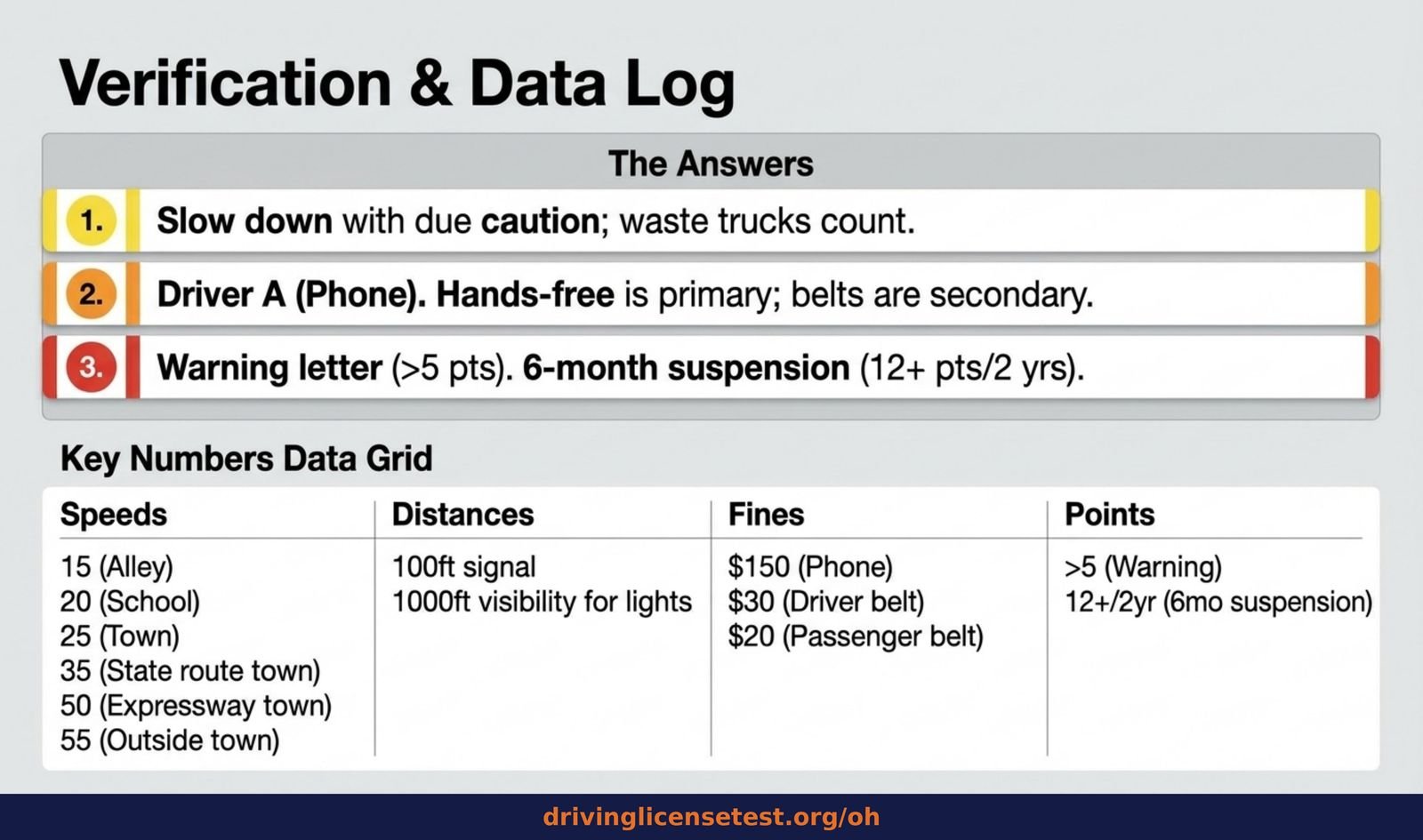
Take it with you: Download the deck as a PDF (7.8 MB) → — free to share.
Why this matters
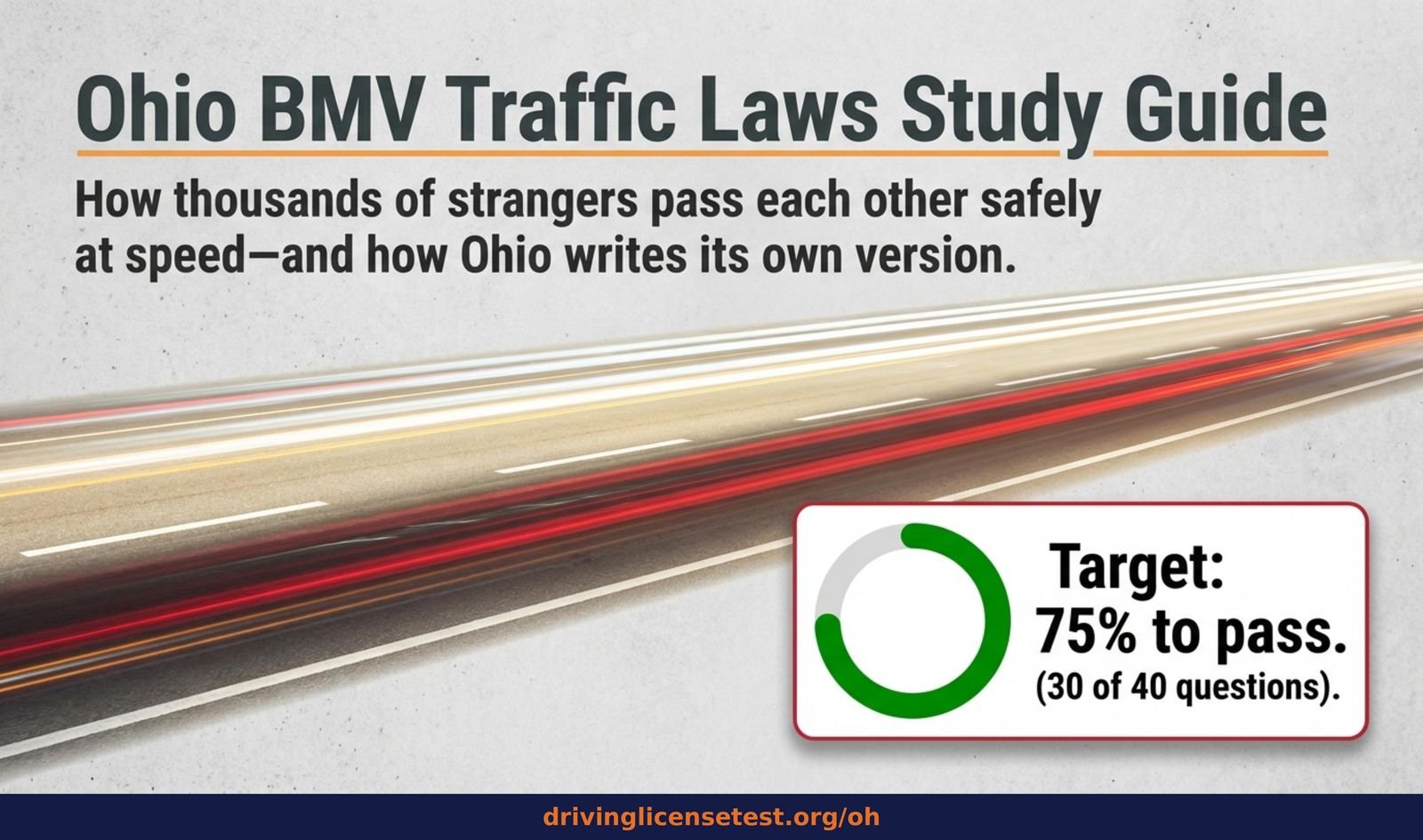
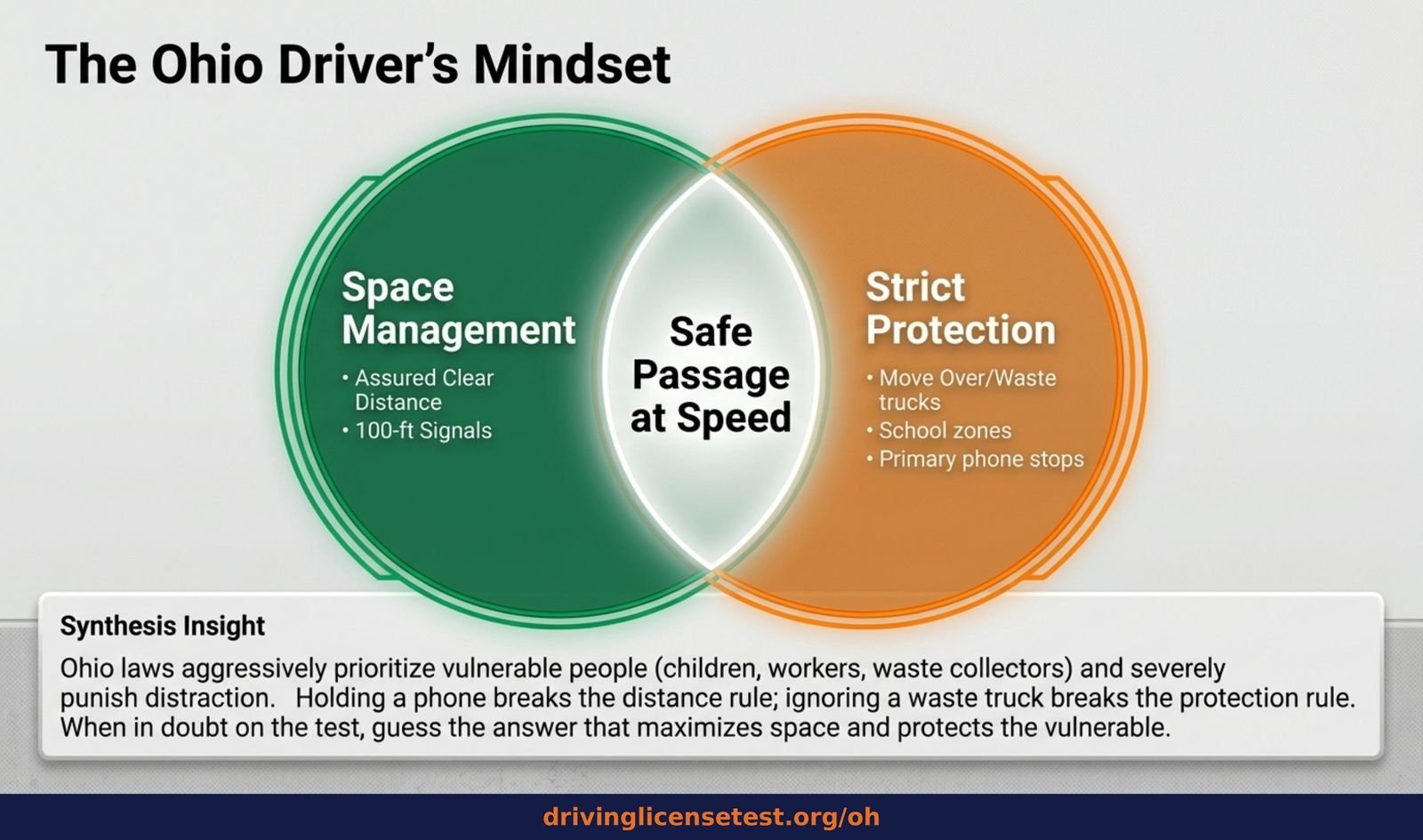
Traffic laws are how thousands of strangers pass each other safely at speed, and Ohio writes its own version. Its fingerprint: a speed system built around municipal corporations rather than neighborhoods, a 20 mph school-zone limit that turns on children’s movements rather than a clock, a Move Over law protecting a waste collection truck as fully as a patrol car, and an enforcement contrast the test loves — holding a phone is a primary stop, a seat-belt violation secondary. Everything here comes from the Digest of Motor Vehicle Laws — the Ohio Driver Manual — and the Ohio Revised Code behind it. The real Ohio BMV knowledge test is 40 questions, 75% to pass — 30 of 40.
Part 1: The basic speed rule and Ohio speed limits
Every Ohio speed question starts with one rule above all the numbers. Under the basic speed rule, no person shall drive at a speed greater or less than is reasonable and proper under the conditions, having due regard to traffic, the surface and width of the street or highway, and any other conditions then existing. Your speed must be controlled so you can stop within the assured clear distance ahead — learn that phrase word for word. If fog, rain, or a curve means you could not stop inside the distance you can see to be clear, you are too fast, even under the posted limit: a limit is a ceiling for good conditions, not a promise.
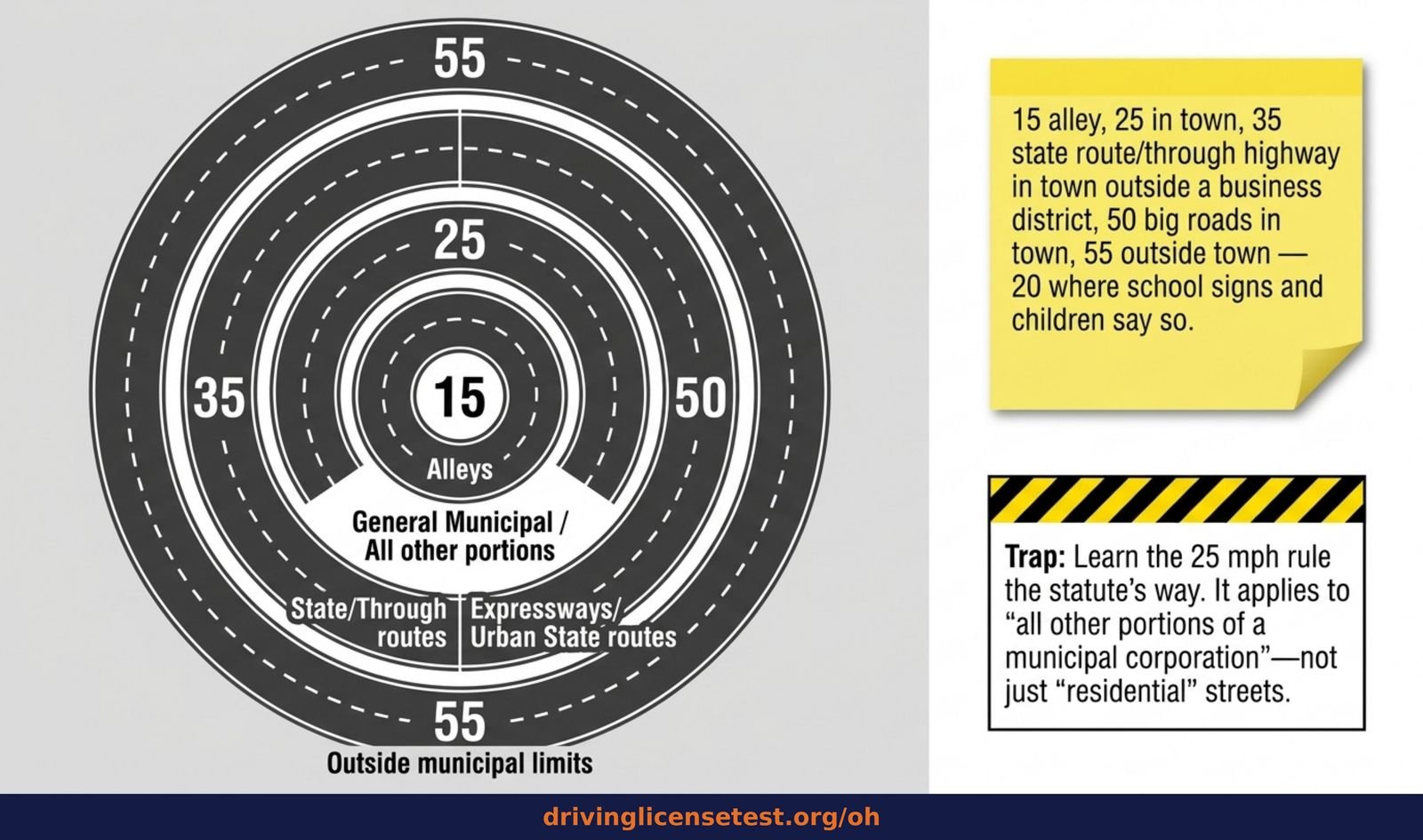
Where no different limit is posted, Ohio’s statutory limits apply — organized by municipal corporations (cities and villages) and by the kind of road you are on.
| Where | Limit |
|---|---|
| School zones, where 20-mph signs are erected and the Part 2 conditions are met | 20 mph |
| All other portions of a municipal corporation, with the exceptions below | 25 mph |
| State routes and through highways within a municipal corporation, outside business districts | 35 mph |
| Controlled-access highways and expressways within a municipal corporation | 50 mph |
| State routes within a municipal corporation, outside urban districts | 50 mph |
| Highways outside municipal corporations | 55 mph |
| Alleys within a municipal corporation | 15 mph |
Memory aid: 15 alley, 25 in town, 35 state route/through highway in town outside a business district, 50 big roads in town, 55 outside town — 20 where school signs and children say so.
Trap — learn the 25 mph rule the statute’s way. Many prep materials shorten it to a “residential” limit; Ohio’s statute does not. The 25 mph limit applies in all other portions of a municipal corporation, except the state routes, through highways, and alleys carved out separately. An answer giving 25 mph because you are inside a municipal corporation is the reasoning Ohio wants.
Work the table with two questions. First: inside or outside a municipal corporation? Outside, the general highway limit is 55 mph. Second, if inside: what kind of road? Alley 15, state route or through highway outside a business district 35, controlled-access or state route outside an urban district 50, everything else 25.
Check yourself: Inside a municipal corporation on an ordinary street — not a state route, through highway, or alley — with no limit posted: what is your limit, and is the reason the houses, or the municipal corporation itself?
Part 2: School zones — 20 mph, and no clock hours
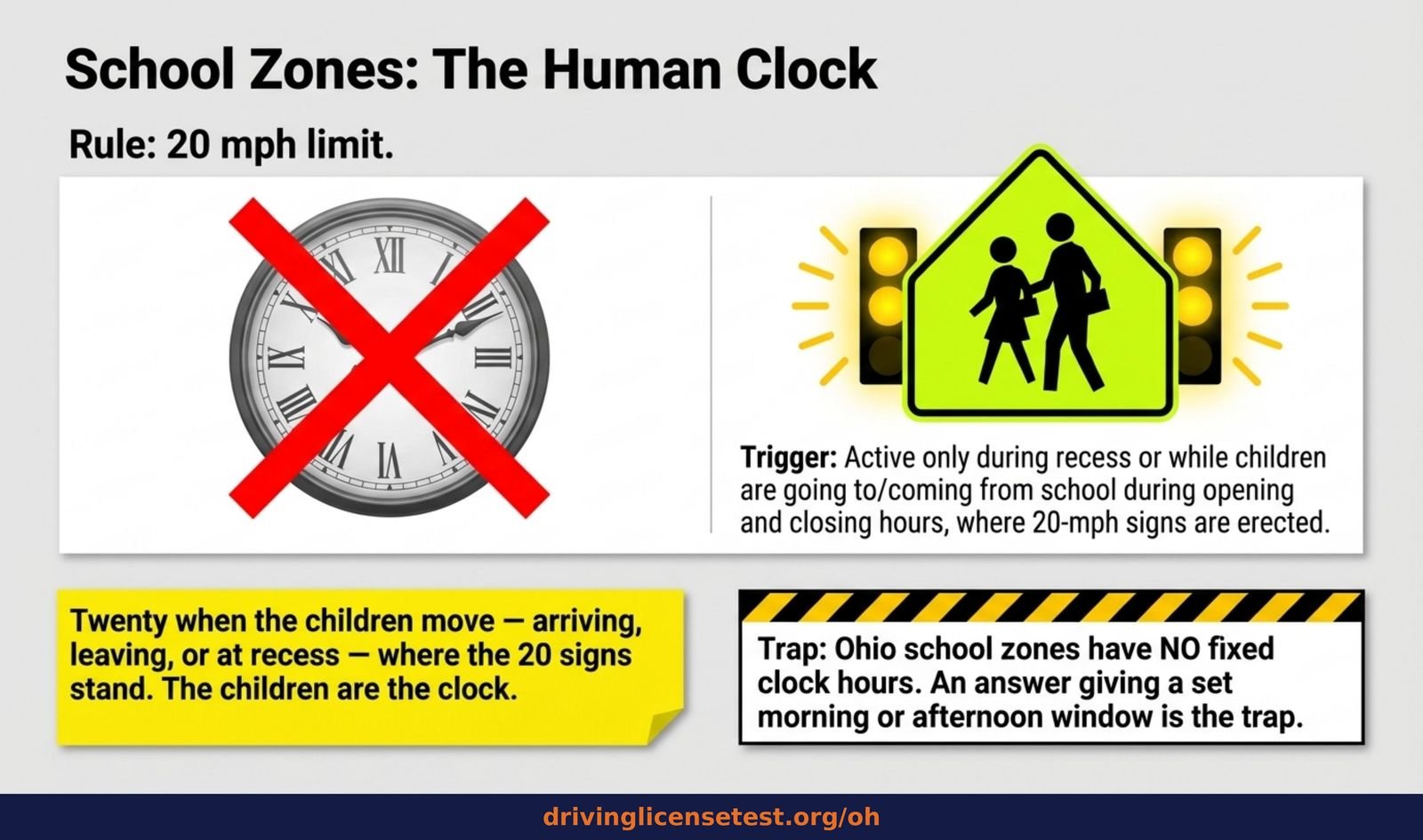
Ohio’s school-zone speed limit is 20 mph. It applies during school recess and while children are going to or coming from school during the opening and closing hours, where 20-mph school speed limit signs are erected — the trigger is what children are doing: arriving, leaving, or out at recess.
Trap — Ohio school zones have NO fixed clock hours. The statute fixes no starting or ending times; an answer giving a set morning or afternoon window is the trap. The trigger is always: recess, or children going to or coming from school at opening or closing hours, where the 20-mph signs are erected. A school building alone does not put the limit in force.
Memory aid: Twenty when the children move — arriving, leaving, or at recess — where the 20 signs stand. The children are the clock.
When the limit is in force, hold 20 mph, scan driveways, parked cars, and crosswalks, and be ready to stop within the assured clear distance from Part 1 — children are smaller, harder to see, and less predictable than adults. Otherwise the ordinary limit for that road applies.
Check yourself: A classmate says the 20 mph school-zone limit runs during set morning and afternoon clock hours. What is wrong with that claim — and what conditions actually put the limit in force?
Part 3: Move Over — protect the people on the shoulder
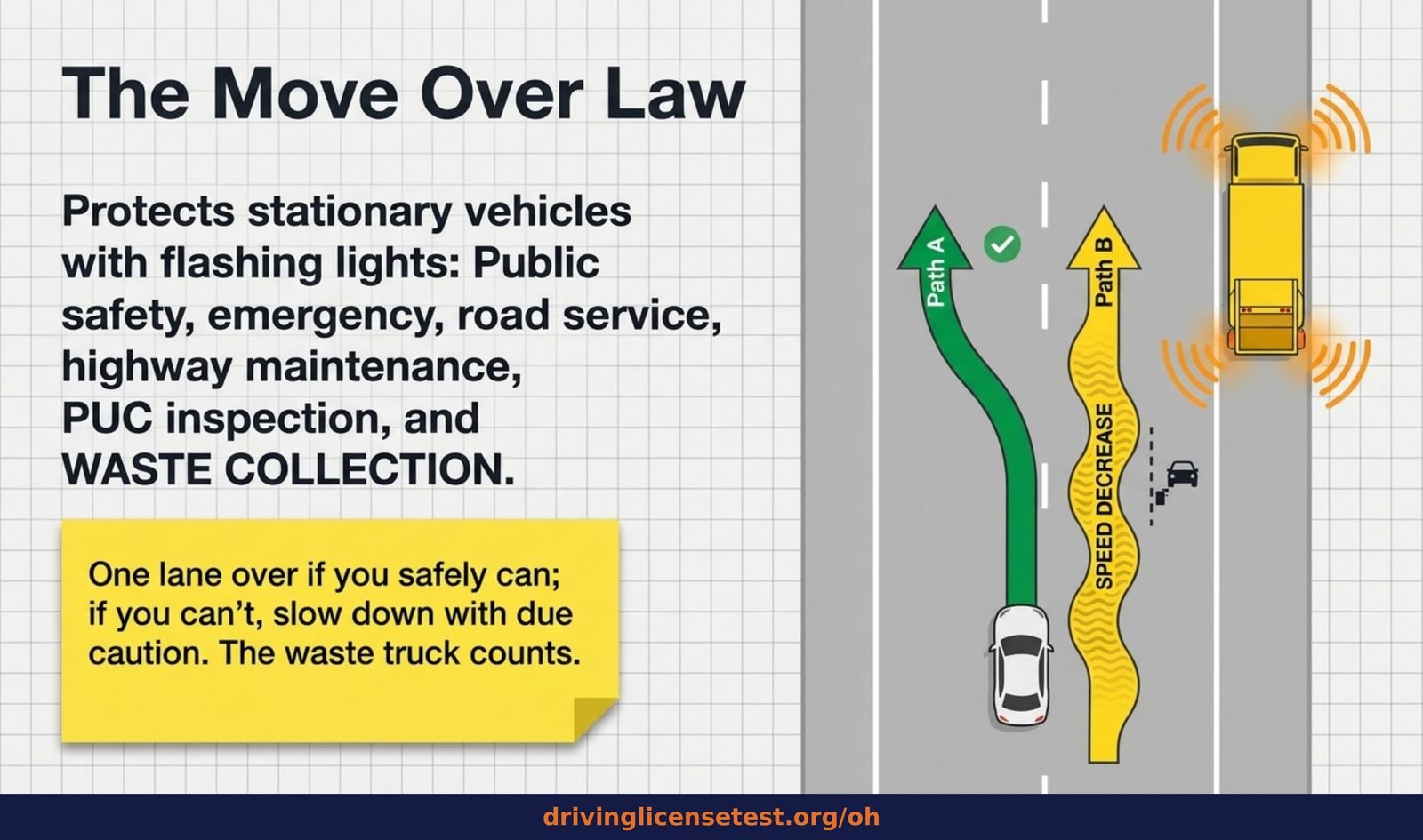
Ohio’s Move Over law applies when you approach certain stationary vehicles displaying flashing, oscillating, or rotating lights. The protected list is wider than most learners expect: public safety, emergency, road service, waste collection, Public Utilities Commission motor vehicle-inspection, and highway maintenance vehicles.
Trap — Move Over covers waste collection trucks, not just police. A question limiting this law to law-enforcement or emergency vehicles is too narrow; a waste collection vehicle — or a Public Utilities Commission inspection vehicle — with flashing lights is covered.
Your duty comes in two steps, in this order:
- Change lanes if you can: on a highway with at least two lanes in the same direction, proceed with due caution and, if possible with due regard to road, weather, and traffic conditions, change into a lane not adjacent to the vehicle; or
- Slow down if you cannot: proceed with due caution, reduce speed, and maintain a safe speed for the conditions.
Notice what Ohio’s rule does not do: it names no set number of miles per hour to slow by. The fallback is a standard, not a figure — do not import a number from another state’s law. A violation is a minor misdemeanor, with enhanced degrees for offenders with prior predicate traffic convictions.
Memory aid: One lane over if you safely can; if you can’t, slow down with due caution. The waste truck counts.
Check yourself: On a highway with two lanes in your direction, a stationary waste collection vehicle displays flashing lights, but traffic beside you makes a lane change impossible. Does the law protect that vehicle — and if so, what must you do instead?
Part 4: Hands-free — Ohio’s distracted driving law
Ohio’s hands-free law states its core rule in one sentence: no person shall operate a motor vehicle while using, holding, or physically supporting with any part of the body an electronic wireless communications device. Holding is the violation — hand, lap, or braced against the wheel — whether or not you are typing or reading.
The statute lists exceptions, in summary: contacting emergency services; a public-safety driver acting in the course of duty; use while stationary outside a lane of travel, stopped at a red traffic signal, or parked for an emergency or a road closure; holding the device to the ear for a voice call without manually entering letters, numbers, or symbols; speakerphone use without holding the device; navigation use without holding the device and without manual entry; a single touch or single swipe without holding the device or manual entry; and factory-integrated vehicle technology under the same conditions. The pattern is hands off: set navigation before you move.
Enforcement is PRIMARY — the classic contrast. An officer may stop a driver for this violation only when the officer visually observes the operator using, holding, or physically supporting the device; no other offense has to happen first. Yet the officer may not search, access, or confiscate the device without a warrant or the driver’s voluntary, unequivocal consent: the stop is primary; the phone is still private.
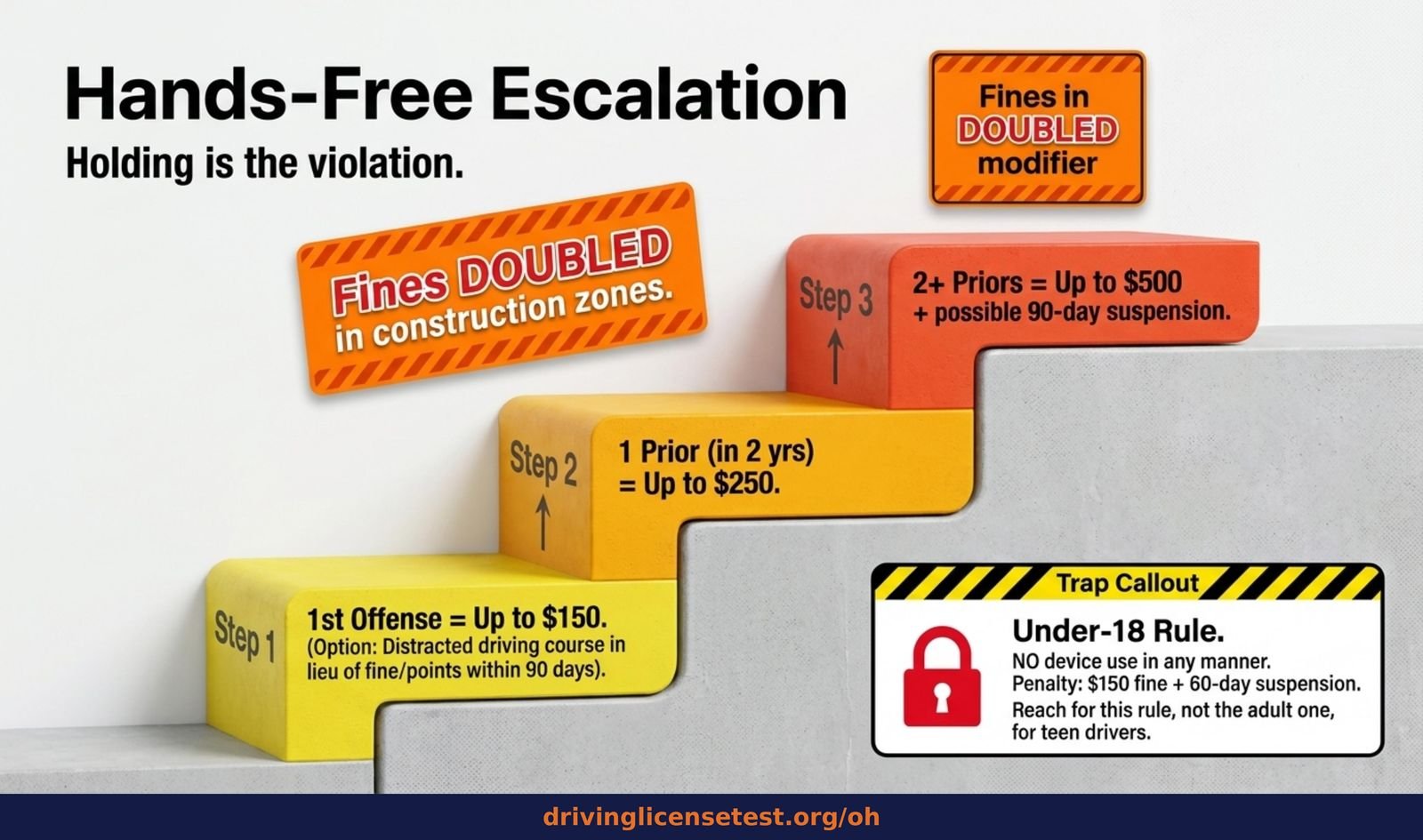
Penalties climb with priors. A violation is an unclassified misdemeanor: up to $150 for a first offense; up to $250 with one prior conviction within two years; up to $500 plus a possible 90-day license suspension with two or more priors within two years. Fines are doubled in a posted construction zone. A first offender with no prior may elect a distracted driving safety course in lieu of the fine and points, completed and evidence filed with the court within 90 days.
Memory aid: 150, 250, 500 and maybe 90 days off the road — doubled in construction zones; a first offender can trade fine and points for a course finished within 90 days.
Drivers under 18 get a stricter rule. No Temporary Instruction Permit Identification Card (TIPIC) holder under 18 and no probationary license holder may drive while using in any manner an electronic wireless communications device — broader than the adult holding ban. Penalty: a $150 fine plus a 60-day license or permit suspension. For a driver under 18, reach for this rule, not the adult one.
Check yourself: An officer watches a driver holding a phone against the steering wheel, with no other violation in sight. Can the officer stop the car on that observation alone — and what may the officer not do with the phone at that stop?
Part 5: Seat belts and child restraints
Ohio requires the driver and every front-seat passenger to wear an occupant restraining device — a seat belt — and the driver must ensure subject passengers are belted. Buckle before you move, every trip; nothing substitutes for a belt worn properly.
Enforcement is SECONDARY — the other half of the classic contrast. No officer shall stop a vehicle for the sole purpose of determining whether a seat-belt violation has occurred. Learn the pairing as one unit: hands-free PRIMARY; seat belts SECONDARY — a test that swaps those words has changed the law. Fines: $30 for the driver, $20 for a front-seat passenger.
Memory aid: Phone in hand: they can stop you for that alone. Belt unbuckled: they cannot stop you for that alone. Driver 30, front passenger 20.
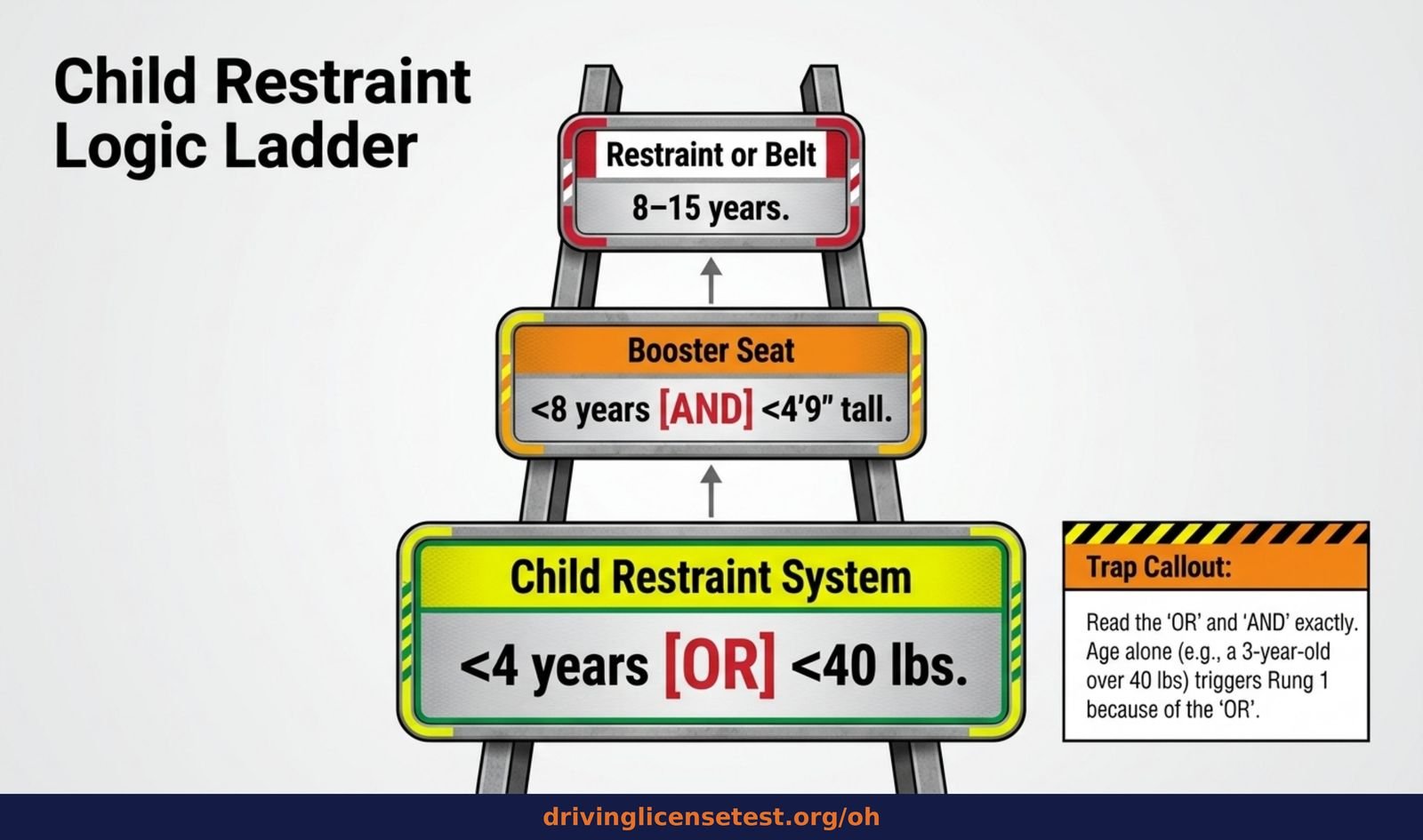
Children follow a ladder that turns on “or” versus “and” — read each rung exactly:
- Child restraint system: a child less than 4 years of age, OR weighing less than 40 pounds, must be transported in a child restraint system meeting federal motor vehicle safety standards. Either condition alone puts the child in this rung.
- Booster seat: a child less than 8 years of age AND less than 4 feet 9 inches tall, not already in a child restraint system, must be transported in a booster seat. Both conditions must be true.
- Restraint or belt: a child at least 8 years of age but not older than 15 must be transported in a child restraint system or an occupant restraining device — a seat belt.
Test the ladder: a 3-year-old over 40 pounds still belongs in a child restraint system, because the first rung uses “or” and age alone is enough. A 7-year-old who is 4 feet 10 inches tall does not meet the booster rung, because that rung uses “and” and the height condition fails.
Check yourself: One driver is stopped solely because an officer saw an unbelted front-seat passenger. Another is stopped solely because an officer saw the driver holding a phone. Which stop does Ohio law allow on that sole basis — and which does it forbid?
Part 6: Turn signals and headlights
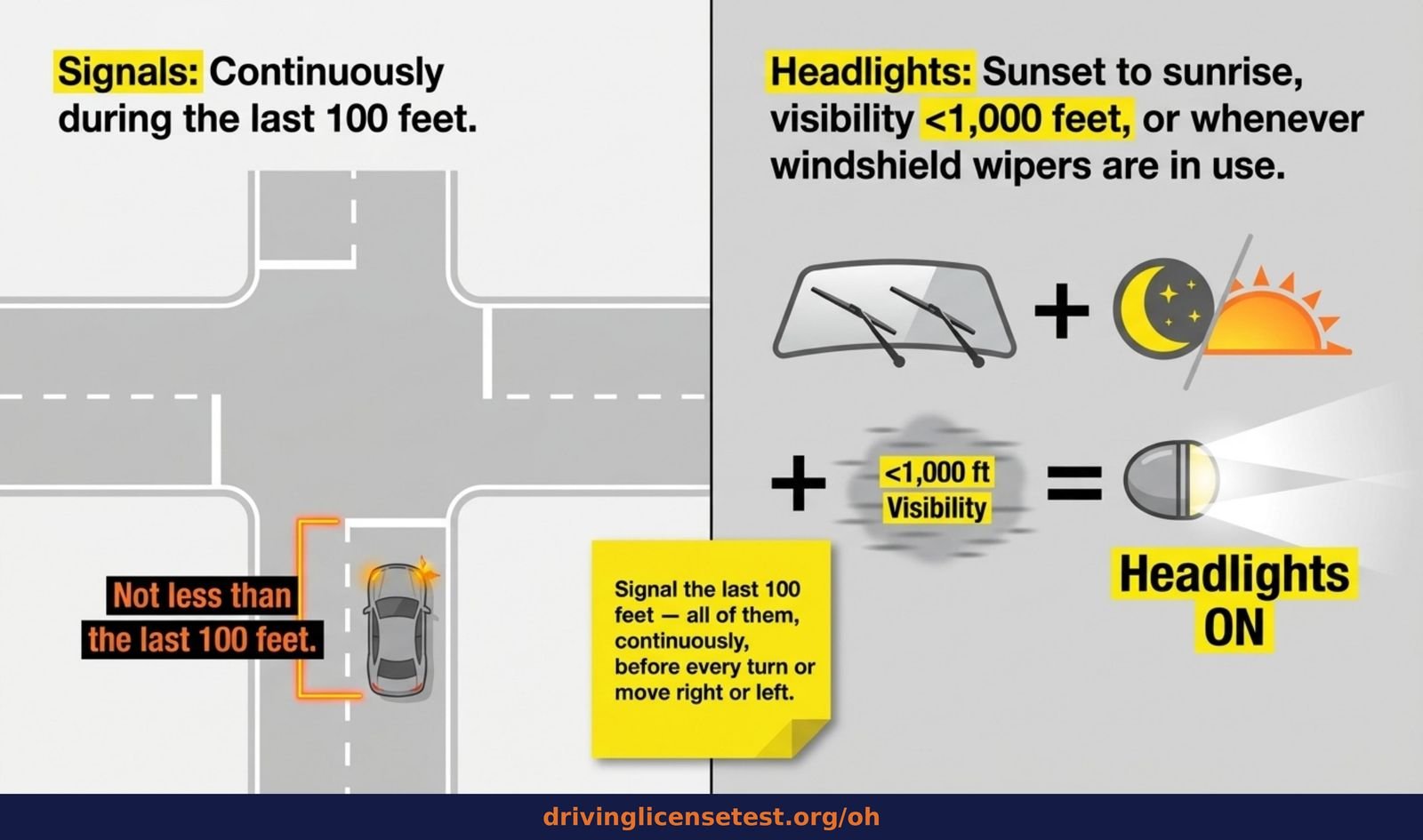
Two communication rules round out the traffic laws, both pure numbers. First, signals: a signal of intention to turn or move right or left must be given continuously during not less than the last 100 feet traveled before turning — a flash as you are already turning warns no one. Signaling announces a turn; it does not give you a right to turn.
Memory aid: Signal the last 100 feet — all of them, continuously, before every turn or move right or left.
Second, lights. Ohio requires lighted lights in three situations. One: from sunset to sunrise. Two: at any other time when, due to insufficient natural light or unfavorable atmospheric conditions, persons, vehicles, and substantial objects are not discernible at a distance of 1,000 feet ahead. Three: whenever the windshield wipers are in use because of precipitation on the windshield. Make the third a habit: wipers on, lights on — your lights are how everyone else discerns you.
Check yourself: Rain at midday, wipers running steadily, and a right turn in half a block: how long must your signal run, and what must be on besides your wipers?
Part 7: Obeying the road — signals, officers, and other drivers
The remaining questions test general duties consistent throughout the question bank: the road works because everyone follows the same instructions in the same order of priority.
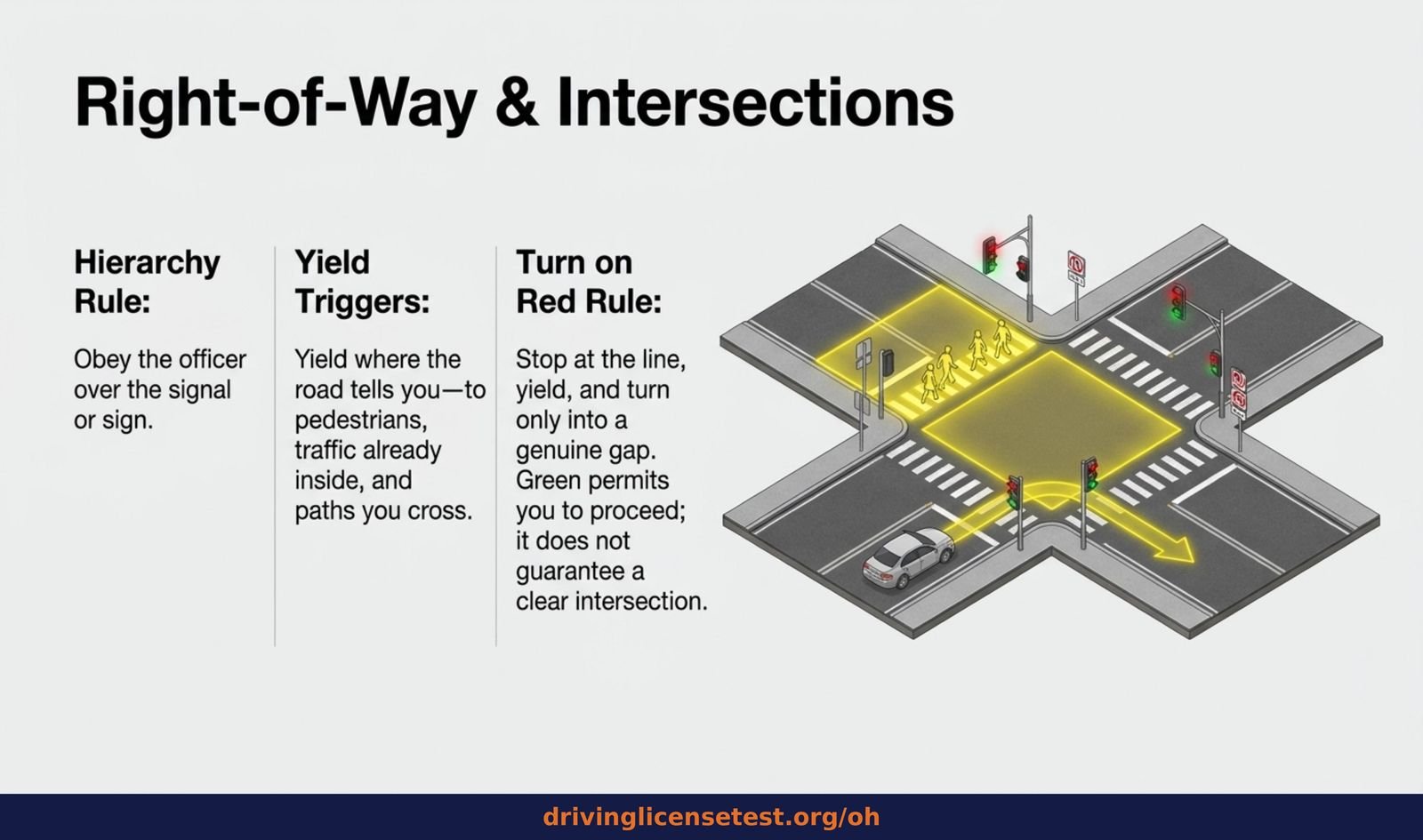
Obey the signal, and obey the officer above the signal. A steady red means stop; a flashing red is treated like a stop sign — stop, yield, proceed when safe. A flashing yellow means slow down and proceed with caution. If an officer is directing traffic, follow the officer even over a signal or sign — the officer sees the crash or closure the signal cannot. Stop at a clearly marked stop line; if there is none, before the near-side crosswalk; if there is no crosswalk, before the intersection.
Yield where the road tells you to yield — to pedestrians in crosswalks, traffic already in the intersection, and anyone whose path you cross when turning. Turning on red, where permitted and not prohibited, follows stop-sign discipline: stop, yield, turn only into a genuine gap. Green permits you to proceed; it does not guarantee the intersection is clear. Following too closely destroys the assured clear distance Part 1 requires — keep a gap, check blind spots, and pass only where legal with a clear view ahead.
Ohio points, in brief
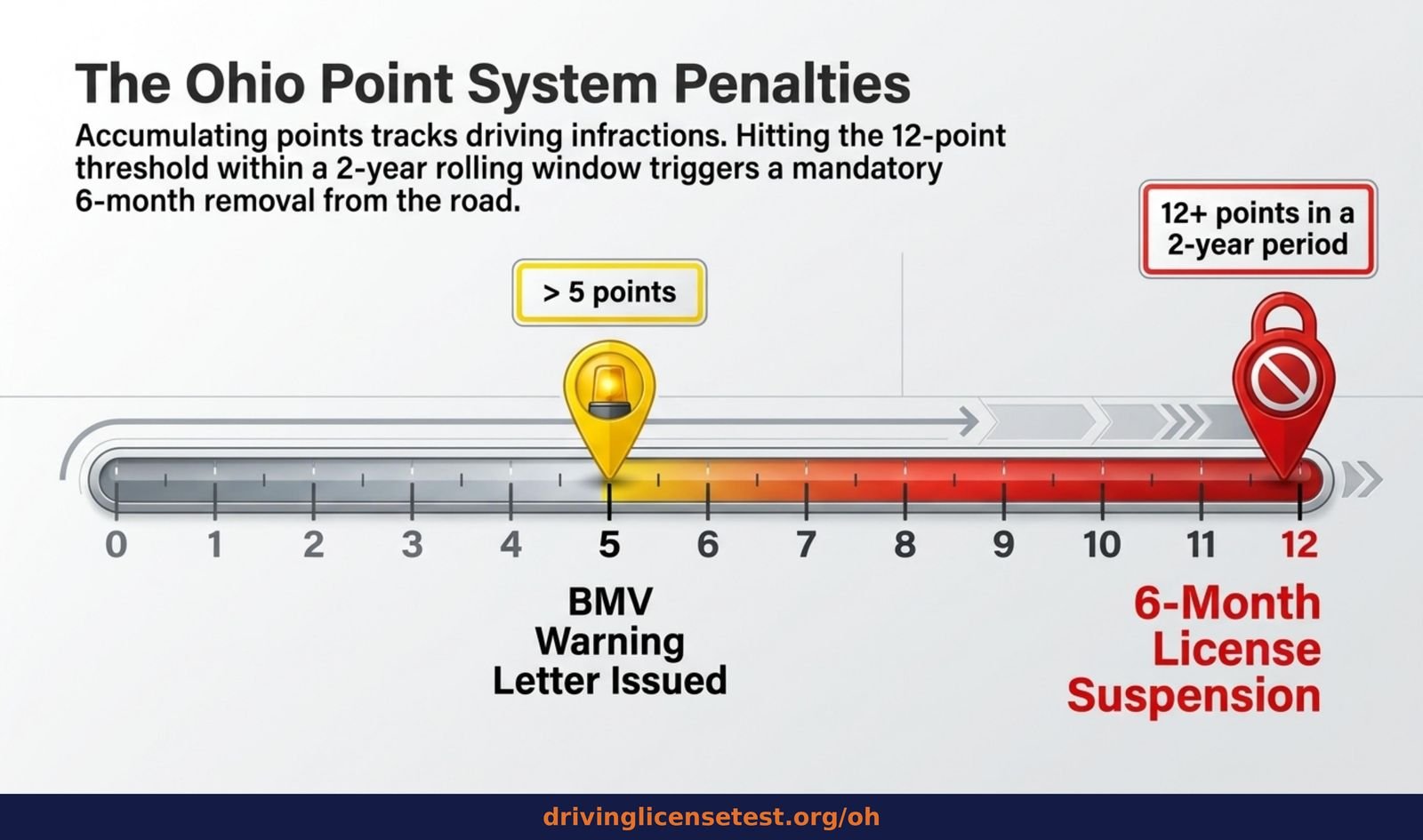
Most moving violations add points to your Ohio driving record, and two thresholds matter most. When your total goes above 5 points, the BMV mails you a warning letter. Reach 12 or more points within two years and your license is suspended for six months. Points are covered in full in the Licensing & Registration guide.
Key numbers to memorize
| Fact | Remember |
|---|---|
| Basic speed rule | Reasonable and proper for the conditions — stop within the assured clear distance ahead |
| Speed limits: municipal corporation generally · state routes/through highways in town, outside business districts · controlled-access/expressways in town · state routes in town, outside urban districts · highways outside municipal corporations · alleys | 25 mph · 35 mph · 50 mph · 50 mph · 55 mph · 15 mph |
| School zones | 20 mph — during recess and while children are going to/coming from school at opening/closing hours, where 20-mph signs are erected; NO fixed clock hours |
| Move Over — covered vehicles | Stationary public safety, emergency, road service, WASTE COLLECTION, Public Utilities Commission inspection, and highway maintenance vehicles with flashing lights |
| Move Over — your duty | On 2+ same-direction lanes, change to a non-adjacent lane if possible; otherwise due caution, reduce speed, keep a safe speed — violation: minor misdemeanor |
| Hands-free law (ORC 4511.204) | No using, holding, or physically supporting a device while operating; PRIMARY enforcement — officer must visually observe the use |
| Hands-free fines | Up to $150 first offense · up to $250 with one prior within 2 years · up to $500 plus possible 90-day suspension with 2+ priors within 2 years · doubled in a posted construction zone |
| Hands-free safety course option | First offender with no prior may elect the course in lieu of fine and points — completed and evidence filed within 90 days |
| Under-18 device rule | TIPIC and probationary drivers: NO device use in any manner — $150 fine plus 60-day suspension |
| Seat belts | Driver and every front-seat passenger; SECONDARY enforcement — no stop solely for belts; fines $30 driver / $20 front-seat passenger |
| Child restraints | Under 4 years OR under 40 pounds: child restraint system · under 8 years AND under 4 ft 9 in: booster seat · ages 8–15: child restraint system or seat belt |
| Turn signals | Continuously during at least the last 100 feet before turning |
| Headlights | Sunset to sunrise · when persons and vehicles are not discernible at 1,000 feet · whenever wipers are in use |
| Real Ohio BMV knowledge test | 40 questions — 75% to pass (30 of 40) |
5-question self-check
- Inside a municipal corporation on an ordinary street, then on a state route outside a business district, then on a highway outside any municipal corporation — no limits posted. What limit applies in each place?
- School signs are erected. A friend says the 20 mph limit runs only during fixed clock hours. Is your friend right? When does the limit actually apply?
- A stationary waste collection vehicle displays flashing lights on a two-lane-in-your-direction highway, and you cannot change lanes safely. What must you do, what offense is a violation, and why does that vehicle count?
- Driver A is stopped solely because an officer visually observed A holding a phone. Driver B is stopped solely because B’s front-seat passenger was unbelted. Which stop is allowed, and what fines apply in each situation?
- A child is 3 years old and 42 pounds. Another is 7 years old and 4 feet 8 inches tall. A third is 10. What restraint does Ohio require for each?
Answer key
- 25 mph inside the municipal corporation — framed by the municipal corporation, not by whether the street is residential. 35 mph on the state route in town outside a business district. 55 mph outside municipal corporations. Everywhere, the basic speed rule still caps you at a speed reasonable and proper, slow enough to stop within the assured clear distance ahead.
- No. The statute fixes no clock hours. The 20 mph limit applies during school recess and while children are going to or coming from school during opening and closing hours, where 20-mph signs are erected — the children’s movement plus the signs, not the clock.
- Proceed with due caution, reduce speed, and maintain a safe speed for the conditions — the lane change is required only if possible. A violation is a minor misdemeanor. The vehicle counts because Move Over expressly covers waste collection vehicles with flashing, oscillating, or rotating lights, not just police.
- Driver A’s stop is allowed: hands-free enforcement is primary, on the officer’s visual observation alone; a first offense is up to $150, rising to $250 with one prior within two years and $500 plus a possible 90-day suspension with two or more priors, doubled in a posted construction zone. Driver B’s stop is not allowed on that sole basis: seat-belt enforcement is secondary. Belt fines: $30 driver, $20 front-seat passenger.
- The 3-year-old: a child restraint system — under 4 years OR under 40 pounds, so age alone qualifies even at 42 pounds. The 7-year-old: a booster seat — under 8 years AND under 4 feet 9 inches, both met. The 10-year-old: a child restraint system or a seat belt (ages 8–15).
Keep practicing
- Take the Traffic Laws practice quiz
- Flip through the Traffic Laws flashcards
- Ready for the whole test? Take the full Ohio practice test
More study guides: Signs & Signals Study Guide · Right of Way Study Guide · Safe Driving Study Guide · Alcohol, Drugs & Driving Conditions Study Guide · Licensing & Registration Study Guide