
Your complete Ohio study guide — plain language, no jargon.
📘 Prefer pictures? Flip through the visual deck
This whole guide as 10 slides — swipe or scroll sideways through them. Ohio’s OVI tiers, penalties, points and fees, in pictures.




Take it with you: Download the deck as a PDF (4.8 MB) → — free to share.
Why this matters
Ohio’s impaired-driving law is built on exact numbers — 0.02, 0.08, 0.17, three days, ten days, twenty days, three months, one year — and the Ohio BMV tests them closely. The real knowledge test, drawn from the Digest of Motor Vehicle Laws (the Ohio Driver Manual), is 40 questions, and you must answer 75% correctly to pass — 30 of 40. In Ohio the offense is OVI — operating a vehicle under the influence — and this guide covers what alcohol and drugs do to a driver, the three blood-alcohol tiers, the penalties for a first and second OVI, implied consent, the administrative license suspension (ALS) that begins at the roadside, and the points and under-18 rules that follow you afterward.
Part 1: What alcohol does, and what counts as OVI
Alcohol harms both your driving skills and your judgment. It slows your reflexes and reaction time, distorts your judgment of speed and distance, and makes you less alert. Even the smallest amount of alcohol can limit your concentration, perception, judgment, and memory — the very abilities safe driving depends on. That is why drinking and driving is a serious traffic safety problem for every driver on the road, not only for the driver who drinks.
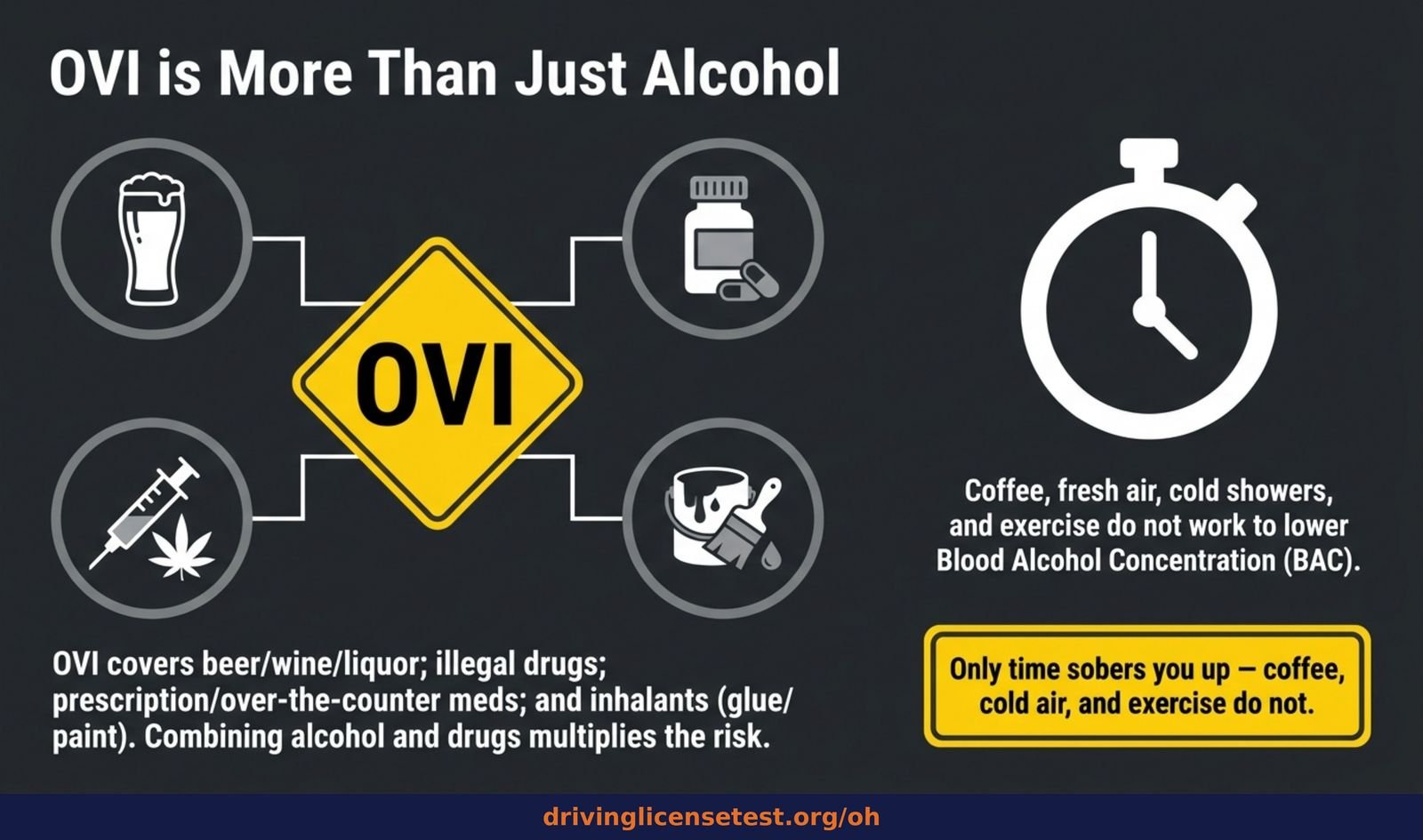
How strongly alcohol affects you is not the same for everyone. Your blood alcohol concentration (BAC) depends on factors such as your body weight, how much you drink, how quickly you drink, the amount of food in your stomach, and how much time passes between drinks. What never changes is the way out: only time reduces BAC. Coffee does not lower your BAC, and neither do a cold shower, exercise, or fresh air. Allow your body time to get rid of the alcohol — on average, the human body can dispose of the alcohol in 12 ounces of beer in about one hour.
Memory aid: Only time sobers you up — coffee, cold air, and exercise do not.
OVI is not only about alcohol, and it is not only about illegal drugs. Substances that may impair your ability to drive safely — and may result in an arrest for OVI — include beer, wine, and other liquor; controlled substances, such as illegal drugs or prescription medicines; and inhalants, such as glue or paint. Taking drugs along with alcohol increases the risk of causing a crash: the combination can increase or multiply the effects of both the alcohol and the medicine. A driver taking a prescription or over-the-counter drug should read the labels before driving, and a medicine that warns it causes drowsiness calls for learning its effects and avoiding driving if impaired. Your ability to drive can also be impaired by medication and by a lack of sleep, even with no alcohol involved.
Check yourself: A driver drinks coffee and takes a cold shower after drinking and says he is now safe to drive. What is wrong with that plan — and what is the only thing that actually reduces BAC?
Part 2: The three BAC tiers — 0.02, 0.08, and 0.17
Ohio law sorts alcohol test results into three tiers, and each tier belongs to a different offense or penalty level. Mixing them up is the single most common trap in this topic, so learn them as a set.
- 0.02 — OVUAC, the under-21 offense. For drivers under 21, the separate offense is OVUAC — operating a vehicle after underage alcohol consumption. It applies at a whole-blood alcohol concentration of at least 0.02% but less than 0.08%. This is not a “warning zone” and it is not a lesser version of the adult limit — it is a complete offense of its own, built for underage drivers.
- 0.08 — the adult per-se limit for OVI. For an adult, the per-se range for OVI begins at a whole-blood alcohol concentration of 0.08% or more but less than 0.17%. The breath equivalent is 0.08 grams per 210 liters of breath. “Per se” means the number itself establishes the violation — at 0.08 or more, it is illegal to drive.
- 0.17 — the high-test tier. A whole-blood alcohol concentration of 0.17% or more (breath equivalent 0.17 grams per 210 liters) places the driver in the “high test” tier, which carries enhanced penalties. Put plainly: 0.17 is a little more than double the 0.08 per-se limit, and Ohio doubles down on the punishment to match.
Memory aid: 0.02 is under-21, 0.08 is over the line, 0.17 is high test. Three numbers, three different legal consequences.
Trap: do not assign the tiers to the wrong driver. A result of 0.02 does not put an adult over the per-se limit, and an under-21 driver does not need to reach 0.08 to commit an offense — for that driver, the offense already begins at 0.02. Likewise, do not treat 0.17 as a separate crime with its own name: it is the high-test level of OVI, and its effect is to raise the penalties for the OVI itself.
Check yourself: Three drivers test at 0.03 (age 19), 0.10 (age 30), and 0.19 (age 45). Name the offense or tier for each driver, in order.
Part 3: A first OVI — low test versus high test
A first OVI offense with a low test — that is, in the 0.08 to under-0.17 range — is a first-degree misdemeanor. It carries a mandatory jail term of three consecutive days (72 hours). The court may suspend that mandatory jail term in favor of three consecutive days in a certified drivers’ intervention program. The total jail exposure for a first low-test OVI is up to six months. The fine is not less than $565 and not more than $1,075, and the license suspension is one to three years.
Memory aid: First OVI, low test — 3 days, $565 to $1,075, 1 to 3 years.
A first OVI offense with a high test — 0.17 or more — or a first offense charged under the refusal provision described in Part 5, is punished more heavily, and the rule has moving parts you must teach yourself in full. The sentence is at least three consecutive days in jail PLUS a three-day drivers’ intervention program — jail and the program, not one or the other. The alternative is at least six consecutive days in jail, and that alternative applies where the program is refused, where attending the program is not conducive for the offender, or where the program is provided by the jail. Do not shorten this to “six days instead” without the conditions — the test can probe exactly those conditions.
Memory aid: High test on a first OVI — 3 days in jail plus 3 days in the program, or 6 days in jail.
One currency warning belongs here. Ohio’s OVI penalties were updated in the law effective April 9, 2025, and the current minimum fine for a first OVI is $565. If you see an older source quoting a lower minimum fine for a first Ohio OVI, that figure is stale — the current minimum is $565.
| First OVI | Mandatory jail / program | Fine | License suspension |
|---|---|---|---|
| Low test (0.08 to under 0.17) | 3 consecutive days (72 hours) in jail — the court may suspend it for 3 consecutive days in a certified drivers’ intervention program; up to 6 months total exposure | $565–$1,075 | 1–3 years |
| High test (0.17+) or refusal provision | At least 3 consecutive days in jail PLUS a 3-day drivers’ intervention program, OR at least 6 consecutive days in jail where the program is refused, not conducive, or provided by the jail | — | — |
Check yourself: State the mandatory jail term, fine range, and license suspension for a first low-test OVI — then explain exactly how the mandatory sentence changes on a high test.
Part 4: A second OVI within 10 years
A second OVI offense within 10 years raises every penalty, and the look-back window matters: it is the second offense within 10 years that triggers this level. The mandatory jail term is 10 consecutive days on a low test, and 20 consecutive days on a high test — the high-test number is exactly double the low-test number, just as 0.17 is roughly double 0.08. The fine is $715 to $1,625. The license suspension is one to seven years.
Memory aid: Second OVI in 10 years — 10 days low, 20 days high; $715 to $1,625; 1 to 7 years.
There is also a vehicle penalty. If the vehicle involved is registered to the offender, a second OVI within 10 years brings 90 days of vehicle immobilization and plate impoundment. Note the condition — the immobilization and plate impoundment apply when the vehicle is the offender’s own vehicle.
Check yourself: A driver is convicted of a second OVI within 10 years, with a high test, in his own car. State his mandatory jail term, fine range, license suspension, and vehicle penalty.
Part 5: Implied consent — the consent you gave by driving
Ohio’s implied consent law means the consent decision was made before any arrest ever happened. A person who operates, or is in physical control of, a vehicle is deemed to have consented to chemical tests if arrested for OVI, OVUAC, or physical control. The tests covered are tests of blood, blood serum or plasma, breath, oral fluid, or urine. In short: by driving in Ohio, you have already agreed to be tested if you are arrested for an impaired-driving offense.
Refusing the test after arrest does not make the problem go away, and it can create a second problem of its own. A driver who, having been arrested for OVI and advised of the refusal consequences, refuses a chemical test is guilty of a separate offense if the driver has a prior OVI conviction within 20 years. Note both conditions: the separate criminal refusal offense requires that prior conviction within 20 years, and it sits on top of the administrative suspension that every refusal triggers, which is covered in Part 6. This is also why a high-test first offense and a refusal-provision first offense share the enhanced mandatory sentence in Part 3.
Trap: refusing the test never “beats” the charge. At best a refusal trades one set of consequences for a larger set — an immediate administrative suspension, and, with a prior OVI within 20 years, a separate criminal offense as well. There is no version of refusal that leaves the driver better off on paper.
Check yourself: Under implied consent, what has every Ohio driver already agreed to, what triggers it, and when does a refusal become a separate criminal offense?
Part 6: The ALS — you can lose your license before any conviction
The administrative license suspension (ALS) is separate from the criminal OVI case. It is imposed through the arrest process itself, and it comes in two very different sizes depending on what the driver did at the testing decision:
- Failed test: failing a chemical test — testing at or over the per-se limit — triggers an ALS of three months for a first failure, escalating to longer suspensions with priors within 10 years.
- Refusal: refusing a chemical test triggers an ALS of one year for a first refusal. With priors within 10 years, the refusal ALS rises to two years, three years, or five years for three or more priors.
Memory aid: Fail the test — 3 months. Refuse the test — 1 year. The refusal suspension is four times the failed-test suspension on a first offense.
Two timing rules make the ALS especially harsh, and both are favorite test material. First, the ALS takes effect immediately when the arresting officer serves the suspension notice — it does not wait for a court date or a conviction. Second, a later not-guilty finding on the underlying charge does not by itself undo the ALS. Trap: winning the criminal case does not automatically erase the administrative suspension; they are two separate tracks, and the not-guilty verdict alone leaves the ALS standing.
Getting a license back after an ALS or an OVI suspension also costs money. The reinstatement fee for an administrative license suspension (ALS) and for an OVI/Physical Control suspension is $315, for record or conviction dates on or after April 9, 2025. Learn that figure as $315 — it is the Ohio BMV’s published current fee.
Check yourself: One driver fails the test on a first offense; another refuses it. State each ALS, when each suspension begins, and what a not-guilty verdict later does — and does not — do to it.
Part 7: Points, young drivers, and staying out of trouble
An OVI conviction follows you on Ohio’s driver point system as well. OVI is assessed at six points — the highest single-offense value in the examples in this guide. OVUAC and reckless operation are each assessed at four points. Points matter because accumulating points moves a driver toward further suspension, so an OVI conviction costs points on top of its fine, jail term, and license suspension.
Memory aid: OVI — 6 points. OVUAC and reckless operation — 4 points.
Young drivers face an extra consequence outside the OVI penalty ladder. An alcohol-related conviction for a driver under 18 results in a license suspension of at least six months. Combined with the OVUAC tier in Part 2, the message for underage drivers is consistent: Ohio’s alcohol limits are lower for you, and the license consequences arrive sooner and last longer.
Finally, the safest material in this guide is also the simplest. Decide before you start drinking that you are not going to drive. Say “No thanks, I’m driving” if someone offers you a drink. Ride home with a friend who has not been drinking, or call a taxi. And learn to spot the impaired drivers around you: telltale signs include weaving between lanes, driving more slowly than the normal traffic flow, and making quick and sudden stops. A driver under the influence of alcohol is every driver’s problem, whether they drink or not.
Key numbers to memorize
| Fact | Remember |
|---|---|
| Real knowledge test | 40 questions · 75% to pass (30 of 40) |
| Under-21 offense — OVUAC | At least 0.02% but less than 0.08% |
| Adult per-se OVI limit | 0.08% or more but less than 0.17% · breath: 0.08 grams per 210 liters |
| High-test tier | 0.17% or more · breath: 0.17 grams per 210 liters · enhanced penalties |
| First OVI, low test | First-degree misdemeanor · 3 consecutive days (72 hours) jail, which the court may suspend for 3 days in a certified drivers’ intervention program · up to 6 months total · $565–$1,075 · suspension 1–3 years |
| First OVI, high test / refusal provision | At least 3 consecutive days in jail PLUS a 3-day drivers’ intervention program, OR at least 6 consecutive days in jail where the program is refused, not conducive, or provided by the jail |
| Second OVI within 10 years | 10 consecutive days jail (low test) / 20 consecutive days (high test) · $715–$1,625 · suspension 1–7 years · 90 days’ vehicle immobilization and plate impoundment if the vehicle is the offender’s |
| Refusal as a separate offense | Refusal after OVI arrest, after being advised of the consequences, with a prior OVI conviction within 20 years |
| Implied consent | Operating or being in physical control = deemed consent to blood, breath, oral fluid, or urine tests if arrested for OVI, OVUAC, or physical control |
| ALS — failed test | 3 months for a first failure · escalates with priors within 10 years |
| ALS — refusal | 1 year for a first refusal · 2, 3, or 5 years with priors within 10 years |
| ALS timing | Immediate when the officer serves notice · a later not-guilty finding does not by itself undo it |
| ALS / OVI reinstatement fee | $315 (record/conviction dates on or after 4/9/25) |
| Points | OVI: 6 points · OVUAC: 4 points · reckless operation: 4 points |
| Under-18 alcohol-related conviction | License suspension of at least 6 months |
| Current first-OVI minimum fine | $565 (law effective April 9, 2025 — older lower figures are stale) |
5-question self-check
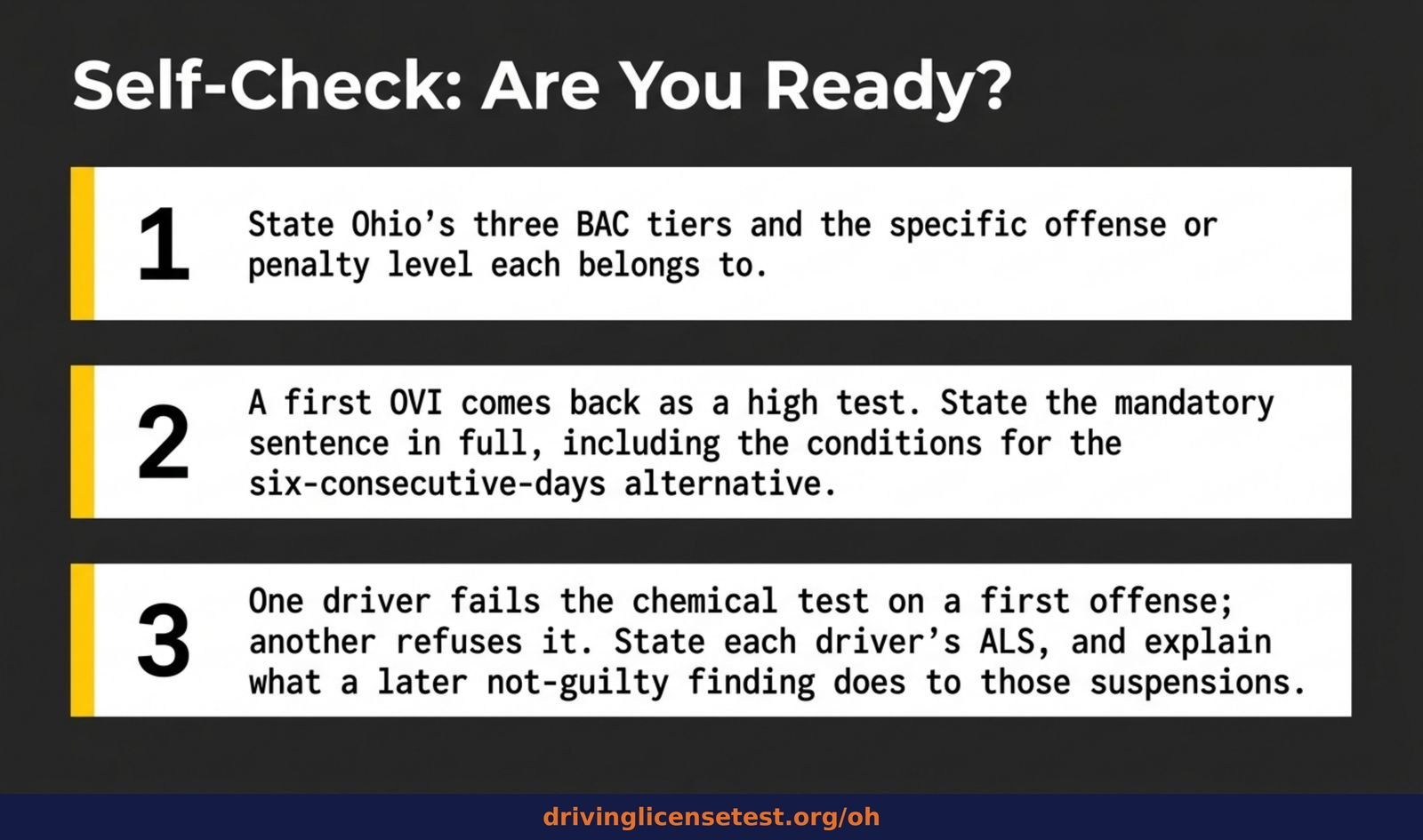
- State Ohio’s three BAC tiers — 0.02, 0.08, and 0.17 — and the offense or penalty level each one belongs to.
- State the mandatory jail term, fine range, and license suspension for a first OVI with a low test, and explain how a court can handle the mandatory jail term.
- A first OVI comes back as a high test. State the mandatory sentence in full, including the conditions under which the six-consecutive-days alternative applies.
- Two drivers are arrested for OVI on a first offense: one fails the chemical test and one refuses it. State each driver’s ALS, and explain what a later not-guilty finding does to those suspensions.
- How many points are assessed for an OVI conviction and for an OVUAC conviction, what is the ALS/OVI reinstatement fee, and what license consequence follows an alcohol-related conviction under age 18?
Answer key
- 0.02: OVUAC, the separate under-21 offense, applying at at least 0.02% but less than 0.08%. 0.08: the adult per-se OVI limit (breath equivalent 0.08 grams per 210 liters), applying from 0.08% to under 0.17%. 0.17: the high-test tier (0.17% or more), which carries enhanced OVI penalties.
- Mandatory jail term of three consecutive days (72 hours); fine of not less than $565 and not more than $1,075; license suspension of one to three years. The court may suspend the mandatory three-day jail term in favor of three consecutive days in a certified drivers’ intervention program. Total jail exposure is up to six months.
- At least three consecutive days in jail PLUS a three-day drivers’ intervention program — or at least six consecutive days in jail where the program is refused, is not conducive for the offender, or is provided by the jail.
- The driver who failed the test receives an ALS of three months for a first failure. The driver who refused receives an ALS of one year for a first refusal. Both suspensions take effect immediately when the arresting officer serves the suspension notice, and a later not-guilty finding on the underlying charge does not by itself undo either ALS.
- OVI: six points. OVUAC: four points (reckless operation is also four points). The ALS/OVI reinstatement fee is $315, for record or conviction dates on or after April 9, 2025. An alcohol-related conviction for a driver under 18 results in a license suspension of at least six months.
Keep practicing
- Take the Alcohol, Drugs & Driving Conditions practice quiz
- Review the Alcohol, Drugs & Driving Conditions flashcards
- Take the full practice test
More study guides: Signs & Signals Study Guide · Traffic Laws Study Guide · Right of Way Study Guide · Safe Driving Study Guide · Licensing & Registration Study Guide