
Your complete Ohio study guide — plain language, no jargon.
📘 Prefer pictures? Flip through the visual deck
This whole guide as 15 slides — swipe or scroll sideways through them. Space cushions, scanning, skids, hydroplaning, weather and crash duties, in pictures.





Take it with you: Download the deck as a PDF (7.1 MB) → — free to share.
Why this matters
Safe driving in Ohio starts with two ideas the Ohio BMV tests again and again: drive only as fast as conditions allow, and keep enough space and sight around your vehicle to stop in time. The Digest of Motor Vehicle Laws — the Ohio Driver Manual — returns to speed, headlights, following distance, and sharing the road in question after question, because most crashes trace back to going too fast for conditions, following too closely, or failing to see a hazard early. The real test is 40 questions, 75% to pass (30 of 40).
Part 1: Speed that fits what you can see — Ohio’s basic speed rule
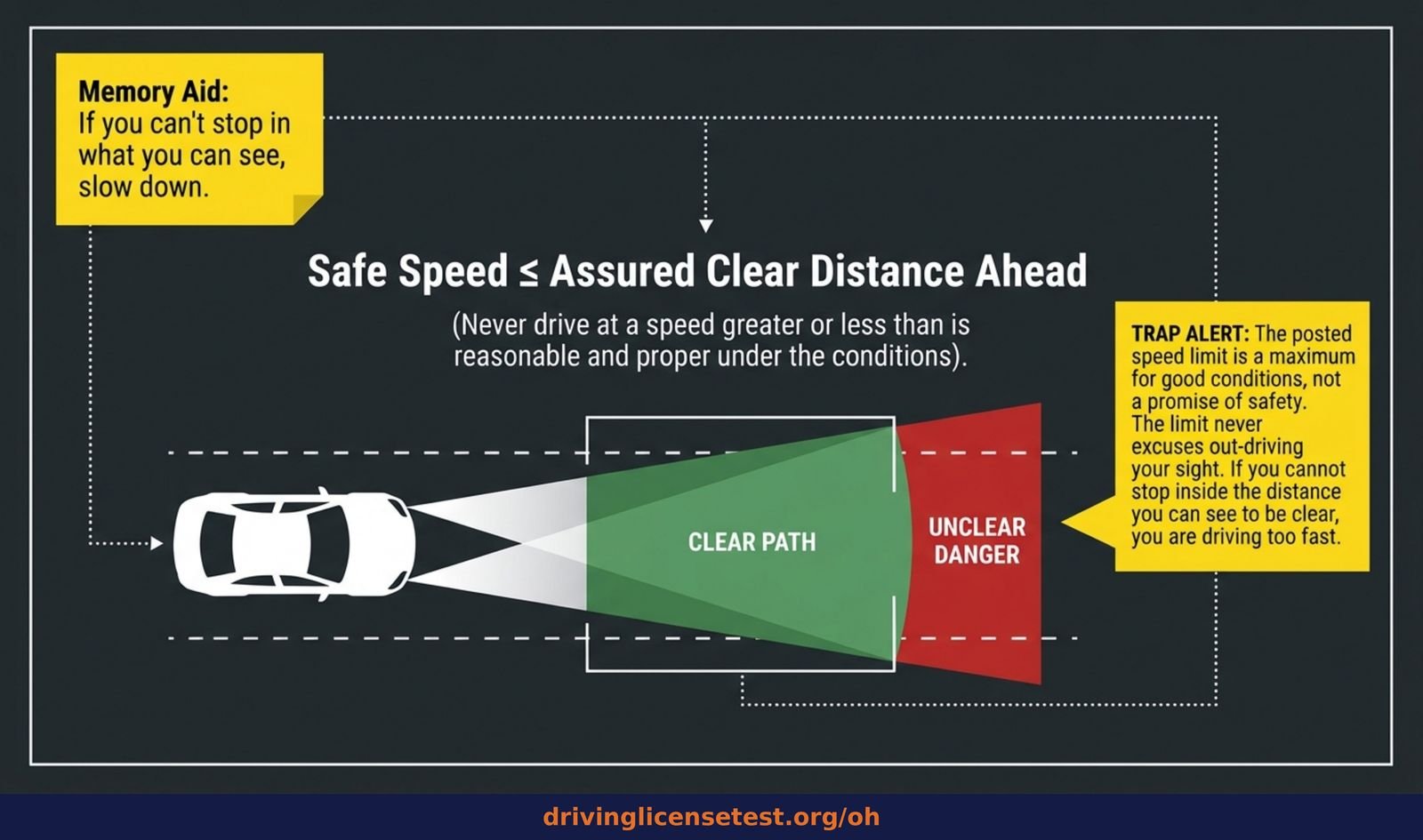
Ohio’s basic speed rule is simple to say and strict in practice: never drive at a speed greater or less than is reasonable and proper under the conditions, having due regard to traffic, the surface and width of the road, and any other condition present. Speed must be controlled so you can stop within the assured clear distance ahead — the stretch of road you can actually see to be clear.
That last phrase does most of the work. If rain, fog, darkness, a curve, or a hill shortens what you can see, your lawful speed falls with it, even if the posted limit has not changed. A posted limit is a maximum for good conditions, not a promise that the speed is safe right now. Driving too fast for conditions is one of the most common causes of crashes, and the bank tests it directly: when weather and traffic make the posted limit unsafe, the correct answer is a speed no greater than reasonable and proper — one that still lets you stop within the assured clear distance ahead.
Trap — the speed limit never excuses out-driving your sight: if you cannot stop inside the distance you can see to be clear, you are too fast, whatever the sign says. At night the same idea appears as driving within the range of your headlights. Slow down before curves, too — a moving vehicle tends to continue straight, and entering a curve too fast can break traction.
Memory aid: “If you can’t stop in what you can see, slow down.” Say both halves — reasonable and proper, stopped inside the clear distance ahead — whenever a speed question tempts you with the posted number.
Check yourself: The posted limit is 55, but rain has cut your view ahead sharply. What does Ohio’s basic speed rule require — and how does the assured clear distance ahead decide your speed?
Part 2: Following distance, scanning, and your space cushion
To prevent tailgating, the bank teaches the three-second rule: watch the vehicle ahead pass a fixed marker — a sign, a shadow, a pavement line — then count off three seconds. If you reach the same marker before you finish counting, you are following too closely and must ease back. Three seconds is the minimum for ordinary conditions. Increase your following distance whenever conditions worsen — on wet, icy, or slippery roads, in darkness or low visibility, and in any hazardous condition — because stopping takes longer. Follow too closely and you may not have time to stop if the vehicle in front of you slows or stops suddenly.
Following distance works because of what your eyes are doing further ahead. Look 10 to 15 seconds ahead — to where your vehicle will be in about 10 to 15 seconds — so you see hazards early instead of reacting at the last moment. Keep your eyes moving and continually scan the entire road and roadsides: ahead, next to, and behind your vehicle. Before changing lanes, passing, or turning, turn your head to check your blind spots, the areas mirrors cannot show. If you are in another driver’s blind spot, move forward or drop back so that driver can see you.
Put the pieces together as a space cushion on all sides of your vehicle. The benefit is time: if another driver makes a mistake, a cushion gives you time to react. Leave enough space ahead to allow for a sudden stop, allow a larger cushion when stopping on an upgrade, and make space for merging vehicles when it is safe. If another driver follows you too closely, stay in control and, when it is safe, move right or pull over and let the tailgater go by. If another driver cuts you off, let it go.
Memory aid: “Three seconds behind, ten to fifteen ahead.”
Check yourself: You reach the marker in under three seconds on a wet road at night. What two adjustments does the bank expect — one to your gap, and one to your speed?
Part 3: Headlights — see and be seen
Ohio requires lighted lights — your headlights — in three situations, and test questions rotate through all three. Headlights are required:
- From sunset to sunrise — the rule begins at sunset itself.
- At any other time when people, vehicles, and substantial objects on the highway are not discernible at a distance of 1,000 feet ahead, because of insufficient natural light or unfavorable atmospheric conditions.
- Whenever the windshield wipers are in use because of precipitation on the windshield.
Trap — the wipers trigger is the one drivers forget: headlights are required whenever the wipers are on due to precipitation — even at midday, even if you can still see well enough. Wipers on, lights on. Headlights also help other drivers see you. Parking lights are not a substitute while driving.
Choose the right beam once your lights are on. In fog, use low beam headlights — high beams reflect back off fog, rain, and snow and make visibility worse. When meeting a vehicle at night, use low beams, and if an oncoming driver fails to dim blinding headlights, look toward the right edge of your lane instead of staring into the glare. If you must stop along the road at night, turn on your emergency flashers and leave your low beams on. And remember Part 1: at night, drive within the range of your headlights.
Memory aid: “Sunset, sight, and swipes.” Sunset to sunrise; not discernible at 1,000 feet; wipers swiping due to precipitation.
Check yourself: Name all three Ohio headlight triggers. Then explain why a bright midday rainstorm still requires headlights, and which beam you would use if fog rolls in.
Part 4: Large trucks, motorcycles, and bicycles
Large trucks need more of everything: more stopping distance, more turning room, and more patience from you. In general, trucks take longer distances than cars to stop, so never cut in closely in front of one. Large trucks have large blind spots that can hide other vehicles completely — in front, behind, and along both sides. Do not linger alongside or directly behind a truck. Trucks also swing wide to turn: a truck may swing left before making a right turn, and it is very dangerous to try to squeeze between the truck and the curb. Stay back and let the truck complete its turn. Behind a truck on an upgrade, leave extra space — the truck may roll backward as it starts. When a truck behind you wants to pass, keep your speed steady or decrease it.
Motorcycles are harder to see than cars — smaller, easier to lose in traffic, and easier to misjudge for distance and speed — so be especially alert for them before turning or changing lanes. A motorcyclist is entitled to the full use of a lane. When a rider shifts position within the lane before a rough patch, allow the full lane and extra following room. Give motorcycles a generous following distance: riders can slow quickly, sometimes by downshifting in a way that does not light the brake lamp.
Bicycles get a number you must know exactly. When a motor vehicle overtakes and passes a bicycle or electric bicycle in Ohio, three feet or greater is considered a safe passing distance. Give at least 3 feet, and if the lane is too narrow for that clearance, slow down and wait until it is safe to pass with sufficient space.
Memory aid: “Trucks need room, riders need a lane, bicycles need three feet.”
Part 5: Wet weather, hydroplaning, skids, and blowouts
Wet pavement changes every calculation from Parts 1 and 2. As you drive faster on a wet roadway, your tires become less effective and stopping distance grows: reduce speed, increase your following distance, and avoid abrupt steering or braking. Roads are most slippery during the first few minutes of rain, especially the first rain after a dry spell. Bridges and overpasses deserve special care in cold, wet weather — they tend to freeze before the rest of the road does and can hide spots of ice. In icy or snowy conditions, the rewarded technique is the same pair: reduce speed and increase following distance. Cruise control is not a safe choice in winter weather.
Hydroplaning is what happens when speed on standing water lifts the tires off the pavement so the vehicle slides on a thin layer of water, losing contact and control. The bank teaches it through causes and cure, not a magic speed: it is usually caused by excessive speed, and the risk falls when you drive slower and avoid sudden movements. If your vehicle begins to hydroplane, ease off the accelerator and avoid sudden braking while speed bleeds off and traction returns. Slow down before standing water, and treat heavy rain as a reason to add following distance, not to hurry.
Three emergencies, three calm recoveries:
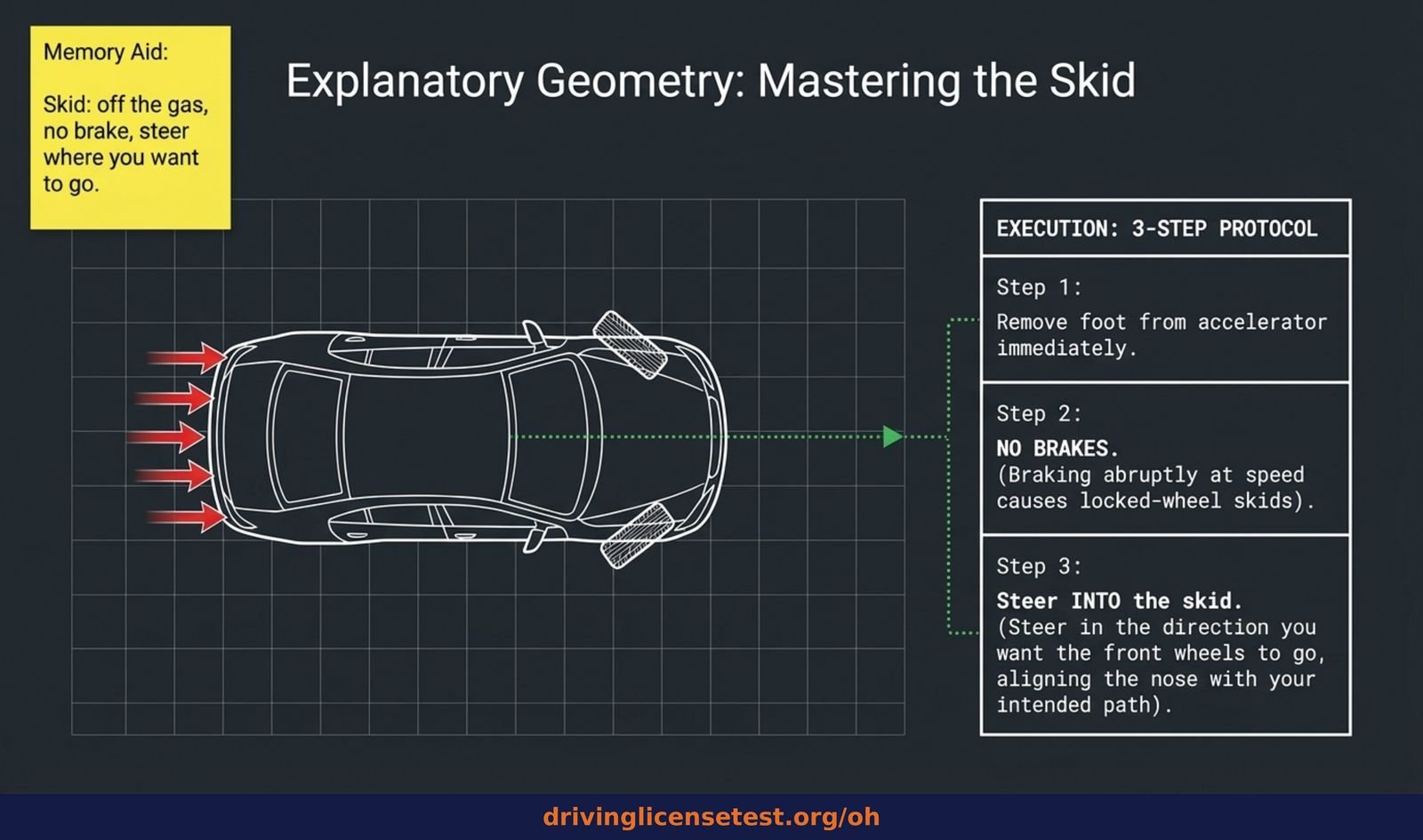
- Skid: remove your foot from the accelerator, avoid braking abruptly — braking too hard at speed usually causes a locked-wheel skid — and steer in the direction you want the front wheels to go.
- Tire blowout: hold the steering wheel firmly, ease up on the gas, and let the car slow gradually to a stop. Do not slam the brakes on a blown tire.
- Wipers fail in heavy rain: slow down, activate your emergency flashers, and pull off the road safely.
Memory aid: “Skid: off the gas, no brake, steer where you want to go. Blowout: grip, ease off, slow to a stop.”
Check yourself: Your vehicle starts to hydroplane, and a moment later you feel the rear begin to skid. Walk through both recoveries — and name the one control input you avoid in each.
Part 6: Belts, signals, and staying focused
Buckle up every trip, and make it the driver’s job. In Ohio, the driver and every front-seat passenger must wear a seat belt, and the driver must ensure that subject passengers are wearing theirs. Seat belts are most effective when worn by all occupants, every time the car is driven — they reduce the risk of striking the interior or being ejected, and wearing yours is the most effective single thing you can do to reduce your risk of injury or death in a crash. Enforcement detail lives in the Traffic Laws guide; the habit here is simpler: nobody moves until everybody is belted. While a permit holder is practice-driving, the driver and all passengers must wear safety belts.
Signal early enough to be useful. Ohio requires a signal to turn or move right or left continuously during not less than the last 100 feet before turning — and the bank applies the same 100 feet to freeway lane changes. Signal, check mirrors, turn your head to clear the blind spot, and only then move.
Put the device down. Ohio’s hands-free law prohibits operating a vehicle while using, holding, or physically supporting an electronic wireless communications device, and it is primary enforcement — an officer who visually observes the violation can stop you for it. Detail lives in the Traffic Laws guide; here, drive hands-free or not at all.
Trap — under-18 drivers get no hands-free loophole: drivers under 18 — TIPIC holders and probationary license holders alike — may not use a device in any manner while driving. Hands-free does not save a teen driver here; apart from narrow exceptions such as emergency use, the device stays unused. Distraction is among the most common causes of collisions.
Memory aid: “Belts on everyone, signal at 100, phone down.”
Check yourself: A 17-year-old on a probationary license says hands-free phone use is fine because Ohio is a hands-free state. Why is that wrong — and how many feet of signal must every Ohio driver give before turning?
Part 7: Move Over, defensive driving, and your own condition
Move Over. When you approach a stationary vehicle displaying flashing, oscillating, or rotating lights — including public safety and emergency vehicles, road service vehicles, waste collection vehicles, and highway maintenance vehicles — Ohio’s Move Over law requires action. On a highway with at least two lanes in your direction, proceed with due caution and, if possible, change into a lane not adjacent to the stationary vehicle. If a lane change is not possible, proceed with due caution, reduce speed, and maintain a safe speed for the conditions. Your lane change or slowdown is the space cushion for people standing outside those vehicles.
Defensive driving ties the guide together: identifying dangerous situations and taking action to avoid accidents. It means scanning, communicating, expecting mistakes from others, and keeping your cushion intact. Slow down and be prepared to stop near a blind pedestrian carrying a white cane or using a guide dog, and look, listen, slow down, and be prepared to stop at railroad tracks.
Your own condition is a safety system. If you begin to feel tired while driving, the best thing to do is to stop driving — stop and rest. Drowsy drivers can drive so poorly that they may appear to be drunk. Opening a window or turning up the radio is not the bank’s answer — stopping is. Keep your eyes moving on long drives to counter highway hypnosis, and know that a leaking exhaust system can make you drowsy while driving. Aggressive driving undoes all of this: erratic lane changes, tailgating, and continuously changing lanes to pass all increase your chances of a collision. Remain polite to aggressive drivers and let confrontations go.
Memory aid: “Flashing lights: move over, or slow down. Feeling tired: stop.”
Check yourself: Flashing lights ahead on a two-lane highway in your direction, but traffic blocks the far lane. What does Move Over require instead — and an hour later, when you catch yourself drifting, what is the only answer the bank accepts?
Part 8: If a crash happens — your duties at the scene
Even careful drivers can be involved in a crash, and the test checks that you know your duties in general terms. Stop. Never leave the scene of a crash you are involved in. Protect the scene and the people in it first: check for injuries, call for emergency help when anyone is hurt, and warn following traffic — tapping the brake pedal lightly several times can warn drivers behind you.
- People first: do not move an injured person unnecessarily — someone who may have a neck injury should not be moved; call emergency help, keep the person warm, and give first aid within your ability.
- Clear the road when it is safe: after a minor, non-injury collision where vehicles are drivable, move out of traffic before exchanging information, so a fender-bender does not become a second crash.
- Exchange information with the other driver or drivers involved, and cooperate with responding officers.
- Debris: after protecting people and calling for help, warn traffic, and remove debris only if it can be done safely.
Think before you act — that principle applies to every driving emergency the bank describes.
Key numbers to memorize
| Fact | Remember |
|---|---|
| Basic speed rule | Never faster or slower than reasonable and proper — and always able to stop within the assured clear distance ahead |
| Following distance to prevent tailgating | 3 seconds — more in wet, icy, dark, or otherwise hazardous conditions |
| How far ahead to look and scan | 10 to 15 seconds ahead — where your vehicle will be in 10 to 15 seconds |
| Headlights required | Sunset to sunrise; when people, vehicles, and objects are not discernible at 1,000 feet; whenever wipers are in use due to precipitation |
| Safe passing distance for a bicycle | 3 feet or greater |
| Turn and lane-change signal | Continuously for at least the last 100 feet before turning or moving |
| Seat belts | Driver and every front-seat passenger belted; driver ensures subject passengers are belted |
| Move Over | Change to a non-adjacent lane if possible; otherwise slow down and proceed with due caution |
| Real Ohio BMV knowledge test | 40 questions — 75% to pass (30 of 40) |
5-question self-check
- The posted limit is 55, but heavy rain has shortened your view ahead. What speed does Ohio law allow, and what must that speed let you do?
- State the three-second rule, how far ahead you should look, and two conditions that require a longer following distance.
- List all three situations in which Ohio requires headlights — and explain the one drivers most often forget.
- How much space must you give a bicycle when passing in Ohio, and why must you never squeeze between a turning truck and the curb?
- You are under 18 and your phone is mounted hands-free. Can you use it while driving? What signal distance must you give before your next turn?
Answer key
- Only a speed that is reasonable and proper under the conditions. It must let you stop within the assured clear distance ahead; the posted 55 never excuses driving faster than you can stop inside what you can see.
- Let the vehicle ahead pass a fixed marker, then count three seconds; reaching it sooner means you are too close. Look 10 to 15 seconds ahead and keep scanning. Increase the gap on wet, icy, or slippery roads and in darkness or low visibility — any two conditions earn the point.
- (1) From sunset to sunrise; (2) whenever people, vehicles, and objects are not discernible at 1,000 feet ahead; and (3) whenever the wipers are in use because of precipitation. The forgotten trigger is the third: wipers on means lights on, even in daylight.
- Three feet or greater. A truck swings wide — often left before turning right — and its blind spots can hide you completely, so the space between the truck and the curb is where the driver cannot see you; stay back and let it finish the turn.
- No. Drivers under 18 may not use a device in any manner while driving, apart from narrow exceptions such as emergency use; the adult hands-free approach does not apply. Every driver must signal continuously for at least the last 100 feet before turning.
Keep practicing
- Take the Safe Driving practice quiz
- Flip through the Safe Driving flashcards
- Take the full Ohio practice test
More study guides: Signs & Signals Study Guide · Traffic Laws Study Guide · Right of Way Study Guide · Alcohol, Drugs & Driving Conditions Study Guide · Licensing & Registration Study Guide