
Your complete Virginia study guide — plain language, no jargon.
📘 Prefer pictures? Flip through the visual deck
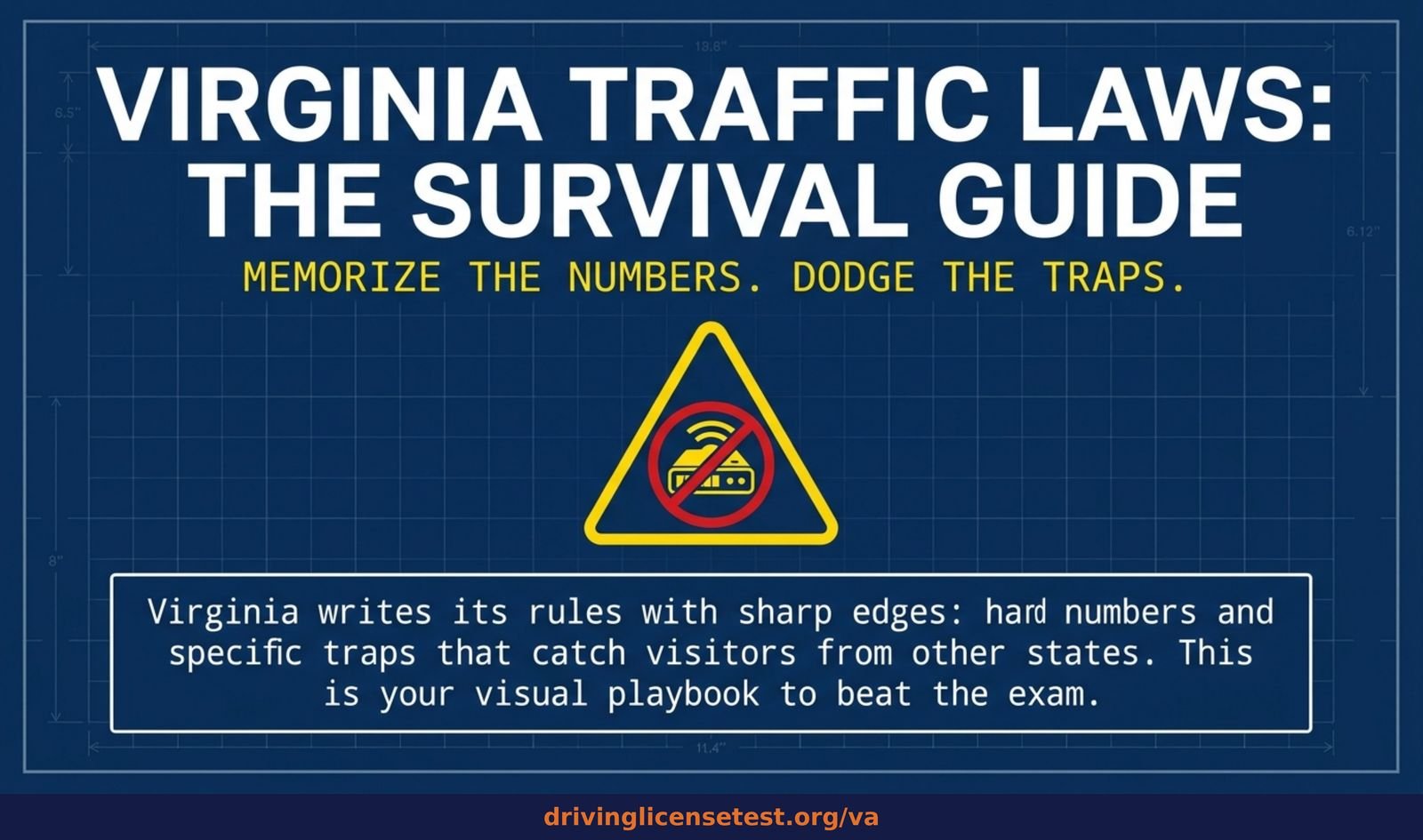
This whole guide as 12 slides — swipe or scroll sideways through them. Every rule in the Virginia guide — the speed ladder, the hands-free fines, the school-bus stop and the parking distance table included.




Take it with you: Download the deck as a PDF (6.8 MB) → — free to share.
Why this matters
Traffic laws are the rules that make thousands of strangers predictable to each other. In Virginia, driver licensing is administered by the Virginia Department of Motor Vehicles — the Virginia DMV — and the official study manual is the Virginia Driver’s Manual (DMV 39). Virginia writes its rules with sharp edges: hard numbers for speeds, distances, and fines, and a few traps that catch visitors from other states — a radar detector is illegal here, and “reckless driving” begins at speeds many states treat as an ordinary ticket. This guide walks the rules in the order you will meet them on the road: speed first, then the device and belt laws, school buses, sharing the road, parking, and the railroad.
Part 1: Speed — the Virginia ladder
Unless a sign posts a different limit, Virginia’s maximum speed limits are set by the kind of road you are on:
- 25 mph — business and residential districts, and school crossings.
- 35 mph — unpaved rural roads.
- 55 mph — other highways (two-lane and divided roads outside town).
- 70 mph — the highest limit that may be posted, on interstate highways where posted.
The posted limit is a maximum, not a target: the basic speed law still requires a speed that is reasonable for traffic, weather, visibility, and the road itself. There are times when even 10 mph is too fast to drive safely.
Reckless driving by speed. Virginia draws a bright line the exam loves: driving more than 20 mph above the posted limit, or driving faster than 85 mph whatever the limit, is reckless driving — a criminal charge, not a simple ticket, and a six-demerit-point violation. (Older materials say “over 80 mph”; the threshold was raised to 85, and 80 is the trap answer.) Passing a stopped school bus is also reckless driving by law.
Check yourself: The limit is 55 mph and you are driving 78 mph to pass a truck. Ticket — or something worse? What if the limit is 70 and you are driving 86?
Part 2: Hands-free — Virginia’s device law
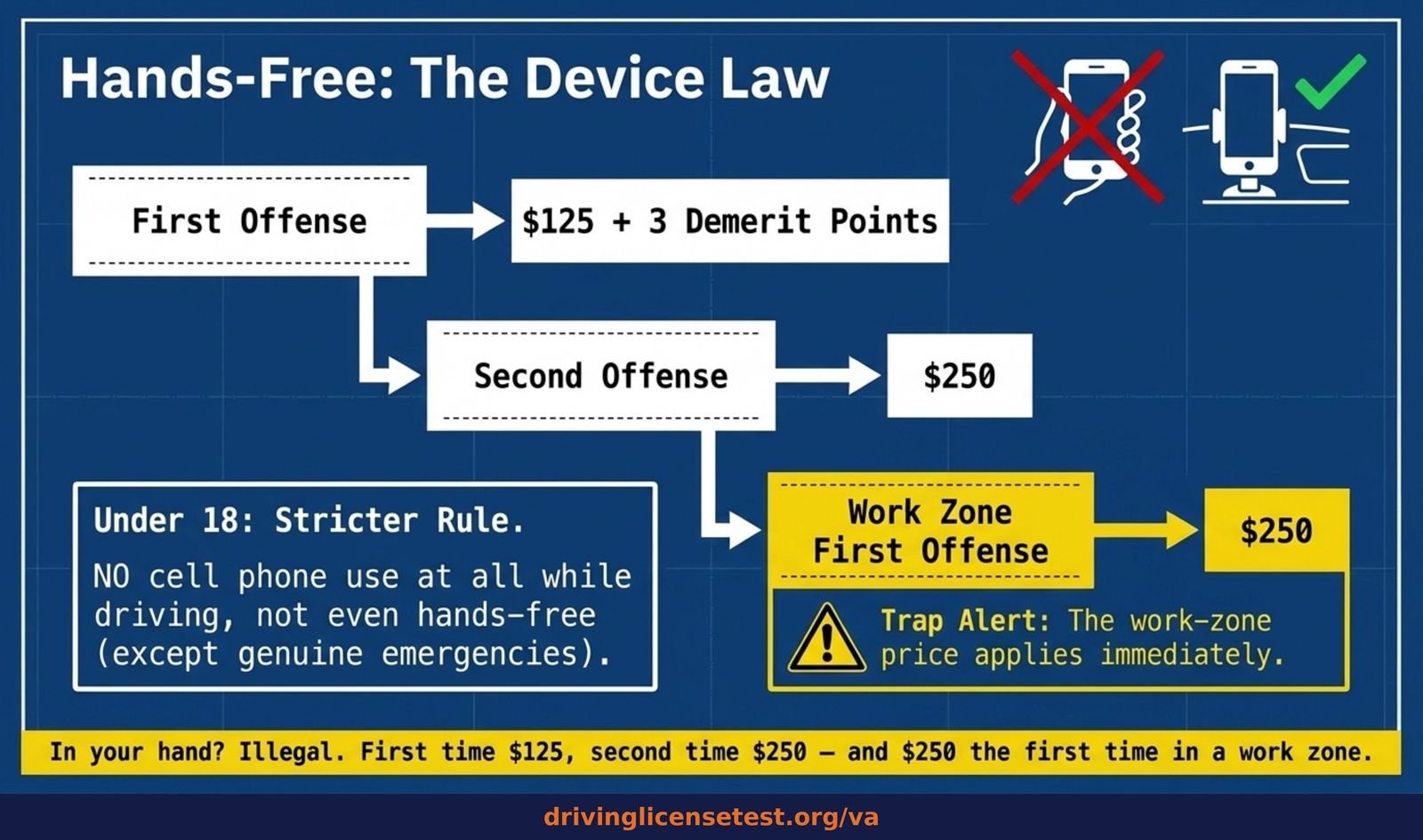
Virginia’s hands-free law (Va. Code § 46.2-818.2) is simple to state and strict in practice: holding a cell phone or other handheld device in your hand while driving is illegal — at a stoplight, in slow traffic, everywhere on the road. Hands-free use — a mounted phone, Bluetooth, voice commands — is legal for adult drivers.
- First offense: a fine of $125. A handheld-device conviction also carries 3 demerit points.
- Second or later offense: $250.
- First offense in a highway work zone: $250 — the work-zone price applies immediately.
- Drivers under 18 are under a stricter rule: no cell phone use at all while driving, hands-free included — the only exception is a genuine emergency. The Licensing & Registration guide covers the full set of under-18 rules.
Memory aid: In your hand? Illegal. First time $125, second time $250 — and $250 the first time in a work zone.
Check yourself: A driver picks up her phone at a red light to read a text, then puts it down before the light changes. Has she broken Virginia law?
Part 3: Seat belts and child restraints
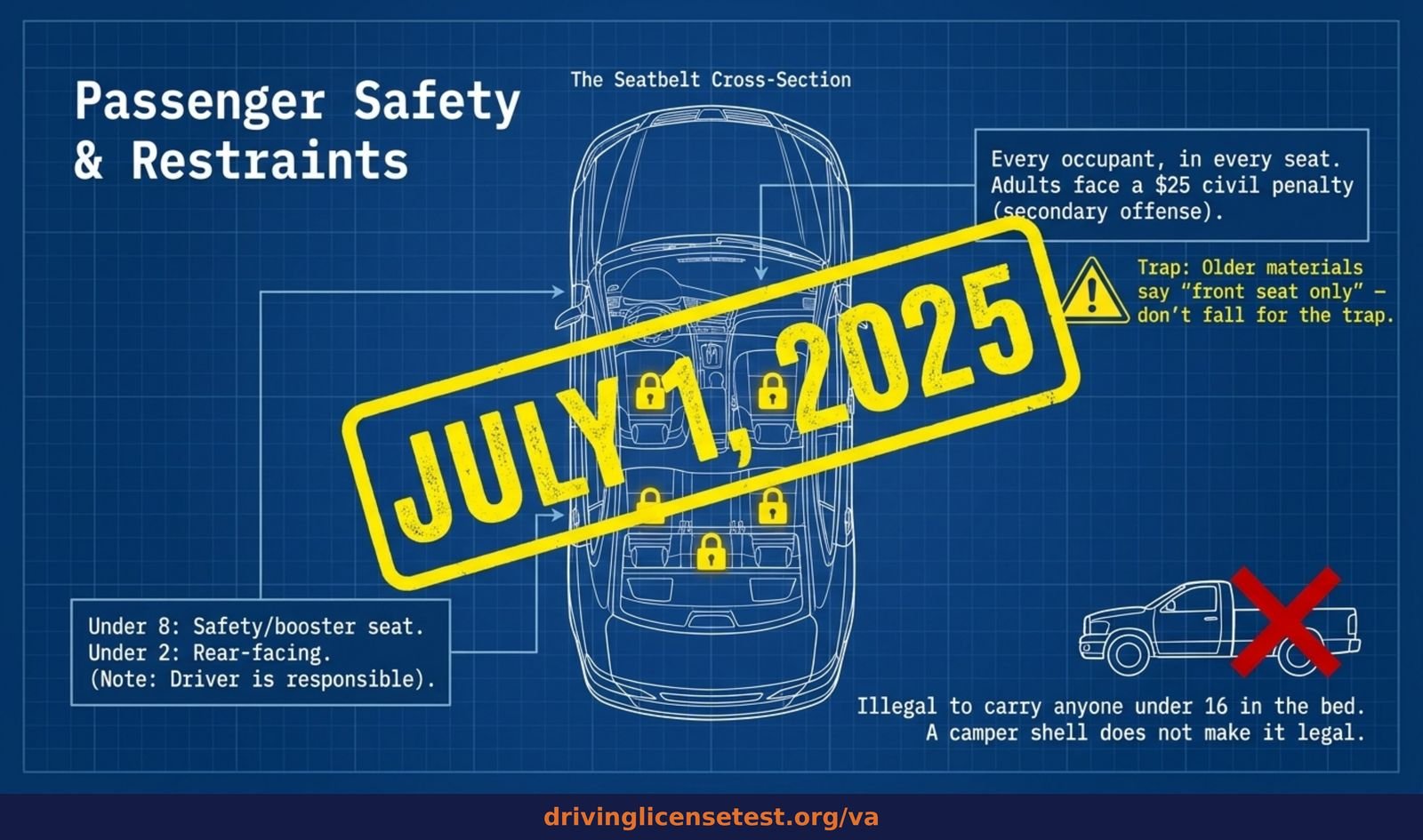
Since July 1, 2025, Virginia’s belt law covers the whole car: every occupant, in every seat, must wear a seat belt. Older materials that say “front seat only” are out of date — that is the trap this guide exists to disarm.
- For adults, the belt law is a secondary offense: an officer cannot stop you for the belt alone, but a violation carries a $25 civil penalty.
- Children under 8 must ride in a child safety seat or booster seat.
- Children under 2 must ride rear-facing.
- It is illegal to carry anyone under 16 in the bed of a pickup truck — a camper shell does not make it legal.
- The driver is responsible for making sure child passengers are properly secured.
Check yourself: An adult rides unbelted in the back seat. The driver says back-seat adults do not count under Virginia law. Who is right?
Part 4: School buses — the strictest stop in Virginia law
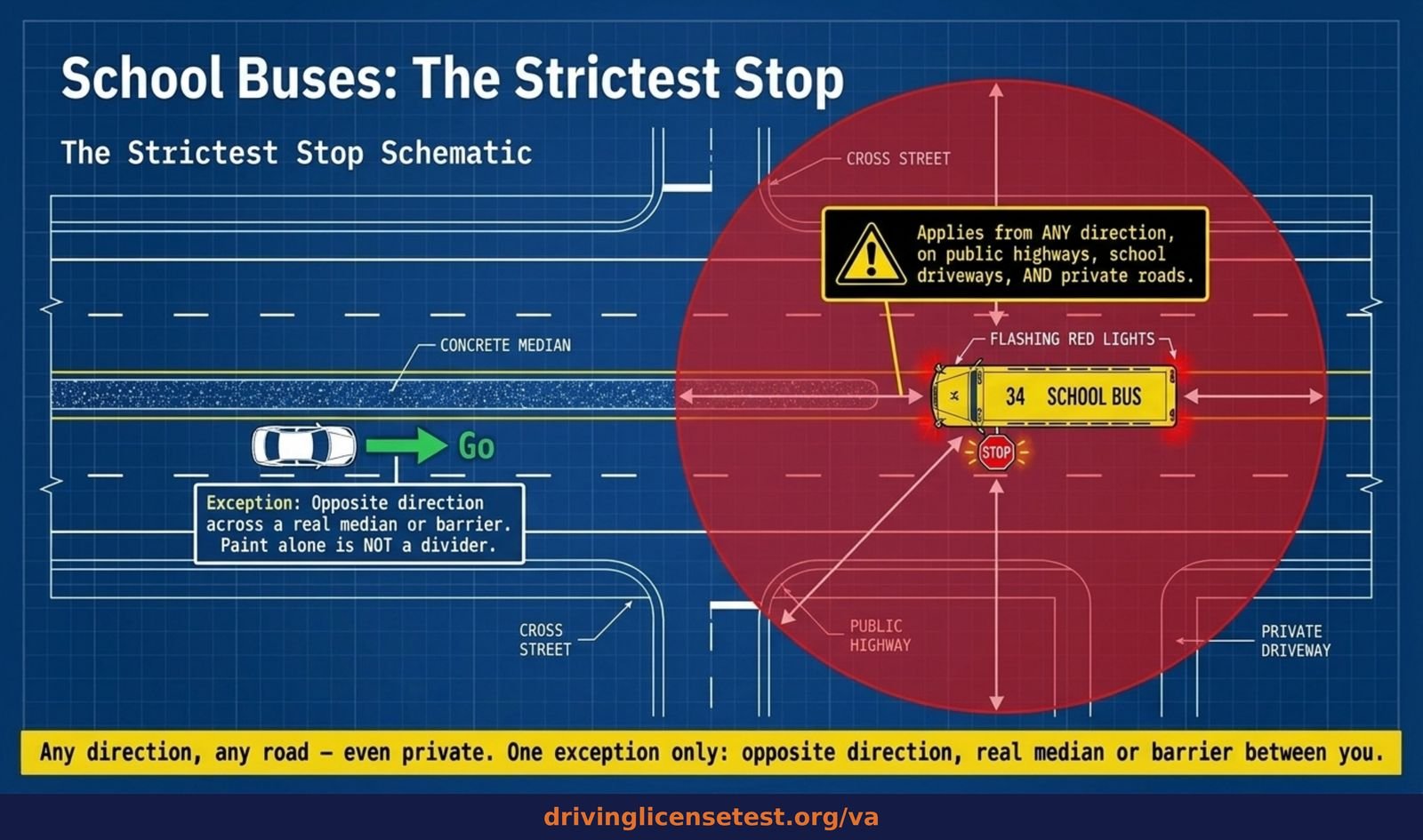
You must stop for a stopped school bus with flashing red lights and an extended stop sign, approaching from any direction — and Virginia extends the duty where many states do not: it applies on private roads and school driveways, not just public highways. You must also stop when the bus is loading or unloading even if its signals are not on. Remain stopped until everyone is clear of the road and the bus moves again.
There is exactly one exception: if you are traveling in the opposite direction on a roadway divided by a median or barrier, with the bus on the other side, you do not have to stop. Paint alone is not a divider. And remember from Part 1: passing a stopped school bus is reckless driving — and a six-point violation.
Memory aid: Any direction, any road — even private. One exception only: opposite direction, real median or barrier between you.
Check yourself: A bus stops with its red lights flashing on the private road into a school, and you are behind it on that same road. A friend says private roads do not count. Do you stop?
Part 5: Move Over — and its wider Virginia family
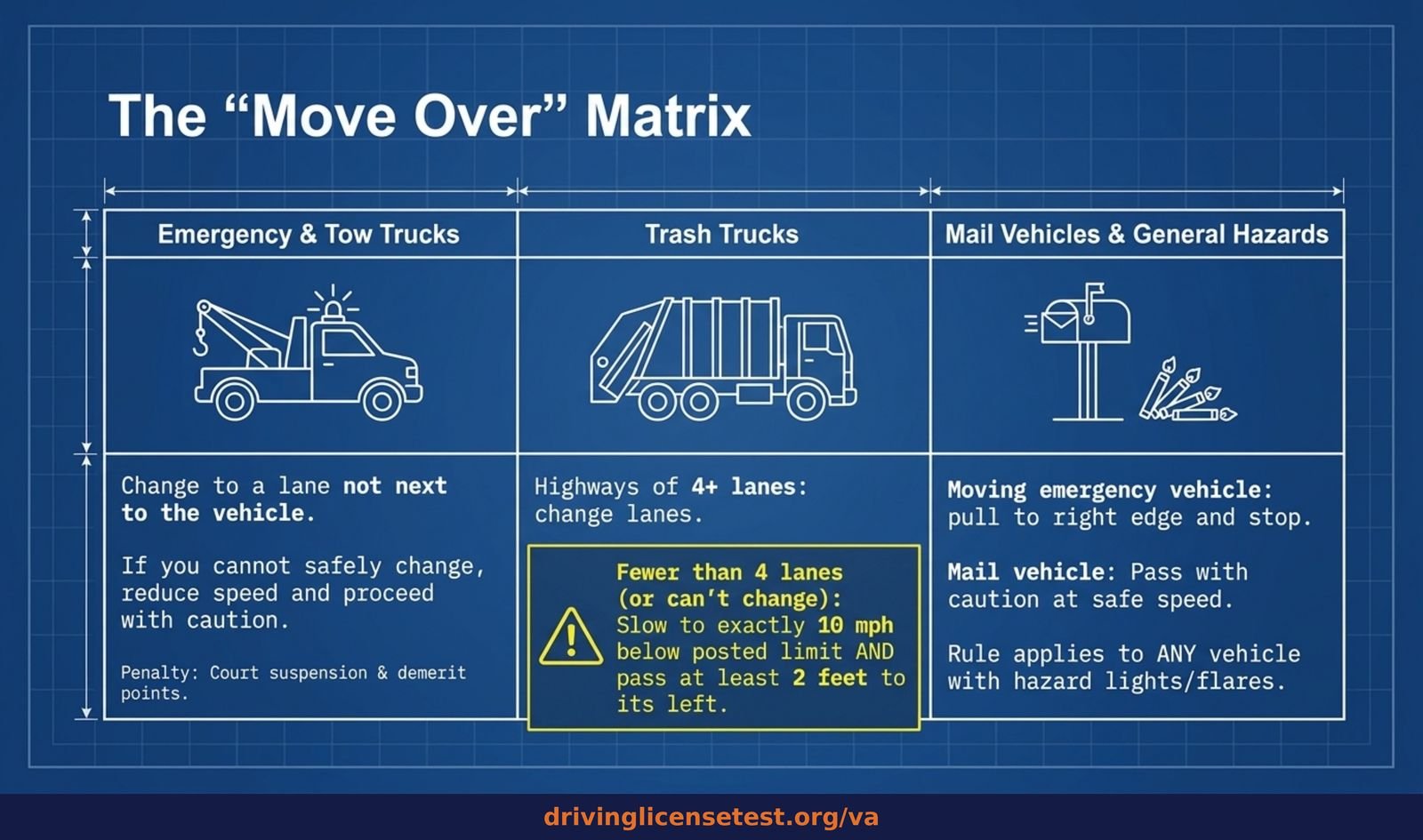
When you approach a stationary emergency vehicle or tow truck with flashing lights, proceed with caution and, if it is reasonable and safe, change to a lane not next to the vehicle. If you cannot safely change lanes, reduce speed and proceed with caution. Violations can bring court suspension of your license and demerit points.
Virginia’s rule reaches further than the tow-truck case: the same lane-change-or-slow duty applies to any stationary vehicle displaying hazard lights, caution signs, or properly lit flares.
- Trash-collection vehicles: on a highway of four or more lanes, change to a lane not next to the vehicle if safe. On a highway of fewer than four lanes — or when you cannot change lanes — slow to 10 mph below the posted limit and pass at least two feet to its left.
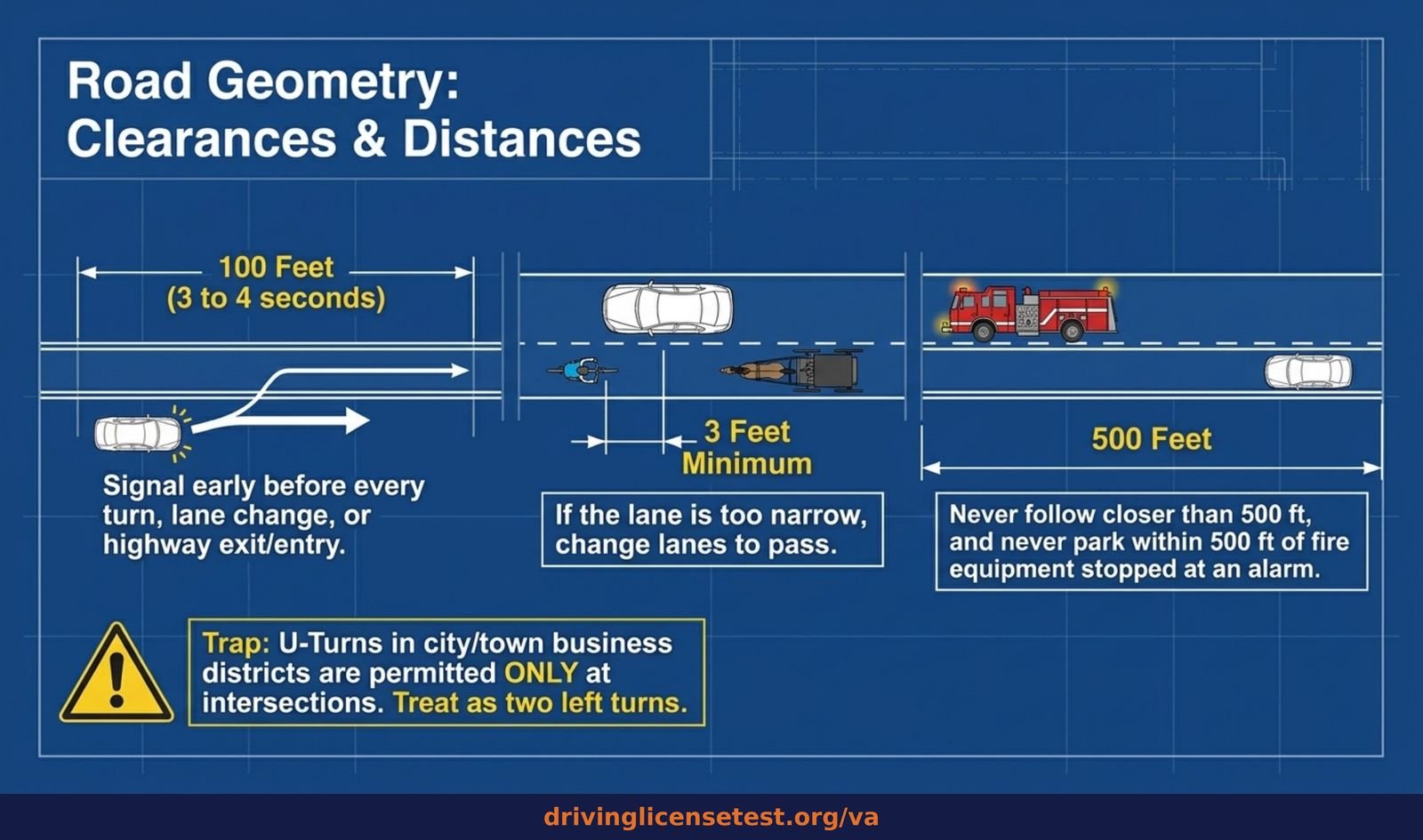
- Emergency vehicles on the move: pull to the right edge of the road and stop when one approaches with siren or lights — from behind, and from the opposite direction on an undivided highway. Never follow one with flashing lights closer than 500 feet, and never park within 500 feet of fire equipment stopped at an alarm.
- Mail vehicles: pass a stopped mail vehicle with caution at a safe speed.
Check yourself: A car sits on the shoulder with its hazard lights flashing — no police, no tow truck. Does Virginia’s Move Over duty apply to it?
Part 6: Passing, turning, and the everyday rules
- Signal early: signal three to four seconds — 100 feet — ahead of every turn. Signals are also required for lane changes and for entering or exiting a highway.
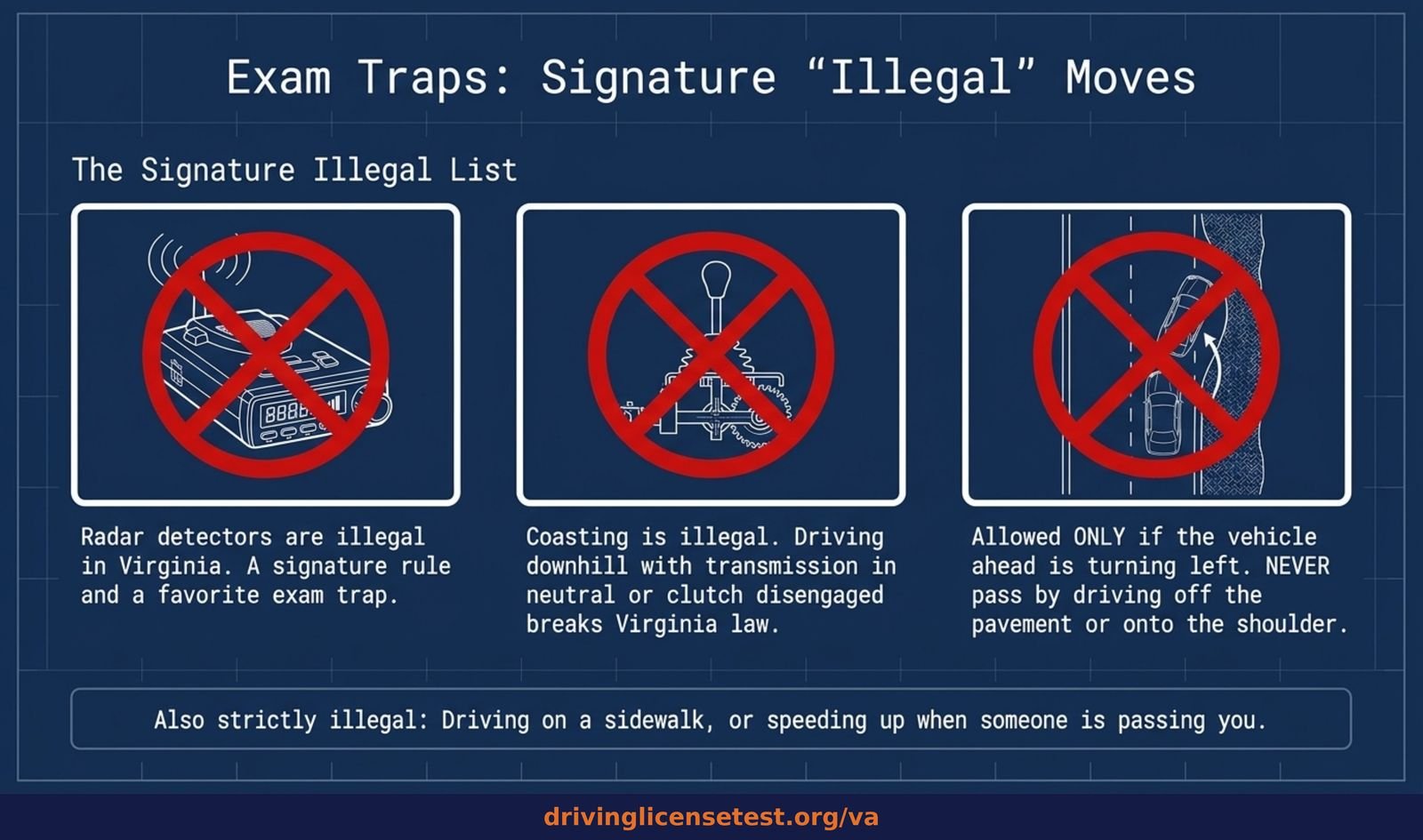
- Passing on the right is allowed only when the vehicle ahead has signaled and is making a left turn — and never by driving off the pavement. When you are being passed, do not speed up; hold a steady speed or slow down.
- No passing on hills, on curves, at intersections, or at railroad crossings (except on roads with two or more lanes in your direction), and never by driving off the pavement or onto the shoulder.
- Bicycles: pass at least three feet to the left; if the lane is not wide enough for three feet of clearance, change lanes to pass. The same three feet applies to horse-drawn buggies.
- U-turns in a city or town business district are permitted only at intersections. Treat every U-turn as two left turns: left into the cross street, then left again in your new direction.
- Coasting is illegal: driving downhill with the transmission in neutral or the clutch disengaged is against Virginia law — and so is driving on a sidewalk.
- Following too closely — more closely than is reasonable and prudent — is a traffic violation and a four-demerit-point conviction. The Safe Driving guide teaches Virginia’s second-by-second following distances.
- Radar detectors are illegal in Virginia — one of the state’s signature rules, and a favorite exam question.
Check yourself: The car ahead of you signals left and slows to turn. Traffic behind you is building. May you pass on the right — and what must you never do while passing?
Part 7: Parking — the distance table
Park no more than one foot from the curb. On a two-way street, park on the right side; on a one-way street, either side is allowed. You may not park:
- Within 15 feet of a fire hydrant.
- Within 20 feet of an intersection.
- Within 50 feet of a railroad crossing.
- Within 15 feet of the entrance to a fire, ambulance, or rescue squad station.
- In a bike lane, on a crosswalk or sidewalk, in front of a driveway, or double-parked.
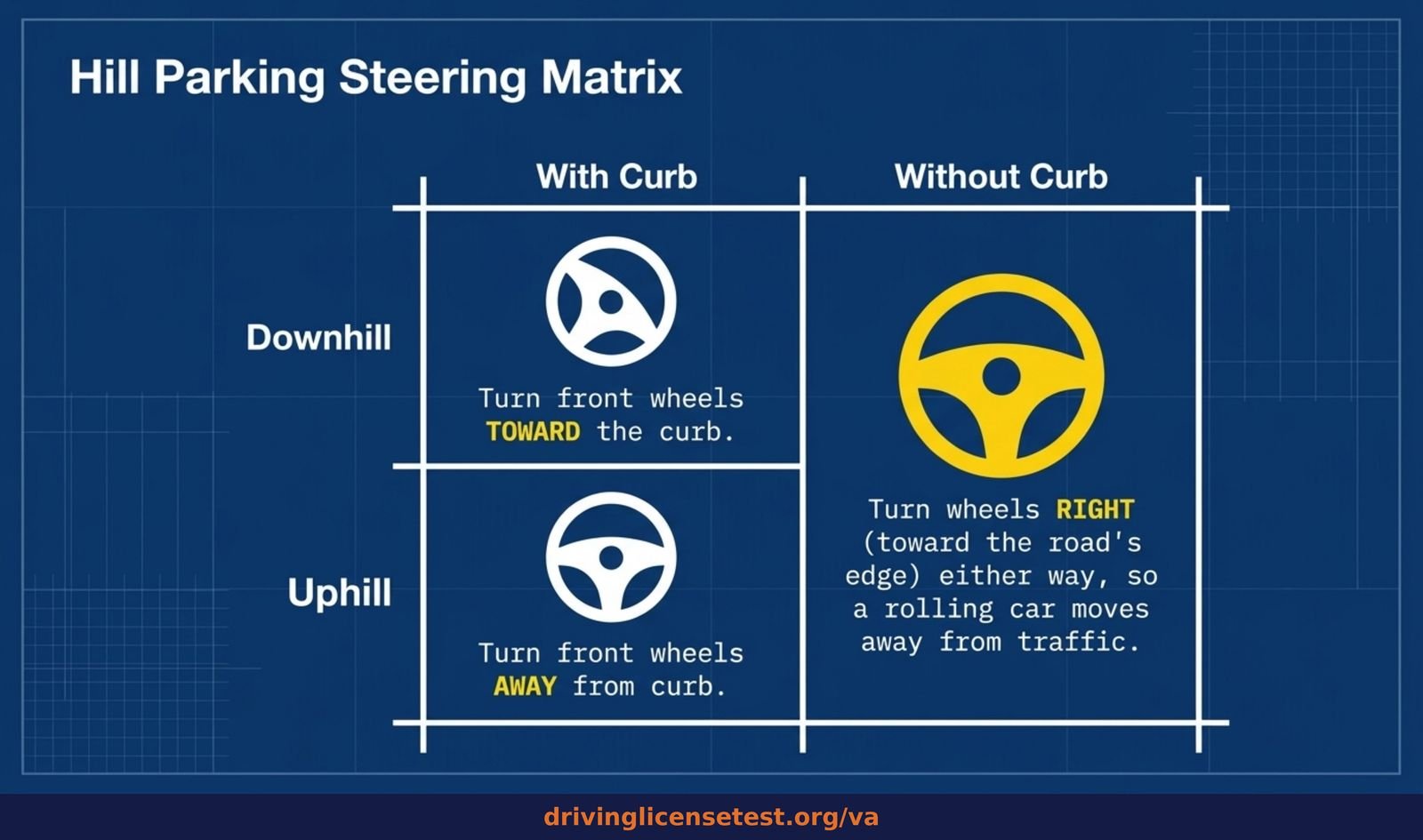
Hills. With a curb: parking downhill, turn your front wheels toward the curb; uphill, turn them away. Without a curb: turn your wheels right — toward the road’s edge — either way, so a rolling car moves away from traffic.
Memory aid: Fifteen, twenty, fifty, fifteen — hydrant, intersection, railroad, fire station. And one foot from the curb, never more.
Check yourself: You park 30 feet from a railroad crossing and 18 feet past an intersection on the same block. Which of those two spots is legal?
Part 8: Railroads
Stop between 15 and 50 feet from the nearest rail when a train is approaching or the signals are active. Never stop on the tracks themselves, never try to beat a train, and remember that school buses always stop at railroad crossings, even when the lights are not flashing. The round advance-warning sign and the crossbuck are covered in the Signs & Signals guide.
Key numbers to memorize
| Default limits | 25 business/residential · 35 unpaved rural · 55 other highways · 70 maximum posted interstate |
| Reckless by speed | More than 20 mph over the limit, or faster than 85 mph |
| Hands-free fines | $125 first · $250 second or work-zone first |
| Adult seat belt | All seats (since Jul 1, 2025) · secondary offense · $25 civil penalty |
| Child restraints | Safety/booster seat under 8 · rear-facing under 2 · pickup bed illegal under 16 |
| School bus | Stop from any direction, even private roads · exception: opposite direction across a median or barrier · passing = reckless |
| Trash truck, under 4 lanes | 10 mph below the limit, pass 2 feet to the left |
| Signal before turning | 100 feet (three to four seconds) |
| Bicycle passing clearance | 3 feet minimum |
| Parking distances | 15 hydrant · 20 intersection · 50 railroad · 15 fire-station entrance · 1 foot from curb |
| Railroad stop position | 15 to 50 feet from the nearest rail |
| Following an emergency vehicle | Never closer than 500 feet |
5-question self-check
- On an unpaved rural road with no posted limit, what is the maximum legal speed — and on an interstate where 70 is posted, at what speed does driving become reckless per se?
- A driver holds her phone at a stoplight in a work zone to check directions. First offense — what fine does she face?
- Since July 1, 2025, who must wear a seat belt in Virginia, and what kind of offense is an adult’s violation?
- Name the one situation in which you do not have to stop for a school bus with flashing red lights.
- You may not park within how many feet of a hydrant, an intersection, a railroad crossing, and a fire-station entrance?
Answer key
- 35 mph on the unpaved rural road. On the interstate, faster than 85 mph is reckless driving regardless of the posted limit (and more than 20 over any limit is reckless too).
- $250 — a first hands-free offense in a highway work zone is fined at the second-offense rate.
- Every occupant in every seat. For adults it is a secondary offense carrying a $25 civil penalty.
- Traveling in the opposite direction on a roadway divided by a median or barrier, with the bus on the other side. Everywhere else — including private roads — you stop.
- 15 feet (hydrant), 20 feet (intersection), 50 feet (railroad crossing), 15 feet (fire-station entrance) — and no more than one foot from the curb.
Keep practicing
- Take the Traffic Laws practice quiz
- Flip through the Traffic Laws flashcards
- Run the full Virginia practice test
More study guides: Signs & Signals Study Guide · Right of Way Study Guide · Safe Driving Study Guide · Alcohol, Drugs & Driving Conditions Study Guide · Licensing & Registration Study Guide