
Your complete Virginia study guide — plain language, no jargon.
Built from the official manual. Every fact in this Virginia section comes from the Virginia Driver’s Manual (DMV 39), published by the Virginia Department of Motor Vehicles — checked against the current edition and verified November 11, 2026. Read the manual itself at dmv.virginia.gov.
📘 Prefer pictures? Flip through the visual deck
This whole guide as 14 slides — swipe or scroll sideways through them. The whole Virginia licensing system — the two exam gates, points running both ways, the 2025 insurance numbers, fees and test day included.






Take it with you: Download the deck as a PDF (7.5 MB) → — free to share.
Why this matters
This guide covers the system around the driving: how Virginians get licensed, what it costs, how the two-part exam gates your progress, and how points, insurance, and registration keep you legal afterward. In Virginia, driver licensing is administered by the Virginia Department of Motor Vehicles — the Virginia DMV — and the official study manual is the Virginia Driver’s Manual (DMV 39). Virginia’s licensing path is unusually structured: a sign test you must ace before the knowledge test even starts, a points system with two directions (demerits pull you down, safe points lift you up), and insurance minimums that changed on January 1, 2025 — newer than many websites. Everything below is the current rule.
Part 1: The journey at a glance
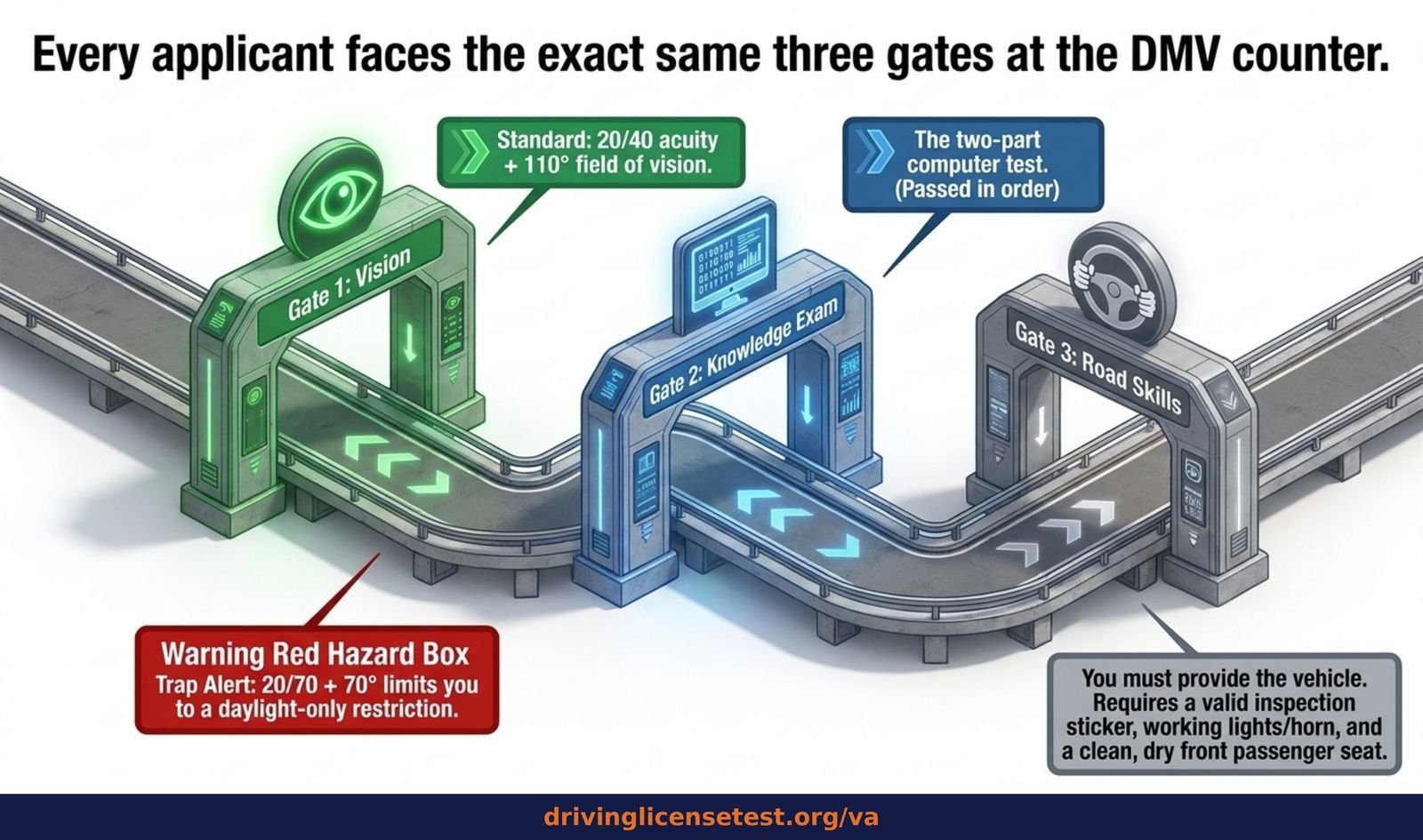
For a first-time Virginia driver under 18, the path runs: learner’s permit → driver education → supervised practice → license. You may apply for the permit at 15 years and 6 months; the license itself can first be issued at 16 years and 3 months. Adults follow a shorter version of the same road (Part 7). Every applicant — teen or adult — faces the same two gates at the DMV counter: the vision screening and the two-part knowledge exam, and then the road skills test.
Part 2: The learner’s permit
- Age: at least 15 years and 6 months.
- Fee: the permit costs $3.
- Under 18: you must hold the permit for at least nine months before licensing, and a parent or guardian must certify at least 45 hours of practice driving — 15 of them after sunset.
- While on a permit, you drive only with a licensed driver supervising you, as Virginia’s permit rules require — the permit is a license to learn, not to drive alone.
Check yourself: A student turns 15 years and 6 months today and passes everything on the first try. What two clocks must still run before a license can be issued — and what is the earliest birthday by which both can finish?
Part 3: Driver education
Applicants under 18 must complete an approved driver education program. Its classroom component is 36 fifty-minute periods — the structure Virginia law sets for the program, quite apart from the behind-the-wheel training that follows it. Driver education returns later in this guide in a sterner role: it is also the remedy for failing the knowledge exam three times (Part 4) and, for the road test, the in-vehicle component — fourteen 50-minute periods — is the remedy for failing the road skills test three times at DMV.
Part 4: The two-part knowledge exam — Virginia’s two gates
Virginia’s knowledge exam is taken on a computer and comes in two parts, passed in order:
- Part One — traffic signs: 10 questions, and you must answer all 10 correctly to continue. There is no partial credit at this gate; the Signs & Signals guide exists because of it.
- Part Two — general knowledge: you must answer at least 80 percent of the questions correctly to pass. (30 questions, 24 correct to pass.)
- One attempt per business day. If you fail, you may try again the next business day — except applicants under 18, who must wait a full 15 days after a failure.
- Three failures change the rules: fail the exam three times and you must complete the classroom component of driver education (36 fifty-minute periods) before testing again. If you are 18 or older, an 8-hour course based on the driver’s manual is the alternative path back.
Memory aid: Ten signs, all ten. Then knowledge at eighty. One try a day — fifteen days if you’re under eighteen.
Check yourself: An applicant answers 9 of 10 sign questions correctly and knows the general material cold. What happens next — and when can a 17-year-old in that position test again?
Part 5: The vision screening
Every applicant takes a vision screening. The unrestricted standard is acuity of at least 20/40 in either or both eyes and a field of vision of at least 110 degrees. An applicant whose daytime vision is at least 20/70 with a field of at least 70 degrees may still be licensed — with a restriction to daylight driving only. Bring your glasses or contacts if you wear them; the screening measures your corrected vision.
Part 6: Provisional rules for drivers under 18
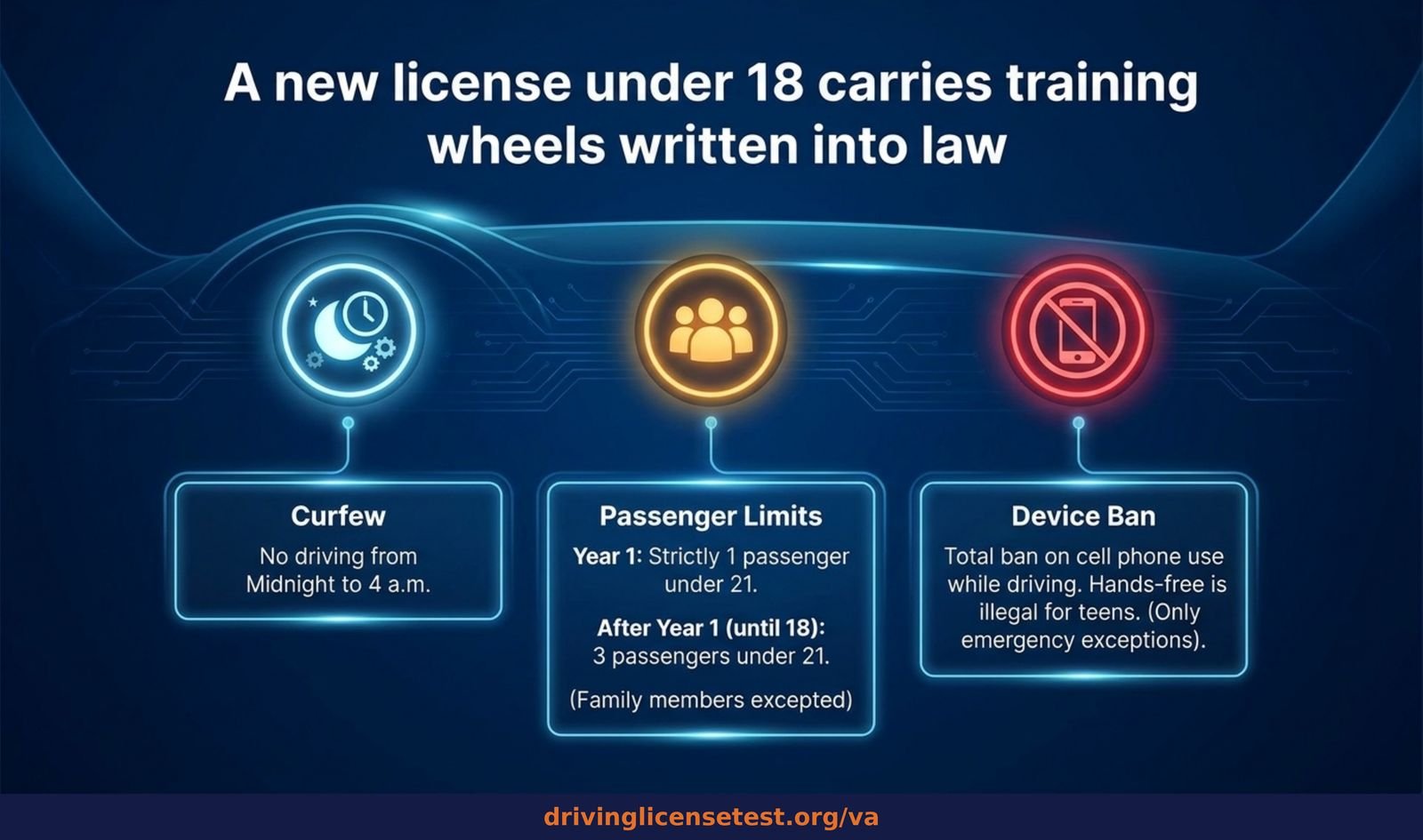
A new license under 18 carries training wheels written into law:
- Curfew: no driving from midnight to 4 a.m.
- Passengers: during the first year of licensure, no more than one passenger under 21 (family members excepted); after the first year and until 18, no more than three passengers under 21. Count passengers by the under-21 line — that is how Virginia’s current guidance reads the rule.
- Devices: a total ban on cell phone use while driving — hands-free included. The only exception is a genuine emergency. (Adults are governed by the hands-free law in the Traffic Laws guide.)
- Points consequences are steeper for teens — see Part 9.
Check yourself: A 17-year-old with eight months of licensure drives two 19-year-old friends home at 11 p.m., using a mounted phone for directions. Count the violations.
Part 7: Adult applicants — and a rule that changes in 2027
Under the rules in effect through 2026, a first-time applicant age 18 or older holds a learner’s permit for 60 days — or completes an approved driver education program instead. Mark the change now: beginning January 1, 2027, first-time applicants ages 18 to 20 must hold the permit for 90 days and complete driver education; applicants 21 and older are unchanged. Whichever path applies, the vision screening, the two-part knowledge exam, and the road skills test are the same gates for everyone.
Part 8: Fees and the card itself
- Driver’s license: $4 for each year of validity — an eight-year license costs $32.
- REAL ID: adding REAL ID costs a one-time $10 fee on top of the license fee.
- Replacements: a replacement driver’s license costs $20; a replacement learner’s permit costs $2.
- The card tells your age: licenses issued to persons under 21 are vertical in format (adults 21 and over receive horizontal cards) — a design required by law so an under-21 card is recognizable at a glance.
Check yourself: A 20-year-old replaces a lost license and adds REAL ID for the first time. What does she pay — and what shape is the card that arrives?
Part 9: Points — the two-way system
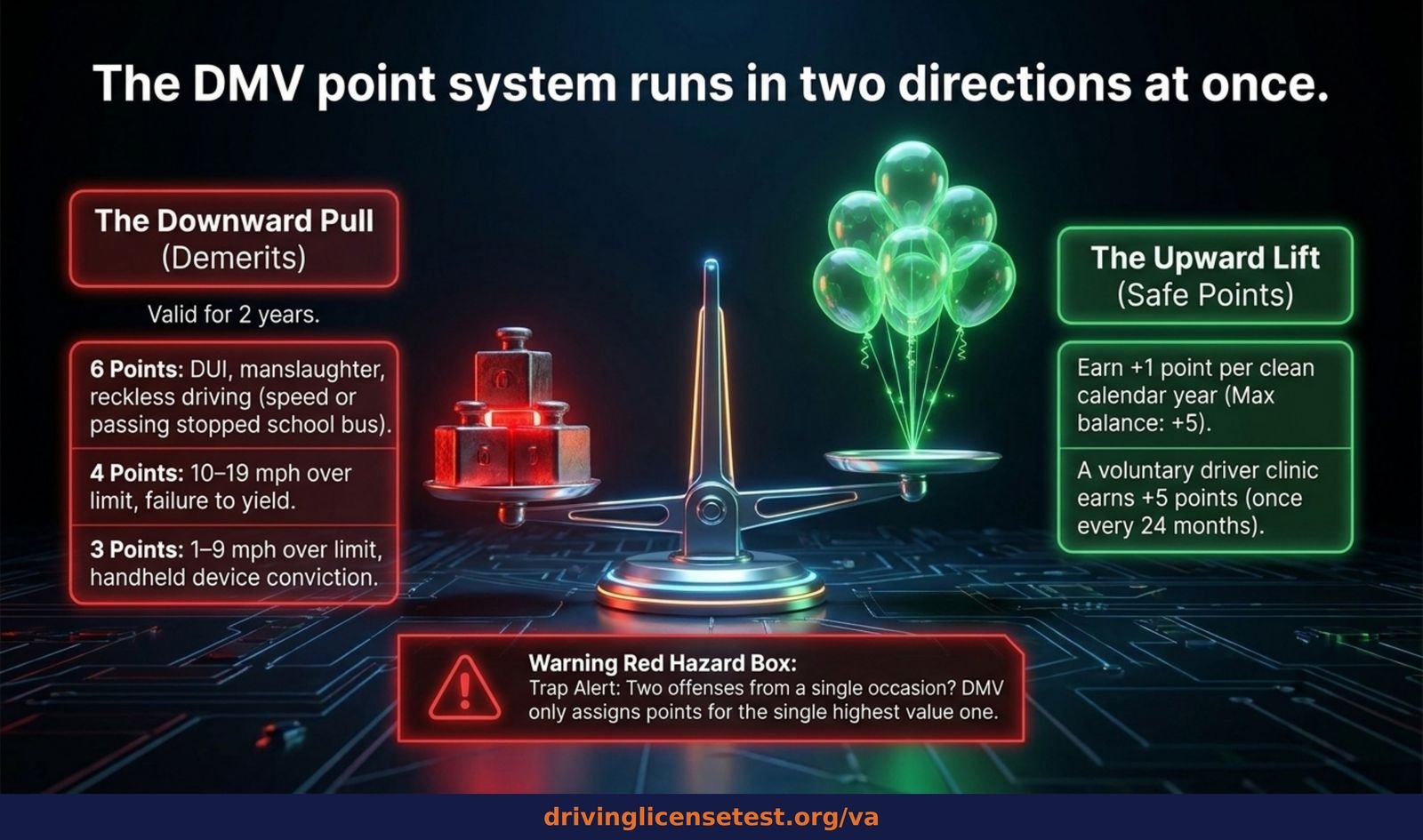
Virginia’s point system runs in two directions at once. DMV — not the courts — assigns points when convictions are reported.
Demerit points (3, 4, or 6 by severity) are valid for two years from the offense:
- 6 points: DUI, manslaughter, and reckless driving — including reckless by speed and passing a stopped school bus.
- 4 points: speeding 10–19 mph over the limit, failure to yield, following too closely.
- 3 points: speeding 1–9 mph over the limit, improper driving — and a handheld-device conviction.
- Two offenses from a single occasion earn points for only one — the one with the highest value.
Safe driving points pull the other way: earn one point for each calendar year driven without a conviction or suspension, up to a maximum balance of +5. Voluntarily completing a driver improvement clinic earns five safe points, available once every 24 months.
The adult ladder (demerits in 12 months): 8 → an advisory letter from DMV. 12 → complete a driver improvement clinic within 90 days or be suspended. 18 → a 90-day suspension, a clinic before restoration, and six months of probation afterward.
The under-18 ladder is faster: a first conviction → a clinic within 90 days; a second → a 90-day suspension; a third → revocation for one year or until age 18, whichever is longer.
Memory aid: Demerits: three, four, six. Safe points climb to five. Adults: eight warns, twelve clinics, eighteen suspends.
Check yourself: An adult driver collects two 6-point convictions and a 4-point conviction across one year. Walk the ladder: what has DMV done at each threshold?
Part 10: Suspensions and revocations
A suspension withdraws your privilege temporarily; a revocation terminates it — after a revocation you must re-apply and pass the vision screening, the two-part knowledge exam, and the road skills test to be licensed again. Convictions that mandate suspension or revocation include DUI, driving while suspended for DUI, driving without a required interlock, refusing a chemical test, eluding police, and making a false statement to DMV. DMV also suspends for child-support noncompliance when payments are 90 days late or $5,000 in arrears, and courts can suspend for offenses ranging from reckless driving to driving off without paying for fuel. Under the Medical Review Program, DMV may require medical or vision reports and re-testing when a condition affects safe driving.
Part 11: Insurance — the 2025 numbers
Virginia requires liability insurance, and the current minimums — for policies issued or renewed on or after January 1, 2025 — are:
- $50,000 for injury or death of one person.
- $100,000 for injury or death of two or more people.
- $25,000 for property damage.
The shorthand is 50/100/25. Older figures still circulating — 30/60/20 and 25/50/20 — are superseded; if a practice question anywhere offers them as the current answer, it is testing whether you know they are history. Driving without the required insurance brings suspension of your license and registration, a $600 statutory fee, and three years of filing an SR-22 Financial Responsibility Certificate. (The old $500 uninsured-motor-vehicle fee was eliminated July 1, 2024 — it survives only as a trap answer.)
Check yourself: A website’s Virginia page says the minimum coverage is 30/60/20 and an uninsured driver can pay a $500 fee to drive legally. Date that page’s information — what is wrong with both numbers today?
Part 12: Registration, plates, and inspection
- New residents: title and register your vehicle in Virginia within 30 days of moving here.
- Plates: Virginia plates are displayed on the front and rear of the vehicle.
- Safety inspection: registered vehicles must pass a Virginia safety inspection every year.
- Moving within Virginia: notify DMV of your new address within 30 days.
- For the road test: you provide the vehicle — it must carry a valid safety inspection sticker, plates, and registration card, with a working horn, headlights, turn signals, brake lights, speedometer, mirrors, and seat belts, and a clean, dry front passenger seat area.
Test day in Virginia — what to expect
For a first Virginia license, the DMV visit runs through three gates: a vision screening, a two-part knowledge exam on a computer, and a road skills test. Here is the whole visit, before you go:
- Part One is signs only — and it is all or nothing. Ten traffic sign questions; you must answer all 10 correctly before Part Two unlocks. Study signs as their own subject (our Signs & Signals guide), not as a warm-up.
- Part Two is general knowledge at 80%. Answer at least 80 percent correctly to pass. It has 30 questions, 24 correct to pass.
- Your eyes get checked. The screening standard is 20/40 acuity with a 110-degree field of vision. Bring your glasses or contacts if you wear them.
- One attempt per business day. Fail, and you can return the next business day — unless you are under 18, in which case you wait a full 15 days. Three failures mean classroom driver education (36 fifty-minute periods) before you test again, or an 8-hour manual course if you are 18 or older.
- Under 18? Bring your paperwork. Your driver-education completion, proof of the nine-month permit hold, and the certified 45 hours of practice (15 after sunset) are what turn a passed exam into a license at 16 years and 3 months.
- You bring the car for the road test. It needs a valid inspection sticker, plates, and registration card; working horn, headlights, turn signals, brake lights, speedometer, mirrors, and seat belts; and a clean, dry front passenger seat.
- Small money, exact change of plan. The permit is $3; the license is $4 per year of validity; REAL ID adds a one-time $10 if you choose it.
Fees and rules above are from the Virginia Department of Motor Vehicles and Virginia law, verified November 11, 2026.
Key numbers to memorize
| Permit | Age 15 years 6 months · fee $3 · under-18 hold 9 months · 45 practice hours (15 after sunset) |
| First license | 16 years 3 months |
| Driver education | 36 fifty-minute classroom periods |
| Knowledge exam | Part One: 10 sign questions, all 10 correct · Part Two: 30 questions, 24 correct (80%) to pass |
| Retakes | Once per business day · under-18 failure: wait 15 days · three failures: classroom course (or 8-hour course at 18+) |
| Vision | 20/40 + 110° · daylight-only license at 20/70 + 70° |
| Under-18 rules | Curfew midnight–4 a.m. · passengers under 21: 1 in year one, 3 after · total device ban |
| Fees | License $4/year · REAL ID +$10 one-time · replacement license $20 / permit $2 |
| Points | Demerits 3/4/6, valid 2 years · safe points to +5 · adult ladder 8 / 12 / 18 |
| Insurance | 50/100/25 (policies from Jan 1, 2025) · noncompliance: suspension + $600 + 3 years SR-22 |
| Registration | New resident 30 days · plates front and rear · inspection every year · address change 30 days |
5-question self-check
- Describe Virginia’s knowledge exam: both parts, both pass standards, and both question counts.
- A 16-year-old has held a permit for nine months and finished driver education. What practice record must a parent or guardian certify before the license issues?
- State the adult demerit ladder at 8, 12, and 18 points in 12 months — and how the under-18 ladder differs.
- What are Virginia’s current minimum liability limits, when did they take effect, and what happens if you drive without them?
- An applicant fails the knowledge exam for the third time at age 19. What must happen before the fourth attempt — and what would be different at 17?
Answer key
- Part One: 10 traffic sign questions, all 10 correct to continue. Part Two: 30 general-knowledge questions, 24 correct (80%) to pass.
- At least 45 hours of practice driving, 15 of them after sunset.
- Adults: 8 points brings an advisory letter; 12 requires a driver improvement clinic within 90 days; 18 brings a 90-day suspension, a clinic before restoration, and six months of probation. Under 18: first conviction — clinic within 90 days; second — 90-day suspension; third — revocation for one year or until 18, whichever is longer.
- 50/100/25 — $50,000 (one person), $100,000 (two or more), $25,000 (property damage) — for policies issued or renewed on or after January 1, 2025. Driving uninsured: suspension of license and registration, a $600 statutory fee, and three years of SR-22 filings.
- At 19: complete the classroom component of driver education (36 fifty-minute periods) — or take the 8-hour manual-based course open to applicants 18 and older. At 17 the 8-hour alternative does not apply (classroom component only) — and a 17-year-old also waits 15 days after each failure, not one business day.
Keep practicing
- Take the Licensing & Registration practice quiz
- Flip through the Licensing & Registration flashcards
- Run the full Virginia practice test
More study guides: Signs & Signals Study Guide · Traffic Laws Study Guide · Right of Way Study Guide · Safe Driving Study Guide · Alcohol, Drugs & Driving Conditions Study Guide