
Your complete Texas study guide — plain language, no jargon.
📘 Prefer pictures? Flip through the visual deck
This whole guide as 14 slides — swipe or scroll sideways through them. Speed limits, lane rules and the laws of the road in Texas.
Take it with you: Download the deck as a PDF (2.7 MB) → — free to share.
Why this matters
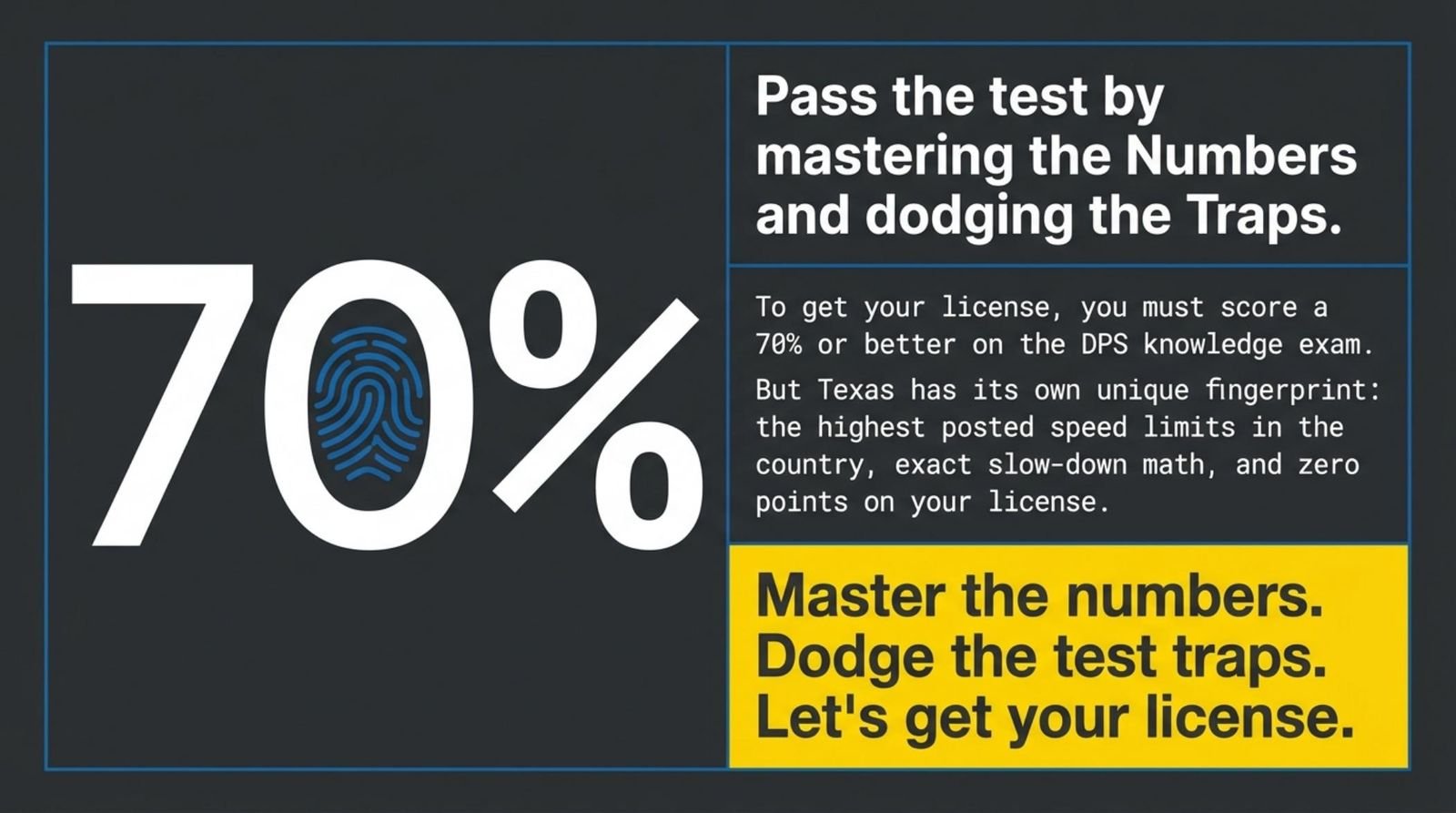
Traffic laws are the rules that keep thousands of strangers moving past each other safely. Texas has its own fingerprint here: the highest posted speed limit in the country, a texting ban that still lets adults make handheld calls, a Move Over law with an exact slow-down number, and — since 2019 — no points system at all. This guide covers the laws the DPS knowledge test loves most. To pass any Texas knowledge exam you must score 70% or better.
Part 1: Texas speed limits
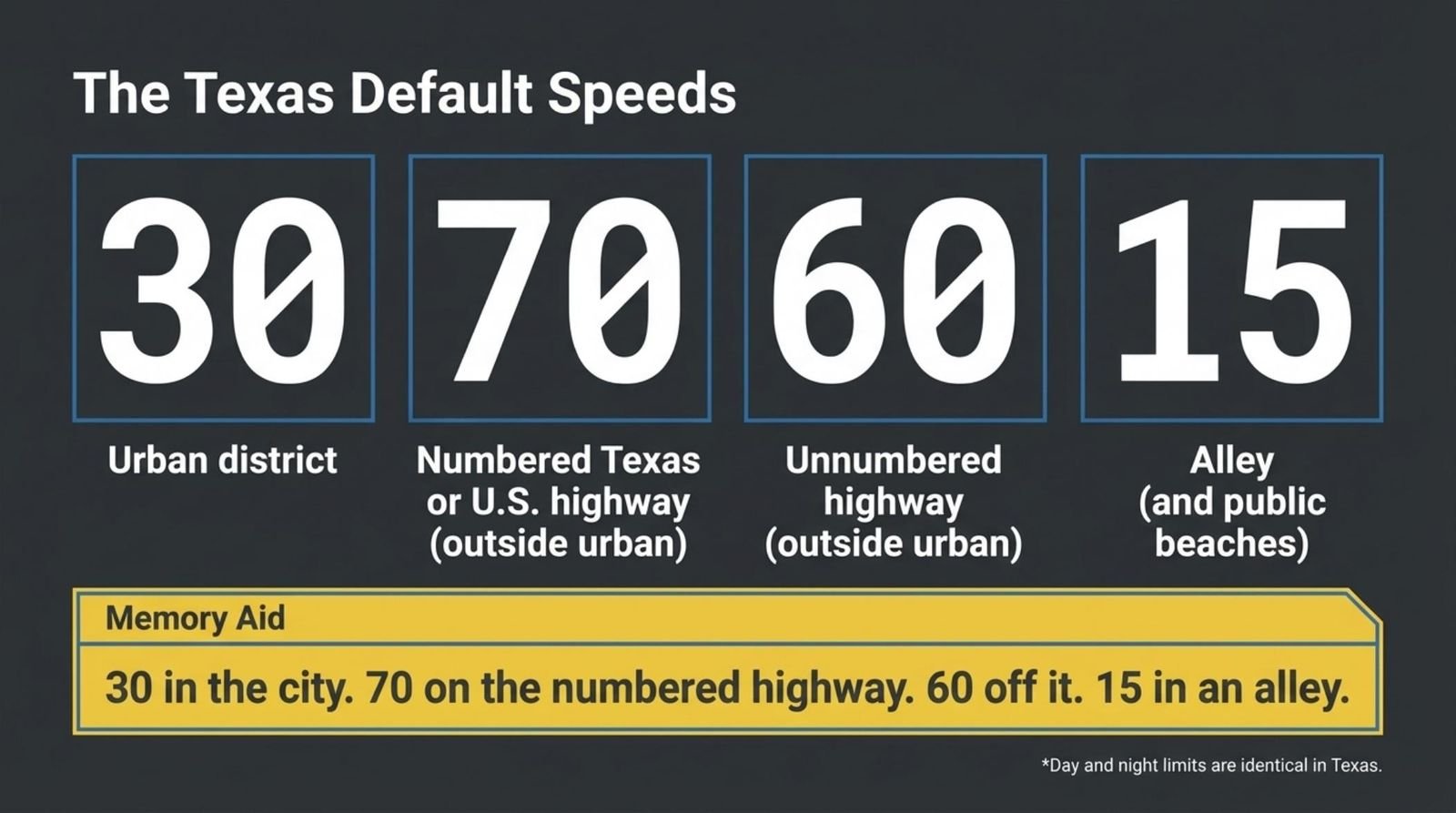
Unless a sign posts a different limit, Texas’s statutory maximum speeds are:
| Where | Limit |
|---|---|
| Urban district | 30 mph |
| Alley | 15 mph |
| Beaches, and county roads next to a public beach (when declared) | 15 mph |
| Numbered Texas or U.S. highway outside an urban district | 70 mph |
| Highway not numbered by the Texas or U.S. system, outside an urban district | 60 mph |
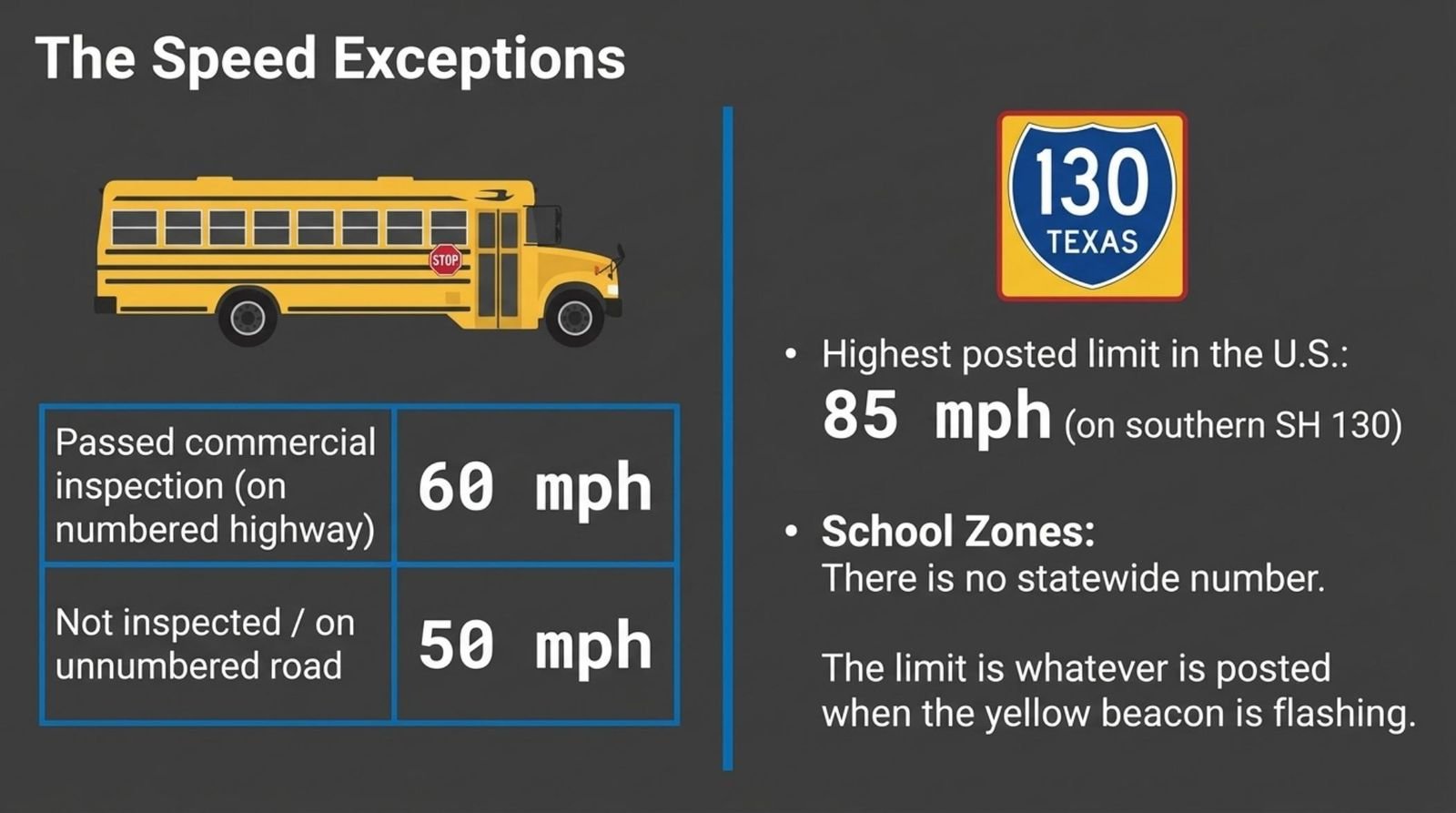
| School bus that has passed a commercial vehicle inspection, on a numbered highway | 60 mph |
| School bus not commercially inspected, or on an unnumbered highway | 50 mph |
Memory aid: 30 in the city, 70 on the numbered highway, 60 off it — and 15 in an alley.
Limits can be changed. The Texas Transportation Commission, regional mobility authorities, and local governments may set higher or lower limits based on traffic and engineering studies. Many limited-access highways are posted at 75 up to 85 mph. The highest posted limit in Texas — and the United States — is 85 mph on the southern portion of SH 130, the toll road between Austin and I-10 near Seguin.
Day and night are the same. Texas has no separate nighttime limits — a limit is identical around the clock.
School zones have no single statewide number: the speed is the posted limit, set locally, in effect when the yellow beacon is flashing.
Check yourself: You’re on an unposted numbered U.S. highway outside any town. What’s your limit — and what would it be driving a school bus that hasn’t passed its commercial inspection?
Part 2: Texting and phones
Texas draws a careful line: messaging is banned statewide; phone calls are treated differently.
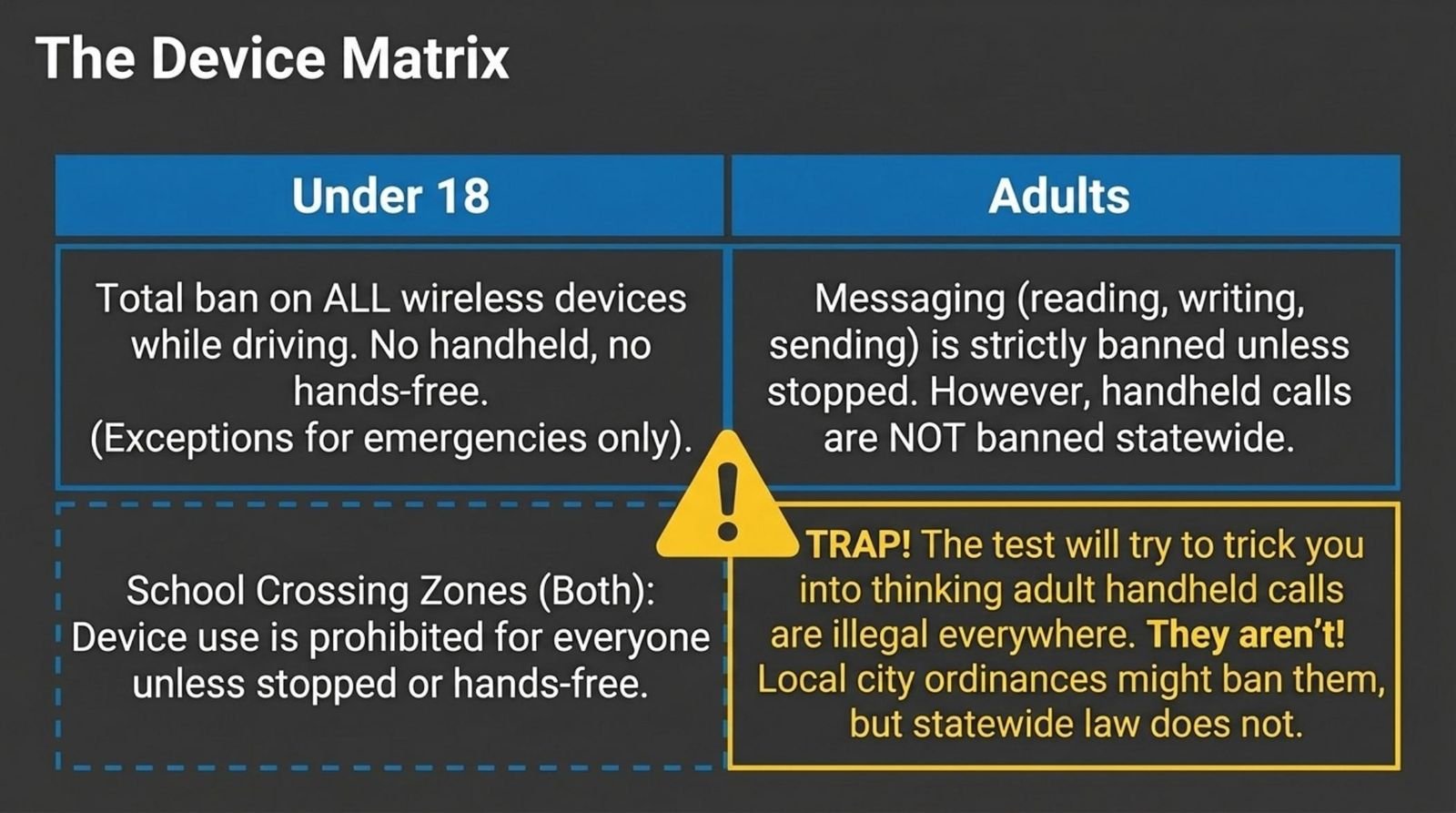
- Texting ban (since September 1, 2017). It is an offense to use a portable wireless device to read, write, or send an electronic message while operating a motor vehicle — unless the vehicle is stopped.
- Defenses in the law include hands-free use, GPS and navigation, reporting illegal activity, summoning emergency help, and reading a message you reasonably believe concerns an emergency.
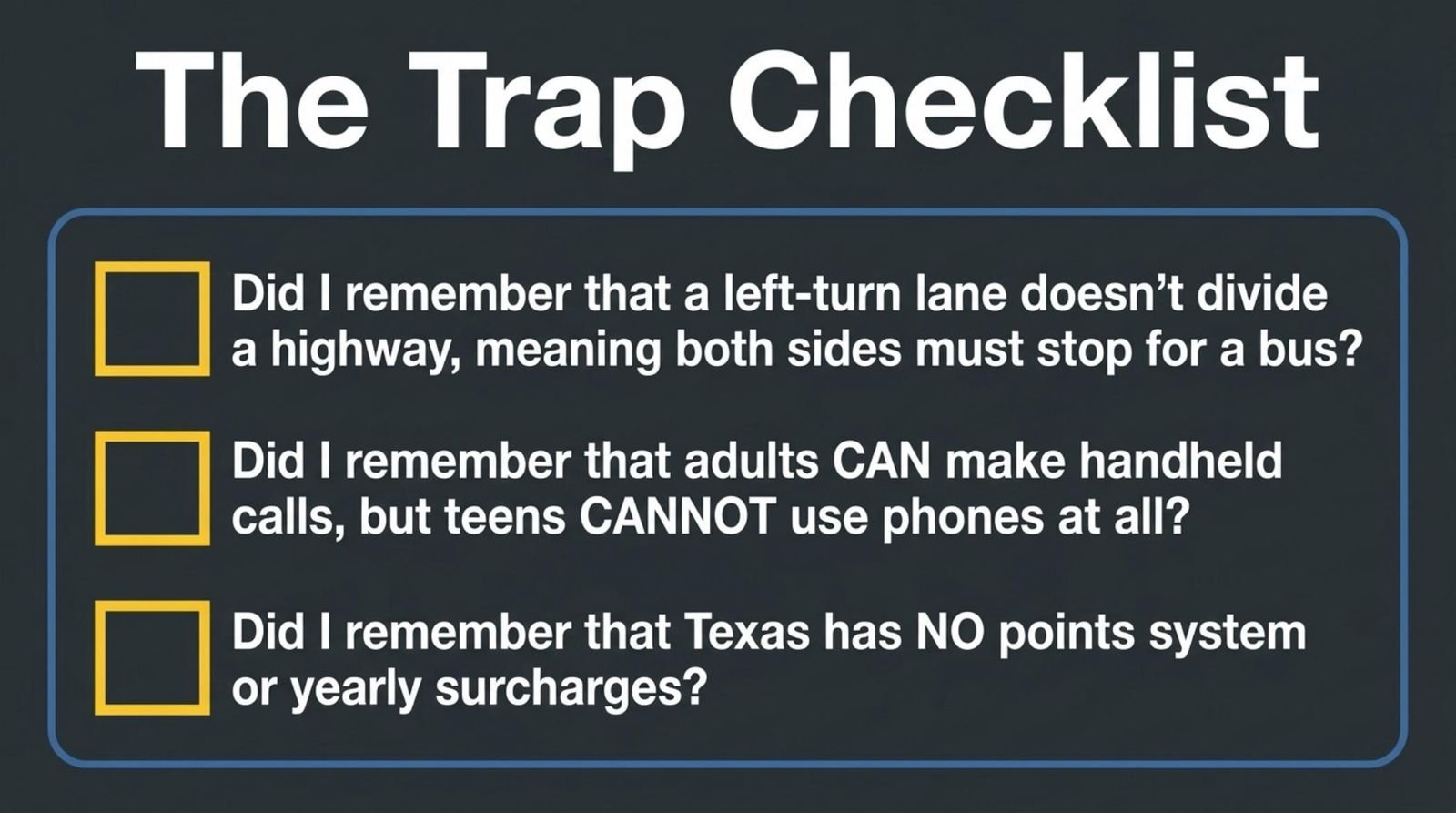
- Handheld calls by adults are not banned statewide. Texas has no general ban on holding a phone to talk — only the messaging ban. Some cities have stricter local hands-free ordinances, and those apply where posted.
- Drivers under 18 get a total ban: no wireless communication device at all while driving — including hands-free — except in an emergency.
- School crossing zones: using a wireless device is prohibited unless the vehicle is stopped or the device is used hands-free. A school-bus operator may not use a device at all while a minor passenger is on board.
The fines (for the texting offense, and the same ladder for the under-18 device offense):
| Offense | Fine |
|---|---|
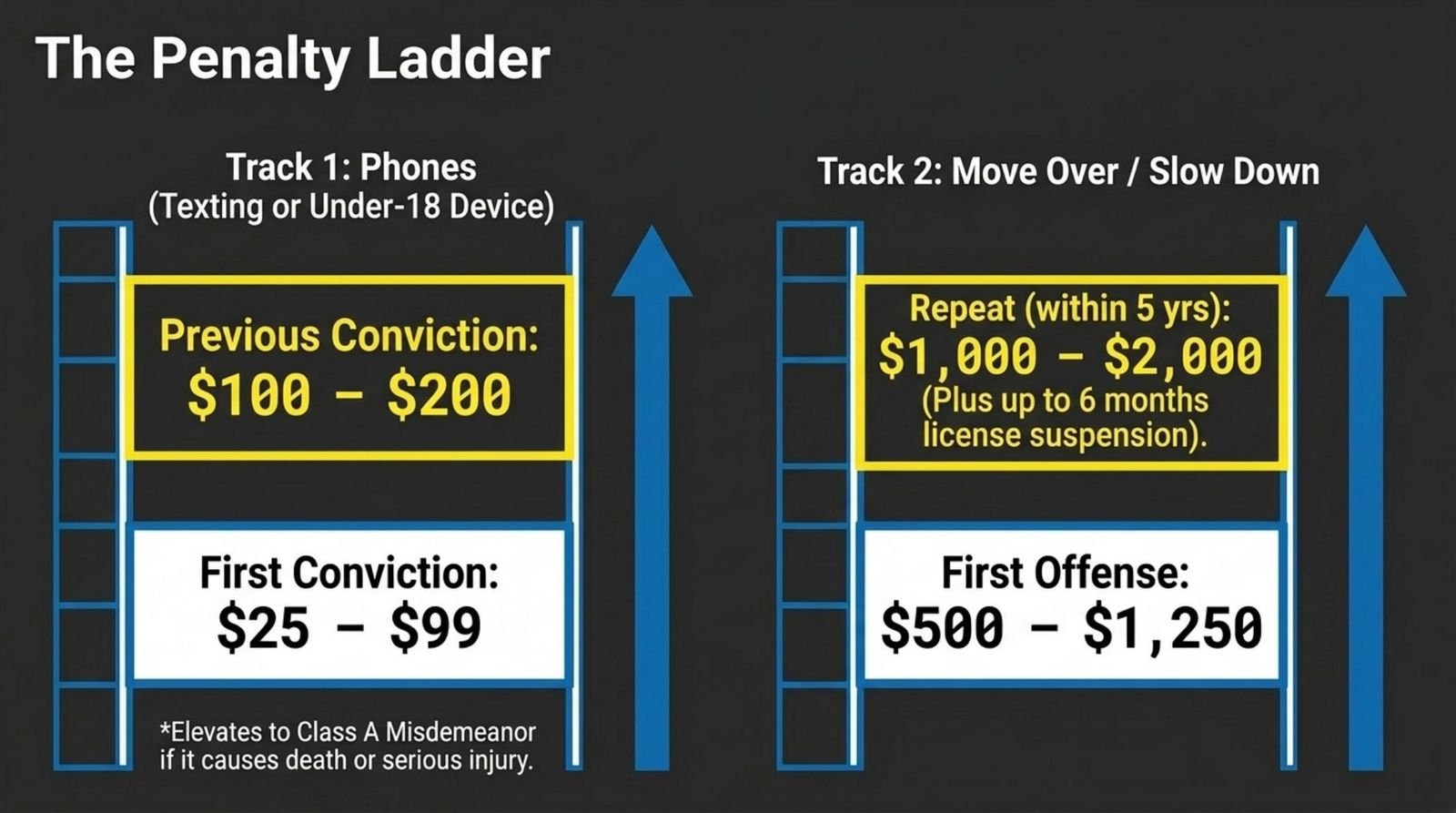
| First conviction | $25–$99 |
| Previously convicted | $100–$200 |
| Offense causes death or serious bodily injury | Class A misdemeanor — fine up to $4,000 and/or up to 1 year in jail |
Check yourself: A 17-year-old takes a call on a hands-free headset. An adult driver reads a text while rolling down the highway. Who has broken Texas law, and why?
Part 3: Move Over / Slow Down
Approaching a covered vehicle stopped with its lights activated, Texas law gives you exactly two options:
- Move out of the lane closest to the vehicle, when more than one lane runs your direction; or
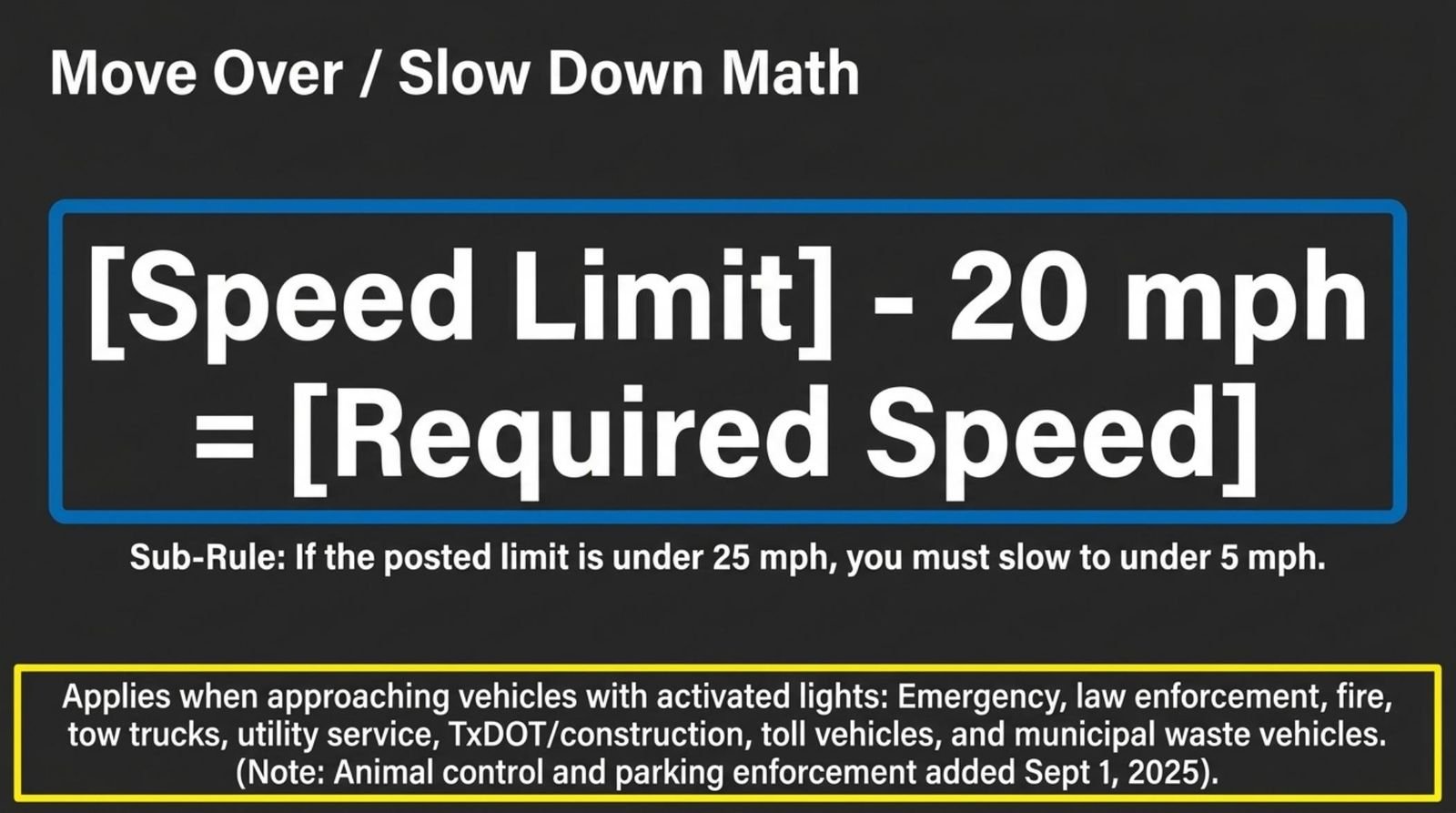
- Slow to 20 mph below the posted limit. If the posted limit is under 25 mph, slow to under 5 mph.
Vehicles covered: emergency medical vehicles, law enforcement vehicles, and fire trucks; tow trucks; utility service vehicles; TxDOT vehicles and other highway construction/maintenance vehicles; toll project entity vehicles using proper signals; and municipal solid-waste and recycling vehicles working next to the highway. Since September 1, 2025, the list also includes animal control officers removing an animal or carcass and local employees issuing parking citations.
The penalties (raised in 2023):
| Offense | Penalty |
|---|---|
| First offense | Misdemeanor, fine $500–$1,250 |
| Second or later offense within 5 years | Fine $1,000–$2,000 |
| Violation causes bodily injury | Class A misdemeanor (fine up to $4,000 and/or up to 1 year in jail); a repeat injury offense is a state jail felony |
On a repeat conviction, the court may also suspend your license for up to six months.
Check yourself: The limit is 70 and a tow truck with lights on is stopped on the shoulder, but traffic blocks your lane change. What speed does Texas law require?
Part 4: School buses and school zones
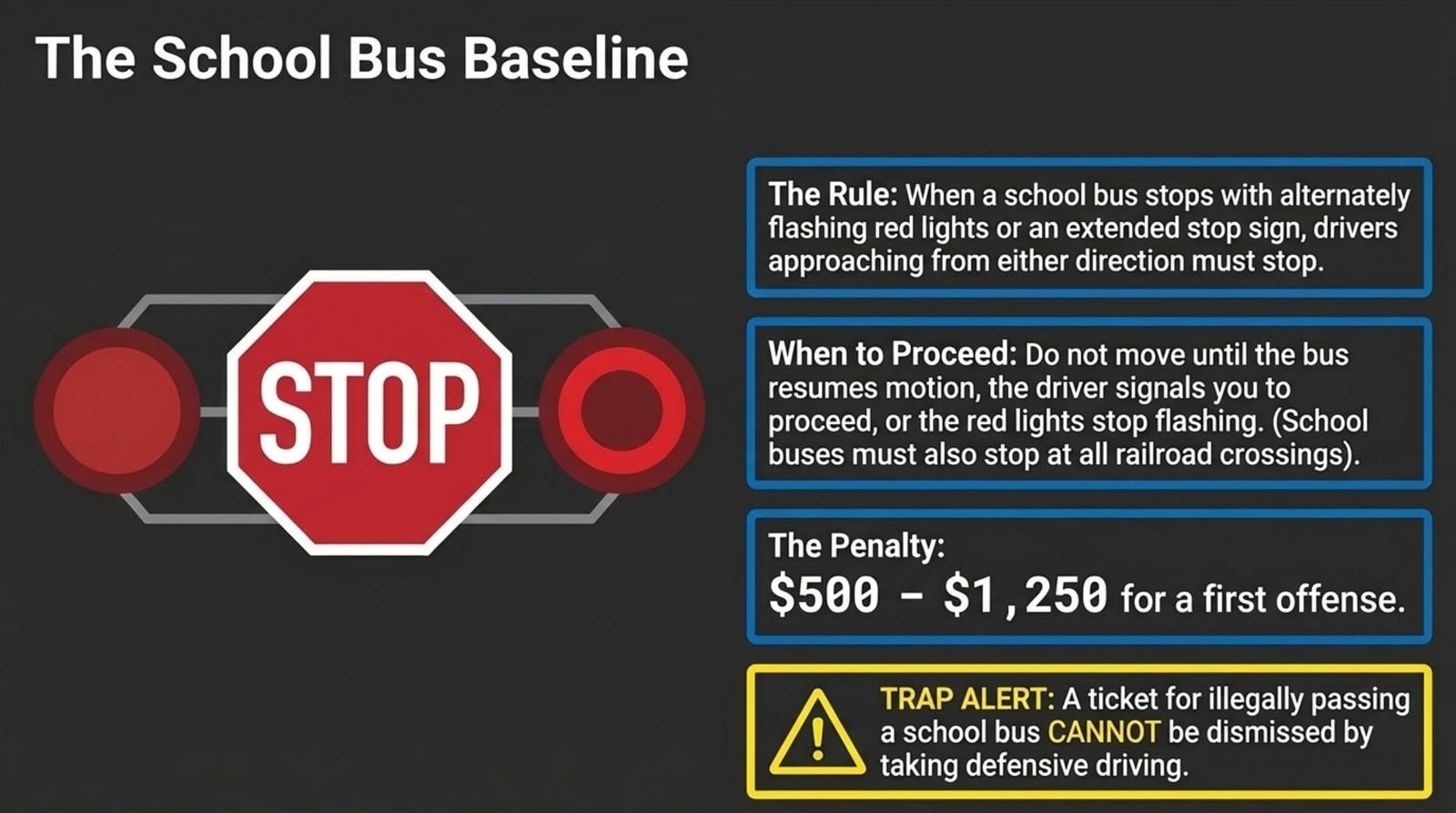
Stop for the bus. When a school bus is stopped with alternately flashing red lights (or its stop sign extended), drivers approaching from either direction must stop. Do not proceed until the bus resumes motion, the driver signals you to proceed, or the red lights stop flashing. School buses must stop at all railroad crossings.
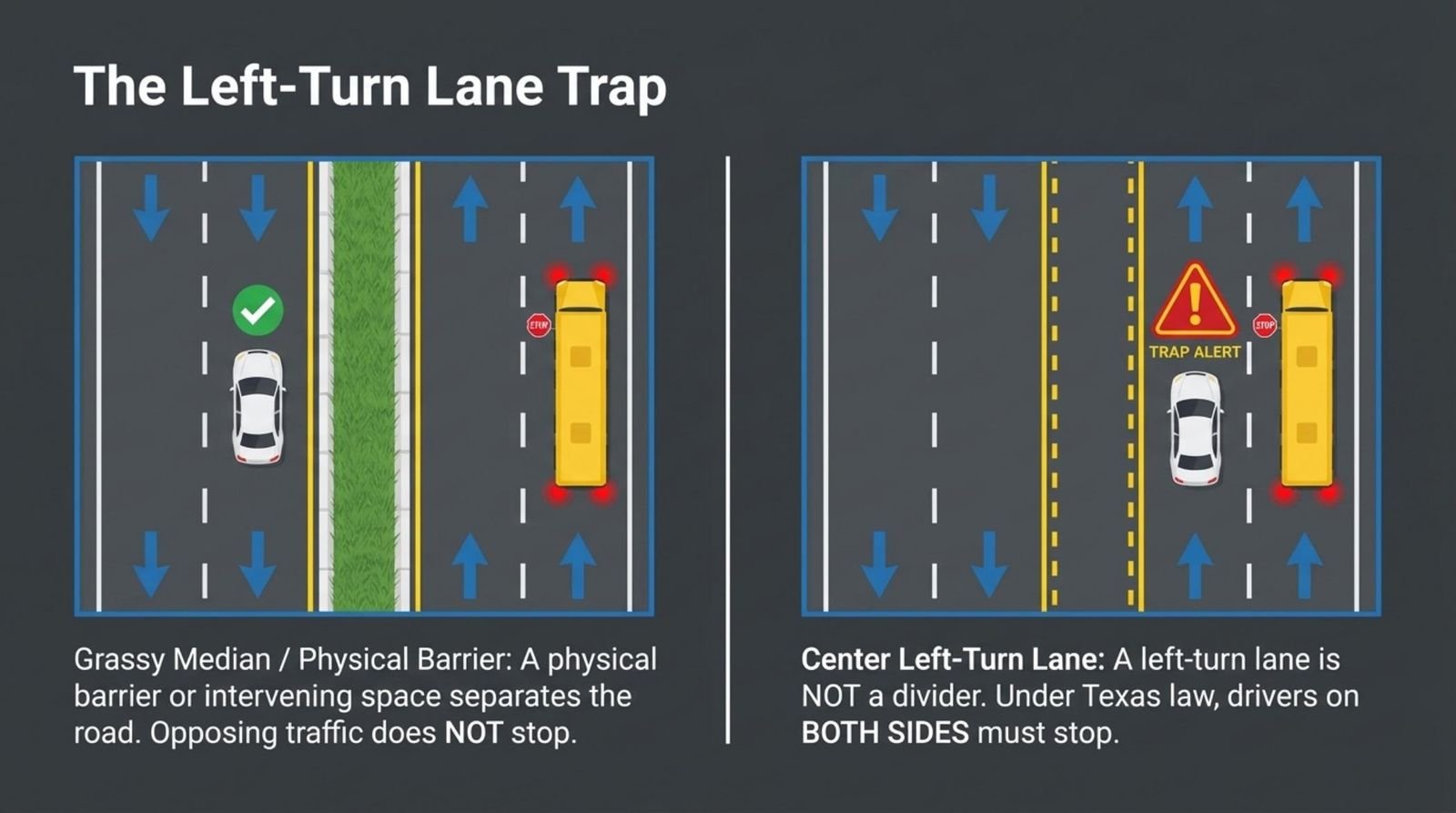
The divided-highway exception — and its trap. You are not required to stop if the bus is on a different roadway, or stopped in a loading zone on a controlled-access highway where pedestrians cannot cross. DPS is explicit: a roadway counts as separated when there is a physical barrier or an intervening space — but a highway divided only by a left-turn lane is NOT separated, and drivers on both sides must stop.
The fines (from the Transportation Code, §545.066):
- First conviction: fine of $500–$1,250.
- Second or later conviction within 5 years: fine of $1,000–$2,000, plus possible license suspension of up to 6 months.
- Causing serious bodily injury is a Class A misdemeanor.
- A ticket for illegally passing a school bus cannot be dismissed by taking defensive driving.
School zones pair the posted speed (Part 1) with the device rule (Part 2): when the beacon is flashing, the posted school-zone limit applies and wireless devices are off-limits unless you’re stopped or hands-free.
Check yourself: A school bus stops with flashing reds on the far side of a road divided only by a center left-turn lane. Must you stop? What if a grassy median separated them?
Part 5: Rules for young drivers
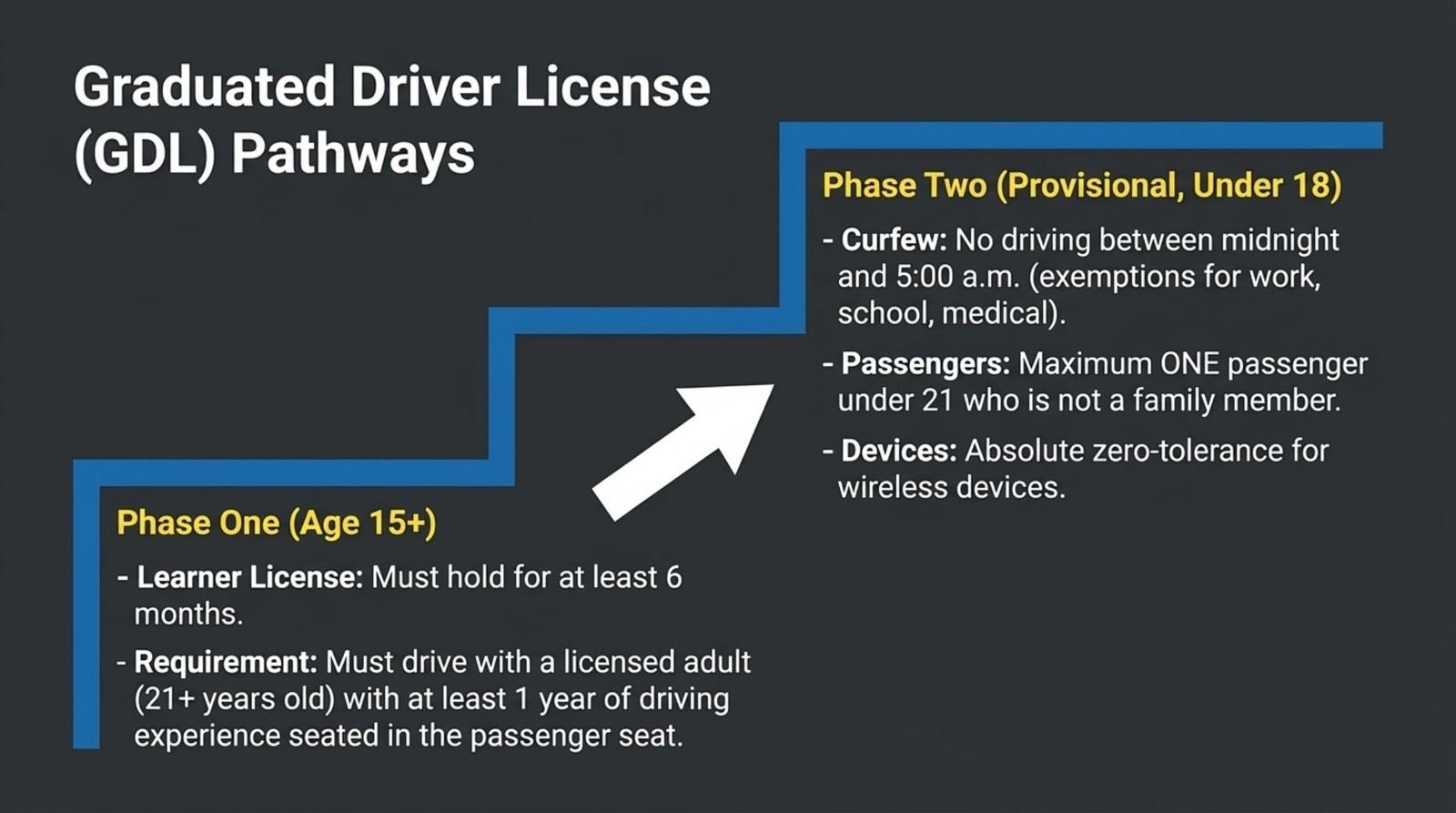
Texas’s Graduated Driver License program puts drivers under 18 in two phases. In Phase One (learner license, from age 15), you may practice only with a licensed driver at least 21 years old with at least one year of driving experience, seated beside you — and you must hold the learner license at least six months. In Phase Two (provisional license, ages 16–18), these restrictions apply until your 18th birthday:
- No driving between midnight and 5:00 a.m., except when necessary for employment, a school-related activity, or a medical emergency.
- No more than one passenger under 21 who is not a family member.
- No wireless device at all while driving — including hands-free — except in an emergency (Part 2).
The card itself tells the story: provisional licenses are marked “PROVISIONAL,” and every license issued under 21 is marked “UNDER 21.”
Check yourself: A 17-year-old with a provisional license drives two friends, both 19 and not family, across town at 3:00 p.m. The driving itself is careful. Has any rule been broken?
Part 6: No points in Texas
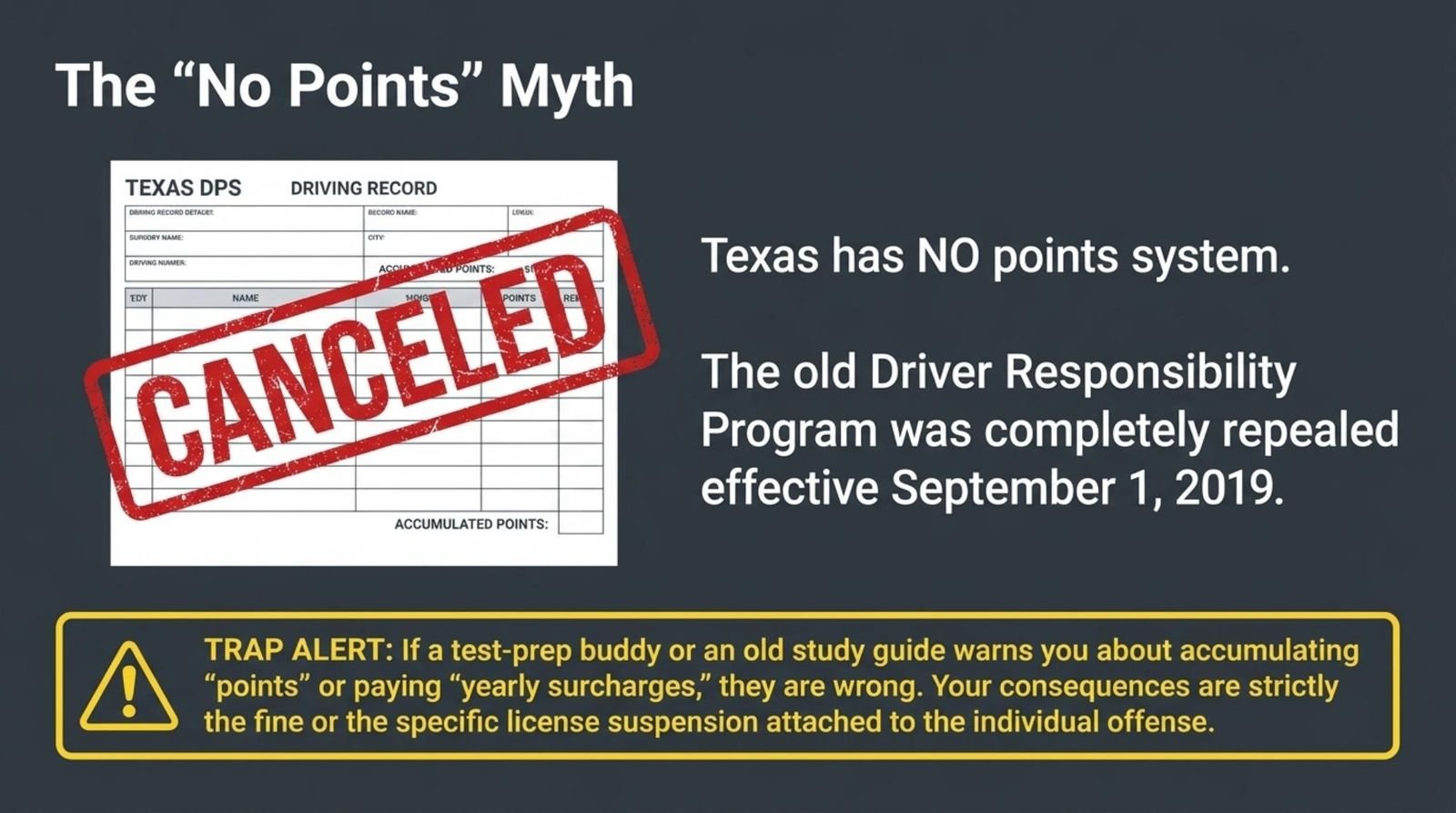
Many states add points to your record for every conviction. Texas does not. The Driver Responsibility Program — which charged annual surcharges based on points and certain convictions — was repealed effective September 1, 2019. When it ended, existing surcharges were waived and suspensions imposed for nonpayment were lifted. No points system replaced it. Texas license consequences flow from the individual offense itself: the court’s fine, a suspension attached to the offense, or an administrative revocation (see the Alcohol, Drugs & Driving Conditions guide). If a study source talks about Texas “points” or “surcharges,” it describes a system that no longer exists.
Key numbers to memorize
| Fact | Remember |
|---|---|
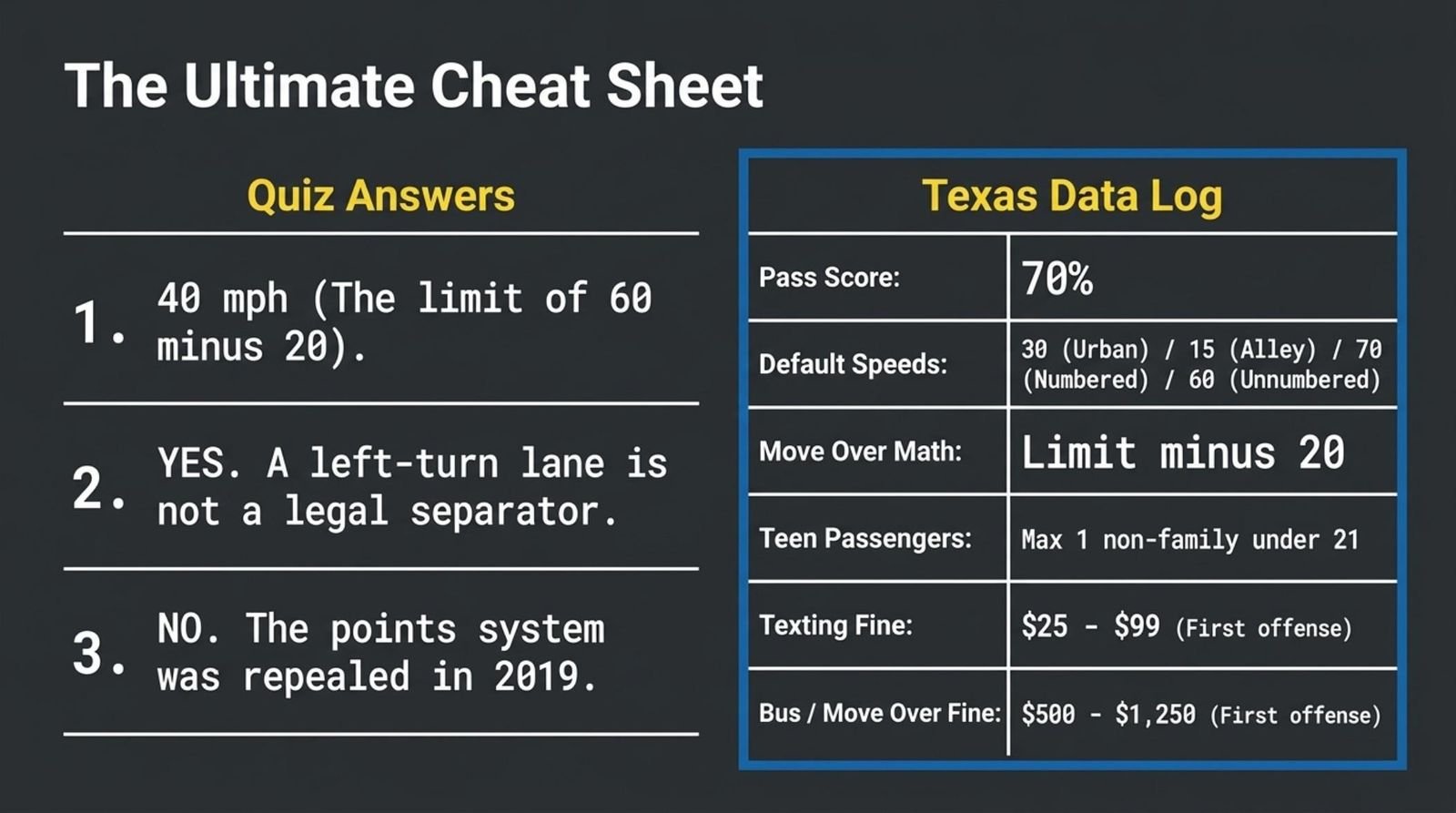
| Default limits: urban / alley / numbered highway / unnumbered highway | 30 / 15 / 70 / 60 mph |
| Highest posted limit | 85 mph — southern SH 130 |
| School-zone speed | The posted limit, when the beacon flashes — no statewide number |
| Texting fines | $25–$99 first conviction → $100–$200 if previously convicted |
| Under-18 device rule | No wireless device at all — handheld or hands-free (emergency excepted) |
| Move Over / Slow Down | Vacate the closest lane, or slow to 20 mph below the limit (under 5 mph if the limit is under 25) |
| Move Over fines | $500–$1,250 → $1,000–$2,000 (repeat within 5 years) |
| Passing a stopped school bus | $500–$1,250 first offense; no defensive-driving dismissal; a left-turn lane is not a divider |
| Phase Two hours / passengers | No driving midnight–5:00 a.m.; at most one passenger under 21 who isn’t family |
| Points and surcharges | None — the Driver Responsibility Program was repealed September 1, 2019 |
| Knowledge exam pass mark | 70% |
5-question self-check
- You’re driving on an unposted numbered Texas highway outside an urban district. What’s the speed limit?
- An adult driver holds a phone to her ear for a call on the highway. Has she broken a statewide Texas law? What if she is reading a text instead?
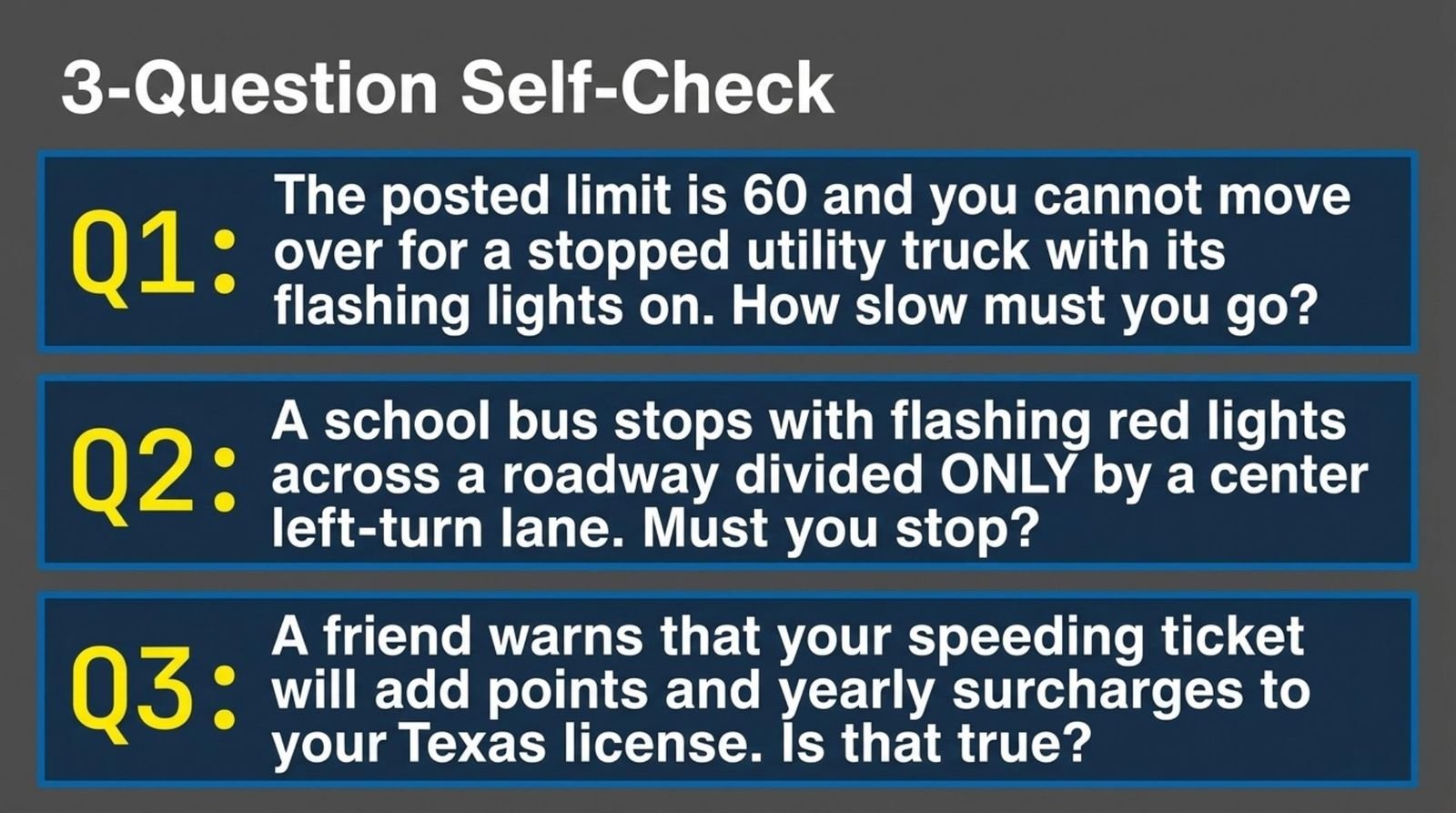
- The posted limit is 60 and you cannot move over for a stopped utility truck with its lights flashing. How slow must you go?
- A school bus stops with flashing red lights across a roadway divided only by a center left-turn lane. Must you stop?
- A friend warns that your ticket will add points and yearly surcharges to your Texas license. Is that true?
Answer key
- 70 mph — the statutory maximum for a numbered Texas or U.S. highway outside an urban district (an unnumbered highway would be 60 mph; an urban district, 30 mph).
- The call itself breaks no statewide law — Texas bans messaging for adults, not handheld calls (though some cities ban handheld use locally). Reading a text while operating the vehicle is an offense unless the vehicle is stopped: reading, writing, or sending a message is banned.
- 40 mph — 20 mph below the posted limit of 60. (If the posted limit were under 25 mph, you’d have to slow to under 5 mph.)
- Yes. A highway divided only by a left-turn lane is not “separated” under Texas law — drivers on both sides must stop. Only a different roadway, a physical barrier, or an intervening space creates the exception.
- No. Texas has no points system. The Driver Responsibility Program, which charged points-based surcharges, was repealed effective September 1, 2019; your consequences are the fine and any suspension attached to the offense itself.
Keep practicing
- Take the Traffic Laws practice quiz
- Flip through the Traffic Laws flashcards
- Ready for the whole test? Take the full Texas practice test
More study guides: Signs & Signals Study Guide · Right of Way Study Guide · Safe Driving Study Guide · Alcohol, Drugs & Driving Conditions Study Guide · Licensing & Registration Study Guide