
Your complete Texas study guide — plain language, no jargon.
📘 Prefer pictures? Flip through the visual deck
This whole guide as 10 slides — swipe or scroll sideways through them. Alcohol, drugs and driving in Texas — the limits, the penalties, the law.



Take it with you: Download the deck as a PDF (2.2 MB) → — free to share.
Why this matters
Texas calls it DWI — driving while intoxicated — and it enforces the law on two tracks at once: a criminal case in court, and a separate license suspension run by DPS that can start before you ever see a judge. For drivers under 21 there is no legal BAC at all: any detectable amount of alcohol is an offense. And one warning for anyone arriving from another state: Texas has no points system — the old Driver Responsibility Program and its yearly surcharges were repealed in 2019. This guide covers the limits, the penalty ladder, implied consent and the ALR, the special rules for minors, and the open container law.
Part 1: The legal limits
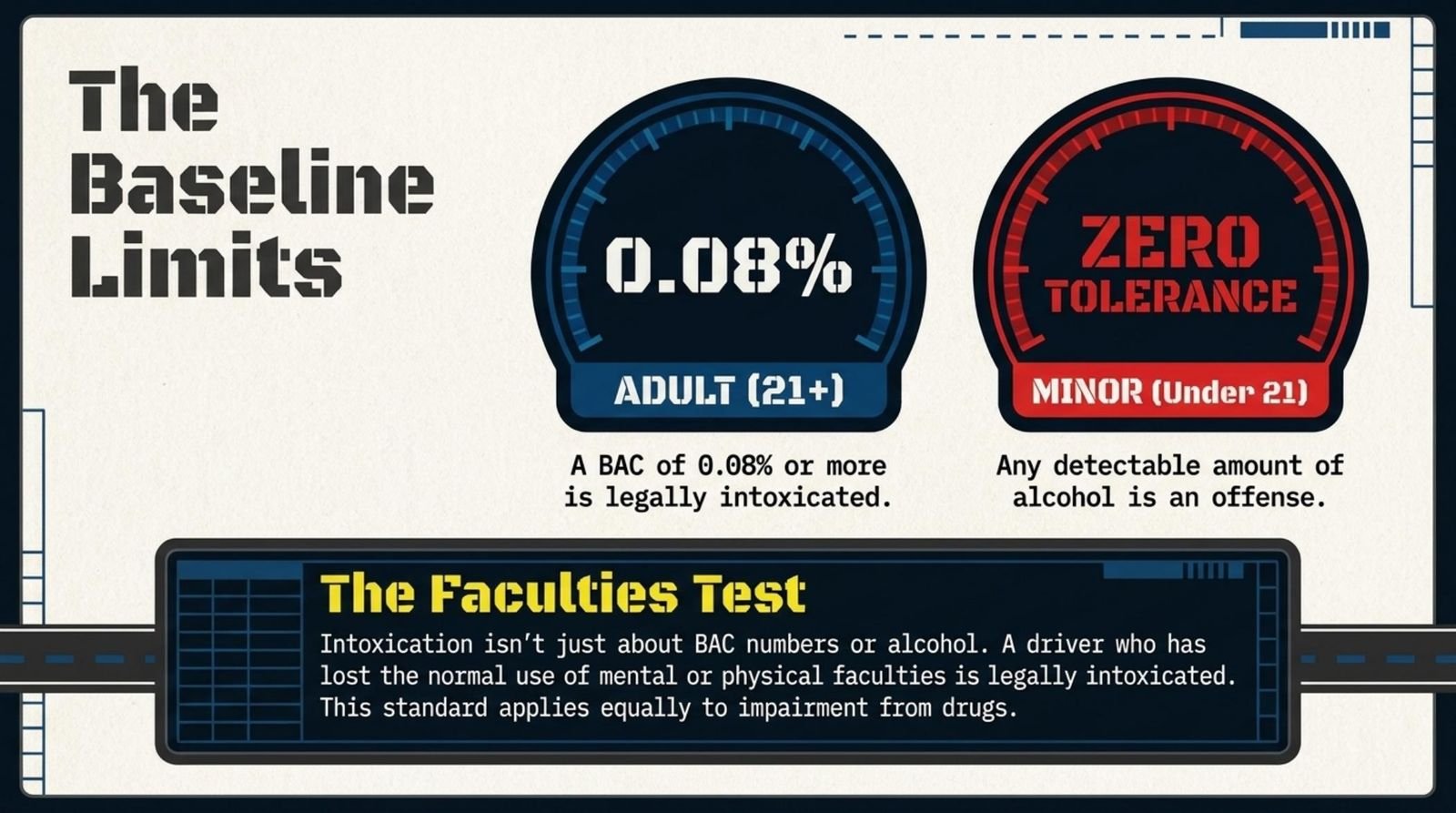
- BAC of 0.08 or more — a driver 21 or older is legally intoxicated at or above this level.
- The faculties test — Texas has a second way to judge intoxication: a driver who has lost the normal use of mental or physical faculties is intoxicated, whatever the cause. That is why DWI is not limited to alcohol — impairment from drugs falls under the same standard.
- Under 21: zero tolerance. A minor who drives with any detectable amount of alcohol commits the offense of Driving Under the Influence of Alcohol by a Minor. A minor can also be charged under the adult DWI law.
- The knowledge exam draws on these numbers — remember the passing score is 70% or better, and alcohol questions are some of the most fact-dense on it.
Check yourself: A 19-year-old driver has a BAC of 0.03% — well under the adult limit. Has she broken Texas law? What is the offense called?
Part 2: Adult DWI penalties
These are the criminal penalties a court can impose. Notice how fast the confinement column climbs — a third offense is measured in years, not days:
| Offense | Fine (up to) | Confinement | License suspension |
|---|---|---|---|
| 1st DWI | $2,000 | 72 hours – 180 days | 90 days – 1 year |
| 2nd DWI | $4,000 | 30 days – 1 year | 180 days – 2 years |
| 3rd or more | $10,000 | 2 – 10 years (prison) | 180 days – 2 years |
A first offense already carries a possible six months of confinement and a fine of up to $2,000 — and that is before the separate administrative suspension in Part 5, which runs on its own track. Keep the two suspensions straight, because the exam tests them separately: the suspension column in this table is imposed by the court as part of the criminal sentence, while the Part 5 suspension is imposed by DPS for failing or refusing the test. A single arrest can produce both, one after the other.
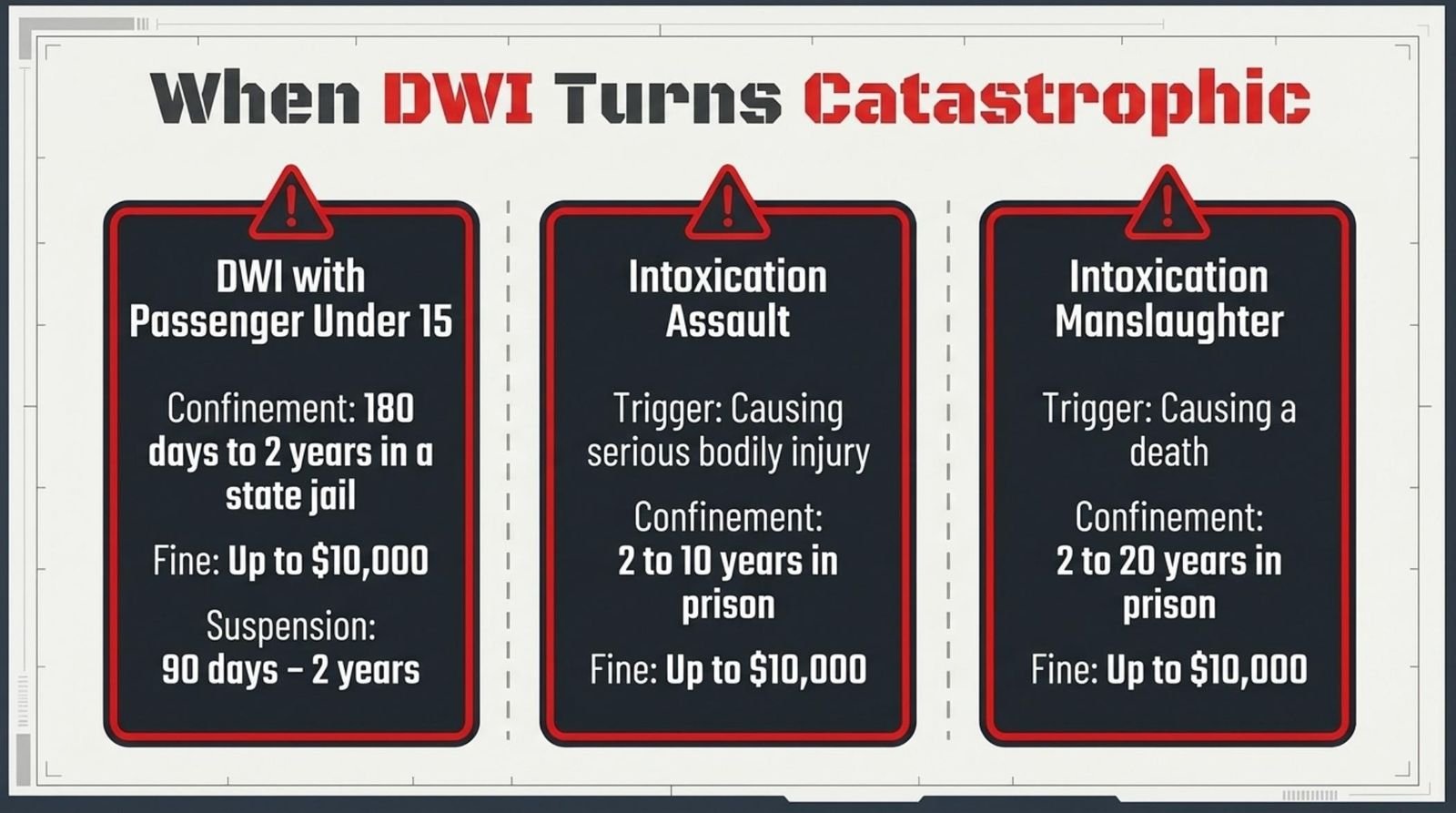
Part 3: When a DWI turns catastrophic
Three related offenses sit above ordinary DWI, and the test likes all three:
- DWI with a passenger under 15: a fine of up to $10,000, 180 days to 2 years in a state jail, and a license suspension of 90 days to 2 years.
- Intoxication assault: driving intoxicated and causing serious bodily injury to another person — a fine of up to $10,000 and 2 to 10 years in prison.
- Intoxication manslaughter: driving intoxicated and causing a death — a fine of up to $10,000 and 2 to 20 years in prison.
Check yourself: Two drivers are convicted of DWI on the same day. One was driving home alone; the other had her 12-year-old in the back seat. What extra exposure does the second driver face?
Part 4: Implied consent
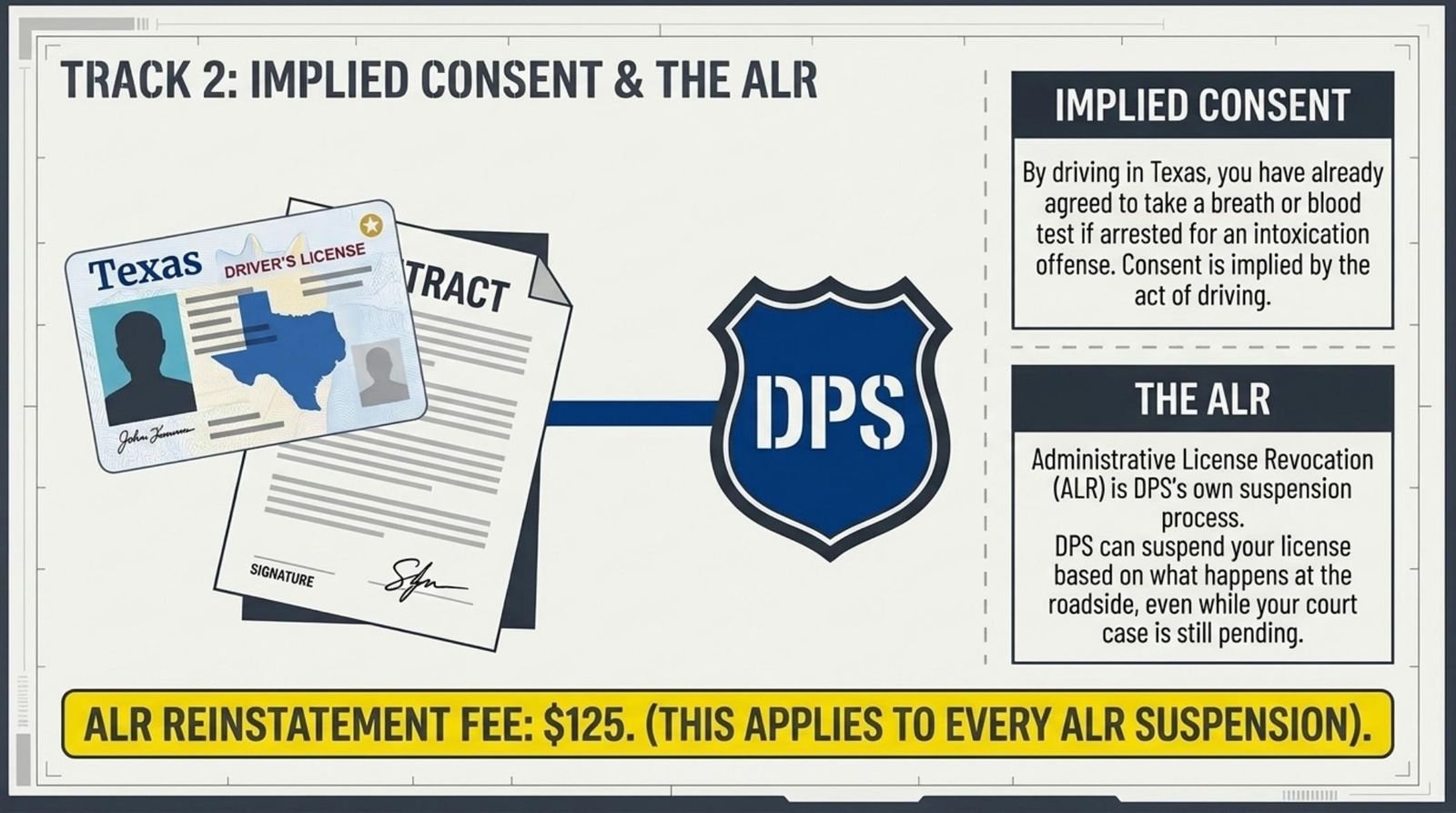
Implied consent: by driving in Texas, you have already agreed to take a breath or blood test if you are arrested for an intoxication offense. The test is not really optional — refusing it triggers its own suspension, covered in Part 5. What matters for the exam: consent is implied by the act of driving, and both failing the test and refusing it carry administrative consequences.
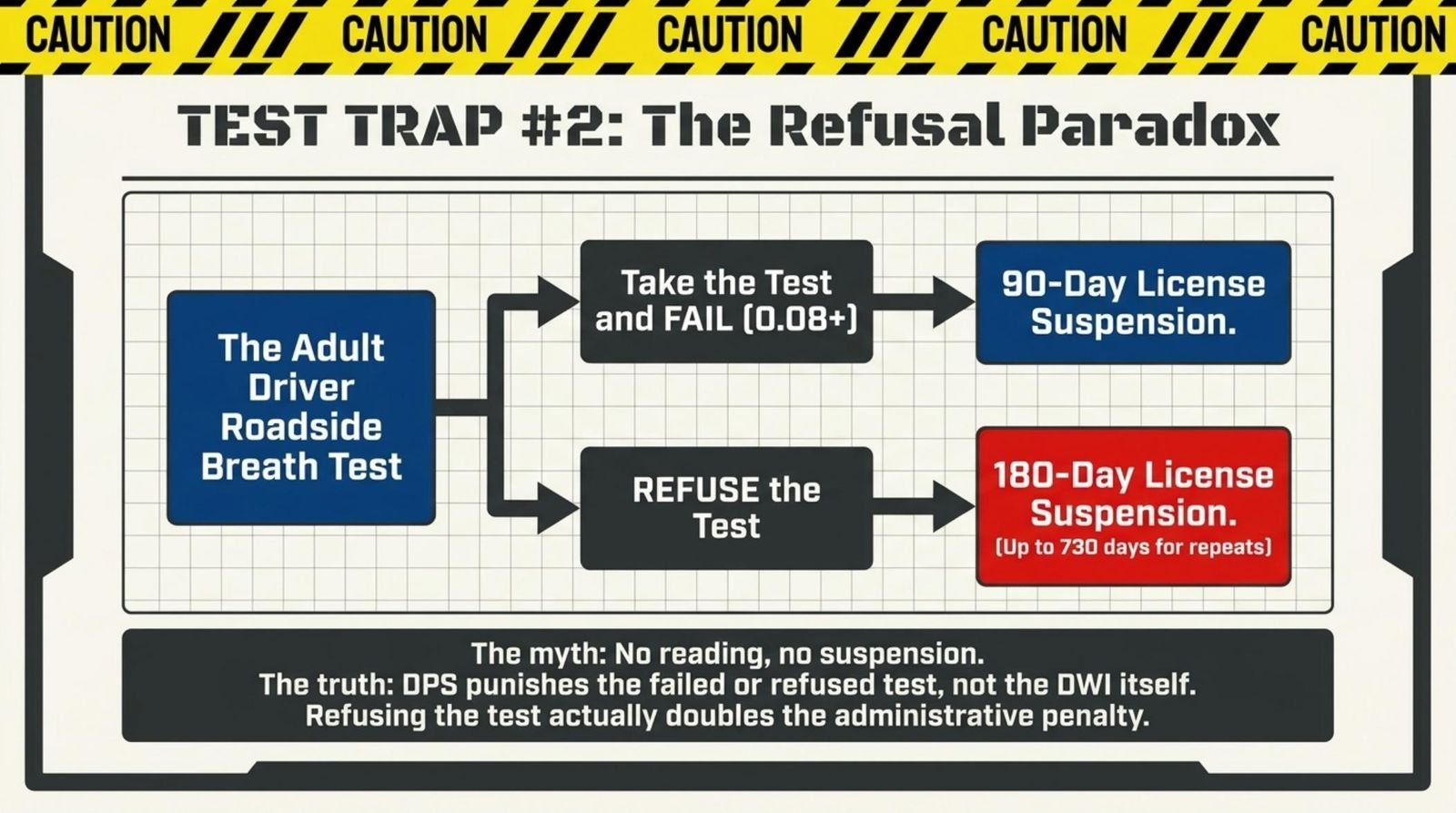
Notice what the ALR punishes: not the DWI itself, but the failed or refused test. That is why DPS does not need to wait for a conviction — the suspension follows from what happened at the roadside, and it applies to a driver 21 or older who fails at 0.08, to any driver who refuses, and to an under-21 driver with any detectable amount of alcohol.
Part 5: The ALR — the second track that takes your license
Administrative License Revocation (ALR) is DPS’s own suspension process. It is separate from the criminal case: DPS can suspend your license even while the court case is still pending. DPS may act against (a) a driver 21 or older who fails a breath or blood test at 0.08 or higher, (b) any driver who refuses a test, and (c) an under-21 driver with any detectable alcohol.
- Refuse the test (adult): license suspended for 180 days — up to 730 days for subsequent offenses.
- Take the test and fail (adult, 0.08+): license suspended for 90 days — up to 365 days for subsequent offenses.
- ALR reinstatement fee: $125, and it applies to every ALR suspension.
Read those first two bullets again: for a first-time adult, refusing costs 180 days but failing costs 90. “No reading, no suspension” is simply wrong in Texas — refusal doubles the administrative penalty.
Check yourself: A driver arrested for DWI refuses the breath test, figuring “no reading, no case.” What does Texas do about the refusal itself, and how does it compare with failing?
Part 6: Minors — DUI by a Minor
A minor’s first offense is a Class B misdemeanor: a fine of up to $2,000, confinement of 72 hours to 180 days, and a license suspension of 365 days — or 90 days if the judge orders an ignition interlock. If there was an open container in the vehicle, the minimum confinement rises to 6 days.
Minors face their own implied-consent ladder, and it is tested too:
- Refusal: suspension of 180 days for a first refusal, 2 years for a subsequent one.
- Failing with any detectable alcohol: suspension of 60, 120, or 180 days, depending on the number of prior convictions.
Notice the pattern in both ladders: a first misstep is punished firmly, and every repeat is punished harder. The examiners’ favorite minor question is the refusal figure — 180 days — so fix that one in memory.
Part 7: Open container
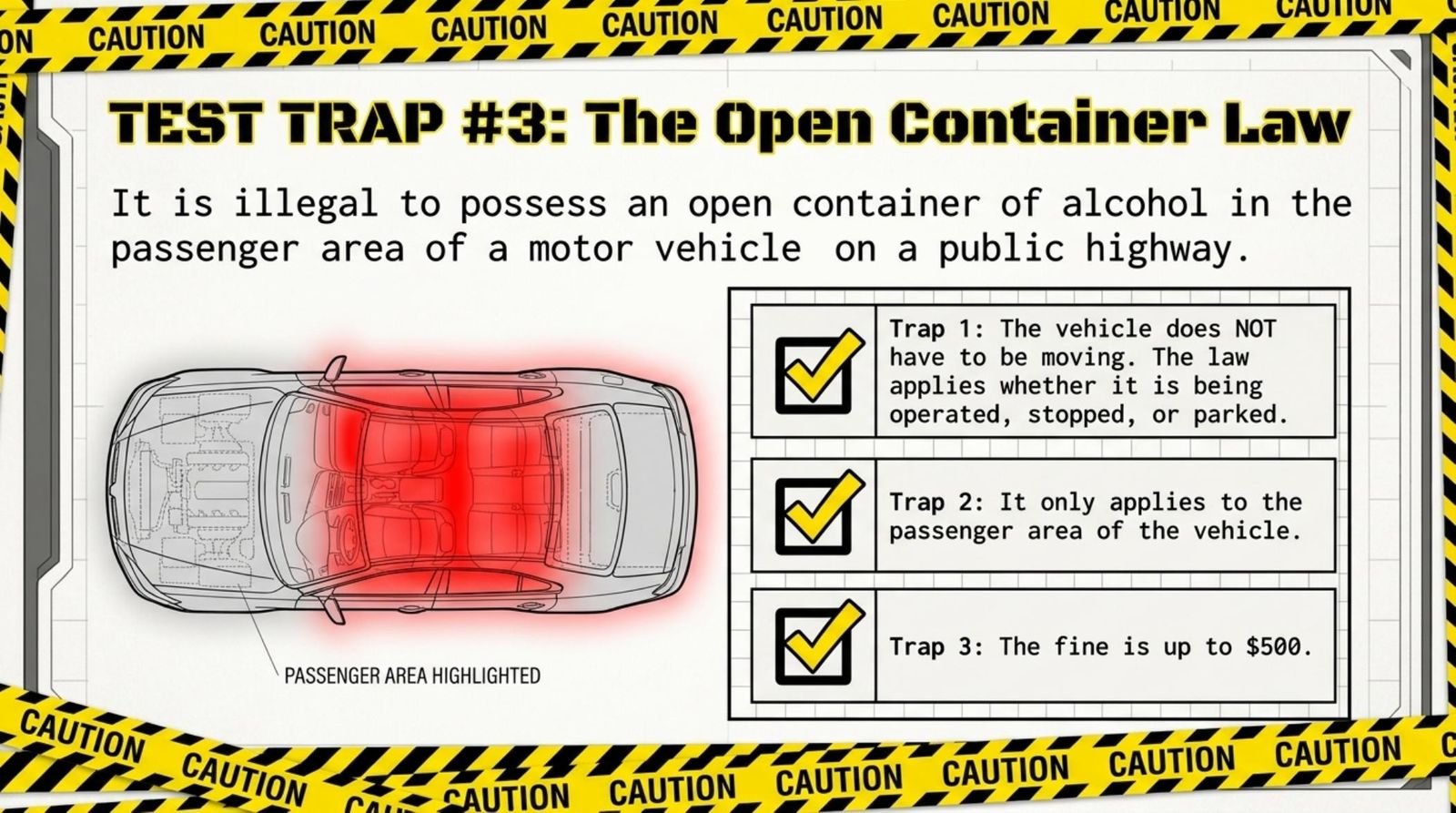
It is illegal to possess an open container of alcohol in the passenger area of a motor vehicle on a public highway. Three details the test loves:
- The vehicle does not have to be moving — the law applies whether it is being operated, stopped, or parked.
- The ban covers the passenger area of the vehicle.
- The fine is up to $500.
Check yourself: A passenger holds an open beer in a car parked on a public street, engine off. Has anyone broken Texas law?
Part 8: The points trap — Texas has none
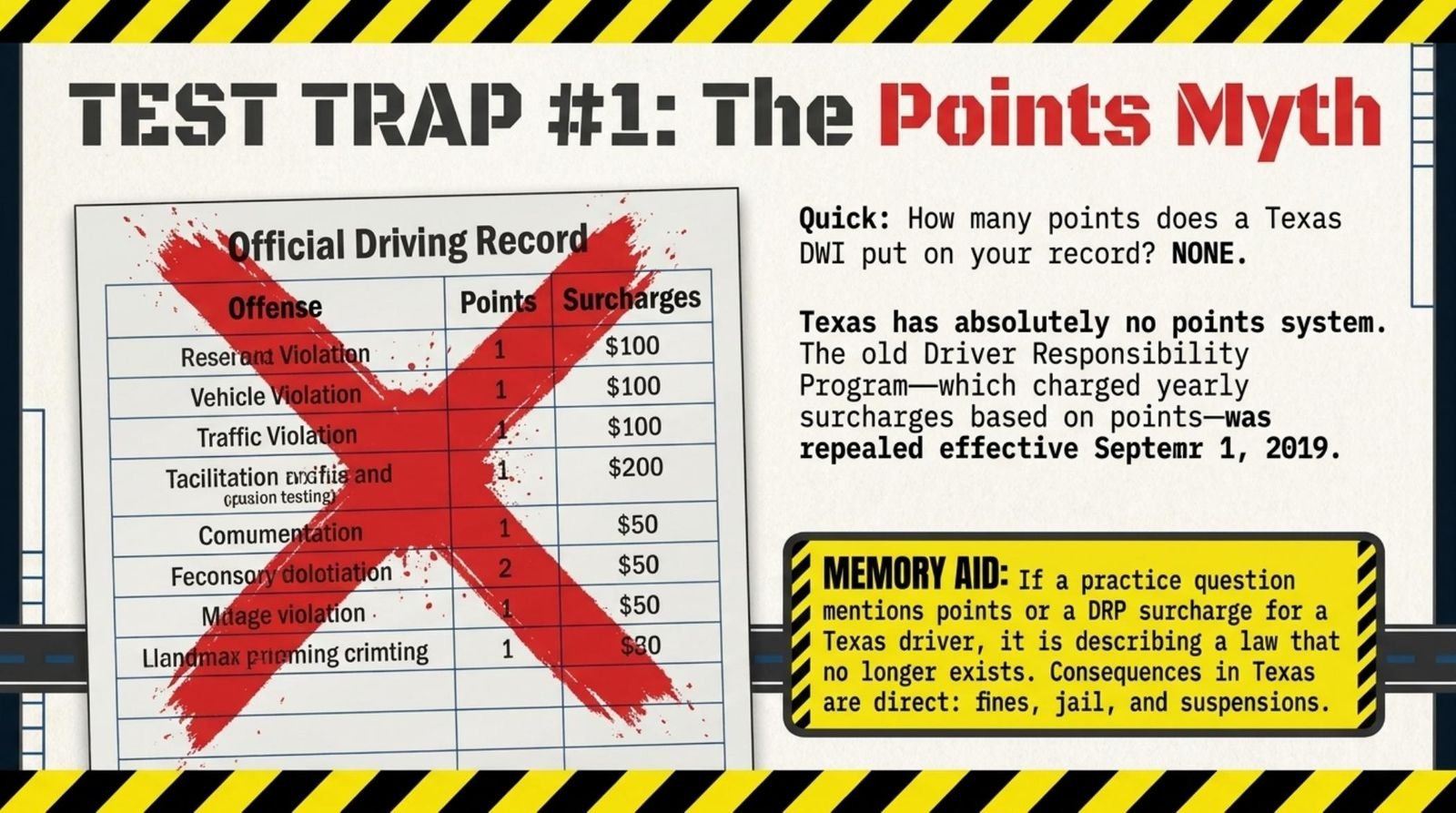
Quick: how many points does a Texas DWI put on your record? None — because Texas has no points system at all. The Driver Responsibility Program, which once charged annual surcharges based on points and convictions, was repealed effective September 1, 2019. On repeal, existing surcharges were waived and suspensions for not paying them were lifted. Nothing replaced it. Today, license consequences in Texas flow from the offense itself — court fines and confinement, ALR suspension, and reinstatement fees. If a practice question anywhere assigns points or a DRP surcharge to a Texas driver, it is describing a law that no longer exists.
Key numbers to memorize
| Fact | Remember |
|---|---|
| Illegal BAC: adults / under 21 | 0.08% / any detectable amount |
| The other intoxication test | Loss of normal use of mental or physical faculties |
| 1st DWI | Fine up to $2,000; 72 hours–180 days; suspension 90 days–1 year |
| 2nd DWI | Fine up to $4,000; 30 days–1 year; suspension 180 days–2 years |
| 3rd or more DWI | Fine up to $10,000; 2–10 years in prison |
| DWI with passenger under 15 | Fine up to $10,000; 180 days–2 years state jail |
| Intoxication assault / manslaughter | Up to $10,000; 2–10 years / 2–20 years |
| Test refusal (adult) | 180-day suspension (up to 730 days for repeats) |
| Test failed at 0.08+ (adult) | 90-day suspension (up to 365 days for repeats) |
| ALR reinstatement fee | $125 |
| Minor’s first DWI | Class B misdemeanor; 365-day suspension (90 days with interlock) |
| Minor refusal / minor fail | 180 days (2 years if repeat) / 60–120–180 days by priors |
| Open container | Up to $500 — passenger area, even when parked |
| Points for a DWI | None — Texas has no points system (DRP repealed Sept 1, 2019) |
| Knowledge exam pass mark | 70% or better |
5-question self-check
- A 19-year-old is stopped with a small but detectable amount of alcohol in her system. Has she violated Texas law, and what is the offense called?
- For a first adult DWI, what are the maximum fine, the confinement range, and the criminal license-suspension range?
- Why can refusing the breath test cost an adult driver more license time than failing it?
- What is the ALR, which agency runs it, and what does reinstatement cost?
- True or false: a Texas DWI adds points to your record and a yearly surcharge for three years. Explain.
Answer key
- Yes. Texas has zero tolerance for minors: driving with any detectable amount of alcohol is Driving Under the Influence of Alcohol by a Minor — and she could also be charged under the adult DWI law.
- A fine of up to $2,000; confinement from 72 hours to 180 days; and a license suspension of 90 days to 1 year — on top of any ALR suspension.
- Because refusal carries its own administrative suspension: 180 days for a first refusal, versus 90 days for a first failure at 0.08 or higher. Refusing doubles the ALR penalty instead of avoiding one.
- The Administrative License Revocation — DPS’s administrative suspension for failing or refusing a breath or blood test, separate from the criminal court case. The reinstatement fee is $125.
- False. Texas has no points system. The Driver Responsibility Program that charged points-based surcharges was repealed on September 1, 2019; consequences now come from the offense itself — fines, confinement, ALR, and suspensions.
Keep practicing
- Take the Alcohol & Drugs practice quiz
- Flip through the Alcohol & Drugs flashcards
- Take the full Texas practice test
More study guides: Signs & Signals Study Guide · Traffic Laws Study Guide · Right of Way Study Guide · Safe Driving Study Guide · Licensing & Registration Study Guide