Your complete Washington study guide — plain language, no jargon.
Built from the official guide. Every fact in this Washington section comes from the Washington Driver Guide, published by the Washington State Department of Licensing (DOL) — checked against the current edition and verified November 12, 2026. Read the guide itself at dol.wa.gov.
📘 Prefer pictures? Flip through the visual deck
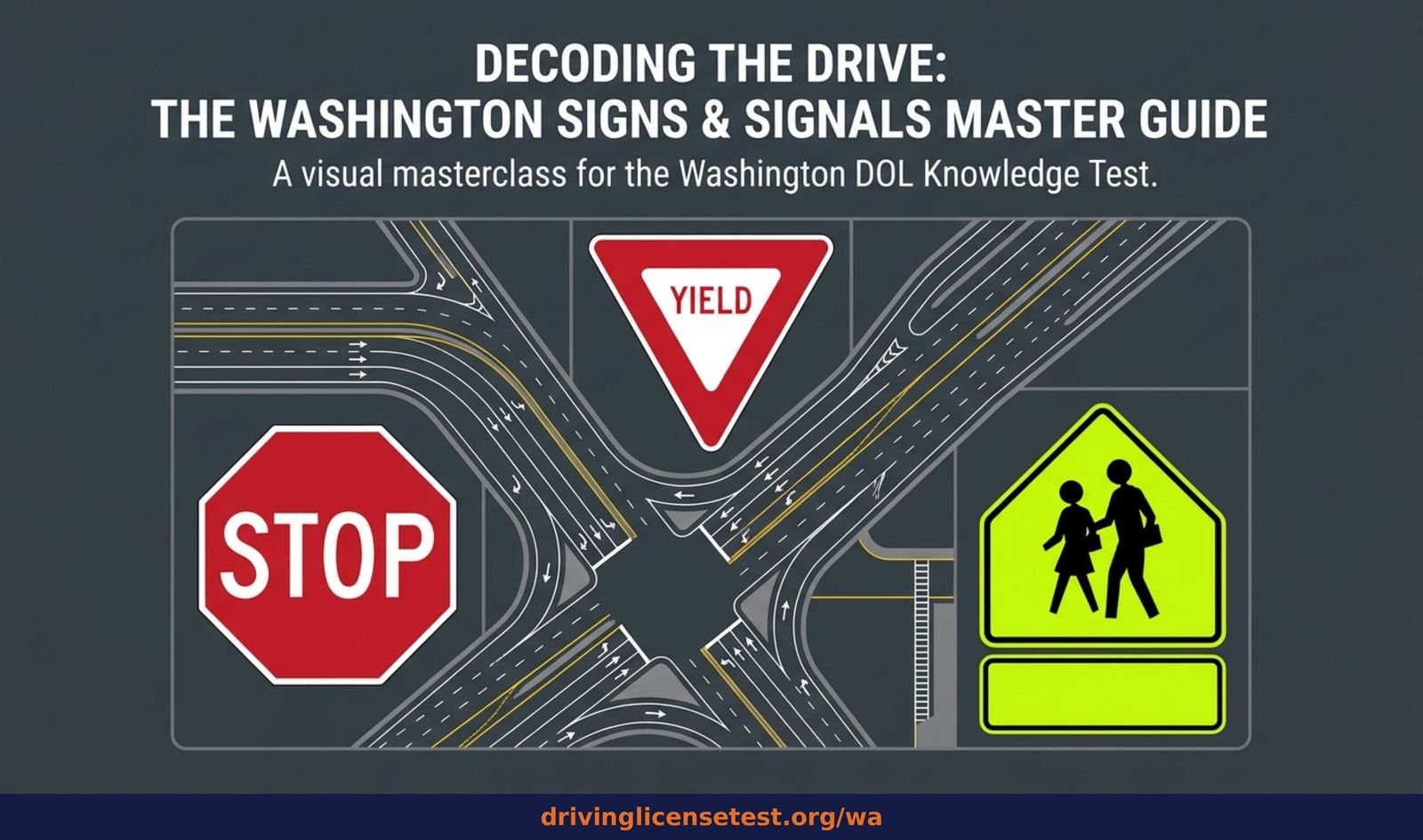
This whole guide as 12 slides — swipe or scroll sideways through them. Washington Signs & Signals study guide, practice tests & flashcards: the shape key, the color families, the dark-signal rule and the painted rules.





Take it with you: Download the deck as a PDF (6.3 MB) → — free to share.
Why this matters
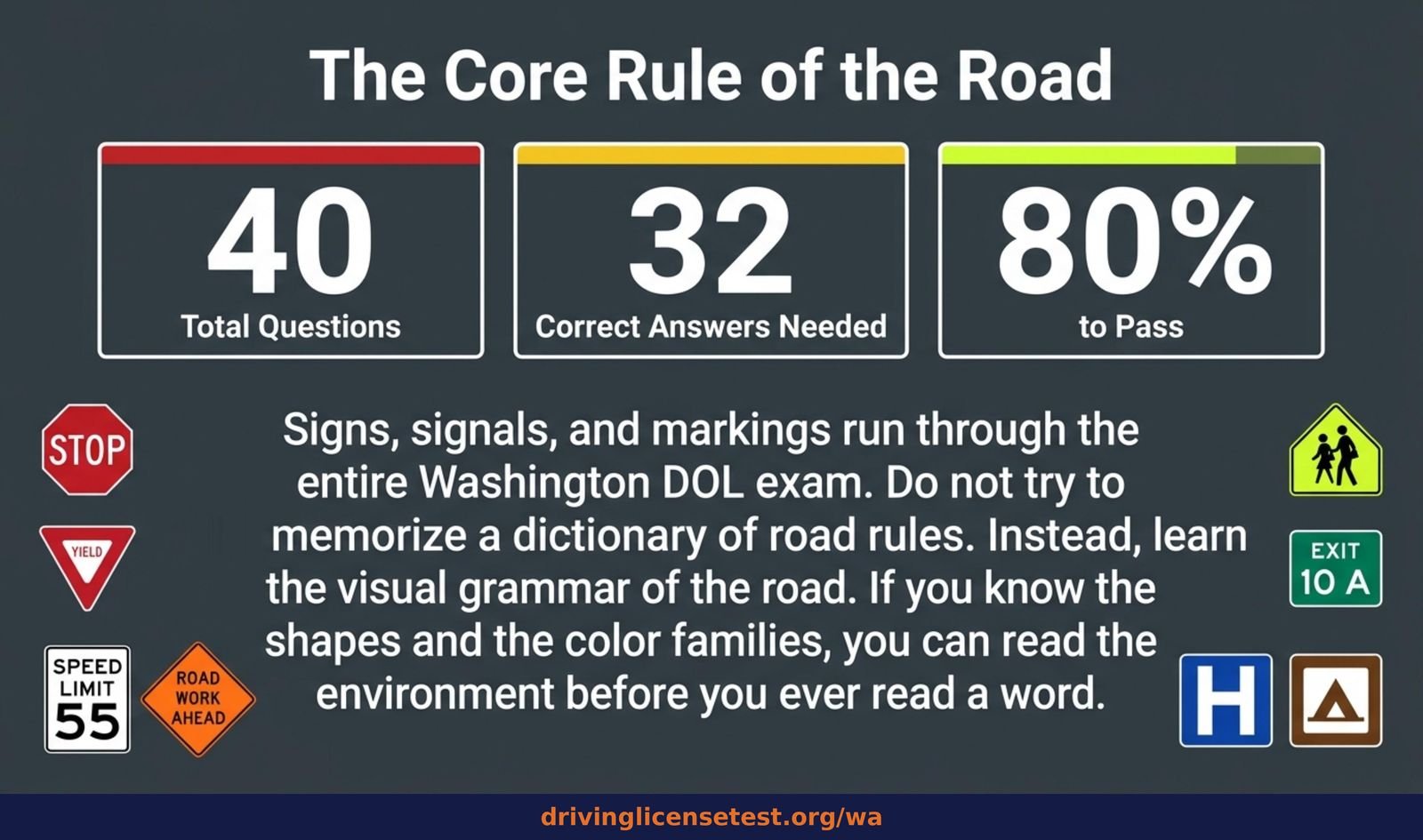
Signs, signals, and road markings are the language of the road: they warn you, tell you the rules, and guide you. In Washington, driver licensing is administered by the Washington State Department of Licensing — the DOL — and the official study book is the Washington Driver Guide. Washington’s knowledge test is 40 multiple-choice questions, and you must answer 32 correctly (80%) to pass — and signs and signals run through the whole test, not just one corner of it. So this guide starts with the code itself: learn the shapes and the color families, and you can read most signs before you can read their words.
Part 1: The master key — sign shapes
Do not start by memorizing signs one at a time. Start with the simpler key the signs themselves use: shape. Each basic shape carries one job:
- Octagon (8 sides) — STOP. Used for the stop sign only, so you can recognize it from behind, in fog, or covered in snow.
- Inverted triangle (point down) — YIELD.
- Diamond — WARNING: a hazard or condition ahead.
- Pentagon (5 sides, like a little house) — SCHOOL: a school zone or school crossing.
- Pennant (sideways triangle) — NO PASSING: a no-passing zone begins.
- Round — RAILROAD CROSSING advance warning: the tracks are coming.
- Crossbuck (an X) — the RAILROAD CROSSING itself. The advance warning is round; the crossing is the X.
- Rectangles — vertical rectangles state regulations (the law); horizontal rectangles give directions and guidance.
Memory aid: Eight sides: stop — and only stop. Point-down triangle: yield. Diamond: danger ahead. House shape: school. Pennant: passing is over. Round: railroad ahead. X: the crossing itself.
Check yourself: Three signs appear in the fog: a round sign, a five-sided sign, and a sideways-triangle pennant. Name each one’s job from its shape alone.
Part 2: The master key, continued — what the colors mean in Washington
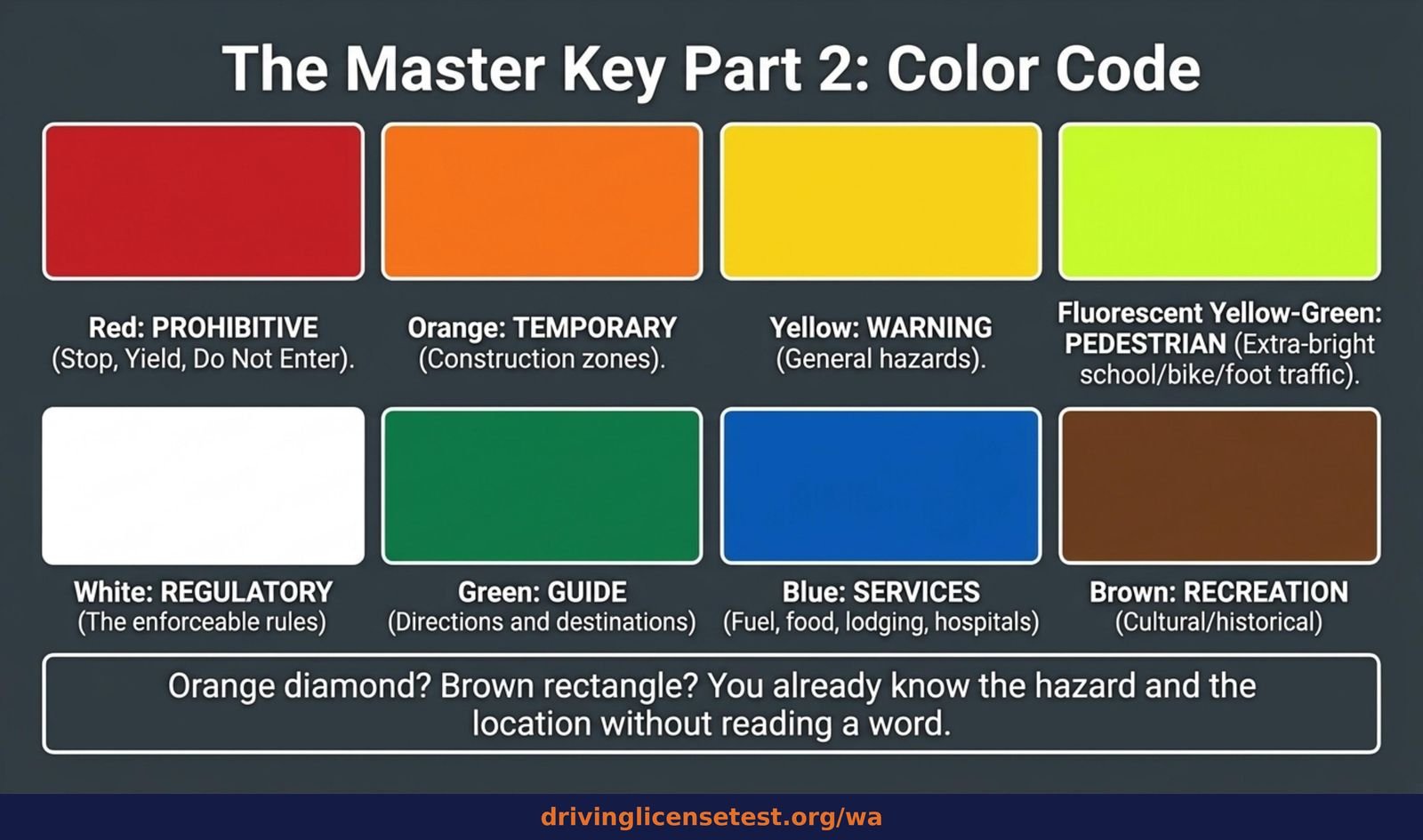
Color is the second half of the master key. The Washington Driver Guide assigns each color family one kind of message:
- Red — prohibitive or restricted: STOP, YIELD, DO NOT ENTER, and the red circle-and-slash that means “No.”
- Orange — construction and temporary conditions.
- Yellow — general warning.
- Fluorescent yellow-green — extra-bright warning for school, pedestrian, and bicycling areas.
- White — regulatory: the rules themselves, such as speed limits.
- Green — guide information: directions and destinations.
- Blue — motorist services: fuel, food, lodging, hospitals.
- Brown — recreation, cultural, and historical information.
Memory aid: Red forbids. Yellow warns. Orange means construction. White regulates, green guides, blue serves, brown shows recreation.
Check yourself: You see an orange diamond and a brown rectangle on the same stretch of road. Before you read either one — what kind of message is each carrying?
Part 3: Regulatory and warning signs on Washington roads
Regulatory signs set limits or tell drivers what they must or must not do. They are enforceable by law — not advice, but the rule for that place.
Stop sign. A complete halt before the stop line — or, if there is no line, before the crosswalk, then the place where you can see traffic.
Yield sign. Slow down, and stop if you cannot merge safely into the flow of traffic. The duty to give the right-of-way is absolute even when a full stop is not needed.
Do Not Enter and Wrong Way. Do Not Enter appears where a roadway may not be entered — one-way streets, exit ramps, divided-highway crossroads. Wrong Way means you are already going against traffic: pull over and turn around immediately when it is safe to do so.
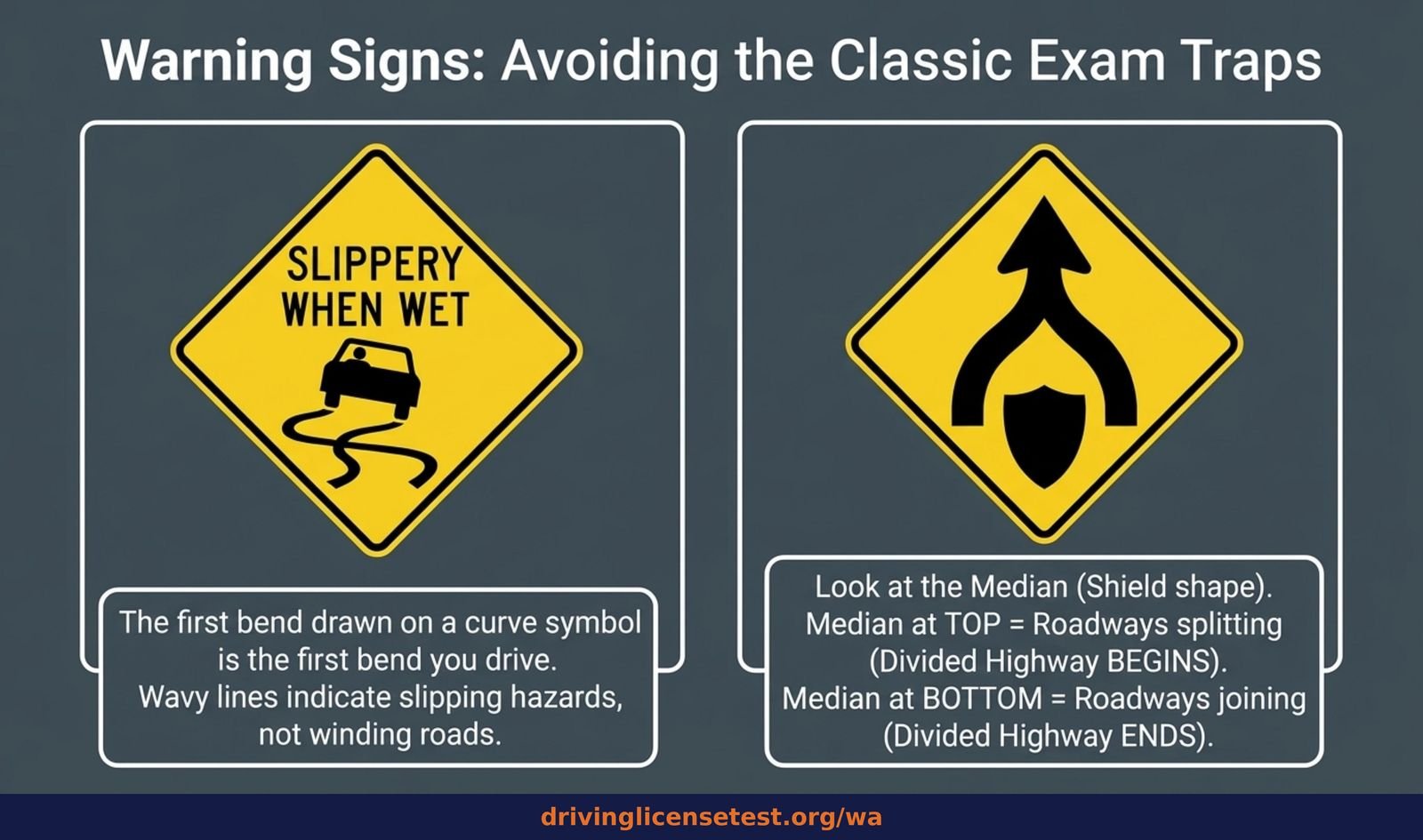
Warning signs are diamond-shaped, usually yellow, and alert you to conditions ahead — a heads-up, not an order. In work zones the same diamonds turn orange. Read a curve symbol carefully: the first bend drawn is the first bend you will drive. A Divided Highway Begins / Ends pair decides whether a median is about to separate you from oncoming traffic or about to disappear — learn the pair by the median’s position: on Begins, the median nose sits at the top and the roadways split around it; on Ends, the median nose sits at the bottom and the roadways join. Swapping them in your head is the classic exam trap.
Work zones. Washington doubles the fines in work zones when workers are present — the orange signs are a warning about people, not just cones.
Check yourself: A diamond shows two roadways joining into one, with the divider drawn at the bottom. Is the divided highway beginning or ending — and what changes about the traffic beside you?
Part 4: Traffic signals — Washington’s set
Signals outrank signs and markings, and only a police officer or authorized traffic director outranks a signal:
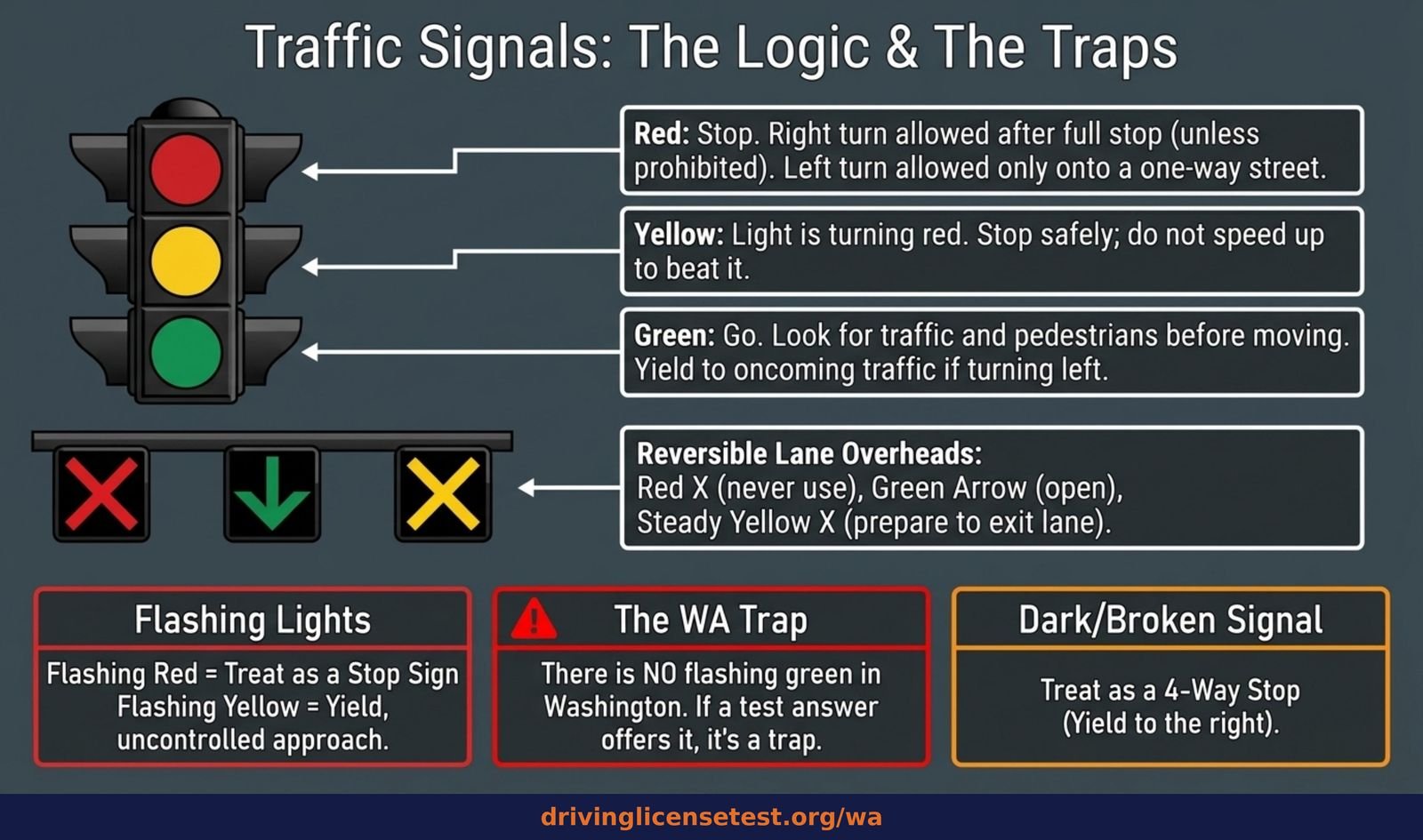
- Steady red — stop and remain stopped until green. A right turn on red is allowed after a complete stop unless a “No Turn on Red” sign prohibits it; a left turn on red onto a one-way street is likewise allowed after stopping.
- Steady yellow — the light is about to turn red. Stop if you can do so safely; do not speed up to beat it.
- Steady green — go, after yielding to anyone still in the intersection.
- Green arrow with a red light — you may turn in the arrow’s direction, yielding as required, even though the round light is red.
- Flashing red — stop, as at a stop sign, then proceed when clear.
- Flashing yellow — yield: an uncontrolled approach, taken with caution.
- There is no flashing green in Washington. If an answer choice offers one, it belongs to some other place — not here.
- Dark signal — a broken signal that shows nothing at all is treated as a 4-way stop: stop, and yield to traffic on the right.
Lane-use signals hang over reversible lanes: a red X means never use the lane; a green arrow means the lane is open to you; a steady yellow X completes the overhead set Washington uses.
Check yourself: The signal at the intersection ahead is completely dark, and a classmate tells you a flashing green will sort it out. Name two errors in that plan.
Part 5: Pavement markings — the painted rules
Markings carry the same authority as signs. Learn the white family and the yellow family separately:
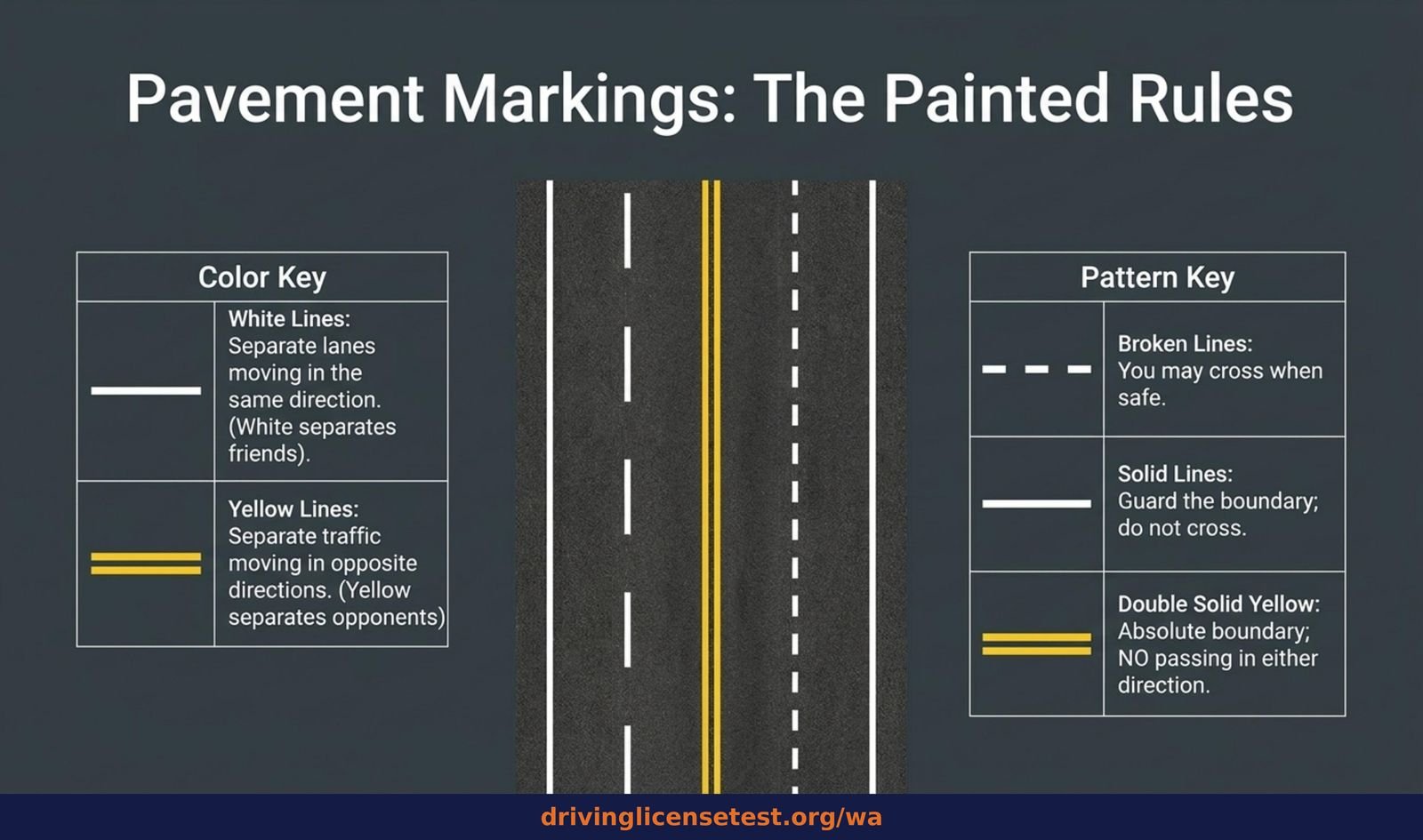
- Yellow lines separate traffic moving in opposite directions.
- White lines separate lanes moving in the same direction.
- Broken lines may be crossed when it is safe; solid lines guard the boundary.
- Double solid white lines may not be crossed.
- Double solid yellow lines mean no passing in either direction.
- Shared center left-turn lane — the lane in the middle, used by both directions for left turns only. You may not travel in it for more than 300 feet — it is a turning lane, never a travel lane or a passing lane.
- HOV lanes are marked with a diamond symbol, and motorcycles may use them.
- Reversible lanes use double-dashed white lines under the overhead red X / green arrow / steady yellow X signals from Part 4.
- Stop lines, crosswalks, and edge lines — stop behind the line; yield to anyone in the crosswalk; the solid white edge line marks the pavement’s edge.
Memory aid: White separates friends (same direction); yellow separates opponents (opposite directions). Broken means you may cross; solid means you may not.
Check yourself: The lane in the middle of the road is the shared center turn lane. How far may you travel in it — and name two things it may never be used for.
Part 6: Crosswalks, cameras, and the markings that protect people
One Washington rule ties this whole guide together: every intersection is legally a crosswalk, marked or not. Painted lines or no painted lines, pedestrians hold the right-of-way there — the Right of Way guide covers the full stop-and-wait duties. Washington also uses automated cameras to enforce three things: red-light running, railroad-crossing violations, and school-zone speeding. Camera locations are marked, and tickets are mailed to the vehicle owner. The sign is doing double duty: it warns you about the hazard ahead, and in these three places it also tells you the enforcement is automatic.
One last tool for reading any intersection: if you use hand signals because a turn signal has failed, an arm extended straight out means left turn, bent upward means right turn, and bent downward means stop or slow.
Check yourself: An intersection has no painted crosswalk at all. A pedestrian steps off the curb to cross. Is that a crosswalk in Washington law — and what three violations do marked cameras enforce?
Key numbers to memorize
| The Washington knowledge test | 40 questions — 32 correct (80%) to pass |
| Octagon | STOP — used for nothing else |
| Pentagon | School zone / school crossing |
| Round sign | Railroad crossing ahead; the crossbuck marks the crossing itself |
| Center left-turn lane | Travel in it no more than 300 feet |
| Work-zone fines | Doubled when workers are present |
| Dark traffic signal | Treat as a 4-way stop; yield to traffic on the right |
| Flashing green | Does not exist in Washington |
5-question self-check
- A round sign and an X-shaped sign both concern the same hazard. What does each one mark?
- What do the colors orange, white, and fluorescent yellow-green each mean on a Washington sign?
- The traffic signal at the intersection ahead is completely dark. How do you treat the intersection?
- The lane in the middle of the street is the shared center turn lane. What is it for, how far may you travel in it, and what must you never use it for?
- What shape marks a school crossing, what shape marks a no-passing zone, and what shape is used for the stop sign and nothing else?
Answer key
- The round sign is the railroad-crossing advance warning — tracks ahead. The crossbuck (the X) marks the crossing itself.
- Orange means construction and temporary conditions. White means regulatory — the rules themselves. Fluorescent yellow-green gives extra-bright warning for school, pedestrian, and bicycling areas.
- As a 4-way stop: stop completely, and yield to traffic on the right.
- Left turns only, shared by both directions. You may not travel in it more than 300 feet, and you may never use it for passing or as a travel lane.
- The pentagon (five sides, like a little house) marks a school zone or crossing. The pennant (a sideways triangle) marks a no-passing zone. The octagon is used for STOP only.
Keep practicing
- Take the Signs & Signals practice quiz
- Flip through the Signs & Signals flashcards
- Run the full Washington practice test
More study guides: Traffic Laws Study Guide · Right of Way Study Guide · Safe Driving Study Guide · Alcohol, Drugs & Driving Conditions Study Guide · Licensing & Registration Study Guide