
Your complete Washington study guide — plain language, no jargon.
Built from the official guide. Every fact in this Washington section comes from the Washington Driver Guide, published by the Washington State Department of Licensing (DOL) — checked against the current edition and verified November 12, 2026. Read the guide itself at dol.wa.gov.
📘 Prefer pictures? Flip through the visual deck
This whole guide as 15 slides — swipe or scroll sideways through them. Speed, devices, belts, signals, parking and tickets — the rules in one pass.





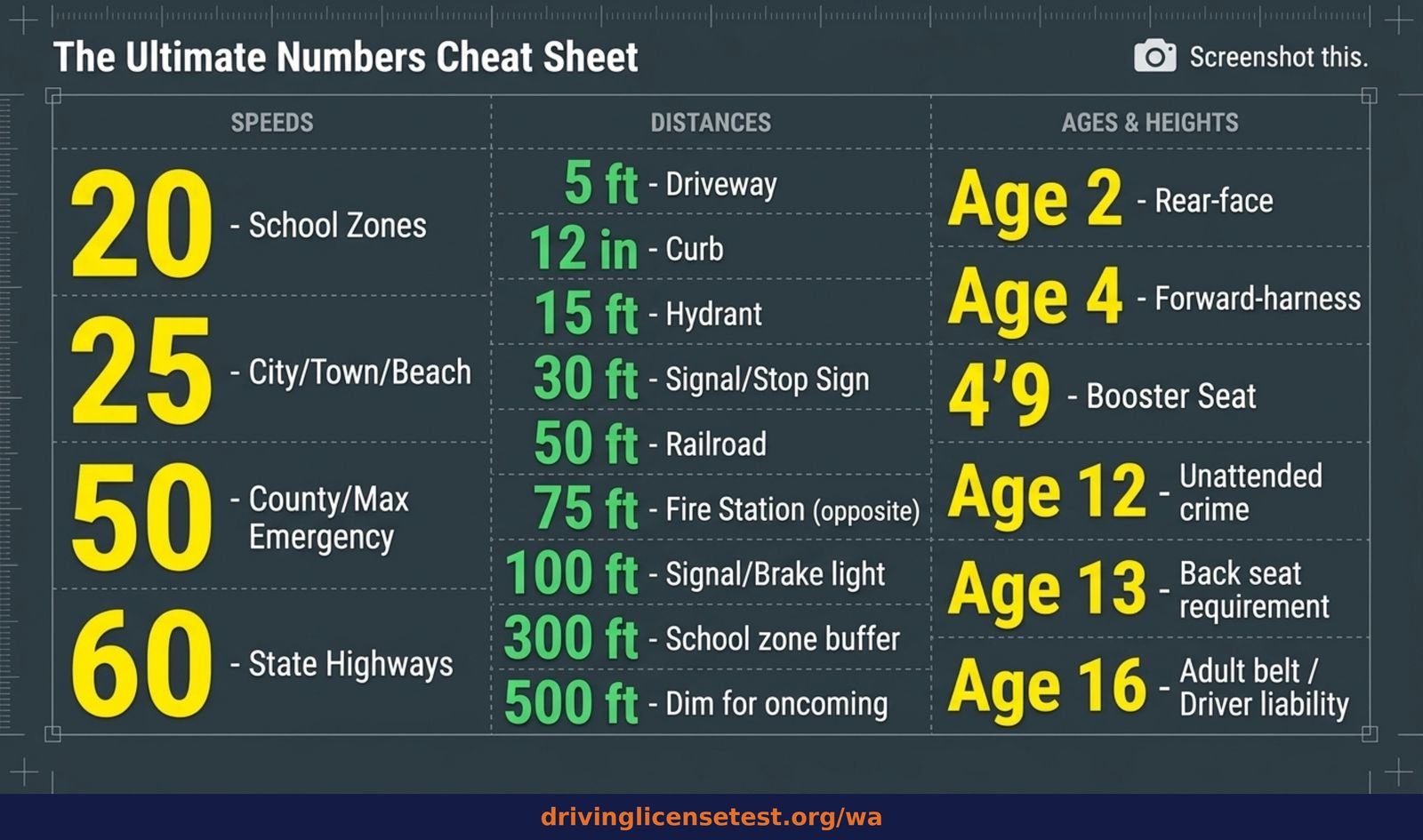

Washington Traffic Laws study guide, practice tests & flashcards: Download the deck as a PDF (7.3 MB) → — free to share.
Why this matters
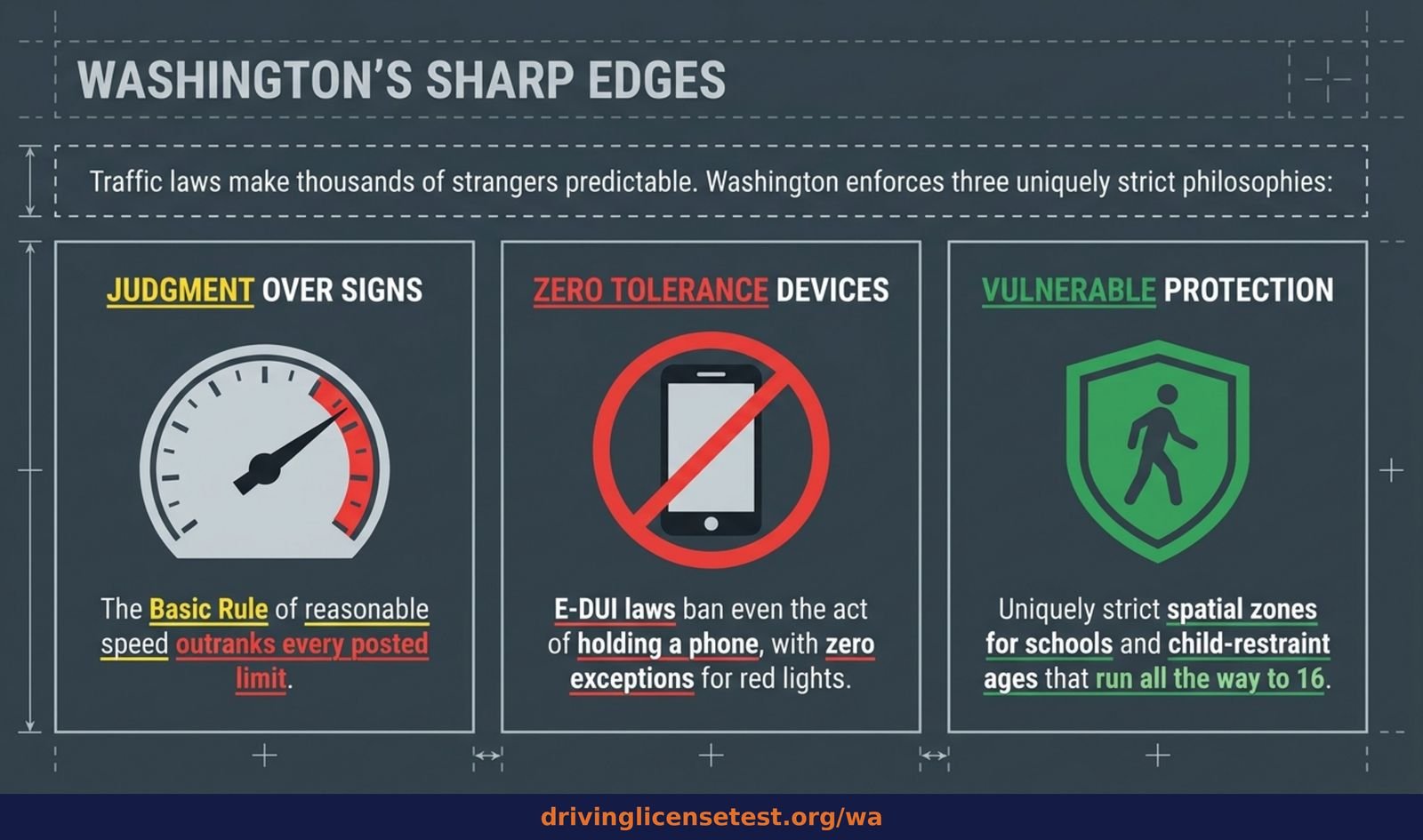
Traffic laws are the rules that make thousands of strangers predictable to each other. In Washington, driver licensing is administered by the Washington State Department of Licensing — the DOL — and the official study book is the Washington Driver Guide, backed by the Revised Code of Washington (the RCW). Washington writes its rules with sharp edges: a basic speed rule that outranks every posted number, an E-DUI law that bans even holding a phone, and child-restraint ages that run all the way to 16. This guide walks the rules in the order you will meet them on the road: speed first, then the device and belt laws, signals and lights, parking, and the shoreline oddity only Washington has.
Part 1: Speed — the basic rule outranks the sign
Washington’s speed law starts with the basic rule: no person may drive at a speed greater than is reasonable and prudent under the conditions and the actual and potential hazards — and speed must be controlled to avoid colliding with any person, vehicle, or property on or entering the highway. The posted limit is a maximum, not a target, and the basic rule still governs when the posted number would be unsafe.
Unless a limit has been lawfully altered and posted, Washington’s statutory maximums are set by the kind of road you are on:
- 25 mph — city and town streets.
- 50 mph — county roads.
- 60 mph — state highways.
Speed must be reduced at intersections and railway crossings, on curves and hill crests, on narrow or winding roads, and for special hazards — pedestrians, traffic, weather, and highway conditions. The Safe Driving guide teaches the judgment side of speed; this guide states the legal side.
Check yourself: The posted limit is 50 mph on a county road, in fog, with deer moving near the tree line. What speed does Washington law actually require?
Part 2: School zones and emergency zones — the doubled penalties
- School and playground crosswalk zones: 20 mph when passing a fully posted marked school or playground crosswalk. The zone extends 300 feet in either direction from the marked crosswalk (a local authority may instead measure the 300 feet from the school or playground property border).
- An infraction in a school or playground crosswalk zone carries twice the standard penalty — and that doubled penalty may not be waived, reduced, or suspended.
- Emergency zones: on seeing a roadside response vehicle with flashing lights, move over or slow down — inside the zone, at least 10 mph below the posted limit, and never faster than 50 mph. The full Move Over duties — which lanes, which vehicles, which distances — are in the Right of Way guide.
Memory aid: Twenty in the school zone, for three hundred feet each way — and the doubled fine cannot be talked down.
Check yourself: A driver is cited for speeding through a posted school crosswalk zone and asks the court to cut the penalty in half. What does Washington law say to that request?
Part 3: E-DUI — Washington’s device law bans holding
Washington’s distracted-driving law has two tiers, and the exam tests them separately. Do not swap them.
E-DUI (RCW 46.61.672) is the serious tier. Using a personal electronic device while driving is a traffic infraction — and “use” is defined broadly:
- Holding the device in either or both hands is use — by itself, with no typing at all.
- Composing, sending, reading, viewing, accessing, browsing, transmitting, saving, or retrieving data by hand or finger is use.
- Watching video is use.
- The one narrow exclusion: minimal finger use to activate, deactivate, or initiate a function of the device.
- “Driving” includes being temporarily stationary — stopped in traffic, at a traffic control device, or in a momentary delay. Holding your phone at a red light is still E-DUI. It does not include being pulled over, off the active roadway, stopped somewhere the vehicle can safely remain.
- The statute states the penalty by reference (RCW 46.63.110(3)) and doubles it for a second or subsequent offense; in a crash prevention zone the base penalty is doubled and the total may not be waived, reduced, or suspended. Exceptions cover contacting emergency services, transit dispatch relay, federally permitted commercial use, and authorized emergency vehicle operators.
- For the general driving population, hands-free use is permitted — holding is banned. Permit and intermediate holders are under a stricter rule: no device use at all, even hands-free (Licensing & Registration guide).
Dangerously distracted driving (RCW 46.61.673) is the separate, lesser tier: driving while engaged in any activity not related to operating the vehicle, in a manner that interferes with safe operation. Its base penalty is $30, and it is enforceable only as a secondary action — a distinction the E-DUI tier does not carry. The $30 figure belongs to this law alone; never attach it to E-DUI.
One more device rule: it is illegal to drive wearing earbuds, headphones, or headsets broadcasting sound or cancelling noise on both ears; one-ear hands-free use is allowed when it complies with the state equipment rules.
Memory aid: In your hand? E-DUI — even at a red light. Other distractions? Thirty dollars, and secondary only.
Check yourself: A driver holds her phone at a stoplight to read a text, then puts it down before the light changes. A passenger says the car was stopped, so no law was broken. Who is right — and which of the two device laws applies?
Part 4: Seat belts and child restraints
Seat belts (RCW 46.61.688). Every person age 16 or older operating or riding in a motor vehicle must wear a safety belt properly adjusted and securely fastened — and no one may operate a vehicle unless all child passengers under 16 are wearing a belt or securely fastened in an approved child restraint system. A belt violation is recorded on the driver’s abstract, but it is not available to insurance companies or employers, and non-use is not negligence and is not admissible as evidence of negligence in a civil action. A physician’s written verification can exempt a person.
Child restraints (RCW 46.61.687) apply to children under 16, in stages:
- Under age 2 — rear-facing, until the manufacturer’s weight or height limit.
- Under age 4 (and not rear-facing) — forward-facing with a harness, until the manufacturer’s limit.
- A child in neither category who is under 4 feet 9 inches tall — a booster seat, until the belt fits properly (typically ages 8 to 12) or the belt is properly adjusted and fastened.
- A driver transporting a child under 13 must transport the child in the back seat where practical.
- The system must meet U.S. DOT standards and the manufacturer’s instructions. A first violation may be dismissed on proof of acquiring an approved system within 7 days, with no prior dismissal.
Check yourself: A 3-year-old who has outgrown the rear-facing seat, a 7-year-old who is 4 feet 5 inches tall, and a 12-year-old all ride in one car. State the restraint each child needs — and where the 12-year-old should sit.
Part 5: Signals, lights, and the equipment numbers
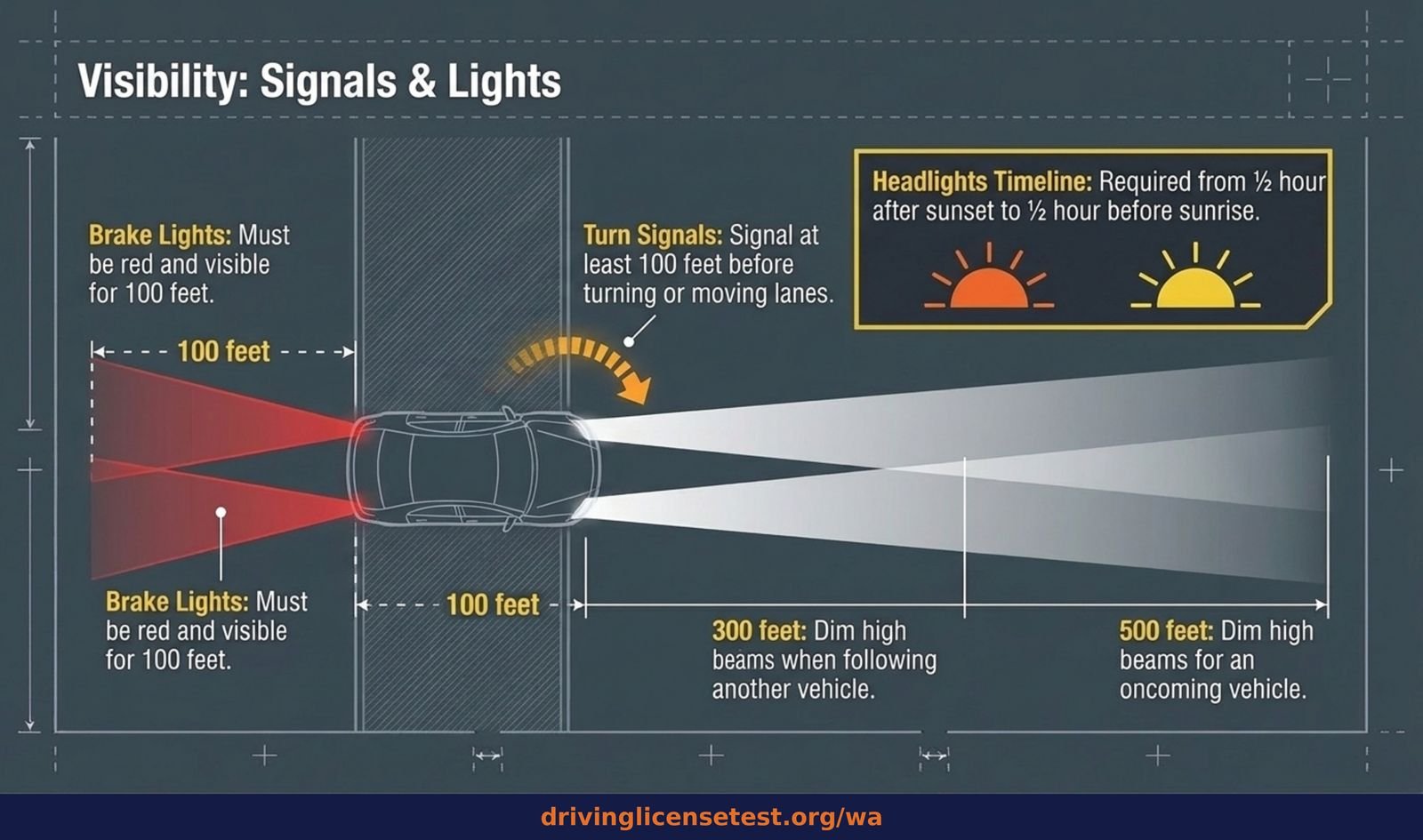
- Signal at least 100 feet before turning or moving; turning across oncoming traffic requires signalling at least 100 feet in advance. Hand signals are defined in the Signs & Signals guide.
- Headlights are required from one-half hour after sunset to one-half hour before sunrise.
- Dim high beams within 500 feet of an oncoming vehicle and within 300 feet when following another vehicle.
- Brake lights must be red and visible for 100 feet.
- Minimum tire tread is 2/32 inch; keep your chest at least 10 inches from the steering wheel.
- At night, drive at a speed that lets you stop within the distance your headlights show — usually about 400 feet (Safe Driving guide).
Check yourself: You are following a car at night with your high beams on, 250 feet behind it. What does Washington law require — and at what distance from an oncoming car would the same duty apply?
Part 6: Parking — the distance table
Park no more than 12 inches from the curb, never facing oncoming traffic, and never double-parked. You may not park:
- In an intersection; on a crosswalk, sidewalk, or bike lane; or on railroad tracks.
- Within 30 feet of a traffic signal, stop sign, or yield sign.
- Within 5 feet of a driveway, alley, or private road.
- Within 20 feet of a pedestrian safety zone.
- Within 15 feet of a fire hydrant.
- Within 50 feet of a railroad crossing.
- Within 75 feet of a fire station driveway on the opposite side of the street.
- On a bridge, overpass, tunnel, or underpass.
U-turns are generally allowed unless a sign prohibits them — but never on a curve or the crest of a hill, and only with clear visibility in all directions; turn into the lane closest to the one you came from.
People and animals left in cars. It is a crime to leave a child under 16 unattended in a parked vehicle with the motor running, a child under 12 unattended in a parked vehicle at all, or an animal unattended in conditions that could harm it. Parking in an EV charging space without being connected to charge is also illegal.
Memory aid: Five for driveways, fifteen for hydrants, twenty for walkers, thirty for signals, fifty for rails, seventy-five for the firehouse — and twelve inches from the curb.
Check yourself: You park 25 feet from a stop sign and 18 inches from the curb. Name both violations.
Part 7: Tickets, beaches, and the last two rules
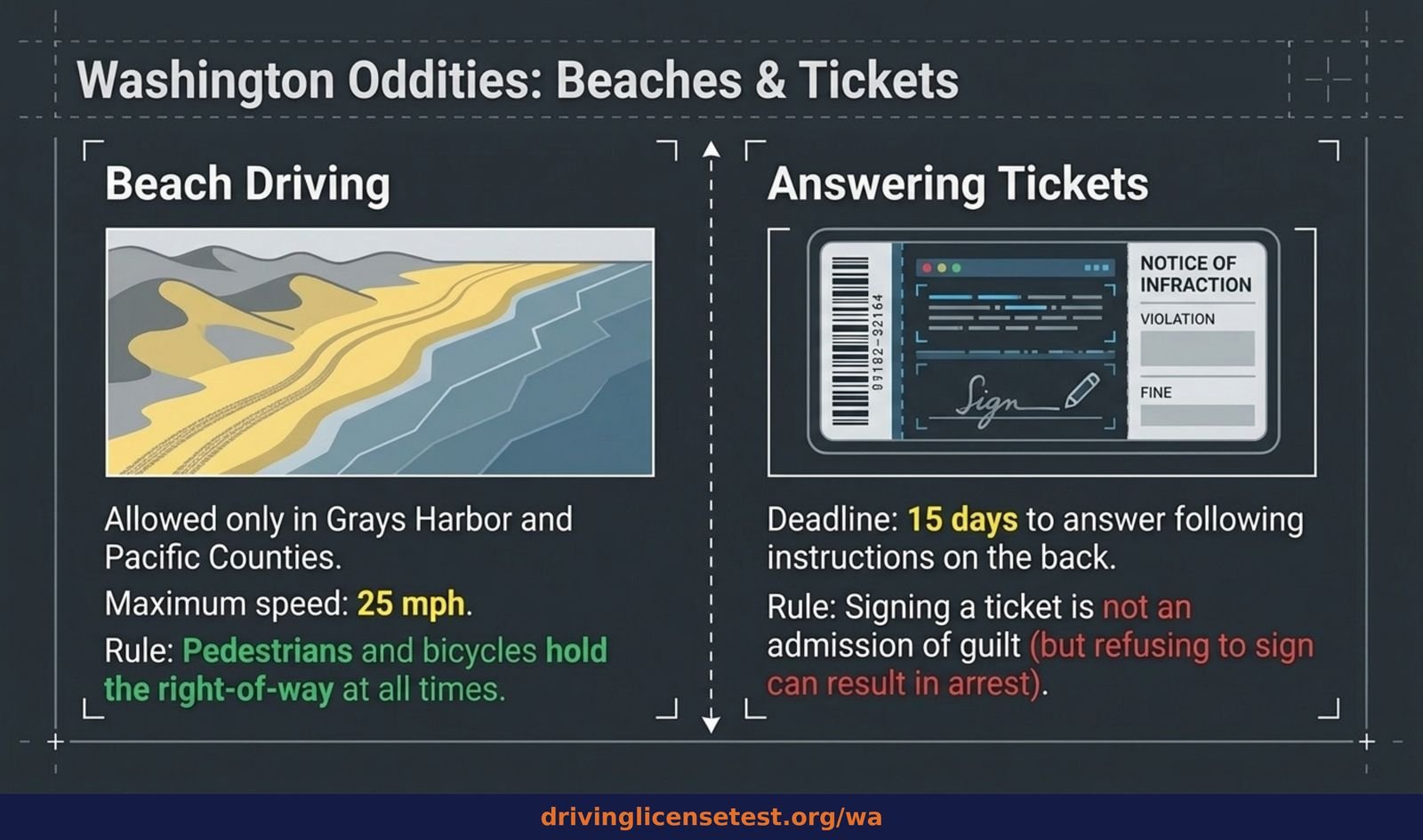
Answering a ticket. A ticket (notice of infraction) must be answered following the instructions on the back, within 15 days, to avoid suspension. Signing a ticket is not an admission of guilt — but refusing to sign may result in arrest.
Beach driving. In Grays Harbor and Pacific Counties only, you may drive on the beach through marked approaches, on hard-packed sand, where the beach is a state highway — limited to 25 mph, with pedestrians and bicyclists holding the right-of-way at all times.
Key numbers to memorize
| Statutory maximums | 25 city/town streets · 50 county roads · 60 state highways — always under the reasonable-and-prudent basic rule |
| School/playground crosswalk zone | 20 mph · zone 300 feet each way · penalty doubled, never waivable |
| Emergency zone speed | 10 mph below the posted limit, never over 50 mph in the zone |
| E-DUI | Holding banned — even stopped in traffic · repeat offense: penalty doubled |
| Dangerously distracted | $30 base penalty · secondary enforcement only |
| Child restraints | Rear-facing under 2 · forward-facing harness under 4 · booster under 4’9″ · back seat under 13 where practical |
| Signal before turning | 100 feet |
| Headlights / dimming | On from ½ hour after sunset to ½ hour before sunrise · dim 500 ft oncoming / 300 ft following |
| Parking distances | 5 driveway · 15 hydrant · 20 pedestrian safety zone · 30 signal/stop/yield · 50 railroad · 75 fire station (opposite side) · 12 inches from curb |
| Ticket answer deadline | 15 days, per the instructions on the back |
| Beach driving | 25 mph — Grays Harbor and Pacific Counties only, marked approaches |
5-question self-check
- State Washington’s three statutory maximum speeds by road type — and the rule that outranks all three.
- A driver holds a phone at a red light to read a text. Which law has she broken, and why does “the car was stopped” fail as a defense?
- How does dangerously distracted driving differ from E-DUI — penalty and enforcement?
- State the child-restraint stages: rear-facing, forward-facing, booster, and the back-seat rule.
- You may not park within how many feet of a driveway, a hydrant, a pedestrian safety zone, a stop sign, a railroad crossing, and a fire station driveway?
Answer key
- 25 mph on city and town streets, 50 mph on county roads, 60 mph on state highways — all beneath the basic rule: never faster than is reasonable and prudent for the conditions and hazards.
- E-DUI. “Driving” under RCW 46.61.672 includes being temporarily stationary in traffic or at a traffic control device, and holding the device is itself “use.”
- Dangerously distracted driving covers any non-driving activity that interferes with safe operation; its base penalty is $30 and it is enforceable only as a secondary action. E-DUI covers device use, carries the statutory penalty structure (doubled for repeat offenses), and has no secondary-action limit.
- Under 2: rear-facing to the manufacturer’s limit. Under 4 (not rear-facing): forward-facing with a harness to the manufacturer’s limit. Under 4 feet 9 inches (in neither earlier category): a booster seat until the belt fits properly. Under 13: the back seat where practical.
- 5 feet (driveway), 15 feet (hydrant), 20 feet (pedestrian safety zone), 30 feet (traffic signal, stop sign, or yield sign), 50 feet (railroad crossing), 75 feet (fire station driveway, opposite side) — and no more than 12 inches from the curb.
Keep practicing
- Take the Traffic Laws practice quiz
- Flip through the Traffic Laws flashcards
- Run the full Washington practice test
More study guides: Signs & Signals Study Guide · Right of Way Study Guide · Safe Driving Study Guide · Alcohol, Drugs & Driving Conditions Study Guide · Licensing & Registration Study Guide