Your complete New Jersey study guide — plain language, no jargon.
📘 Prefer pictures? Flip through the visual deck
This whole guide as 15 slides — swipe or scroll sideways through them. Every sign shape and color, decoded — read the road at a glance.



Take it with you: Download the deck as a PDF (3.7 MB) → — free to share.
Why this matters
Signs, signals, and road markings are the language of the road. They warn you about what’s coming, tell you the rules where you’re driving, and guide you to where you’re going. New Jersey’s knowledge test has 50 questions, and a big share of them test whether you can read this language — including New Jersey specifics like when your headlights must be on and how far to park from a hydrant, a crosswalk, or a stop sign. Learn the code behind the signs and you won’t just pass the test — you’ll read every road faster for the rest of your driving life.
Part 1: The master key — colors and shapes
You don’t need to memorize hundreds of individual signs. Signs are built from a code of colors and shapes. Learn the code, and you can read almost any sign at a glance — even one you’ve never seen before.
Colors tell you the type of message:
- Red means stop, yield, or prohibition. Think: red = danger or “don’t.” (Stop signs, Do Not Enter, No Turn signs.)
- Yellow means warning. Think: yellow = caution. (Curves, merges, slippery roads.)
- Green means guidance and direction. Think: green = “here’s information.” (Exit signs, distance signs, mile markers.)
- Blue means services. Think: blue = help nearby. (Hospital, gas, food, rest areas.)
- Orange means construction or work zones. Think: orange = workers ahead, slow down.
- Brown means recreation or points of interest. (Parks, campgrounds, historic sites.)
- White means regulation — a law you must follow. (Speed limits, lane-use signs.)
Memory aid: Red stops you. Yellow warns you. Green guides you. Blue serves you. Orange means workers.
Shapes tell you the job of the sign:
- Octagon (8 sides) — Stop. Only the stop sign uses this shape, so you can recognize it even in fog or snow.
- Upside-down triangle — Yield. Slow down and be ready to stop.
- Diamond — Warning. A hazard is ahead: curves, intersections, merging traffic.
- Rectangle — Regulatory or guide signs: speed limits, lane controls, parking rules, exit and distance information.
- Circle — Railroad crossing ahead. (The advance warning sign is a yellow circle with a black X and the letter R on each side.)
- Pentagon (5 sides, shaped like a little house) — School zone or school crossing.
- Pennant (sideways triangle) — No-passing zone.
- Crossbuck (X shape) — Placed right at a railroad crossing itself. Treat it like a yield: be ready to stop for a train.
Check yourself: You’re driving at dusk and see a yellow diamond with a black arrow curving right. Without reading this guide again — what is it telling you, and what should you do?
Part 2: Regulatory signs — the law on a stick
Regulatory signs tell you what you must or must not do. Ignoring one isn’t just risky — it’s a traffic violation that can put points on your New Jersey record.
Stop sign. A red octagon with white letters spelling STOP. Come to a complete stop — wheels fully still. In New Jersey, stop no more than five feet before the nearest crosswalk or stop line. If there’s no line or crosswalk, stop where you can see clearly without rolling into the intersection.
Yield sign. A red-and-white upside-down triangle. Slow down and be prepared to stop. You don’t always have to stop — but you must give the right-of-way to traffic and pedestrians already there.
Speed limit signs. White rectangles with black numbers. They show the maximum speed for good conditions — not a target. New Jersey’s default limits are in the Traffic Laws guide, but the sign always wins where you’re driving.
Do Not Enter. A red circle with a white horizontal bar. It guards one-way streets and highway ramps against wrong-way driving. If one is facing you, you’re going the wrong way — stop and turn around safely.
No Left Turn / No U-Turn. A red circle with a slash over a black arrow. The arrow shows what’s banned. These matter extra in New Jersey, where many highways use jughandles — right-side exit ramps that loop you around to turn left — instead of direct left turns (more in the Right of Way guide).
Keep Right. A white rectangle telling you to pass to the right of an island, median, or divider.
Slow-moving vehicle emblem. An orange triangle with a red border, mounted on the back of vehicles that can’t keep up with traffic, like farm equipment. When you see it, slow down — you’re catching up to something traveling 25 mph or less.
Check yourself: There is no painted stop line at a stop sign, but there is a crosswalk. Where exactly do you stop, and how close to the crosswalk may you be?
Part 3: Warning signs — hazard ahead
Warning signs are almost always yellow diamonds with black symbols or words. They don’t give orders; they give you a heads-up so you can adjust early and smoothly.
Common ones to know:
- Curve or winding road — an arrow bending left or right. Slow down before the curve, not in it.
- Merging traffic — lanes joining, with traffic entering from the right (or left). Be ready to adjust speed or lane position.
- Slippery when wet — a car with wavy skid lines. The surface gets slick in rain; slow down and avoid sudden moves. (New Jersey roads can hydroplane at surprisingly low speeds — see the Safe Driving guide.)
- Traffic signal ahead — a small traffic-light symbol. A light is coming up that you may not see yet, often just over a hill or around a bend.
- Hill / grade ahead — a slope symbol. On a steep downhill, shift to a lower gear and go easy on the brakes so they don’t overheat.
- Lane ends — a lane is disappearing. Merge early, when it’s safe — don’t race to the very end.
- Two-way traffic ahead — two arrows pointing in opposite directions. You’re leaving a divided road; opposing traffic will be right beside you.
- Divided highway ends — the median is going away. Stay alert and keep right.
- School crossing — a yellow pentagon with two walking figures. Children may be crossing; slow down and watch carefully.
- Railroad crossing ahead — a yellow circle with a black X and R’s. Start slowing down and be ready to stop. (Full railroad rules are in the Right of Way guide.)
- Hospital — technically a guide sign: a blue square with a white H. Blue means services.
Work zone signs break the yellow rule: they’re orange diamonds with black letters — orange means workers. Merge into the open lane early. Rear-end crashes are the most common work-zone crash, so slow down and leave extra space.
Check yourself: An orange diamond says “Road Work Ahead.” What color would this sign be if it were a permanent warning instead? What two things should you change about your driving right now?
Part 4: Traffic signals — more than red, yellow, green
Steady red — stop and wait. (Right turns on red, after a full stop, are covered in the Traffic Laws guide.)
Steady yellow — the light is about to turn red. Prepare to stop before the intersection. Don’t speed up to “beat” it, and don’t slam the brakes if stopping suddenly would be unsafe.
Steady green — go, if the intersection is clear. Green never means “go no matter what” — if traffic ahead is blocking the box, stay out of it.
Green arrow with a red light — you may go only in the direction of the arrow. The red light still applies to every other movement.
Flashing red light — treat it exactly like a stop sign. Full stop, then go when safe.
Flashing yellow light — slow down and proceed with caution. You don’t have to stop, but stay alert.
A dark signal is a stop. New Jersey law is explicit here: if a traffic signal is out because of a power failure or malfunction, treat the intersection as a four-way stop. Every driver stops, then takes turns.
Who wins? A police officer directing traffic outranks everything — lights, signs, and markings. If an officer waves you through a red light, you go.
Check yourself: A storm knocks out the traffic light at a busy intersection. The light is completely dark. What does New Jersey law require you to do?
Part 5: Pavement markings — paint with meaning
Yellow lines separate traffic going in opposite directions. White lines separate traffic going the same direction, or mark the right edge of the road.
- Broken yellow line — you may pass if it’s safe.
- Solid yellow + broken yellow — if the broken line is on your side, you may pass when traffic is clear. If the solid line is on your side, stay put.
- Double solid yellow lines — do not cross to pass. The exception is turning left into a driveway or side street where that’s permitted — and in New Jersey, many left turns are routed through jughandles instead.
- Broken white line — you may cross it to change lanes when safe.
- Solid white line — a stronger guide: cross only when traffic conditions require it.
- Solid white edge line slanting inward — the road is getting narrower ahead. (This one shows up on tests!)
- White arrows painted in lanes — they direct you into the correct lane for turning. Follow them early.
- Crosswalk lines and stop lines — stop before them, never on top of them. At a stop sign in New Jersey, that means no more than five feet before the nearest crosswalk or stop line.
Check yourself: You’re on a two-lane road. Your side has the broken yellow line; the other side is solid. A slow truck is ahead and the road is clear. May you pass? What if the lines were reversed?
Part 6: New Jersey numbers hiding in the signs topic
Some test questions dressed as “signs and markings” are really New Jersey distance and lighting rules. Know these cold:
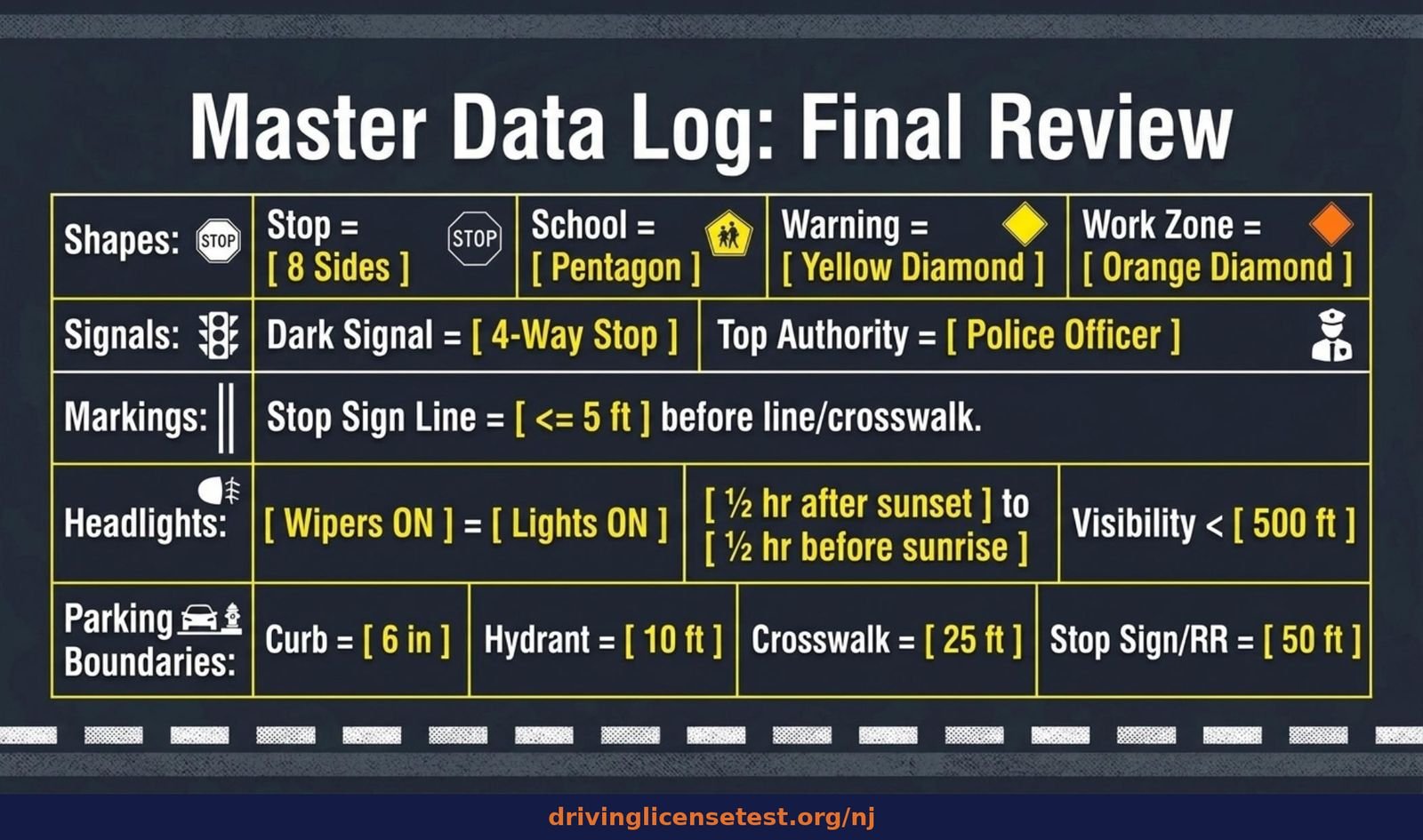
- Headlights: New Jersey requires headlights from one-half hour after sunset to one-half hour before sunrise, whenever visibility is 500 feet or less, and whenever your windshield wipers are in use — including in fog, mist, or smoke. Parking lights are not a substitute for headlights.
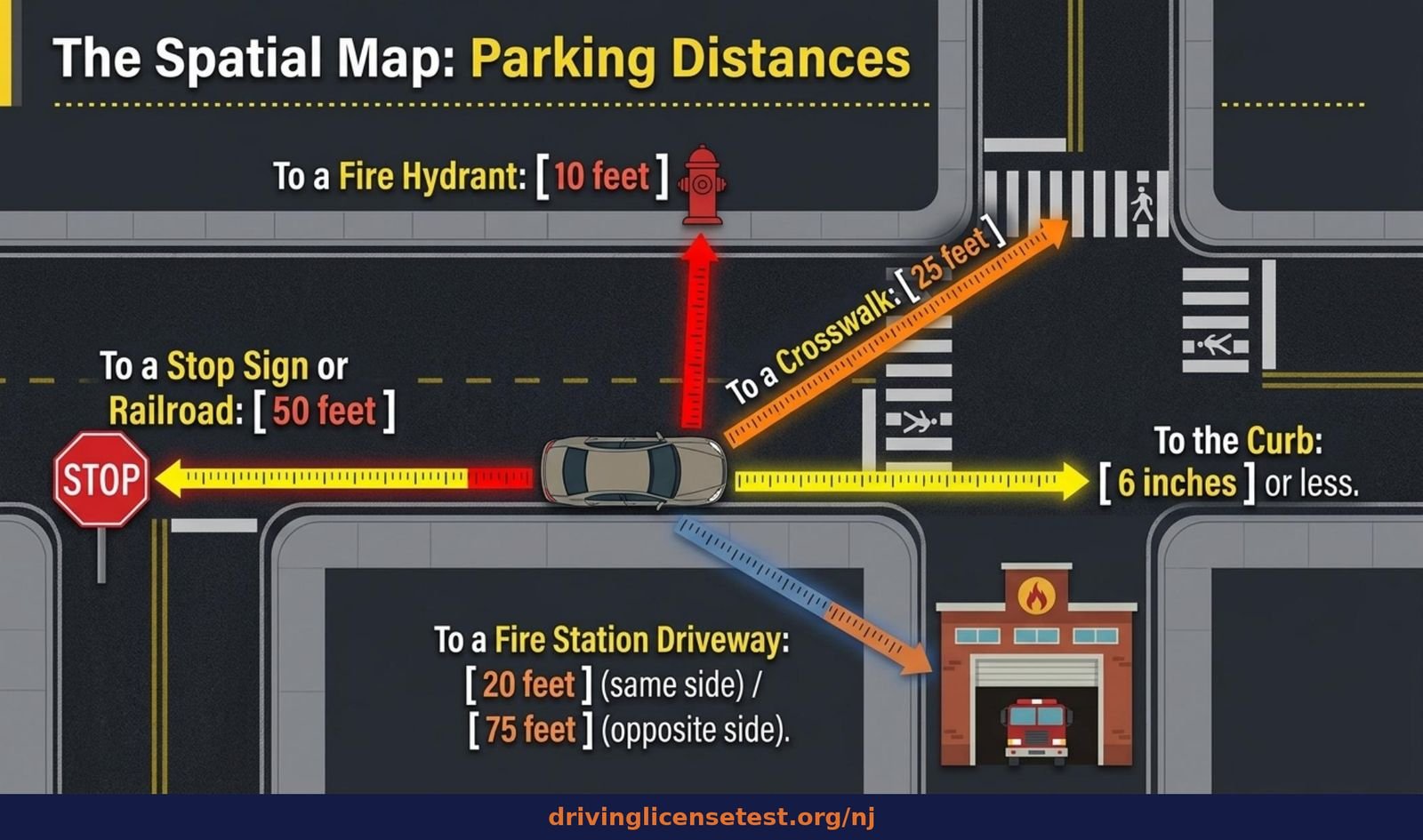
- Parking distances: never park within 10 feet of a fire hydrant, 25 feet of a crosswalk at an intersection, 50 feet of a railroad crossing, or 50 feet of a stop sign. Keep at least 20 feet from a fire-station driveway entrance on the same side (75 feet on the opposite side). Park no more than six inches from the curb.
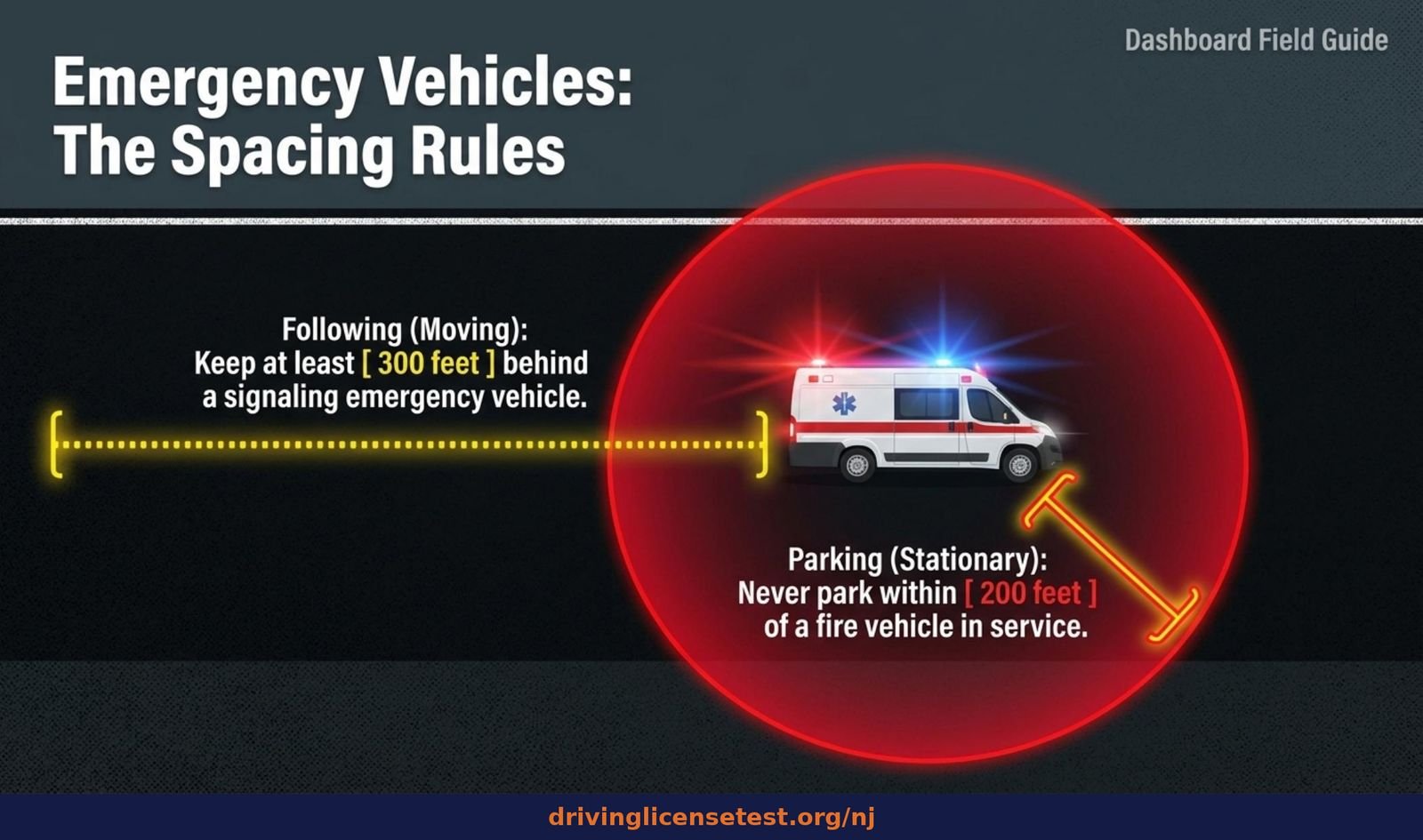
- Following an emergency vehicle: keep at least 300 feet behind one that’s signaling, and never park within 200 feet of a fire vehicle in service.
Key numbers to memorize
| Fact | Remember |
|---|---|
| Stop sign shape | 8-sided octagon — the only one |
| Yield sign shape | Upside-down triangle |
| Warning sign color/shape | Yellow diamond (orange diamond = work zone) |
| Railroad advance warning | Yellow circle, black X and R’s |
| School crossing sign | Yellow pentagon, two walking figures |
| Dark traffic signal in NJ | Treat as a four-way stop |
| Stop position at a stop sign | No more than 5 feet before the crosswalk or stop line |
| Headlights required | ½ hour after sunset to ½ hour before sunrise; visibility 500 ft or less; whenever wipers are on |
| Parking: fire hydrant / crosswalk / railroad / stop sign | 10 ft / 25 ft / 50 ft / 50 ft |
| Distance from the curb when parked | 6 inches or less |
| Who outranks all signals | A police officer |
5-question self-check
- You see a yellow diamond sign with a car and wavy lines behind it. What does it mean, and what should you do?
- The traffic light at your intersection is completely dark after a power failure. What does New Jersey law say to do?
- A traffic light shows a green arrow pointing left and a steady red light. Which way(s) may you legally drive?
- It’s raining lightly and your wipers are on, but it’s mid-afternoon. Do New Jersey rules require your headlights?
- You park on a residential street. How close to the curb must you be, and how far must you stay from the fire hydrant on the corner?
Answer key
- Slippery when wet — the road surface gets slick in rain. Slow down, avoid sudden braking or sharp steering, and leave extra following distance.
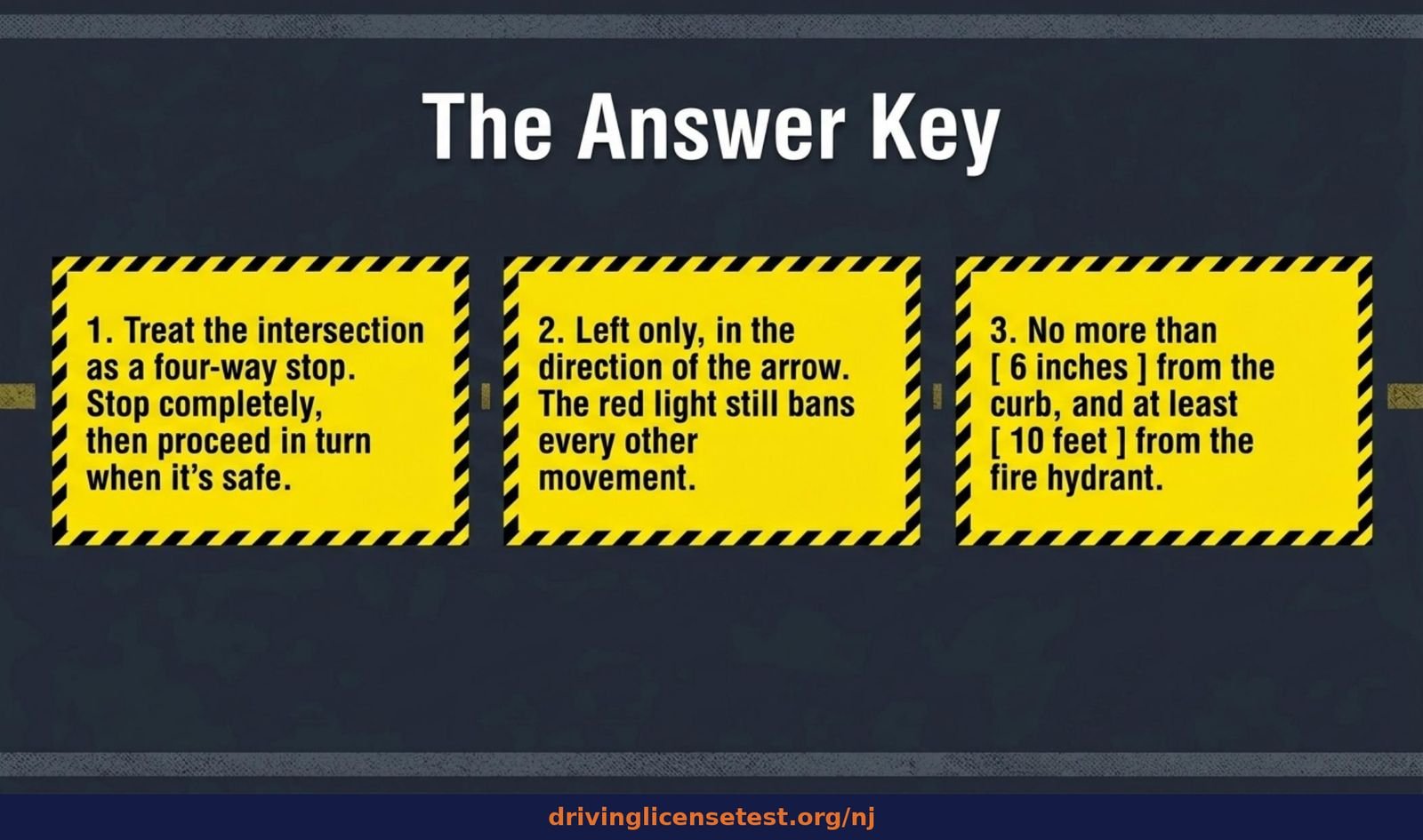
- Treat the intersection as a four-way stop. Stop completely, then proceed in turn when it’s safe.
- Left only, in the direction of the arrow. The red light still bans every other movement.
- Yes. In New Jersey, headlights are required whenever windshield wipers are in use, at any hour — and also whenever visibility drops to 500 feet or less.
- No more than six inches from the curb, and at least 10 feet from the fire hydrant.
Keep practicing
- Take the Signs & Signals practice quiz
- Flip through the Signs & Signals flashcards
- Watch the Signs & Signals video lesson
More study guides: Traffic Laws Study Guide · Right of Way Study Guide · Safe Driving Study Guide · Alcohol, Drugs & Driving Conditions Study Guide · Licensing & Registration Study Guide