
Your complete New Jersey study guide — plain language, no jargon.
📘 Prefer pictures? Flip through the visual deck
This whole guide as 13 slides — swipe or scroll sideways through them. New Jersey’s road rules in pictures — speeds, stops, and the fines that follow.




Take it with you: Download the deck as a PDF (3.2 MB) → — free to share.
Why this matters
Traffic laws are the rules that keep thousands of strangers moving past each other safely every day. New Jersey has its own fingerprint here: a five-step speed ladder, double fines in 65 mph zones and Safe Corridors, a handheld-phone fine ladder that climbs to $800, and a Graduated Driver License program with rules — like red decals and an 11:01 p.m. curfew — that exist nowhere else in quite this form. This guide covers the everyday laws the knowledge test loves most.
Part 1: New Jersey’s speed ladder
Unless a sign posts a different limit, New Jersey’s default speed limits are:
| Where | Limit |
|---|---|
| School zones, business districts, residential districts | 25 mph |
| Suburban business and residential districts | 35 mph |
| Non-posted rural roadways | 50 mph |
| Certain state highways and interstates, as posted | 55 mph |
| Certain interstate highways, as posted | 65 mph |
Memory aid: 25 in town, 35 in the suburbs, 50 in the country — then 55 and 65 only where the signs say so.
The Basic Speed Law sits above every number: never drive faster than weather, road, and traffic conditions safely allow, no matter what the sign says. Doing 50 in a 50 zone during a downpour can still be a violation — and a crash.
Double fines. New Jersey doubles the stakes in two places. Exceed a 65 mph limit by 10 mph or more — or commit most other moving violations in a 65 mph zone — and fines are doubled. The same doubling applies on designated Safe Corridor highways for speeding, aggressive driving, and other offenses.
Too slow is also illegal. Driving so slowly that you block the normal flow of traffic, when conditions are normal, is prohibited. Match the flow; if you can’t, you’re creating the hazard.
Check yourself: You’re on an unposted rural road in New Jersey and see no speed limit sign for miles. What’s your legal limit — and what could still make driving at that speed illegal?
Part 2: Cell phones and distracted driving
New Jersey’s rules here are strict, and the test knows it.
- Handheld devices are banned for every driver on any public road or highway. Holding a phone or texting is a primary offense — an officer can stop and cite you for it alone.
- Hands-free is allowed for regular (non-GDL) drivers, as long as it doesn’t interfere with safe operation. Legal — but the manual still calls it strongly discouraged.
- Emergencies are the exception: you may use a handheld device — one hand still on the wheel — for a fire, a crash, a serious road hazard, a medical emergency, or a hazardous-materials emergency.
- GDL drivers get no exceptions for convenience: permit and probationary drivers may not use any electronic device while driving — handheld or hands-free. That includes phones, handheld games, and other wireless gadgets.
- School bus drivers may not use a handheld or hands-free phone while operating a school bus, except in an emergency or when the bus is parked safely off the highway.
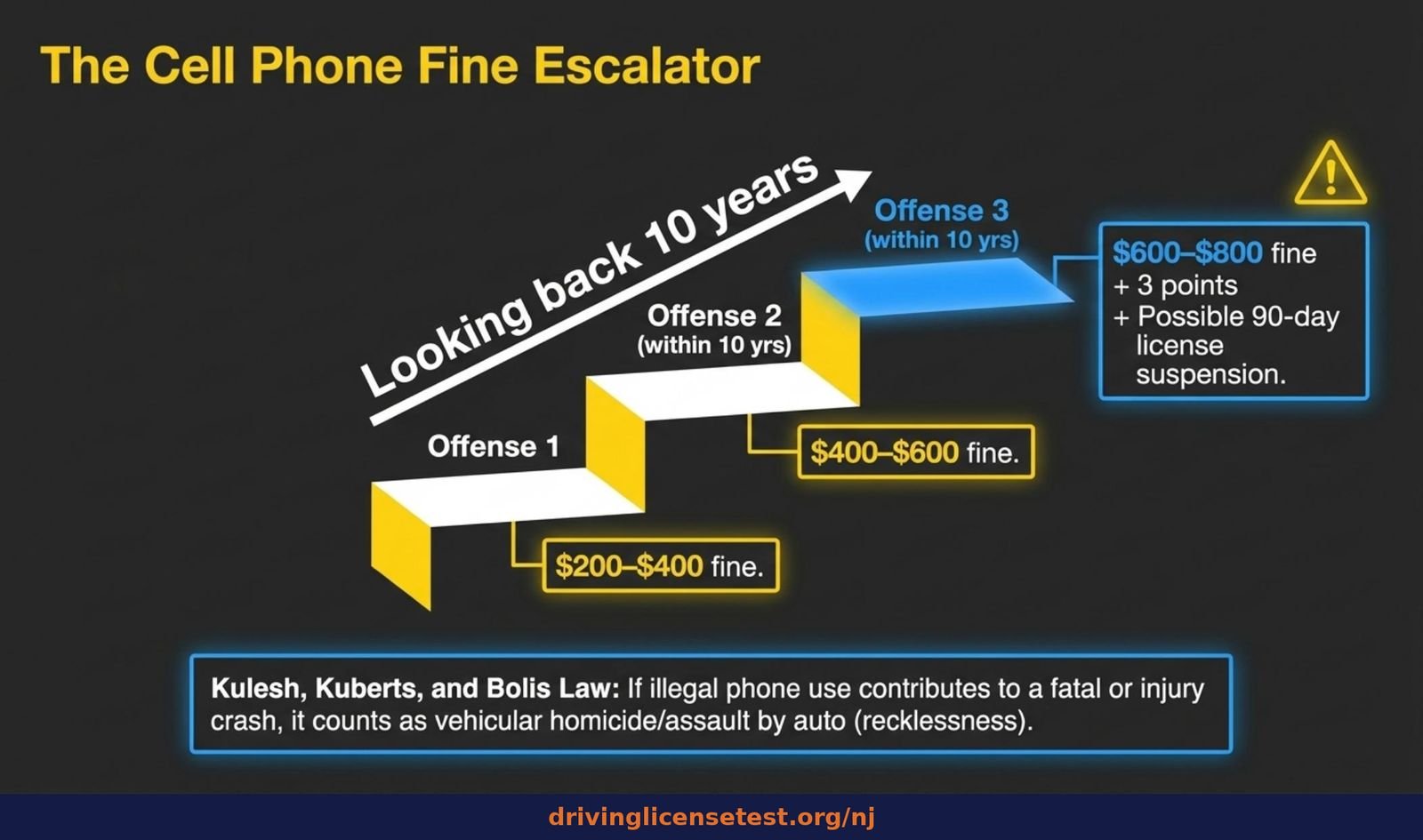
The fine ladder (each step looks back 10 years):
| Offense | Fine |
|---|---|
| First offense | $200–$400 |
| Second offense (within 10 years of the first) | $400–$600 |
| Third offense (within 10 years of the second) and beyond | $600–$800, plus 3 points and a possible 90-day license suspension |
And if illegal phone use contributes to a fatal or injury crash, it counts as recklessness under New Jersey’s vehicular homicide and assault-by-auto laws — the 2012 law named for Kulesh, Kuberts, and Bolis.
Check yourself: A probationary driver uses a hands-free headset to take a call. A friend with a basic license does the same. Who has broken New Jersey law, and why?
Part 3: Seat belts and child restraints
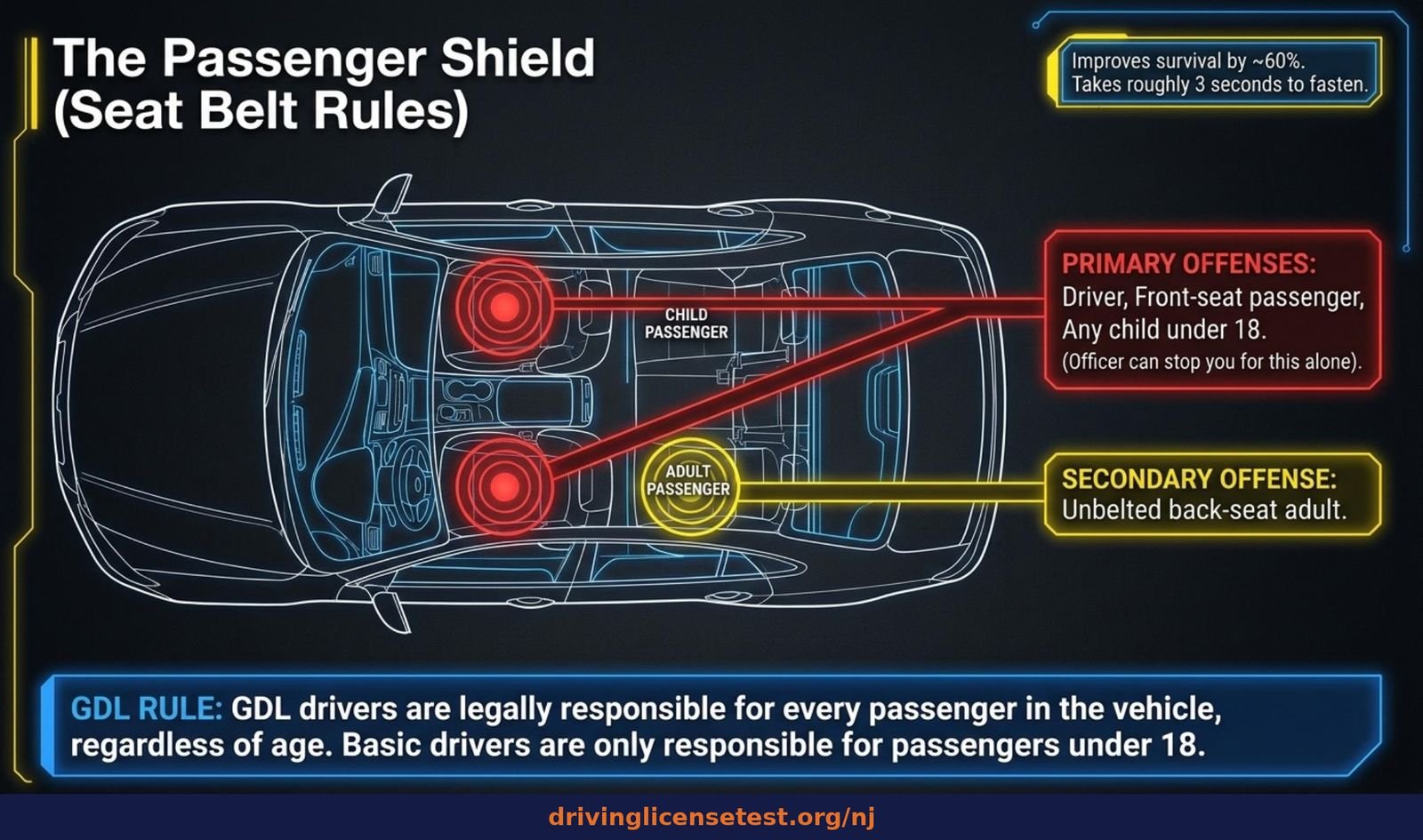
Seat belts. In a passenger vehicle, the driver and every passenger must wear a seat belt. For the driver, front-seat passengers, and any child under 18, an unbelted occupant is a primary offense — you can be stopped for it alone. The driver is responsible for all passengers under 18; front-seat adults are responsible for themselves. An unbelted back-seat adult is a secondary offense. GDL drivers must belt themselves and make sure every passenger in the vehicle is belted. Belts improve your chances of surviving a crash by about 60%, and fastening one takes roughly three seconds.
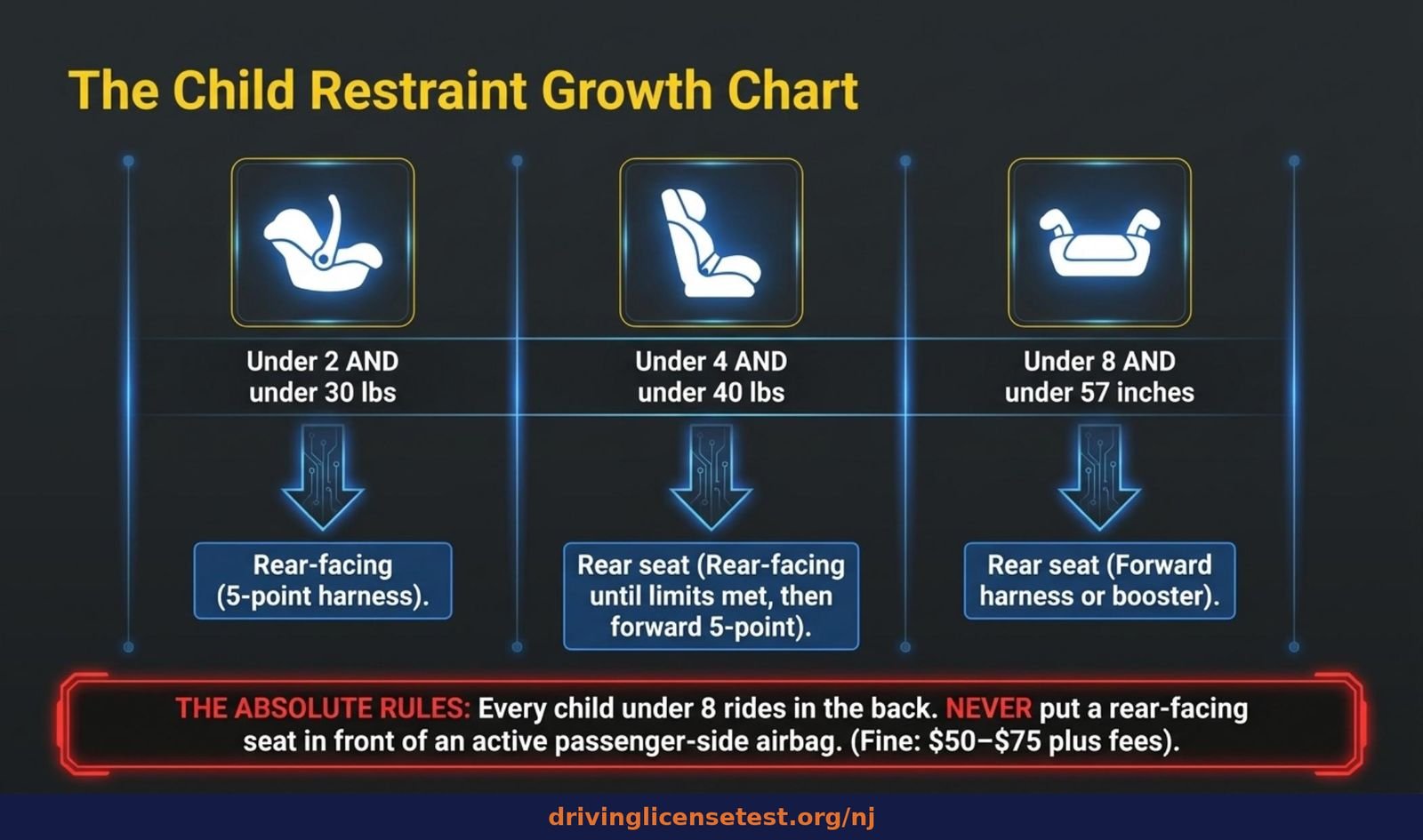
Child passenger law — learn it as a ladder by age, weight, and height:
- Under age 2 AND under 30 pounds: a federally approved rear-facing restraint with a five-point harness.
- Under age 4 AND under 40 pounds: a five-point-harness restraint in a rear seat — rear-facing until the child outgrows the manufacturer’s limits, then forward-facing.
- Under age 8 AND under 57 inches (4 ft 9 in): a forward-facing harness restraint or a booster seat, in a rear seat.
- Every child under 8 rides in a rear seat. If the vehicle has no rear seat, the child may ride secured up front — but never put a rear-facing seat in front of an active passenger-side airbag.
Breaking the child-restraint law costs a $50–$75 fine plus fees and court costs. Children 12 and under are safest belted in the back seat.
Check yourself: A 6-year-old who is 50 inches tall is riding in your car. What restraint does New Jersey law require, and where in the car?
Part 4: Everyday rules of the road
- Keep right. Drive on the right half of the roadway except when passing or preparing to turn.
- Headlights. Required from one-half hour after sunset to one-half hour before sunrise, when visibility is 500 feet or less, and whenever your wipers are on. Parking lights never substitute for headlights.
- No cutting through. Driving across private property to avoid a traffic signal or sign is a violation.
- Idling. Letting a vehicle idle for more than three consecutive minutes is prohibited, with limited exceptions.
- Studded snow tires are allowed only from November 15 to April 1.
- Ice and snow. You are legally responsible for ice or snow that flies off your vehicle and causes death, injury, or damage. Clear the whole car — roof included.
Part 5: Parking rules
New Jersey’s parking distances are heavily tested (they also appear in the Signs & Signals guide — they’re worth learning twice). Park no more than six inches from the curb, and never park:
- Within 10 feet of a fire hydrant
- Within 25 feet of a crosswalk at an intersection
- Within 50 feet of a railroad crossing
- Within 50 feet of a stop sign
- Within 20 feet of a fire-station driveway entrance on the same side of the street (75 feet on the opposite side)
- In a crosswalk or intersection, in front of a driveway, in a bus stop zone, on a sidewalk, on an interstate highway, on a bridge or in a tunnel — or double-parked
Check yourself: Rank these from smallest to largest legal parking distance: a stop sign, a fire hydrant, a crosswalk at an intersection, a railroad crossing.
Part 6: Points — a first look
New Jersey runs a point system: moving-violation convictions add points to your record, and points trigger real consequences — a surcharge at 6 points within three years and suspension at 12 points. Speeding alone can cost 2, 4, or 5 points depending on how far over the limit you were. The full point chart, surcharges, and ways to remove points are in the Licensing & Registration guide — but remember this now: DUI carries no points at all in New Jersey. It’s punished with fines, surcharges, suspension, and an ignition interlock instead.
Key numbers to memorize
| Fact | Remember |
|---|---|
| Default limits: town / suburb / rural / posted max | 25 / 35 / 50 mph; 55 or 65 only where posted |
| Double fines | 10+ mph over a 65 limit; most violations in 65 zones; Safe Corridors |
| Handheld phone fines | $200–$400 → $400–$600 → $600–$800 (+3 points, possible 90-day suspension) |
| GDL electronics rule | No devices at all — handheld or hands-free |
| Child restraint tiers | Under 2 & 30 lb rear-facing; under 4 & 40 lb harness; under 8 & 57 in booster/harness; under 8 always rear seat |
| Child restraint fine | $50–$75 plus fees |
| Headlights | ½ hour after sunset to ½ hour before sunrise; visibility ≤500 ft; wipers on |
| Idling limit | 3 consecutive minutes |
| Studded tires | November 15 – April 1 |
| Points: surcharge / suspension | 6 points in 3 years / 12 points |
5-question self-check
- You’re driving through a suburban residential district with no posted limit. What’s the speed limit?
- A driver is caught texting for the second time in eight years. What’s the fine range?
- Why does New Jersey double fines for going 10 mph over on a 65 mph interstate?
- A probationary driver answers a call on a hands-free headset. Legal or not?
- Your 3-year-old weighs 35 pounds. Describe the restraint and seating position New Jersey requires.
Answer key
- 35 mph — the default for suburban business and residential districts (25 mph applies in school zones, business districts, and residential districts).
- $400–$600. The ladder is $200–$400 for a first offense, $400–$600 for a second within 10 years, and $600–$800 for a third, which also adds 3 points and a possible 90-day suspension.
- It doesn’t need a “why” — it’s the rule: exceeding a 65 mph limit by 10 mph or more doubles fines, as do most moving violations in a 65 mph zone and offenses on Safe Corridor highways.
- Not legal. GDL permit and probationary drivers may not use any electronic device while driving — handheld or hands-free. (A basic-license driver may use hands-free.)
- A five-point-harness restraint in a rear seat: rear-facing while within the manufacturer’s limits (the law’s under-4/under-40-pounds tier), then forward-facing — and always in the back seat, since all children under 8 ride in a rear seat.
Keep practicing
- Take the Traffic Laws practice quiz
- Flip through the Traffic Laws flashcards
- Watch the Traffic Laws video lesson
More study guides: Signs & Signals Study Guide · Right of Way Study Guide · Safe Driving Study Guide · Alcohol, Drugs & Driving Conditions Study Guide · Licensing & Registration Study Guide