Your complete Pennsylvania study guide — plain language, no jargon.
📘 Prefer pictures? Flip through the visual deck
This whole guide as 13 slides — swipe or scroll sideways through them. Every sign, signal and marking in the Pennsylvania guide.






Take it with you: Download the deck as a PDF (2.9 MB) → — free to share.
Why this matters
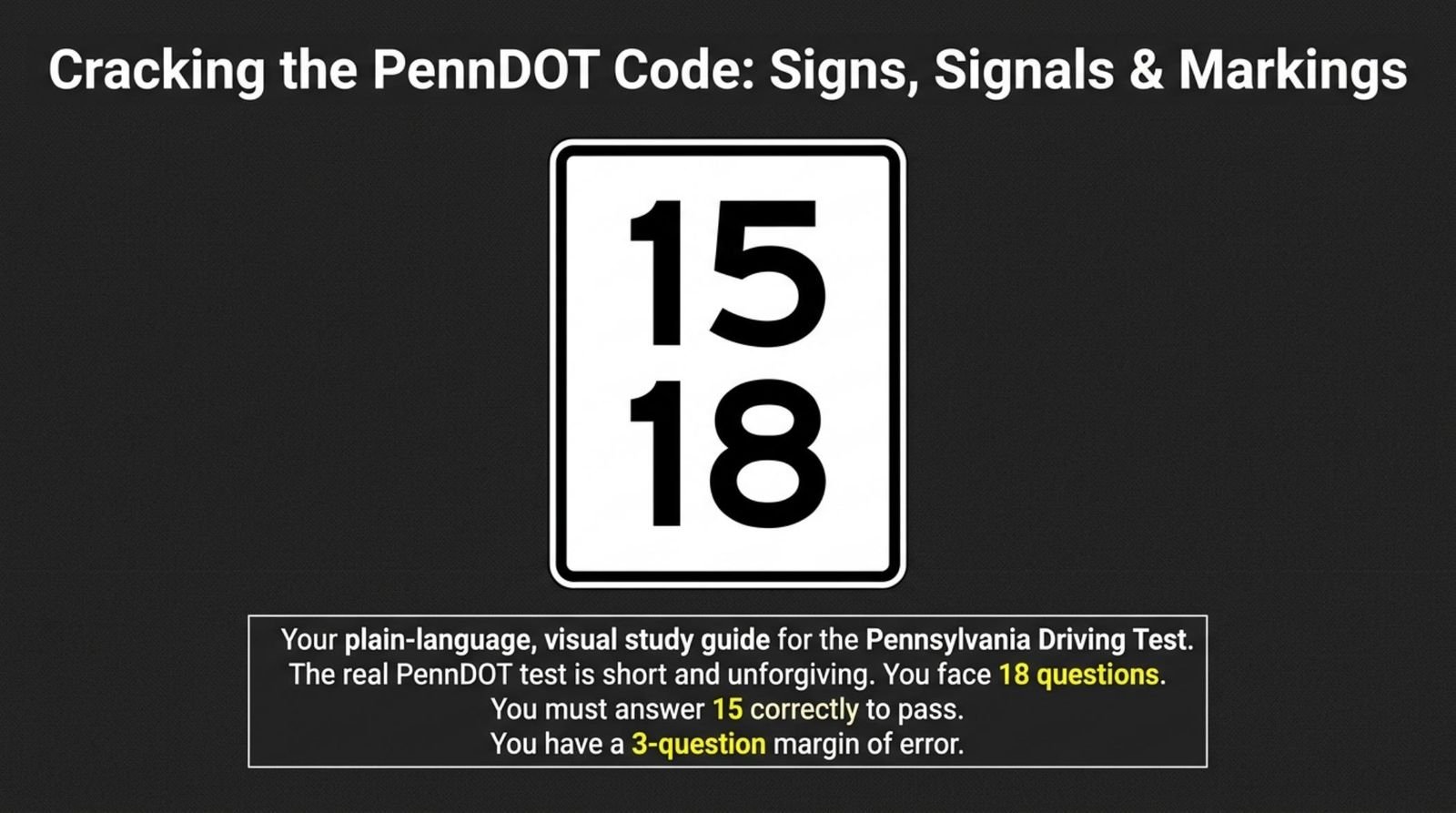
Signs, signals, and road markings are the language of the road. They warn you about what’s coming, tell you the rules where you’re driving, and guide you to where you’re going. The real PennDOT knowledge test is short and unforgiving: 18 questions, and you must answer 15 correctly to pass. It measures your knowledge of traffic signs, Pennsylvania driving laws, and safe driving practices — so reading this language fluently is not optional. Learn the code of colors and shapes and you won’t just pass — you’ll read every Pennsylvania road faster for the rest of your driving life.
Part 1: The master key — colors and shapes
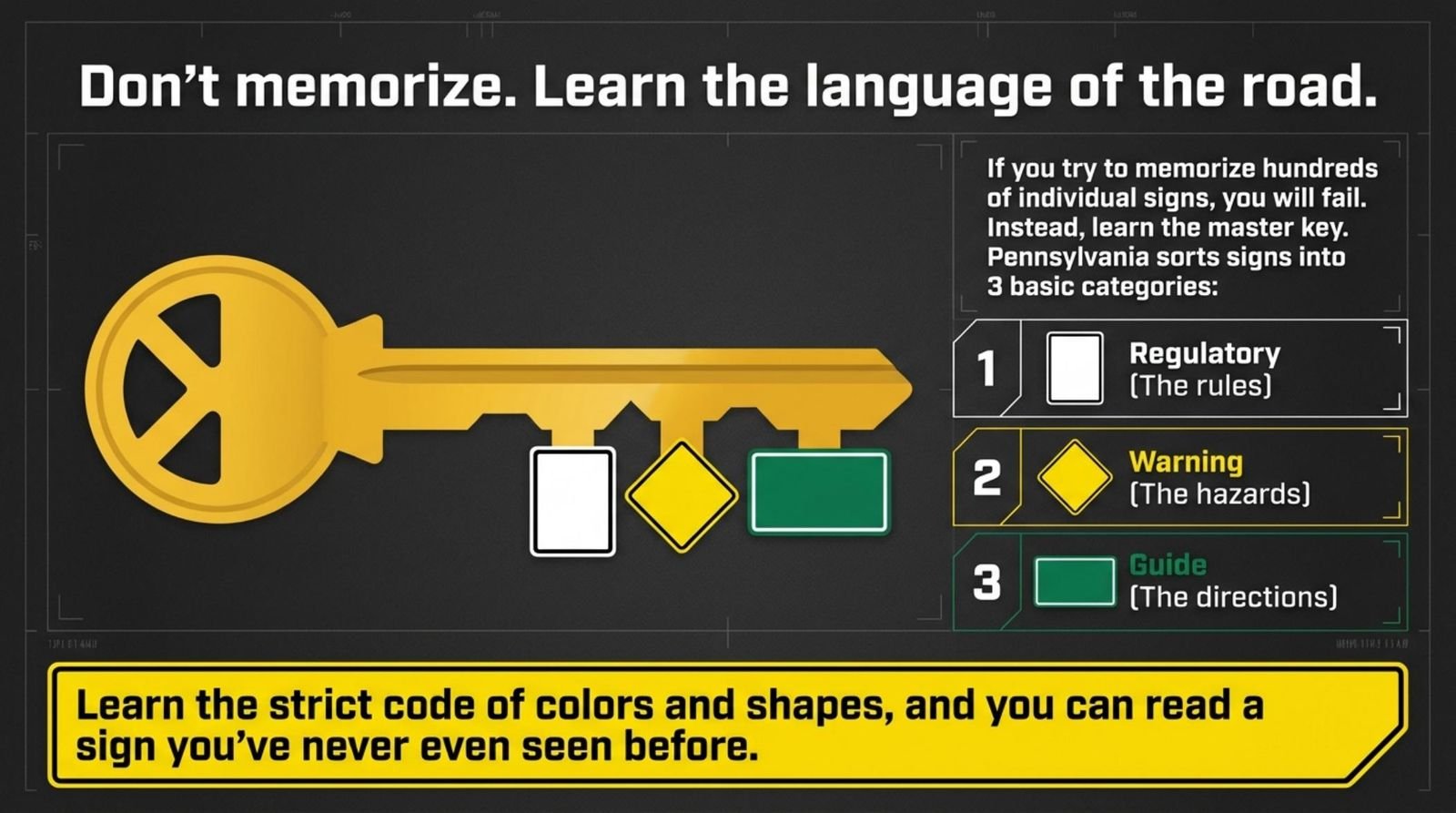
You don’t need to memorize hundreds of individual signs. Pennsylvania’s manual sorts signs into three basic categories — regulatory, warning, and guide — and builds them from a code of colors and shapes. Learn the code, and you can read almost any sign at a glance, even one you’ve never seen before.
Shapes tell you the job of the sign:
- Octagon (8 sides) — Stop. The STOP sign is the only octagon-shaped sign on the highway, so you can recognize it even in fog or snow.
- Triangle (3 sides) — Yield. Slow down, check for traffic, and give the right-of-way to pedestrians and approaching cross traffic.
- Diamond — Warning. Warning signs are usually diamond-shaped, with black symbols or words on a yellow background, posted before the condition they warn about.
- Pennant (sideways triangle) — No-passing zone. The NO PASSING ZONE sign is the only pennant-shaped warning sign; it marks the beginning of a no-passing zone and sits on the left side of the road facing you.
- Pentagon (5 sides) — School zone. The school sign is the only pentagon-shaped sign used on the roadway. A pentagon with a downward-pointing arrow means you are at the school zone crosswalk: slow down, watch for children, and stop if necessary.
- Rectangle — Regulatory signs are usually black-and-white vertical rectangles or squares (the speed limit sign is the classic example), and guide signs are usually horizontal rectangles.
- Crossbuck (X shape at the tracks) — Placed where railroad tracks cross the roadway. Treat the crossbuck as a yield sign: slow down and prepare to stop if you see or hear a train approaching.
Colors tell you the type of message:
- Red and white — the regulatory exceptions: STOP, YIELD, DO NOT ENTER, and WRONG WAY.
- Yellow — warning. School, pedestrian, and bicycle-crossing signs use a yellow or fluorescent yellow-green background.
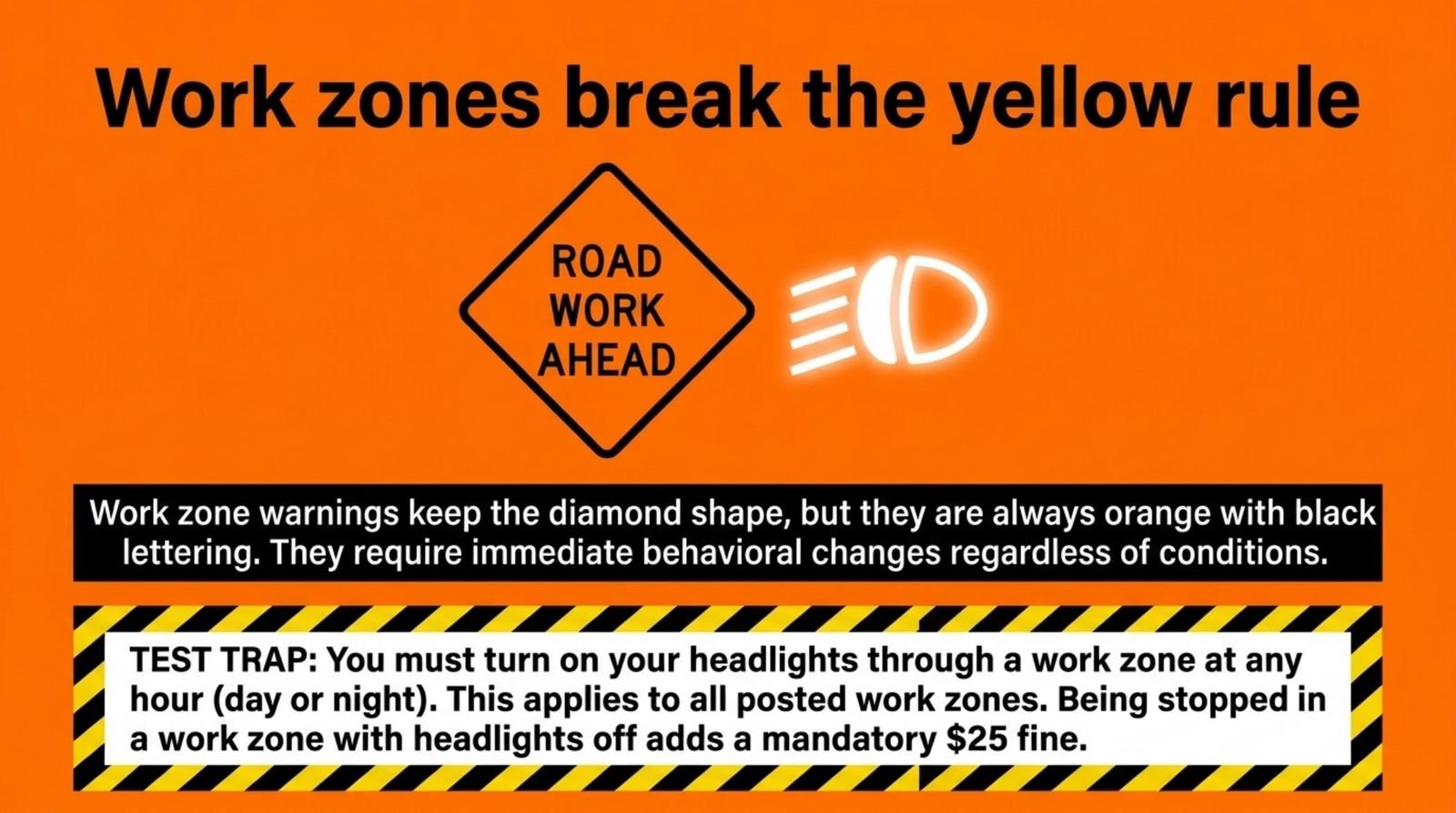
- Orange — work zones. Work zone signs are normally diamond-shaped like warning signs, but orange with black lettering, not yellow.
- Green with white letters — highway and expressway guide signs: exits, distances, directions.
- Blue with white letters or symbols — service signs (gas, food, lodging, hospitals). Tourist-oriented directional signs are blue or brown with white lettering.
- Black and white — most regulatory signs. One exception: the RESERVED PARKING sign is a regulatory sign even though it isn’t black-and-white — and unauthorized vehicles parked there are subject to a fine and towing.
Memory aid: Octagon stops you. Triangle yields. Diamond warns you. Pentagon means school. Orange means workers.
Check yourself: You’re driving at dusk and see a yellow diamond with a black arrow curving right. Without reading this guide again — what is it telling you, and what should you do?
Part 2: Regulatory signs — the law on a stick
Regulatory signs tell you what you must or must not do. In Pennsylvania, ignoring one doesn’t just risk a fine — Pennsylvania has a points system, and many violations add points to your record: PennDOT begins corrective action at 6 points, and suspension is mandatory at 11 or more.
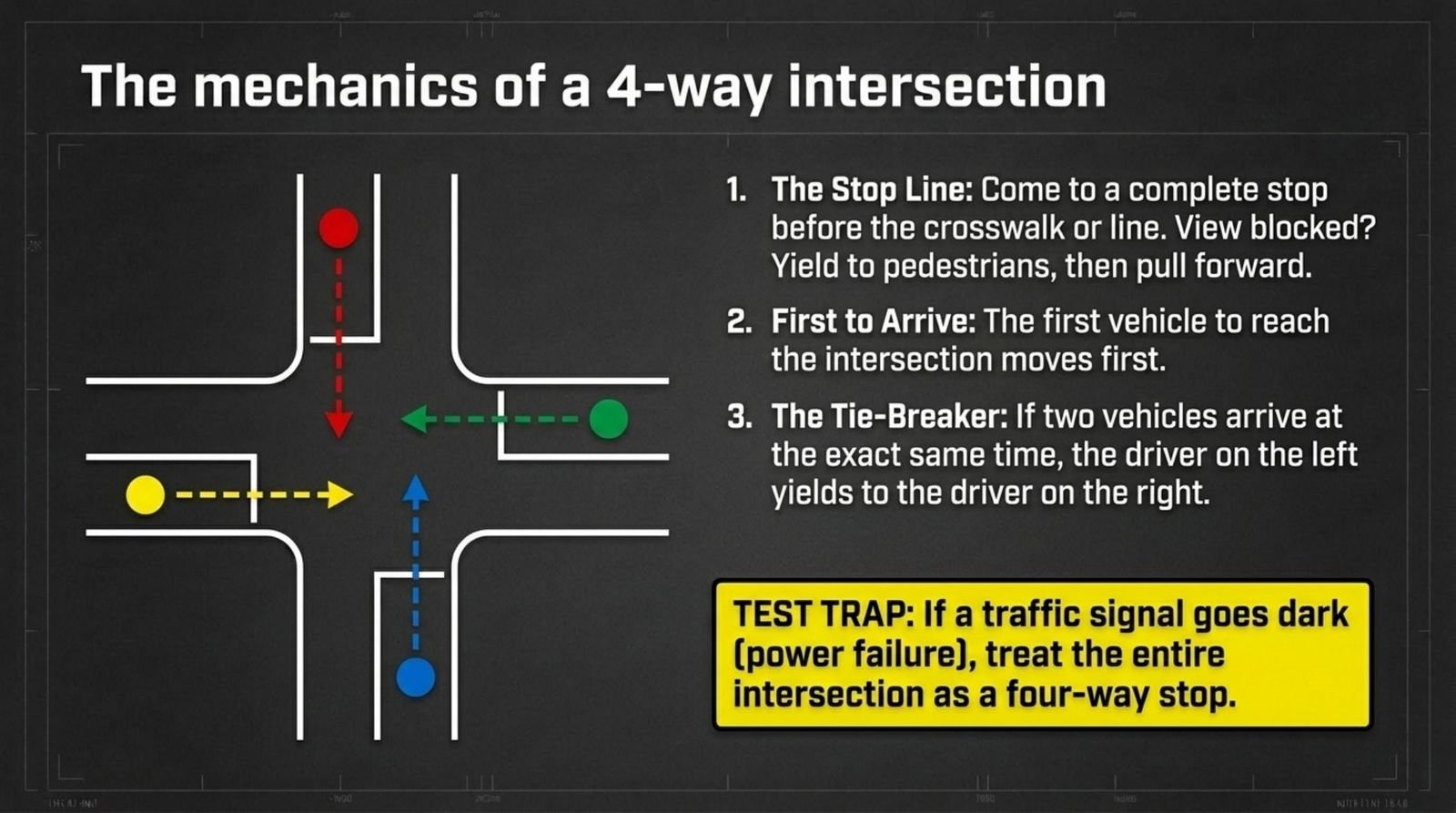
Stop sign. Come to a complete stop — slowing without fully stopping is illegal — before your vehicle reaches the crosswalk or stop line. View blocked? Yield to pedestrians, then pull forward until you can see.
Yield sign. Slow down, check for traffic, and give the right-of-way to pedestrians and approaching cross traffic. Stop only when necessary — then proceed only when there’s a sufficient gap that doesn’t interfere with the normal flow of traffic.
Four-way stop plaque. When a FOUR-WAY STOP plaque hangs below a stop sign, traffic from all four directions must stop. The first vehicle to reach the intersection moves first. If two vehicles arrive at the same time, the driver on the left yields to the driver on the right. Vehicles facing one another may both proceed, with caution.
Speed limit signs. The number is the maximum legal speed under ideal conditions for that stretch of road — not a target. Rain, fog, or traffic can make the posted number too fast, and you can be ticketed for driving too fast for conditions even under the limit.
Divided highway sign. The road you’re on is about to intersect a divided highway — two one-way roadways separated by a median or a guide rail. At the first roadway you can only turn right; at the second, only left.
Check yourself: A friend who moved from a no-points state shrugs off a stop-sign ticket: “It’s just a fine.” In Pennsylvania, what’s the fuller picture?
Part 3: Warning signs — hazard ahead
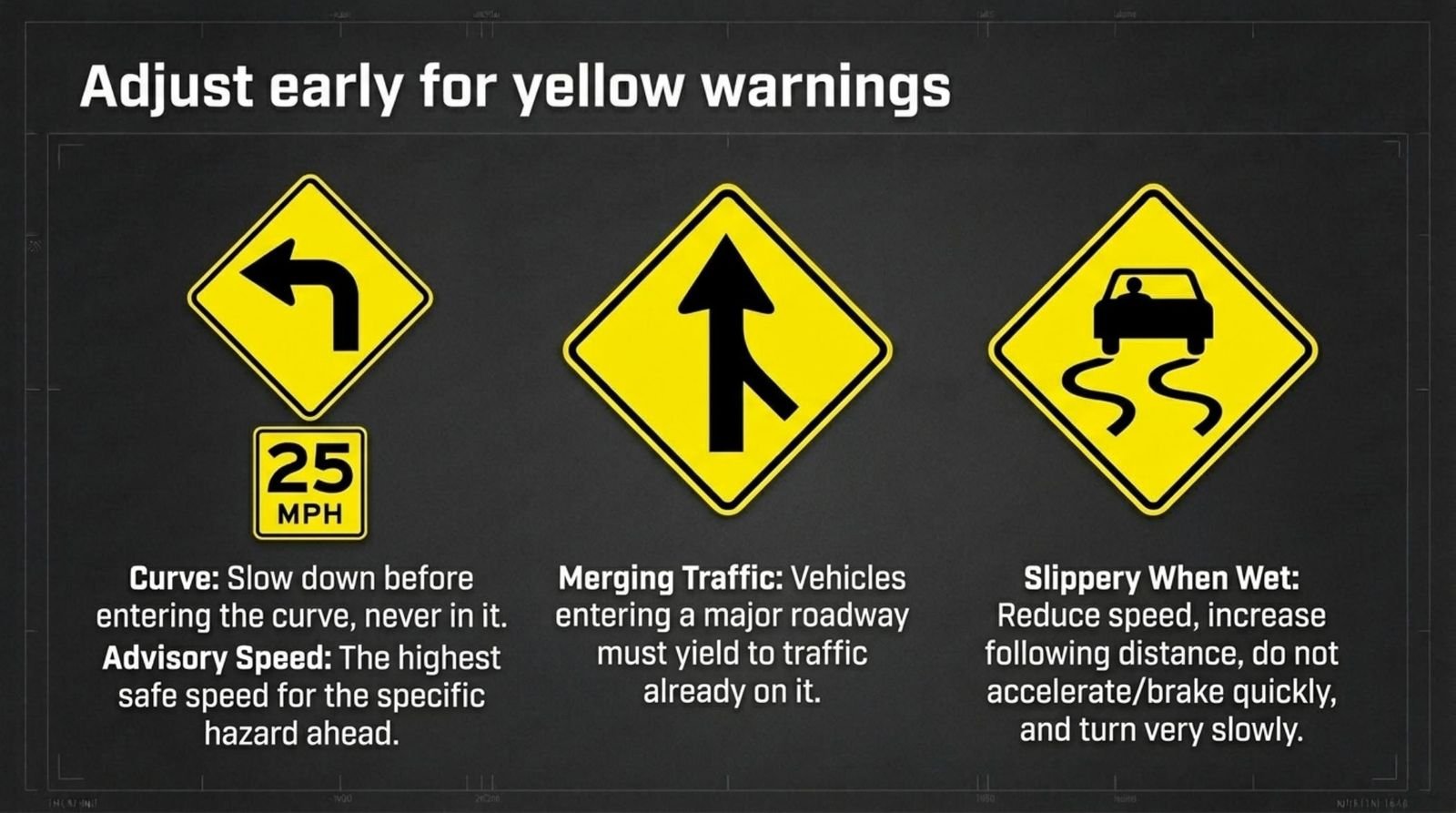
Warning signs are almost always yellow diamonds with black symbols or words. They don’t give orders; they give you a heads-up so you can adjust early and smoothly. An advisory speed sign may appear with any diamond-shaped warning sign — the manual’s example shows a sharp left curve ahead where the highest safe speed is 25 mph.
Common ones to know:
- Curve or winding road — an arrow bending left or right. Slow down before the curve, not in it.
- Merging traffic — lanes joining. Traffic entering a major roadway must yield to traffic already on it.
- Slippery when wet — especially slippery conditions exist when wet. Reduce your speed, increase your following distance, do not accelerate or brake quickly, and make turns at a very slow speed.
- School crossing — a yellow or fluorescent yellow-green pentagon. Children may be crossing; the school-zone speed limit is 15 mph when the lights on the school zone sign are flashing or during the time periods shown on the sign (Part 6).
- Railroad crossing ahead — you are approaching a railroad crossing. Begin looking and listening for a train; the sign is placed far enough in advance to let you stop before the tracks if necessary.
- Two-direction large arrow (at a T-intersection) — you can only go left or right.
Work zone signs break the yellow rule: orange diamonds with black lettering. Turn on your headlights through a work zone at any hour — the law applies to all posted work zones, and a stop in one with headlights off adds a $25 fine.
Check yourself: An orange diamond says “Road Work Ahead.” What color would this sign be if it were a permanent warning instead? What should you switch on as you enter the work zone, day or night?
Part 4: Traffic signals — more than red, yellow, green
Position backs up color: on a vertical signal, red is on top and green on the bottom; on a horizontal signal, red is on the left and green on the right.
Steady red — stop before the marked stop line or crosswalk; if there are no lines, stop before entering the intersection, and wait for green. Two turns on red are legal in Pennsylvania unless a sign prohibits them: a right turn on red after stopping and yielding to pedestrians and other traffic, and a left turn on red only from the left lane, turning left from a one-way street onto another one-way street, after stopping and yielding.
Steady yellow — a steady red light will soon appear. Slow down and prepare to stop. If you’re already within the intersection or cannot stop safely, continue through carefully.
Steady green — you may drive through if the road is clear, and turn right or left unless a sign prohibits it. When turning, yield to other vehicles and pedestrians within the intersection.
Arrows. A steady red arrow means stop — no turning in the arrow’s direction (the turns on red allowed at a steady red light are allowed here too). A steady yellow arrow means the movement is ending. A steady green arrow gives a protected turn — oncoming traffic is held by red. A flashing yellow arrow permits a cautious turn after yielding — not protected, because oncoming traffic has green.
Flashing red light — the same meaning as a STOP sign: complete stop, look both ways, proceed only after the intersection is clear. Flashing yellow light — caution: slow down, look, and proceed with care.
A dark signal is a stop. If a traffic signal isn’t functioning, treat the intersection as a four-way stop.
Lane-use signals hang over reversible lanes: a green downward arrow means you may use the lane; a steady yellow X means you must change lanes because the lane’s direction is about to be reversed; a steady red X means you are not allowed to use the lane at all.
Ramp-metering signals alternate green and red at some highway entrance ramps. Wait for green — on a single-lane ramp, only one car may enter per green — and still look for a safe gap: the green doesn’t protect your entry.
Pedestrian signals. WALK means start crossing, alert for turning vehicles. A flashing DON’T WALK means finish crossing if you’re in the street, but don’t start from the curb. A steady DON’T WALK means do not cross. Near a blind pedestrian with a white cane or guide dog, slow down, always yield, and be prepared to stop.
Check yourself: A storm knocks out the traffic light at a busy intersection. The light is completely dark. What do you do?
Part 5: Pavement markings — paint with meaning
Yellow lines divide traffic traveling in opposite directions, and also mark the left edge of divided highways, one-way streets, and ramps. White lines divide lanes traveling the same direction and mark the right edge of the road.
- The general rule: broken lines can be crossed; solid lines cannot — except when making a turn. You may cross solid yellow lines when making turns.
- Double solid yellow lines — passing by traffic in either direction is not allowed, even without a NO PASSING sign.
- Center turn lane — outside solid yellow lines with an inside broken-yellow/solid-yellow pattern mark a center lane either direction may use for left turns only — never for passing or regular travel.
- Crosswalks and stop lines — stop before them, never on top of them.
Check yourself: You need to turn left into a driveway across double solid yellow lines. Is that the same violation as crossing them to pass a slow car? What’s the difference?
Part 6: Pennsylvania numbers hiding in the signs topic
Some test questions dressed as “signs and signals” are really Pennsylvania speed and signal rules. Know these cold:
- School zones: 15 mph when the yellow signals on the school zone speed limit signs are flashing, or during the time periods indicated on the sign. Exceeding the school-zone limit means 3 points plus a fine.
- The statewide maximum is 70 mph. Where no limit is posted, Pennsylvania’s statutory defaults apply instead: 35 mph in an urban district, 25 mph in a residence district, and 55 mph in other locations. A posted sign always wins where you’re driving.
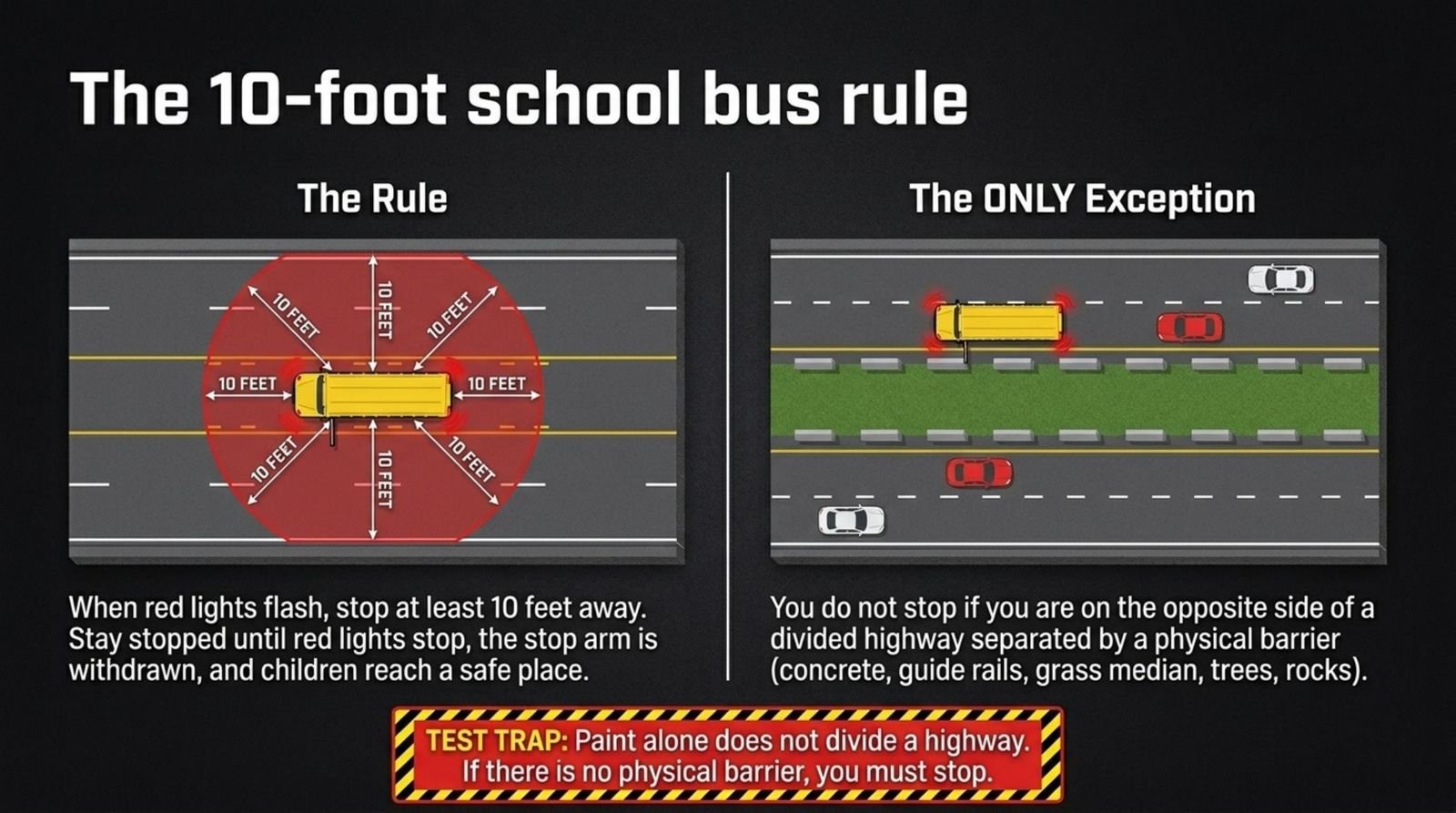
- School bus flashing reds: stop at least 10 feet away, and stay stopped until the red lights stop flashing, the stop arm is withdrawn, and the children have reached a safe place. The one exception: on the opposite side of a divided highway — concrete or metal barriers, guide rails, or trees, rocks, streams, or a grass median — you don’t stop, but slow down and proceed with caution. Paint alone doesn’t divide a highway.
- Railroad signals: stop when there’s a signal of an approaching train — flashing red lights, a lowered gate, a flagger, or the train’s audible warning. Never go around a gate or ignore a signal, and never stop your vehicle on a railroad track.
- Slow-moving vehicle emblem: the orange triangle displayed on farm tractors and horse-drawn vehicles designed to operate at 25 mph or less. When you see it, you’re catching up to something slow — adjust early.
Key numbers to memorize
| Fact | Remember |
|---|---|
| Sign categories | 3 — regulatory, warning, guide |
| Stop sign shape | Octagon (8 sides) — the only one |
| Yield sign shape | Triangle (3 sides) |
| Warning sign color/shape | Yellow diamond (orange diamond = work zone) |
| No-passing zone sign | Pennant — the only pennant-shaped warning sign |
| School sign | Pentagon — the only pentagon-shaped sign on the roadway |
| Crossbuck | At the tracks themselves — treat it as a yield |
| Dark traffic signal | Treat as a four-way stop |
| Real PennDOT knowledge test | 18 questions — 15 correct to pass |
| School-zone speed | 15 mph when lights flash or during posted times |
| Maximum speed in Pennsylvania | 70 mph |
| Unposted defaults: urban / residence district / other | 35 / 25 / 55 mph |
| School bus stop distance | At least 10 feet away |
| Points: corrective action / mandatory suspension | 6 points / 11 or more points |
5-question self-check
- You see a yellow diamond sign with a car and wavy lines behind it. What does it mean, and what should you do?
- The traffic light at your intersection is completely dark after a power failure. What do you do?
- A traffic light shows a flashing yellow arrow for your left turn. Is your turn protected? What must you do before turning?
- You’re driving past a school and the yellow lights on the school zone sign are flashing. What speed applies?
- No speed limit sign is posted. What’s the maximum legal speed in an urban district — and in a residence district?
Answer key
- Slippery when wet — especially slippery conditions exist when wet. Reduce your speed, increase your following distance, do not accelerate or brake quickly, and make turns at a very slow speed.
- Treat the intersection as a four-way stop. Stop completely, then proceed in turn when it’s safe.
- No — a flashing yellow arrow turn is not protected, because oncoming traffic has a green light. Yield to oncoming traffic and pedestrians, then turn with caution.
- 15 mph — the school-zone limit applies when the lights are flashing (or during the time periods shown on the sign). Exceeding it brings 3 points and a fine.
- 35 mph in an urban district, and 25 mph in a residence district. (Elsewhere, the unposted default is 55 mph, and Pennsylvania’s maximum is 70 mph.)
Keep practicing
- Take the Signs & Signals practice quiz
- Flip through the Signs & Signals flashcards
- Run the full Pennsylvania practice test
More study guides: Traffic Laws Study Guide · Right of Way Study Guide · Safe Driving Study Guide · Alcohol, Drugs & Driving Conditions Study Guide · Licensing & Registration Study Guide