
Your complete Tennessee study guide — plain language, no jargon.
Built from the official manual. Every fact in this Tennessee section comes from the Tennessee Comprehensive Driver License Manual, published by the Tennessee Department of Safety & Homeland Security (Driver Services Division) — checked against the current edition and verified November 15, 2026. Read the manual itself at tn.gov/safety.
📘 Prefer pictures? Flip through the visual deck
This whole guide as 15 slides — swipe or scroll sideways through them. Tennessee Traffic Laws study guide, practice tests & flashcards: speed limits and the basic rule, seat belts and child restraints, Hands-Free Tennessee, work zones and the points system.





Take it with you: Download the deck as a PDF (6.3 MB) → — free to share.
Why this matters
Traffic laws decide whether everyone gets home safely — and whether you keep your license. This guide covers Tennessee’s rules on speed, work zones, belts and child restraints, phones, points, and carrying your license.
Your study source is the Tennessee Comprehensive Driver License Manual, from the Tennessee Department of Safety & Homeland Security, Driver Services Division — the agency that issues Tennessee licenses through its Driver Service Centers.
The honest test-format note: the only published format is the online knowledge test for ages 15–17 — 30 questions, 60 minutes, 80% to pass. For the in-center test, no question count or pass mark is published, and we will not guess at one. The manual describes an approximate composition — roughly 25% each from signs/signals, safe driving, rules of the road, and drugs/alcohol — approximate, not a promise.
Our topic quizzes are 15 questions at 80%; our full practice exam is 30 questions, pass 24, mirroring that published online format.
Part 1: The speed laws — posted limits and the basic rule
Start with the rule underneath every posted number: drive at a speed that permits stopping before reaching hazards. A posted limit is a maximum for good conditions, not a target. Tennessee law sets the interstate maximum at 70 mph, but not on all sections — as low as 55 mph in larger urban areas. Rural interstates are posted at 70 on most sections; urban/metropolitan interstates are typically 55. Drive the maximum only in ideal conditions.
Unless otherwise posted, the limit on primary and secondary state and federal highways is 55 mph. The state, counties, and municipalities set limits on their own roadways; some sections are set by TDOT.
Going too slowly is also unlawful: less than 55 mph in the leftmost lane of any interstate (unless congestion or traffic flow prevents it), and the minimum in the right lane(s) is 45 mph.
Memory aid: 70 is the ceiling, 55 is the default, 45 is the floor — and the basic rule beats them all.
Check yourself: The limit is 70 mph, but traffic ahead is slowing. What does the basic rule require? A speed that lets you stop before reaching hazards — here, slowing down despite the posted 70.
Part 2: Work zones — slow down where people are working
In a work zone, crews work close to traffic. Obey the posted limit — it is not a suggestion.
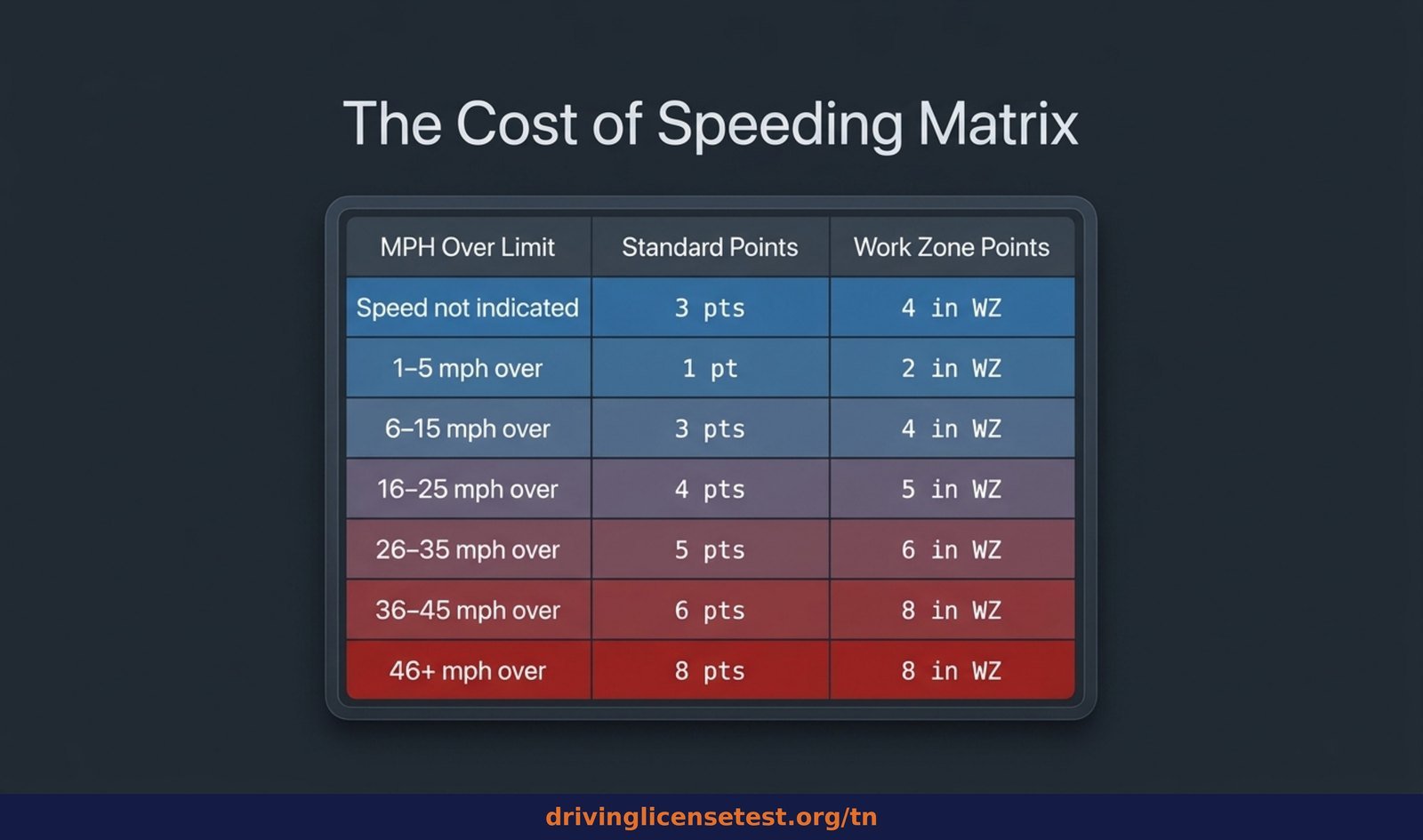
Violating it in an active work zone carries a minimum fine of $250 and a maximum of $500. Speeding there also costs more points than elsewhere (see the values in parentheses in Part 5) — a ticket hits you twice.
Memory aid: Orange signs, heavy fines — $250 to $500 on the line.
Check yourself: Minimum fine for violating the posted limit in an active work zone? $250 (maximum $500).
Part 3: Seat belts and child restraints — everyone, every ride
This is primary enforcement: officers can stop and ticket drivers solely for a belt or child-restraint violation. No other violation is needed first.
Belts are required for all drivers and all front-seat passengers any time the vehicle is in motion (statute: operator and front-seat passengers aged 4+). Occupants aged 16–17 must be belted in any seat. If the driver holds a learner permit or intermediate license, the driver and all passengers ages 4–17 must be belted.
The right restraint for a child’s age and size:
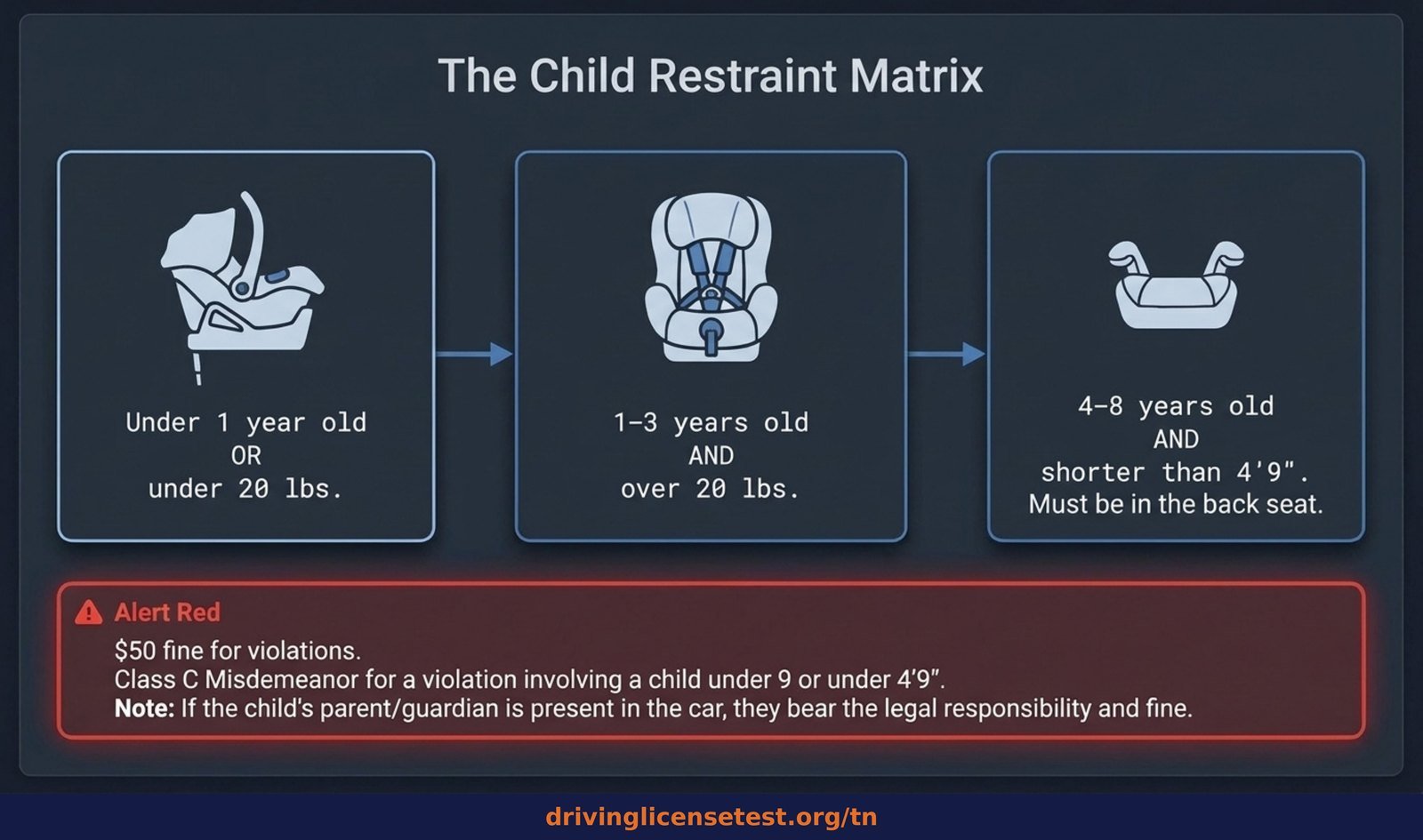
- Under 1 year old, or under 20 lbs — rear-facing child restraint.
- 1–3 years old and over 20 lbs — forward-facing child restraint.
- 4–8 years old and shorter than 4’9″ — a belt-positioning booster seat, in the back seat if the vehicle has one, meeting federal standards.
If children under 16 are not properly restrained, the driver may be charged and fined $50.00 — unless the child’s parent/legal guardian is present but not driving, in which case the parent/guardian bears the responsibility and may be fined. A car-seat/booster violation for a child under 9 or under 4’9″ is a Class C misdemeanor, with required attendance at a class on safely transporting children and possible fees and fines.
Doctor-prescribed modified restraints are provided for — carry the prescription in the vehicle. Tennessee was the first state to pass a Child Passenger Protection Law.
Memory aid: Rear-facing under 1 or 20, forward-facing at 1 to 3, booster from 4 to 8 if under 4’9″.
Check yourself: Your 17-year-old passenger rides in the back seat. Belt required? Yes — ages 16–17 must be belted in any seat.
Part 4: Phones and Hands-Free Tennessee — hands off, eyes up
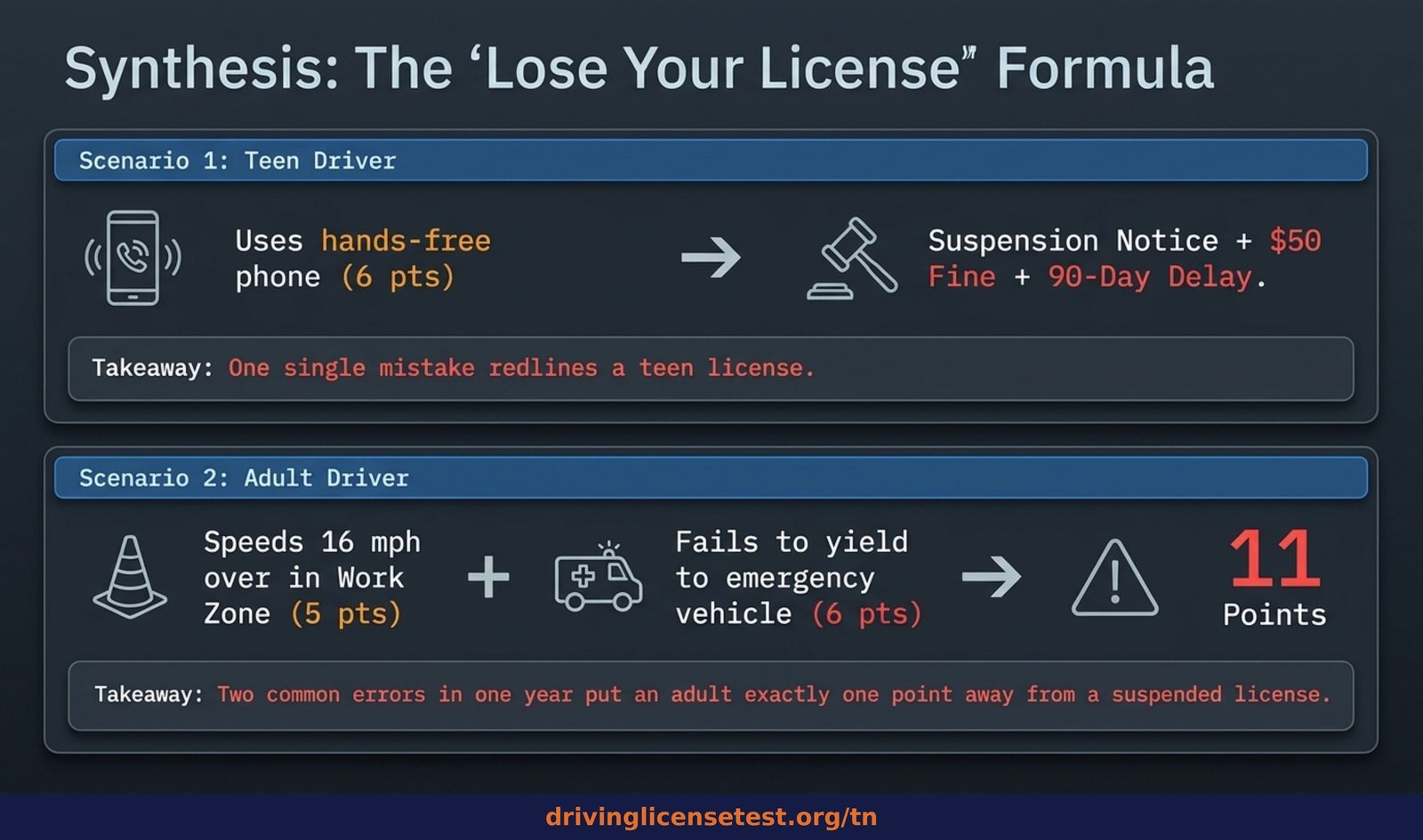
Teen drivers — learner permit or intermediate license — may not use a cell phone while driving on any Tennessee roadway at all: handheld, car phone, or other mobile phone. Penalty: Class C misdemeanor, $50.00 fine, 6 points on the minor’s record, and a 90-day delay in eligibility for the Intermediate Restricted license.
Texting while driving has been prohibited since July 1, 2009, for teen and adult drivers alike — using a handheld telephone or PDA to transmit or read a written message while the vehicle is in motion. Fine: not to exceed $50; court costs: not to exceed $10. Emergency personnel on official duty are exempt.
Since 2019, Hands-Free Tennessee goes further. It is illegal to:
- Hold a cellphone or mobile device with any part of the body.
- Write, send, or read any text-based communication.
- Reach for a device in a way that requires leaving the seated driving position or proper seat-belt restraint.
- Watch a video or movie on a device.
- Record or broadcast video on a device.
School zones: since January 1, 2018, using a hand-held mobile phone while in motion in a marked school zone with warning flashers operating is an offense for persons 18+. The hands-free-mode exception applies only to drivers 18+ — for under-18s, it is a delinquent act.
State law also prohibits a video monitor/screen capable of displaying a TV broadcast or video signal visible to the driver while in motion. Navigation/GPS, vehicle information, and camera-view displays are not prohibited.
Memory aid: If you have to hold it, read it, watch it, or reach for it — don’t.
Check yourself: A teen on an intermediate license takes a hands-free call while driving. Allowed? No — teens may not use a cell phone while driving at all.
Part 5: The points system — how violations add up
The Department of Safety keeps violation and crash records, each with a point value. Reach the threshold, and it can act on your license.
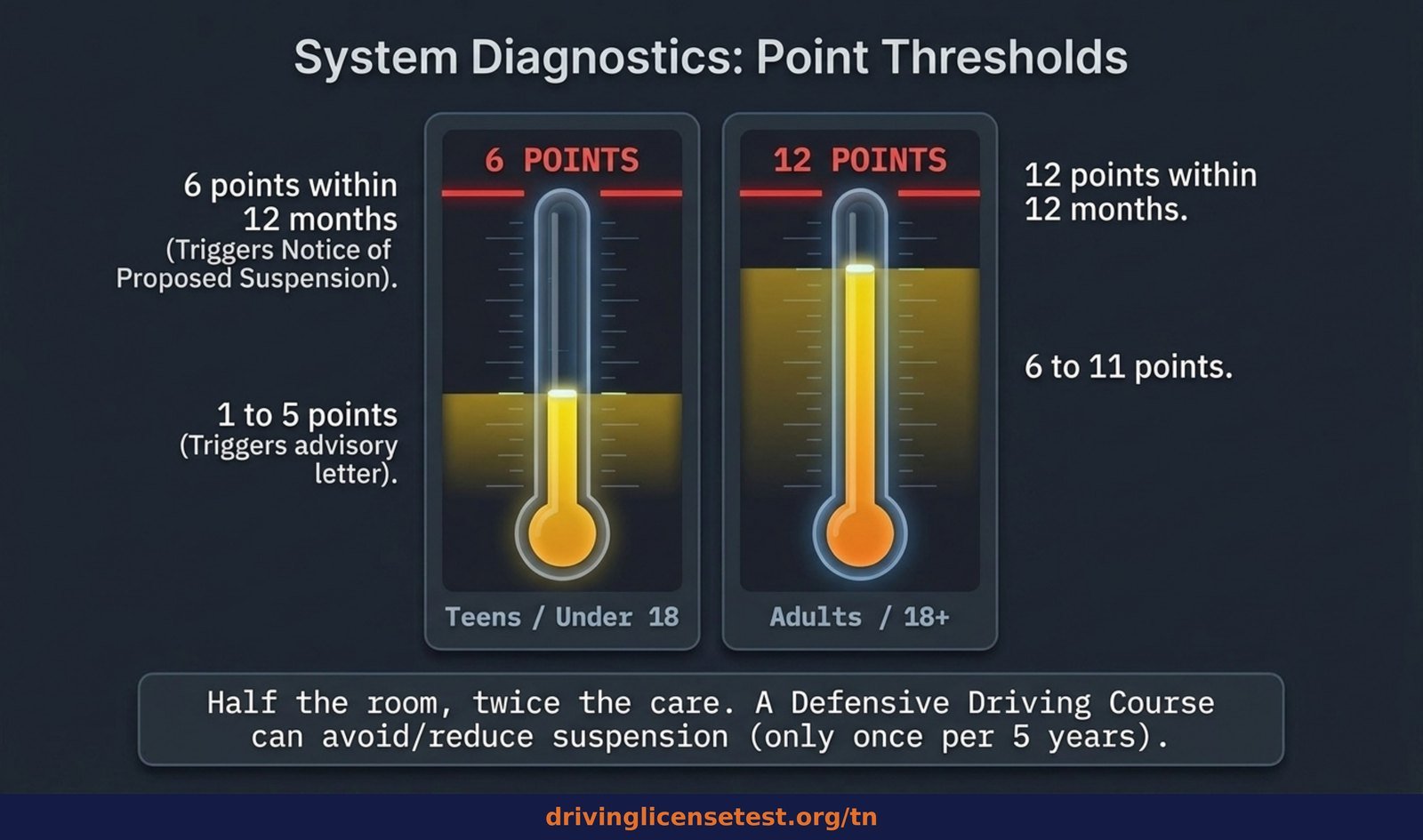
Adults (18+): 12+ points within 12 months brings a notice of proposed suspension; an advisory letter comes at 6–11. Juveniles (under 18): 6+ points within 12 months brings a notice of proposed suspension; an advisory letter comes at just 1–5.
After a hearing, the Department may require education, re-examination, restrictions, and/or probation before suspending. A Defensive Driving Course can avoid suspension or reduce its period — only once in any five-year period.
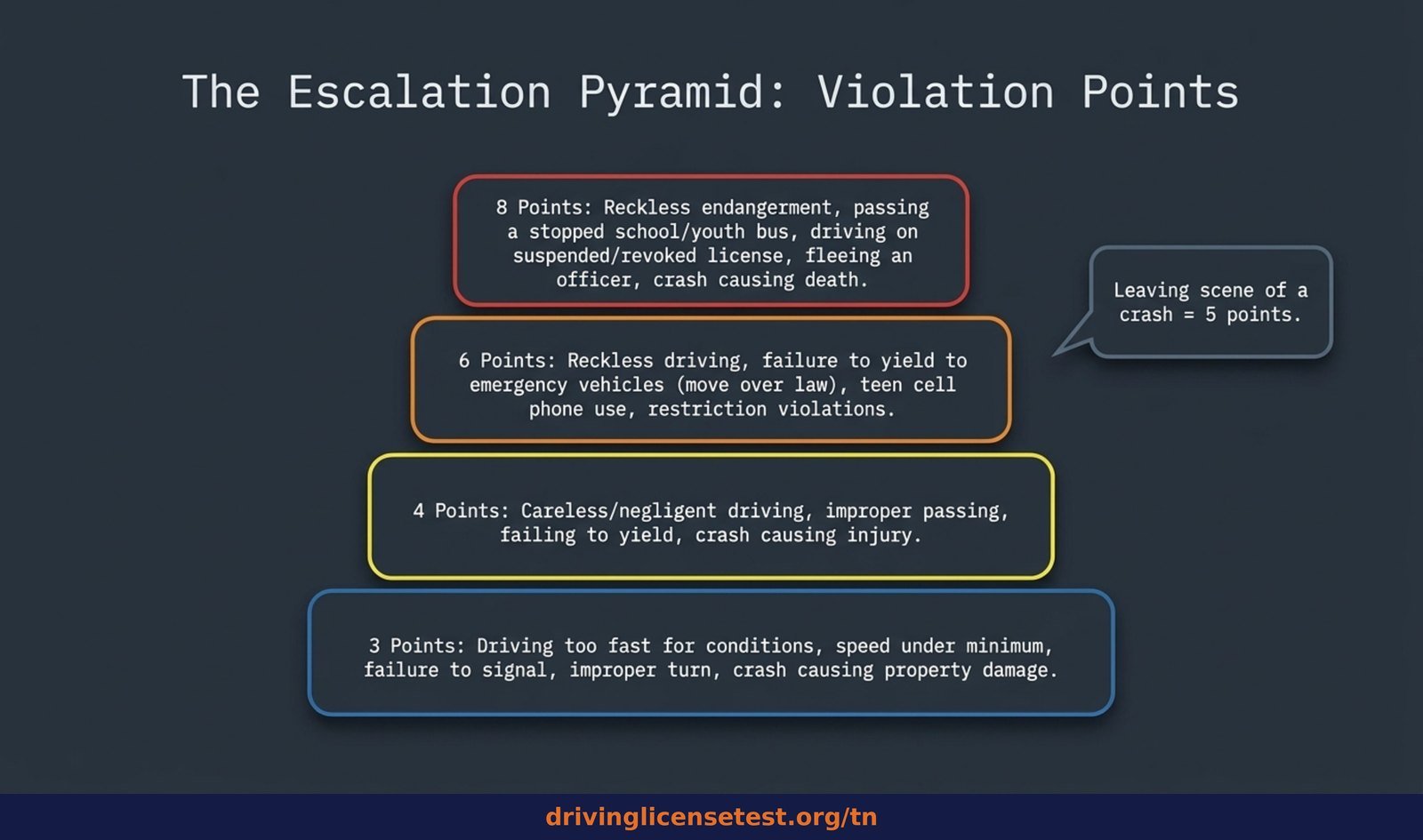
8 points: reckless endangerment by vehicle; passing a stopped school, church, or youth bus taking on or discharging passengers; failure to stop at a railroad crossing; operating while the required license is under suspension, revocation, or cancellation; fleeing a law enforcement officer; child endangerment. 6 points: reckless driving; failure to yield right-of-way to emergency vehicles, including failure to change lane or slow down for authorized vehicles on the roadside; operating a vehicle while using a cell phone (under 18); violation of driver license restrictions. 4 points: careless or negligent driving; improper passing; passing where prohibited; failing to yield right-of-way; use of a controlled access roadway; crossing private property to avoid a stop sign or signal; failure to report a crash. 3 points: driving too fast for conditions; speed less than the posted minimum; following improperly; improper turn; failure to signal; coasting; improper backing; inattentive driving; operating without the license required for the vehicle type. Leaving the scene of a crash (where no revocation applies) is 5 points; operating without a driver license in possession is 2 points.
Speeding points (construction-zone value in parentheses): speed not indicated, 3 (4); 1–5 mph over, 1 (2); 6–15 over, 3 (4); 16–25 over, 4 (5); 26–35 over, 5 (6); 36–45 over, 6 (8); 46+ over, 8 (8).
Crash points, if you contribute: property damage, 3; bodily injury, 4; death of another person, 8.
Memory aid: Adults: 12 points in 12 months. Teens: 6 is the line — half the room, twice the care.
Check yourself: An adult collects 7 points in one year. What should they expect? An advisory letter (the 6–11 range) — 12 or more within 12 months brings a notice of proposed suspension.
Part 6: Carrying your license — have it, show it
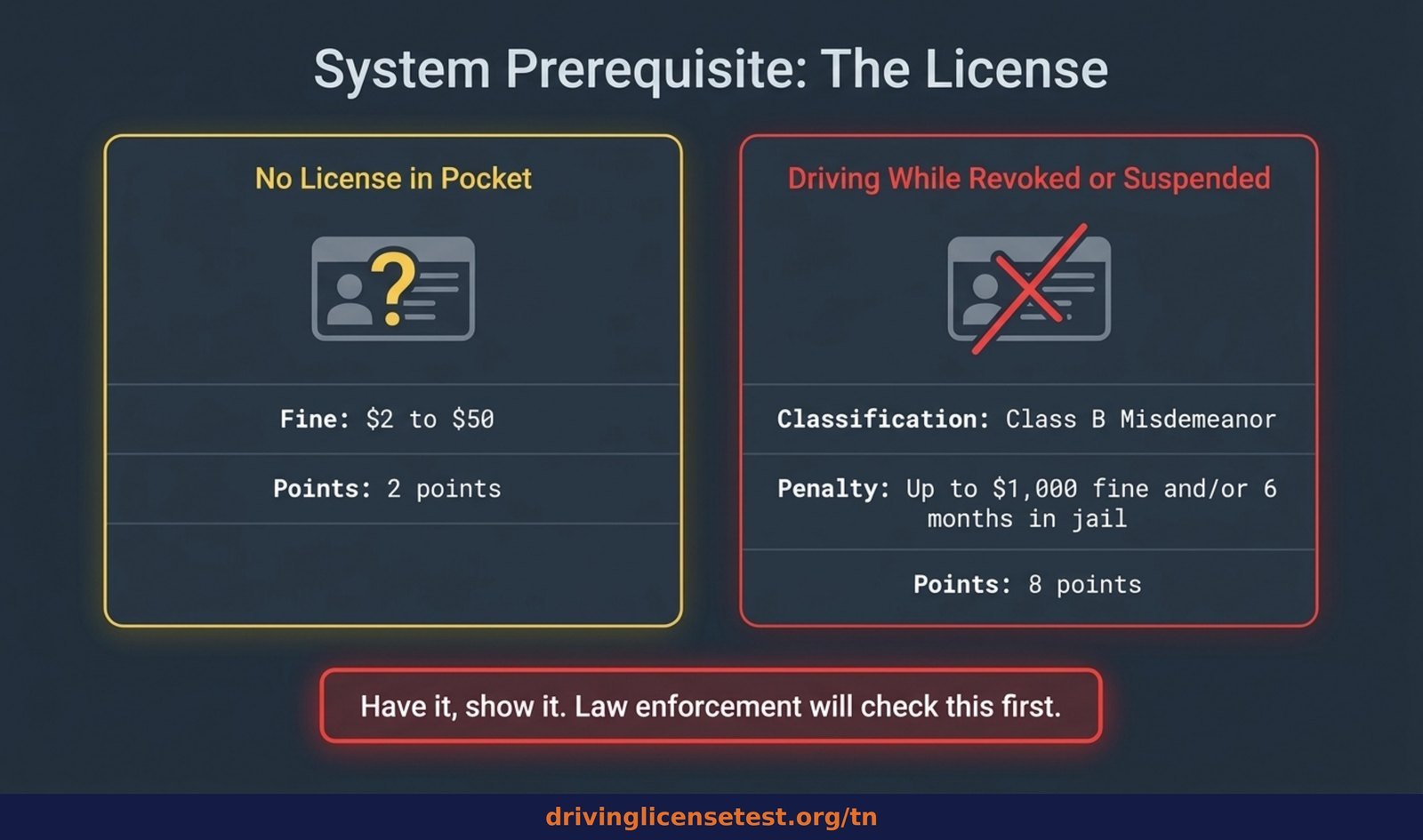
Your license must be carried when you drive, and shown on request. Driving without it in possession: a fine of not less than $2.00 and no more than $50.00, plus 2 points (Part 5).
Driving while revoked, canceled, or suspended is far more serious: a Class B misdemeanor, up to $1,000 and/or six months in jail — and 8 points.
Memory aid: No license in pocket: $2 to $50. Suspended license: up to $1,000 and six months.
Check yourself: Penalty for driving while revoked, canceled, or suspended? Up to $1,000 and/or six months in jail — a Class B misdemeanor.
Key numbers to memorize
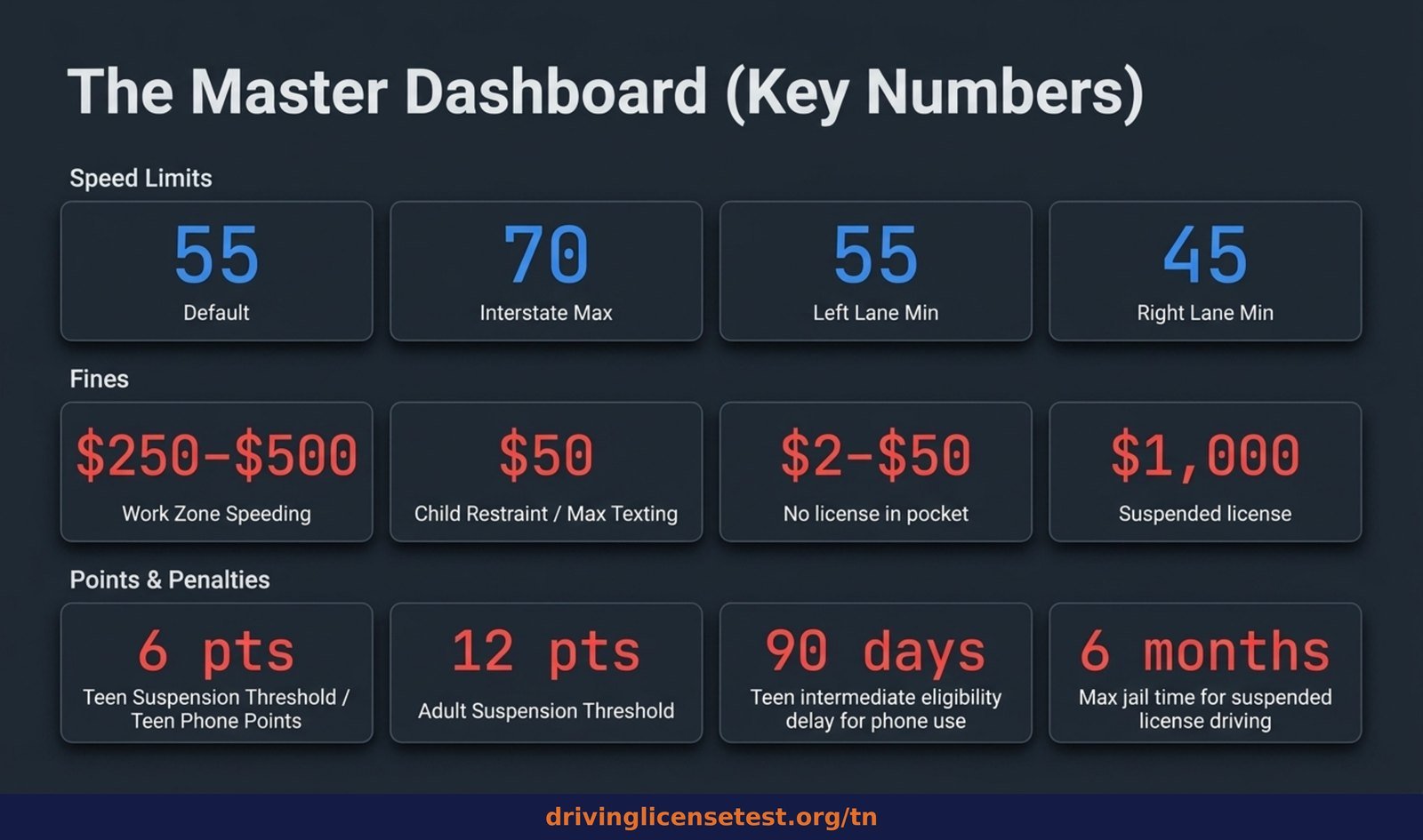
| Number | What it means |
|---|---|
| 55 mph | Default limit on primary/secondary state and federal highways, unless otherwise posted |
| 70 mph | Interstate maximum set by law — not on all sections |
| 55 mph | Typical urban interstate limit; minimum for the leftmost interstate lane |
| 45 mph | Minimum speed in the right lane(s) of an interstate |
| $250–$500 | Fine for violating the posted limit in an active work zone |
| $50.00 | Fine when a child under 16 is not properly restrained |
| $50.00 / $10 | Maximum texting fine / maximum court costs |
| 6 points + 90 days | Teen phone points, plus delay in Intermediate Restricted eligibility |
| 12 / 6 points | Adult / juvenile suspension threshold within 12 months |
| $2.00–$50.00 | Fine for driving without your license in possession |
| $1,000 / 6 months | Max fine and/or jail, driving while revoked/canceled/suspended |
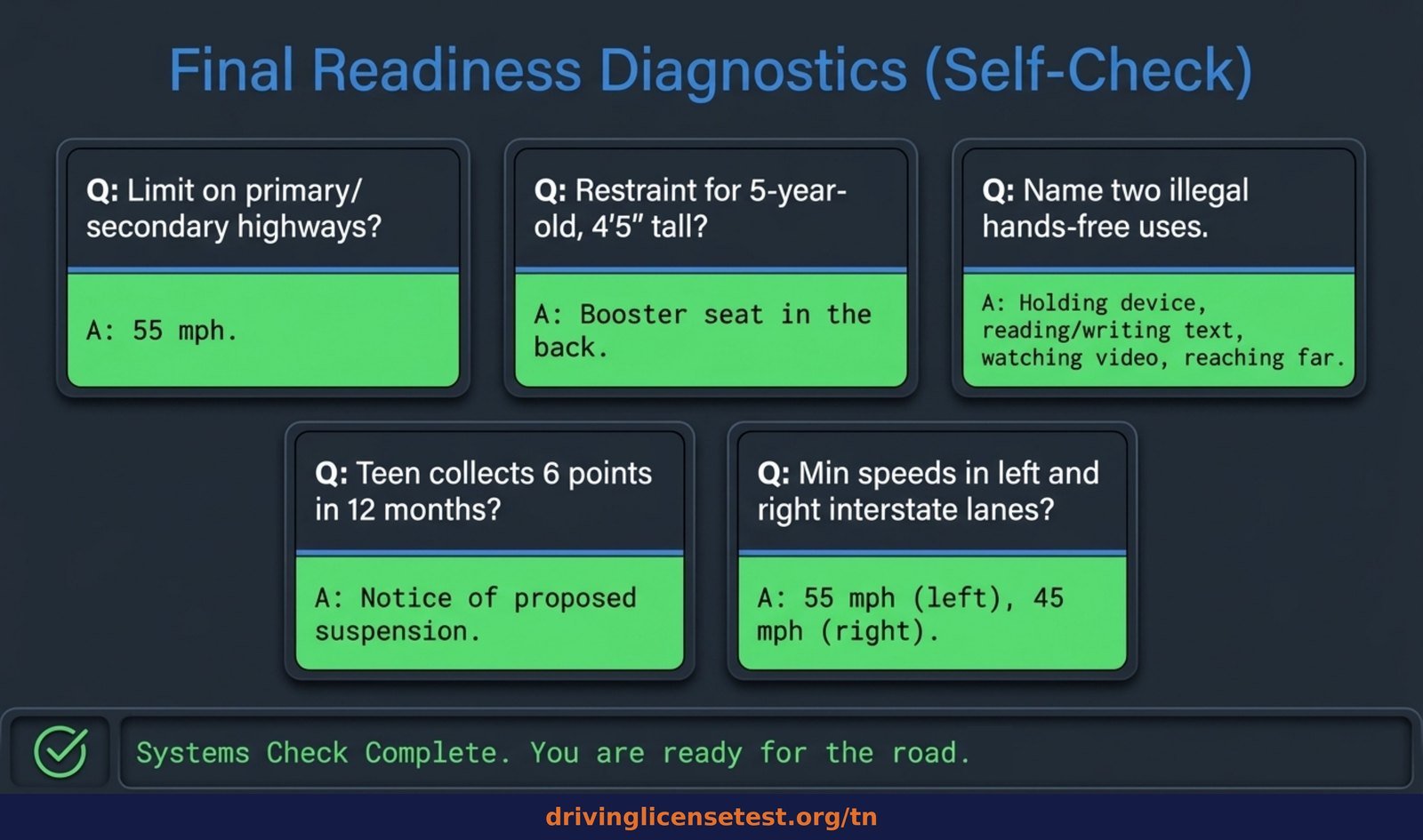
5-question self-check
- Unless otherwise posted, what is the limit on primary and secondary state and federal highways?
- A child is 5 years old and 4’5″ tall. What restraint is required, and where?
- Under Hands-Free Tennessee, name two illegal uses of a device.
- A driver under 18 collects 6 points within 12 months. What happens?
- What are the minimum speeds in the right lane and the leftmost lane of an interstate?
Answer key
- 55 mph.
- A belt-positioning booster seat meeting federal standards, in the back seat if the vehicle has one (ages 4–8, shorter than 4’9″).
- Any two of: hold a device with any part of the body; write, send, or read a text-based communication; reach for a device in a way that requires leaving the seated position or seat-belt restraint; watch a video or movie; record or broadcast video.
- A notice of proposed suspension — the juvenile threshold is 6 or more points within 12 months.
- 45 mph in the right lane(s); 55 mph in the leftmost lane, unless congestion or traffic flow prevents it.
Keep practicing
- Take the quiz: Tennessee Traffic Laws Practice Test — 15 questions at 80%.
- Flip the flashcards: Tennessee Traffic Laws Flashcards
- Try the full practice exam: Tennessee Full Practice Test — 30 questions, pass 24, mirroring the published online knowledge-test format.
More study guides: Signs & Signals Study Guide · Right of Way Study Guide · Safe Driving Study Guide · Alcohol, Drugs & Driving Conditions Study Guide · Licensing & Registration Study Guide