Your complete Tennessee study guide — plain language, no jargon.
Built from the official manual. Every fact in this Tennessee section comes from the Tennessee Comprehensive Driver License Manual, published by the Tennessee Department of Safety & Homeland Security (Driver Services Division) — checked against the current edition and verified November 15, 2026. Read the manual itself at tn.gov/safety.
📘 Prefer pictures? Flip through the visual deck
This whole guide as 15 slides — swipe or scroll sideways through them. Tennessee Signs & Signals study guide, practice tests & flashcards: the six sign shapes and nine colours of the Tennessee manual, signals and lights, railroad crossings and the pavement-marking rules.



Take it with you: Download the deck as a PDF (7.9 MB) → — free to share.
Why this matters
Every rule here comes from the Tennessee Department of Safety & Homeland Security, Driver Services Division — the agency that issues driver licenses at its Driver Service Centers. Its Tennessee Comprehensive Driver License Manual is the study source for the knowledge test, drawn from Sections B and C of the manual.
The manual describes the test’s composition in approximate terms only: about 25% each across traffic signs and signals, safe driving principles, rules of the road, and drugs and alcohol — rough shares, not exact counts.
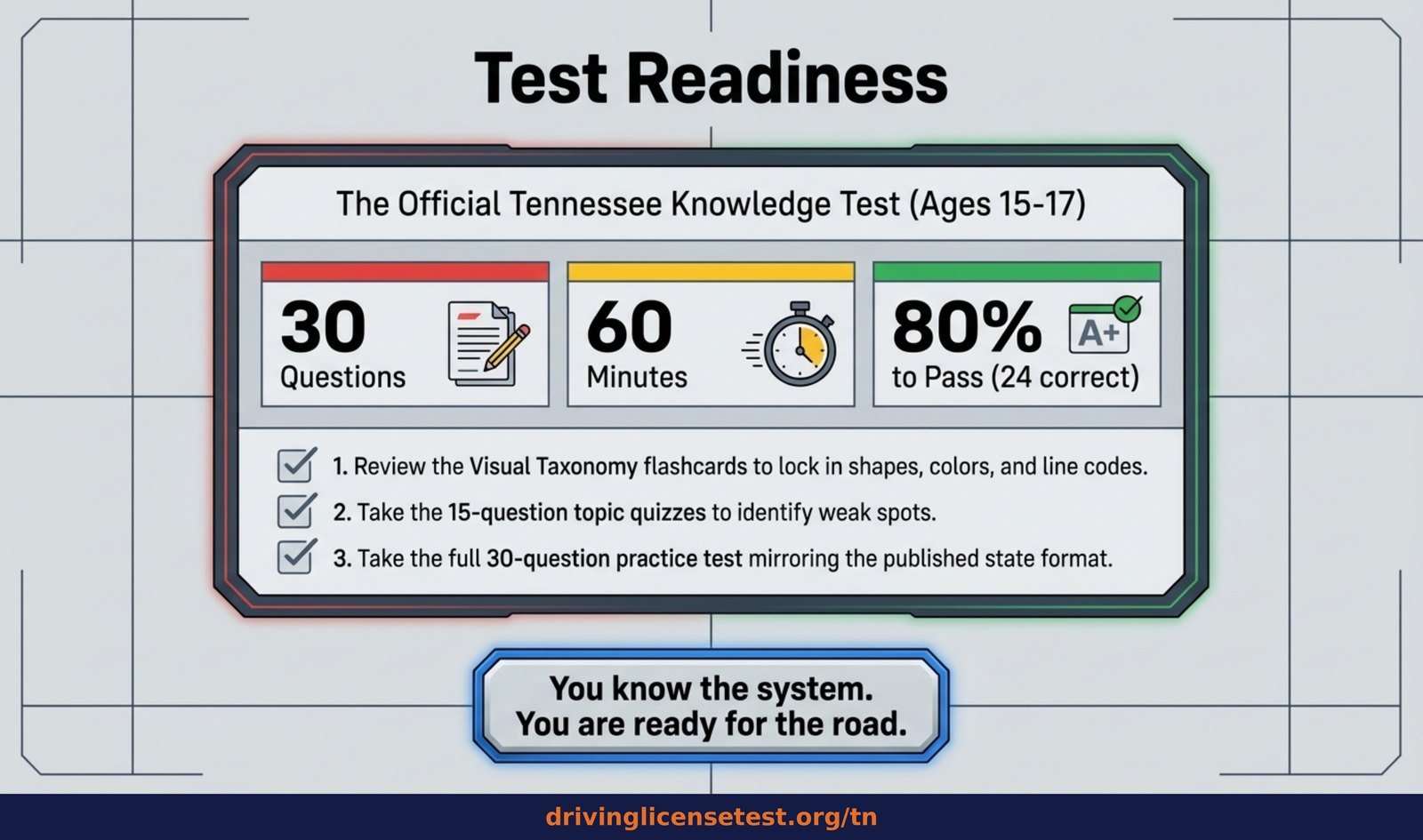
The only published test format is the online knowledge test for ages 15–17: 30 questions, 60 minutes, 80% to pass. For the in-center test, no question count or pass mark is published — it is plainly not published, so we will not guess.
Our practice mirrors that published online format: topic quizzes are 15 questions at 80%, and the full practice exam is 30 questions with 24 to pass.
Part 1: Sign shapes — read the shape before you read the words
Traffic control devices — signals, signs, and pavement markings — control traffic, and so do law enforcement officers, highway construction personnel, and school crossing guards. Obey directions from those people even when they differ from what the lights and signs say, and obey every sign at all times unless an officer directs otherwise.
Every sign has a definite shape and colors that announce its purpose. You should recognize a sign by shape alone — even if a stop sign is damaged or blocked by dirt, limbs, or snow, its octagonal shape and red color tell you to stop. The Tennessee manual presents exactly six shapes:
- Octagon — Stop. The only eight-sided sign on the roadway. It always means danger ahead at an important street or highway: bring your car to a complete stop, not going beyond the crosswalk. If you cannot see, proceed cautiously to a point where you can see, and go only when it is safe. It is always red with white lettering.
- ALL WAY plaque. A red rectangle added below a stop sign. It means all traffic approaching the intersection must stop.
- Triangle — Yield. You are approaching an intersection. Stop and wait when other vehicles are approaching from the right or left. If you are sure no other cars are coming, you need not come to a complete stop — but slow down and enter with caution. Always stop when traffic is heavy.
- Round — Railroad Ahead. A circular sign always means you are approaching a railroad grade crossing. Slow down and be ready to stop; it is up to you to stop if you see a train coming. Never try to “beat” the train.
- Broad “X” — Railroad Here (crossbuck). Placed at all railroad grade crossings, it shows exactly where the tracks are. The smaller signs on the post below it show the number of tracks — important, because with two or more tracks, one train passing might hide a train approaching from the other direction. Some crossbucks have two flashing lights under the “X” or a gate as well: stop when the lights flash and stay stopped until the train has passed and all tracks are clear.
- Diamond — Hazardous or Unexpected Condition Ahead. These signs call for caution and usually a slower speed. Some carry written information; others are miniature symbolic road maps — the black lines show just what kind of intersection or condition lies ahead.
- Rectangle — Special Laws, Regulations, or Important Information. A regulatory sign is always a rectangle: it tells you about laws and regulations or gives instructions such as speed limits or lane uses. Lane control signs are one example — some direct certain vehicles (trucks) to specific lanes; others say traffic in a lane must go straight or turn left. Some are mounted overhead.
One shape you will not find in the Tennessee manual’s list: the pentagon. Some states teach a five-sided school-crossing sign, but the Tennessee manual never presents it — Tennessee handles school signage through the fluorescent yellow-green color and the warning-sign family (Part 2). Learn it the Tennessee way.
Memory aid: Eight sides stop, three sides yield, round and X are railroads, diamonds warn, rectangles regulate.
Check yourself: A sign is covered in snow and only its eight-sided outline shows. What must you do — and which shape is missing from the Tennessee manual’s list?
Part 2: Sign colors — the nine families
The manual says the meanings of the nine basic background colors of signs should be memorized:
- RED — stop, yield, do not enter, or wrong way
- YELLOW — general warning
- ORANGE — construction and maintenance warning
- BLACK — regulatory
- BROWN — public recreation areas
- GREEN — guidance
- WHITE — regulatory and route markers
- BLUE — motorist services and information
- FLUORESCENT YELLOW-GREEN — school zones
The details behind the chart:
- Red is used only as a background color for STOP signs, ALL WAY supplemental plates, DO NOT ENTER messages, and WRONG WAY signs, and on Interstate route markers. Red is also the legend color on YIELD signs, parking prohibition signs, and the circle-and-diagonal-bar “no” symbol.
- Black and white work as a pair for regulatory signs: black messages on white, yellow, and orange signs. Whenever white is specified, it includes silver-colored reflective coating that reflects white light.
- Orange is the background for construction and maintenance signs and shall not be used for any other purpose.
- Yellow backgrounds warning signs (except where orange is specified) and school signs.
- Fluorescent yellow-green is the school-zone color, now used for school zones and other pedestrian areas such as crosswalks. These signs are much easier to see in low light and foggy or rainy weather — where they are posted, watch carefully for pedestrians, school children, bicyclists, and motor vehicles.
- Fluorescent pink (sometimes called “coral”) is used for incident management signing — traffic accidents, wildland fires, floods, and hazardous material spills on or near the road.
- Brown marks guide signs for points of recreational or cultural interest; green marks guide signs, mileposts, and (as a legend on white) permissive parking regulations; blue marks motorist-service information, including police services and rest areas, and the Emergency Route Marker.
Memory aid: Red stops, yellow warns, orange works, green guides, blue serves, brown plays — and fluorescent yellow-green means children.
Check yourself: Which color is reserved for construction and maintenance and no other purpose, and which color marks a school zone?
Part 3: Sign families — regulatory, warning, and work-area signs
Regulatory signs state the law. The ones the manual names:
- Keep-right / lane-use: on a highway with more than one lane each way, drive in the extreme right lane unless passing a slower car or making a left turn. Never straddle lanes or cruise slowly in the center lane.
- No Passing: posted where sight distance makes passing unsafe — hills, curves, intersections, driveways. A triangular No Passing Zone sign may also be used; these are yellow or orange and sit on the left side of the roadway.
- HOV signs: lanes reserved for buses and vehicles carrying at least the minimum number of occupants shown on the sign; sometimes mounted overhead.
- Speed control signs: show the maximum allowed, the minimum required, or a change in the limit. The school speed-limit sign is used whenever children are within walking distance of school and is controlled by a time clock, flashing yellow lights while it displays the limit.
- Prohibitory signs: a white background with a red circle and a diagonal line through the picture means “NO” — NO TRUCKS, NO BICYCLES, NO LEFT TURN, NO U TURN.
- No Parking and Do Not Enter mean exactly what they say: no parking where posted; do not enter a one-way street from the direction you are traveling.
- It is also illegal in Tennessee to stand on a roadway to solicit a ride — hitchhiking from the roadway is against the law.
Warning signs (diamond-shaped, yellow) alert you to conditions that may call for slower speed or a safety action:
- Turn vs. curve: the sharp-turn sign prepares you for a rather sharp turn; turn signs mark turns with a recommended speed of 30 m.p.h. or less. Curve signs mark curves with recommended speeds between 30 and 55 m.p.h.
- Reverse turn: two turns in opposite directions less than 600 feet apart — first one way, then the other.
- Advisory speed plate: the smaller sign on the post beneath a warning sign gives the recommended maximum safe speed for the condition ahead.
- Lane ends and merges: the lane-ending sign warns your lane is ending — signal and merge. The merge sign warns traffic may blend into your stream — check behind you and, if possible, move over to give the merging motorist a clear path.
- Advance warnings: Stop Ahead means a STOP sign is just ahead that you cannot yet see — start slowing now. A matching sign with a traffic-light symbol and a black arrow means a signal is ahead; Yield Ahead works the same way for a hidden YIELD sign.
- Falling rocks: warns of rocks that may be in the road — not rocks falling on you from overhead. Watch the roadway, not the hill.
- Chevrons emphasize a sharp change in direction; the T-intersection sign says you must turn right or left and be ready to yield; the low clearance sign shows the distance from the road surface to the bottom of a bridge or overpass; the narrow bridge sign warns the bridge is narrow and passing cars may need to slow.
Work-area signs are generally diamond or rectangular, orange with black letters or symbols. They warn of reduced speed, detours, slow-moving equipment, and lane closures — and that workers are present, so be prepared to stop. Barricades, vertical panels, concrete barriers, drums, and cones channel you through: keep your vehicle in the middle of the lane, obey the posted speed, and do not change lanes until you are completely clear of the work zone. Flashing arrow panels mean a lane is closing — begin merging well in advance. Flaggers use paddles with STOP on one side and SLOW on the other; red flags are used in emergencies. You must obey the directions of these persons. Two more devices: the Slow-Moving Vehicle emblem — a bright fluorescent orange triangle by day with red reflective borders that glow at night, seen on farm tractors, machinery, construction equipment, and horse-drawn vehicles — and object markers, which warn of objects not in the roadway but close to its edge, such as bridge ends and underpass abutments.
Memory aid: Turns are 30 or under, curves run 30 to 55 — and orange always means people are working.
Check yourself: A warning sign marks a curve with a recommended speed of 45 m.p.h. Is that a turn sign or a curve sign — and what does the small plate under a warning sign tell you?
Part 4: Guide, service, and route signs
Guide signs get you there; service signs feed and fuel you on the way.
- Interstate route markers are blue and red, marking the national system of interstate and defense highways.
- Interstate and expressway guide signs are green with white letters and numbers, placed above or to the right of the highway, with arrows pointing to the lane you should be in to enter or leave. If a guide sign carries an EXIT ONLY panel, all traffic in the lane or lanes directly below the arrows must exit.
- U.S. route signs are black numerals on a white shield surrounded by a black background without a border; a U.S. route reaches into another state. A state primary route sign primarily connects cities; a state secondary route is the other state category (the manual’s example is State 44).
- Service signs are blue and direct you to service facilities — service stations, restaurants, and motels.
- The handicap symbol on a blue sign reserves the space for vehicles bearing disabled veteran or handicapped license plates or a special handicapped decal. Use of those spaces by anyone else is prohibited by law.
- Directional signs are green and give directional information, including pointing to bike and hiking trails (BIKE ROUTE / TRAIL).
- Emergency reference markers are installed every 1,000 feet along heavily traveled sections of urban interstates in Nashville, Knoxville, Memphis, Jackson, and Chattanooga. They show the route number, direction of travel, and the “log mile” in tenths — most are mounted on median dividers.
Memory aid: Green guides, blue serves — and EXIT ONLY means your lane leaves, like it or not.
Check yourself: Your lane passes under a guide sign with an EXIT ONLY panel. What must you do, and how often do emergency reference markers appear on urban interstates?
Part 5: Traffic signals, pedestrian signals, and lane control signals
Standard traffic lights are red, yellow, and green, from top to bottom. The manual’s rules:
- RED: stop behind the crosswalk or stop line. Unless otherwise posted, you may turn right on red after a complete stop, when no pedestrians or cross traffic are present.
- YELLOW: caution — prepare to stop; the red signal follows immediately. Adjust speed to come to a smooth stop; you must stop if it is safe to do so, and you must not speed up to beat the light. Tennessee law requires the yellow to show for a minimum of three seconds before the red. If you are already in the intersection when yellow appears, do not stop — continue cautiously through.
- GREEN: go if the intersection is clear. Yield to pedestrians and to vehicles still in the intersection from the last cycle, and yield to oncoming vehicles when turning left. Never “jump the gun” by starting early or cutting a quick left in front of oncoming traffic.
- Flashing red means a complete stop — the same as a stop sign: look both ways, yield, proceed when safe. Flashing yellow means slow down and proceed with caution.
- Protected arrows: a green arrow gives you the right-of-way to move only in the direction of the arrow, after yielding to vehicles and pedestrians already in the intersection. A yellow arrow means prepare to yield to oncoming traffic. A red arrow — or a red light for your lane — prohibits all turns, even if other lanes have green and your path looks clear.
- Flashing yellow arrow: you may turn left after yielding to all oncoming traffic and to any bicyclists and pedestrians in the crosswalk. Wait for a safe gap, then turn in the direction of the arrow.
- A signal that is not working is treated by Tennessee law as an all-way stop intersection — stop as if stop signs faced every direction.
- Do not block the intersection: never pull in to make a turn until your path is clear, so you are not stranded inside when the light changes.
Pedestrian signals display the word “WALK” or a walking-person symbol when it is safe to cross; some intersections have a push button that activates the WALK sign. “DON’T WALK” — or a raised-hand symbol — means it is not safe to begin crossing. A pedestrian who started crossing on WALK should continue as quickly as possible to the other side before the signal changes. As a driver, watch pedestrian signals to anticipate when someone may step out.
Lane control signals hang over individual lanes, most often where traffic direction changes at different hours of the day, and at toll plazas. Per the manual’s chart: a green downward arrow means driving in the lane is permitted; a flashing yellow X means the lane is changing direction; a red X means driving is not permitted in the lane.
Memory aid: Flashing red is a stop sign, flashing yellow is a caution — and a dead light is a four-way stop.
Check yourself: The light turns yellow while you are already in the intersection. What do you do — and what does a flashing yellow X over your lane mean?
Part 6: Pavement markings
Lines and symbols divide the road into lanes, tell you when you may pass or change lanes, show which lanes to use for turns, define pedestrian walkways, and show where you must stop. Line colors tell you whether you are on a one-way or two-way roadway.
- Edge lines: a solid white line marks the right edge of the traffic lane; a solid or broken yellow line marks the left edge of lanes going in your direction. If you ever find yourself with yellow to your right and white to your left, you are going the wrong way. On a divided highway, the side nearest the median always has a yellow line and the right side always has a white line — a quick way to confirm your direction on an unfamiliar road.
- Yellow lines separate traffic moving in opposite directions, and also mark barriers at hazards such as bridge supports. That is the same distinction as the center-line rule: center lines on two-way streets are yellow, and center lines on one-way streets are white. Broken yellow means you may cross to pass if no oncoming traffic is present and it is safe. Two solid yellow lines may not be crossed from either direction, even with no traffic in view — but you may cross a solid yellow line to turn into a driveway or side road if it is safe. With one solid and one broken yellow line, the side with the solid line may not pass; the side with the broken line is in the “passing zone” and may pass if safe, returning before the zone ends.
- White lines separate lanes flowing in the same direction — freeways, limited-access highways, bypasses, and one-way streets. Broken white lines may be crossed to pass or change lanes if safe. One solid white line means stay in your lane and do not cross to pass (unless an emergency requires a lane change); never cross a double solid white line.
- Crosswalks are white lines painted across the road at intersections or mid-block — but not all crosswalks are marked. You must yield the right-of-way to pedestrians who are in, or about to enter, the crosswalk or street.
- Stop lines are white lines painted across traffic lanes, usually at intersections, marking where you must stop for signs or signals: stop behind the stop line. The manual’s diagram gives the fallback order: (A) if a stop line is painted, stop behind it; (B) if there is no stop line, stop before crossing the first line of the crosswalk (if the crosswalk is marked); (C) if there is neither, stop before your front bumper crosses the white edge line of the cross street, so your vehicle does not protrude into cross traffic.
- HOV lanes are designated by a diamond-shaped marking in the center of the lane; during heavy traffic they are reserved for buses, vanpools, motorcycles, carpools, and other high-occupancy vehicles. Signs state the minimum passengers and the hours the restriction applies.
- Turn-lane arrows: a lane marked with a curved arrow and the word ONLY requires a turn in the direction of the arrow. A lane with both a curved and a straight arrow lets you turn or go straight. Double or triple arrows mean more than one movement is permitted; a single arrow means only one mandatory direction.
- Railroad markings: a white crossbuck and the letters “RR” are painted on the pavement as a warning at many railroad/highway grade crossings.
Memory aid: Stop line first, crosswalk second, edge line last — and yellow on your right means wrong way tonight.
Check yourself: There is no stop line and no marked crosswalk at an intersection where you must stop. Where exactly do you stop?
Part 7: Your turn signals, hand signals, and turns on red
Your signal tells others what you are about to do, early enough to react. Signal at least 50 feet before a turn or lane change. By statute, signals must be given continuously for at least 50 feet before stopping, turning, partly turning, or materially altering your course.
Signal before:
- Changing lanes
- Turning at an intersection, driveway, alley, or parking lot
- Entering or exiting the interstate
- Pulling away from a parked position
- Pulling to the curb
- Slowing or stopping suddenly
That last one surprises people — everyone behind you needs to know about a sudden slowdown. Remember: signaling does NOT give you the right-of-way. A blinking light is information, not permission. Wait for a safe gap.
Lights can fail, and the manual still expects you to know hand signals — your left arm out the window, only three:
- Left turn — arm extended horizontally, straight out.
- Right turn — arm extended upward.
- Slowing or stopping — arm extended downward.
Picture the logic: left, your arm points where you are going; down, as if pressing the car to a stop; up is the opposite of down, so right cannot be confused with stopping. Read these signals from others too: an arm straight down ahead of you means slowing or stopping — ease off and give space.
A red light means stop first. After a complete stop, some turns on red are permitted. A left turn on red is permitted from a one-way street onto a one-way street, at intersections not marked “No Turns on Red,” after a complete stop — the same as a right turn on red. Read that narrowly: one-way onto one-way only.
Turn from the closest lane in your direction to the closest legal lane in the new direction. Do not swing wide into a far lane. Keep your wheels straight while waiting to turn left — if hit from behind with wheels turned, you could be pushed into oncoming traffic. And do not signal for a turn beyond an intersection until you are in the intersection, so you do not mislead a driver on a side street.
Memory aid: Fifty feet first — signal, look, then move. Left is level, right is raised, down means decelerate.
Check yourself: How far before a turn must your signal be given continuously, and when is a left turn on red permitted in Tennessee?
Part 8: Railroad signals and school bus lights
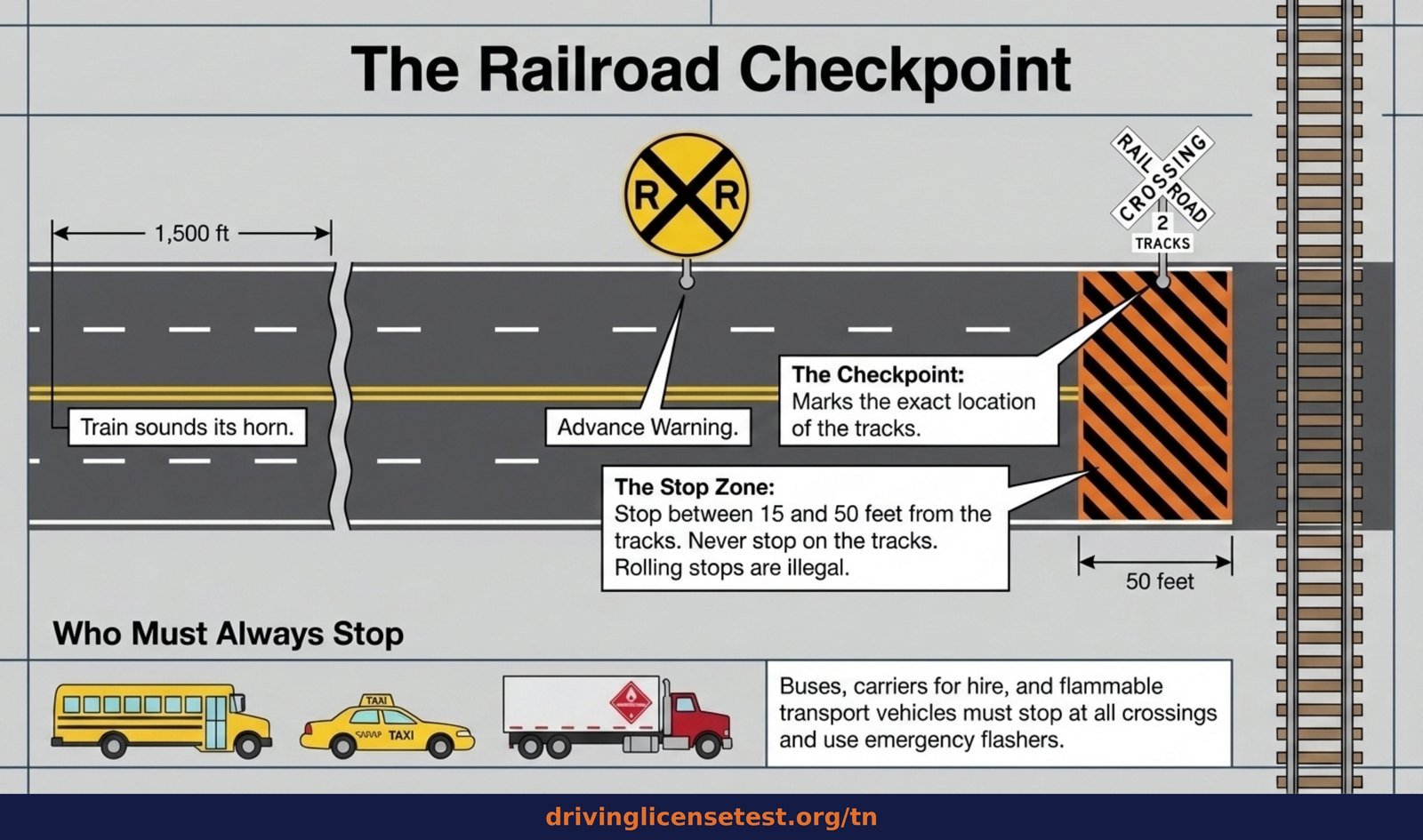
Trains cannot stop quickly and cannot swerve. At a crossing, the job is yours. When a train approaches, stop between 15 and 50 feet from the tracks. Never stop on the tracks. Trains sound a horn approximately 1,500 feet before a crossing.
A flashing red light at a crossing requires a complete stop, the same as a stop sign. Rolling stops are illegal — grounds for a ticket AND for failing the road test.
Some vehicles must stop at ALL crossings, whether or not signals are active:
- Church or school buses, loaded or not
- Common carriers carrying passengers for hire, such as taxis
- Vehicles transporting flammables, explosives, or other dangerous articles
Those vehicles signal with emergency flashers. Expect their stop. Railroad signal and sign violations carry the same penalties as other traffic-control-device violations.
Two flashing-light situations protect children. Do not confuse them.
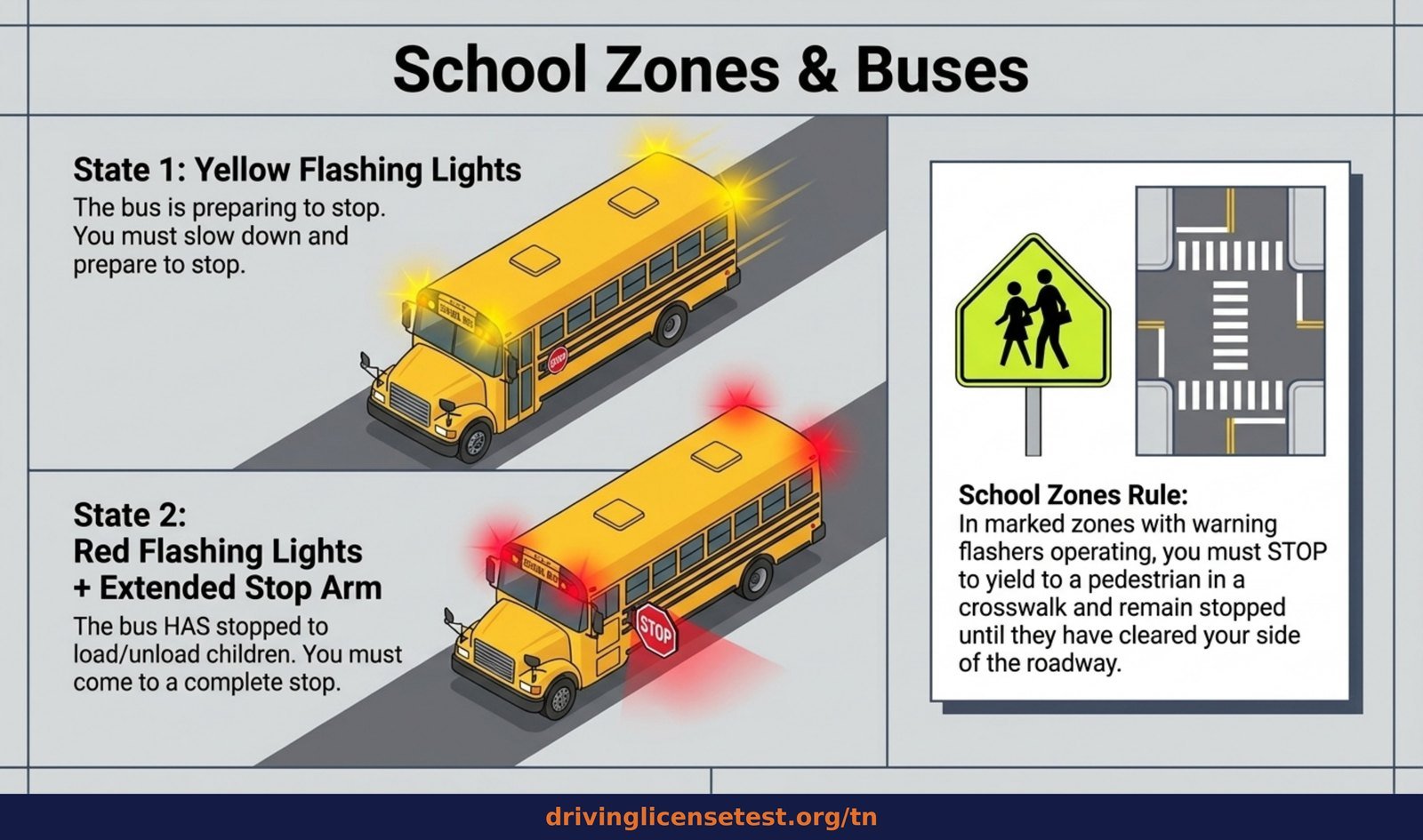
School bus lights:
- Yellow flashing — the bus is preparing to stop. Slow down and prepare to stop.
- Red flashing, with the stop arm extended — the bus HAS stopped to load or unload children.
Yellow is your warning. Red with the arm out is the stopped bus.
In a marked school zone with warning flashers operating, you must STOP to yield to a pedestrian in a marked crosswalk — or at an intersection with no marked crosswalk — and remain stopped until the pedestrian has crossed the roadway your vehicle is on.
For pedestrians generally: pedestrians may not cross on a red or yellow traffic light. If DON’T WALK starts flashing mid-crossing, that person should keep walking, not turn back.
Memory aid: 15 to 50, never on the tracks — and bus yellow means get ready, bus red means it has already stopped.
Check yourself: How far from the tracks must you stop for an approaching train, and what do a school bus’s yellow flashing lights mean?
Part 9: Your headlights at night
At night your headlights are how you see and are seen. The law requires headlights that let you see clearly any person on the highway at least 200 feet ahead.
Dim to low beams when meeting or overtaking vehicles within 500 feet, and always use low beams in cities and towns.
Never outrun your headlights: your stopping distance must be less than your sight distance. If you can only see 200 feet ahead, you must be able to stop within 200 feet.
When parked on or along a highway at night, leave emergency and parking lights on — never headlights. Interstate shoulder parking is prohibited except in emergencies.
If stopped by police: pull as close as safely practical to the right-hand edge or curb, clear of any intersection, and keep your hands on the wheel in plain view. If the police car is unmarked, you may drive slowly a short distance to the nearest area with other people, such as the next business parking lot or exit.
Memory aid: See 200, dim within 500, and never outrun what you can see.
Check yourself: Within what distance must you dim to low beams, and what does “never outrun your headlights” mean?
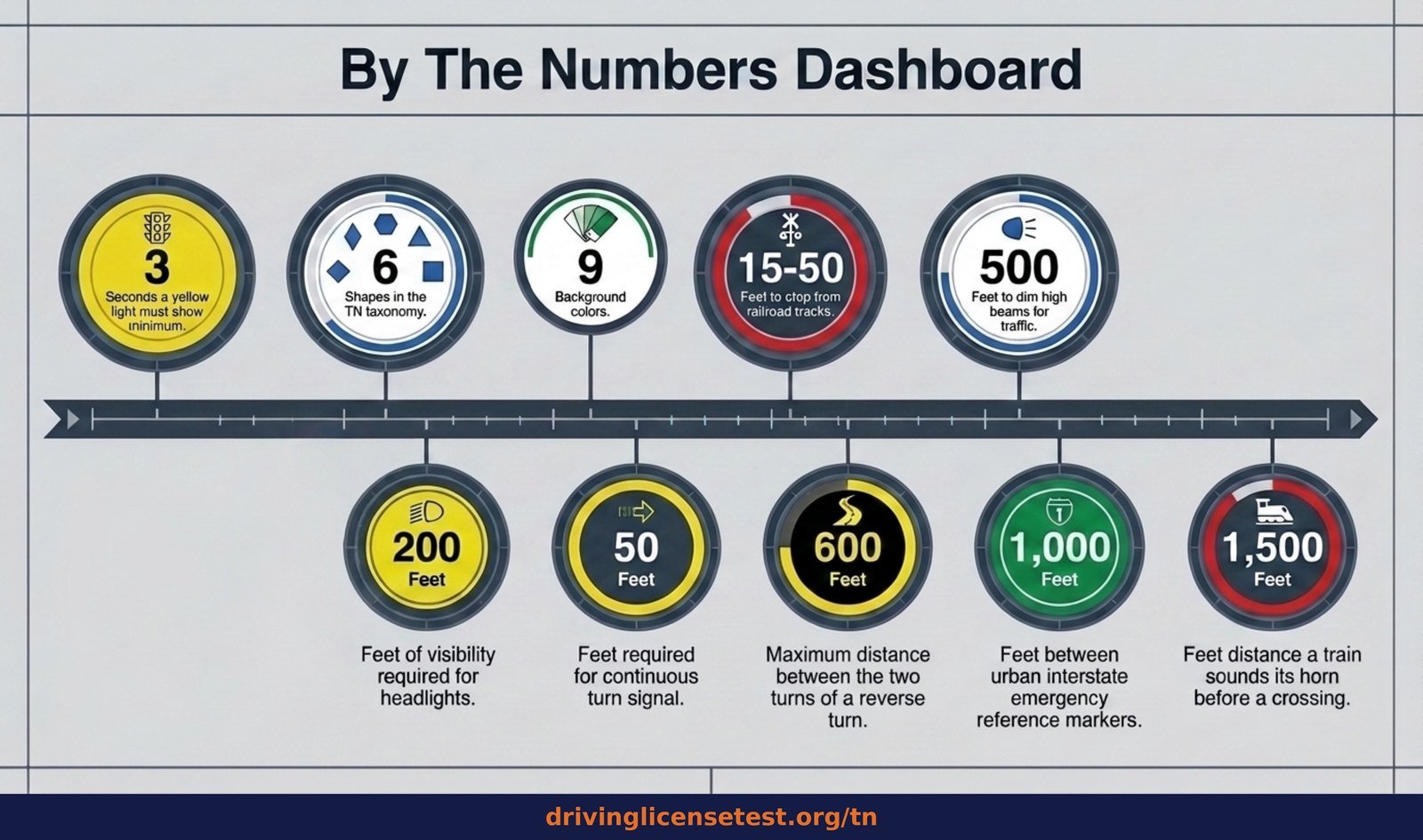
Key numbers to memorize
| Number | What it means |
|---|---|
| 6 shapes | The manual’s sign shapes: octagon, triangle, round, broad “X”, diamond, rectangle |
| 9 colors | The manual’s basic sign background colors, from red to fluorescent yellow-green |
| 30 m.p.h. or less | Recommended speed marked by a turn sign |
| 30–55 m.p.h. | Recommended speeds marked by a curve sign |
| 600 feet | Reverse turns are two turns in opposite directions closer together than this |
| 3 seconds | Minimum time Tennessee law requires a yellow light to show before red |
| 1,000 feet | Spacing of emergency reference markers on urban interstates |
| 50 feet | Signal continuously for at least this distance before stopping, turning, partly turning, or materially altering course |
| 15–50 feet | Stop this far from the tracks when a train approaches |
| 1,500 feet | Approximate distance before a crossing at which a train sounds its horn |
| 200 feet | Headlights must let you see a person on the highway at least this far ahead |
| 500 feet | Dim to low beams when meeting or overtaking a vehicle within this distance |
| 30 questions / 60 minutes / 80% | Published online knowledge test for ages 15–17 |
| 15 questions / 80% | Our Signs & Signals topic quiz format |
| 30 questions / 24 to pass | Our full practice exam, mirroring the published online format |
5-question self-check
- Name the six shapes in the Tennessee manual’s sign taxonomy and what each one means. Which familiar shape is NOT in the manual’s list, and how does Tennessee present school signage instead?
- Which sign color may be used for construction and maintenance and no other purpose? Which color marks school zones, and which color is used for incident management?
- What is the difference between a turn sign and a curve sign, and what does the small plate mounted under a warning sign tell you?
- You face a flashing yellow arrow at an intersection. What may you do, and what must you do first? Separately: what do a red X and a flashing yellow X over your lane mean?
- You must stop at an intersection with no stop line. Where do you stop if there is a marked crosswalk — and where if there is no crosswalk either?
Answer key
- Octagon — stop. Triangle — yield. Round — railroad crossing ahead. Broad “X” (crossbuck) — a railroad crossing is here. Diamond — hazardous or unexpected condition ahead. Rectangle — special laws, regulations, or important information (regulatory signs are always rectangles). The pentagon is not in the manual’s list; Tennessee presents school signage through fluorescent yellow-green signs in the warning-sign family.
- Orange — construction and maintenance only. Fluorescent yellow-green — school zones. Fluorescent pink — incident management (crashes, fires, floods, hazardous spills).
- A turn sign marks a turn with a recommended speed of 30 m.p.h. or less; a curve sign marks a curve with a recommended speed between 30 and 55 m.p.h. The small plate under a warning sign is the advisory speed plate — the recommended maximum safe speed for the condition ahead.
- You may turn left in the direction of the flashing yellow arrow, but only after yielding to all oncoming traffic and to any bicyclists and pedestrians in the crosswalk, waiting for a safe gap. A red X means driving is not permitted in that lane; a flashing yellow X means the lane is changing direction.
- With no stop line, stop before crossing the first line of the crosswalk. With no crosswalk either, stop before your front bumper crosses the white edge line of the cross street, so your vehicle does not protrude into cross traffic.
Keep practicing
- Take the Signs & Signals practice quiz — 15 questions at 80%.
- Review the Signs & Signals flashcards — lock in the shapes, colors, signals, and markings.
- Try the full Tennessee practice test — 30 questions, 24 to pass, mirroring the published online format.
More study guides: Traffic Laws · Right of Way · Safe Driving · Alcohol, Drugs & Driving Conditions · Licensing & Registration Study Guide