
Your complete Massachusetts study guide — plain language, no jargon.
Built from the official manual. Every fact in this Massachusetts section comes from the Massachusetts Driver’s Manual, published by the Massachusetts Registry of Motor Vehicles (RMV) — checked against the current edition and verified November 14, 2026. Read the manual itself at mass.gov.
📘 Prefer pictures? Flip through the visual deck
This whole guide as 12 slides — swipe or scroll sideways through them. Massachusetts Alcohol & Drugs study guide, practice tests & flashcards: BAC limits, implied consent, the OUI conviction ladder and the § 24D alternative.





Take it with you: Download the deck as a PDF (6.9 MB) → — free to share.
Why this matters
No topic in the Manual carries heavier consequences than this one, and Massachusetts frames it its own way: the offense is OUI — Operating Under the Influence — and this guide uses that name throughout, because the RMV, the statute, and the courts all do. OUI law is a ladder: an administrative track that can suspend your license before any court date, a criminal track with fines and jail, a first-offender alternative program, and a lifetime lookback that never forgives old priors. Every figure here comes from the Massachusetts Driver’s Manual and Massachusetts law (MGL c. 90, § 24), published by the Massachusetts Registry of Motor Vehicles (RMV). The permit exam is 25 questions, 18 to pass, in 25 minutes — and the RMV lists the consequences of driving under the influence among its published exam topics, so expect this material.
Part 1: The offense itself — operating, not just driving
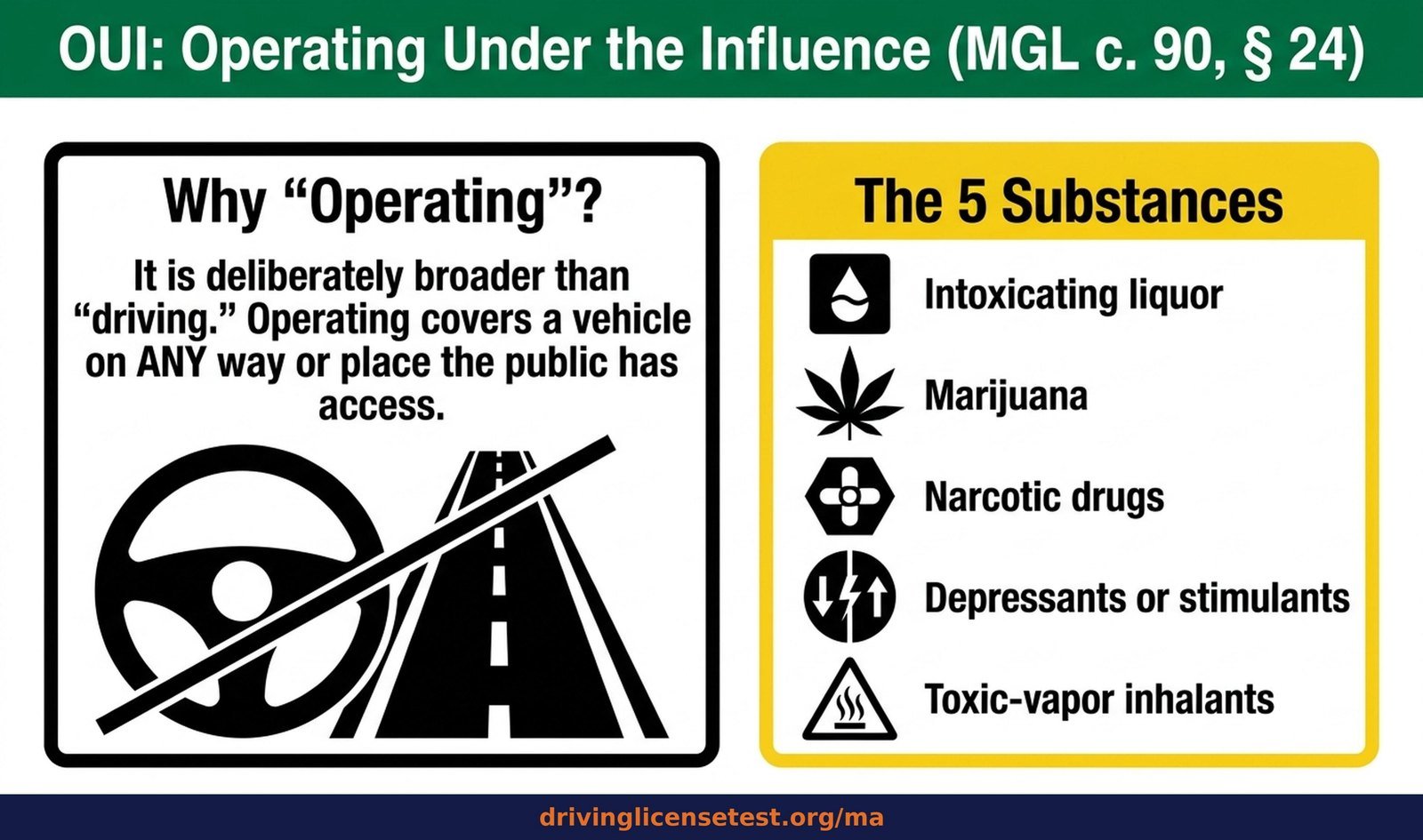
Massachusetts charges OUI for operating a motor vehicle under the influence of intoxicating liquor, marijuana, narcotic drugs, depressants or stimulants, or toxic-vapor inhalants. “Operating” is deliberately broader than “driving”: the charge reaches operating a vehicle on any way or place the public has access. That breadth is why the statute, the RMV, and this guide all say OUI and “operate.”
The per se limit at age 21 and older is 0.08: operating with a blood alcohol concentration of eight one-hundredths or greater is itself an offense. But 0.08 is a floor for one kind of proof, not a safe harbor — a driver can also be convicted below 0.08 on evidence of impairment. There is no BAC at which operating after drinking becomes legally safe; there is only a BAC at which guilt becomes automatic.
Check yourself: A driver blows 0.06 and argues the per se limit makes conviction impossible. What is wrong with that argument?
Part 2: Under 21 — the 0.02 administrative trigger, stated exactly
For drivers under 21, Massachusetts sets a BAC of 0.02 or higher as the trigger for a set of administrative penalties — the “zero tolerance” framework. State it precisely, because the exam does: 0.02 is an administrative trigger, not the criminal per se standard; the criminal per se figure remains 0.08. What 0.02 sets in motion is license action:
- Failed test (0.02+): a 30-day suspension, plus a Youth Alcohol Program (YAP) suspension of 1 year if under 18 or 180 days at ages 18–20, running after the 30 days — with a 6-month reduction available for entering the 24D Driver Alcohol Education Program.
- Refusal: 3 years with no prior OUI (3 years with one prior, 5 years with two, lifetime with three or more), plus a YAP add-on of one year (under 18) or 180 days (ages 18–21) — which a first offender can reduce or waive by entering a Department of Public Health–approved alcohol education program.
- Other under-21 alcohol laws: buying or attempting to buy alcohol — 180-day suspension; possessing, carrying, or transporting alcohol unaccompanied by a parent or guardian — 90 days; procuring alcohol for a person under 21 — 180 days.
For commercial drivers, one more figure: operating a commercial motor vehicle at 0.04 or more is a CDL-disqualifying major offense — at least 1 year disqualification for a first offense, life for a second.
Memory aid: 0.08 is the crime line at 21+. 0.02 is the under-21 tripwire — administrative, immediate, and long. 0.04 ends a commercial career.
Check yourself: A 19-year-old refuses a chemical test with no prior OUI. What suspension follows, and what add-on rides on top of it?
Part 3: Implied consent — the license goes at the arrest
Every licensed driver is deemed to have consented to a breathalyzer or blood test after an OUI arrest. If your BAC is above the limit or you refuse the test, the officer must take your license and issue a notice of suspension effective immediately. Refusing is not a criminal offense — it carries an administrative suspension instead — and on refusal the officer also impounds the vehicle for 12 hours and notifies the RMV within 24 hours. Two stacking rules matter: a refusal suspension and any later conviction suspension run consecutively, not at the same time.
Refusal suspensions at 21 and older, by prior OUIs: 180 days (none), 3 years (one), 5 years (two), lifetime (three or more). A failed test at 0.08 or higher (21+) suspends the license for 30 days, or until the court case concludes, whichever is shorter.
Check yourself: A driver with one prior OUI refuses the test, reasoning that refusal cannot be punished because it is not a crime. What actually happens, and for how long?
Part 4: Conviction penalties — the five-offense ladder
The Manual’s conviction chart climbs steeply, and Melanie’s Law makes it climb forever: the RMV counts all OUI convictions and program assignments — including out-of-state ones, however old — when setting suspension periods. That is a lifetime lookback; there is no washing out a prior.
- 1st offense: fine $500–$5,000, up to 2½ years imprisonment, license 1 year (but see the § 24D alternative in Part 5).
- 2nd offense: fine $600–$10,000, minimum 30 days to 2½ years, license 2 years.
- 3rd offense (felony): fine $1,000–$15,000, minimum 150 days to 5 years, license 8 years.
- 4th offense (felony): fine $1,500–$25,000, minimum 1 year to 5 years, license 10 years.
- 5th offense (felony): fine $2,000–$50,000, minimum 2 years to 5 years, license lifetime.
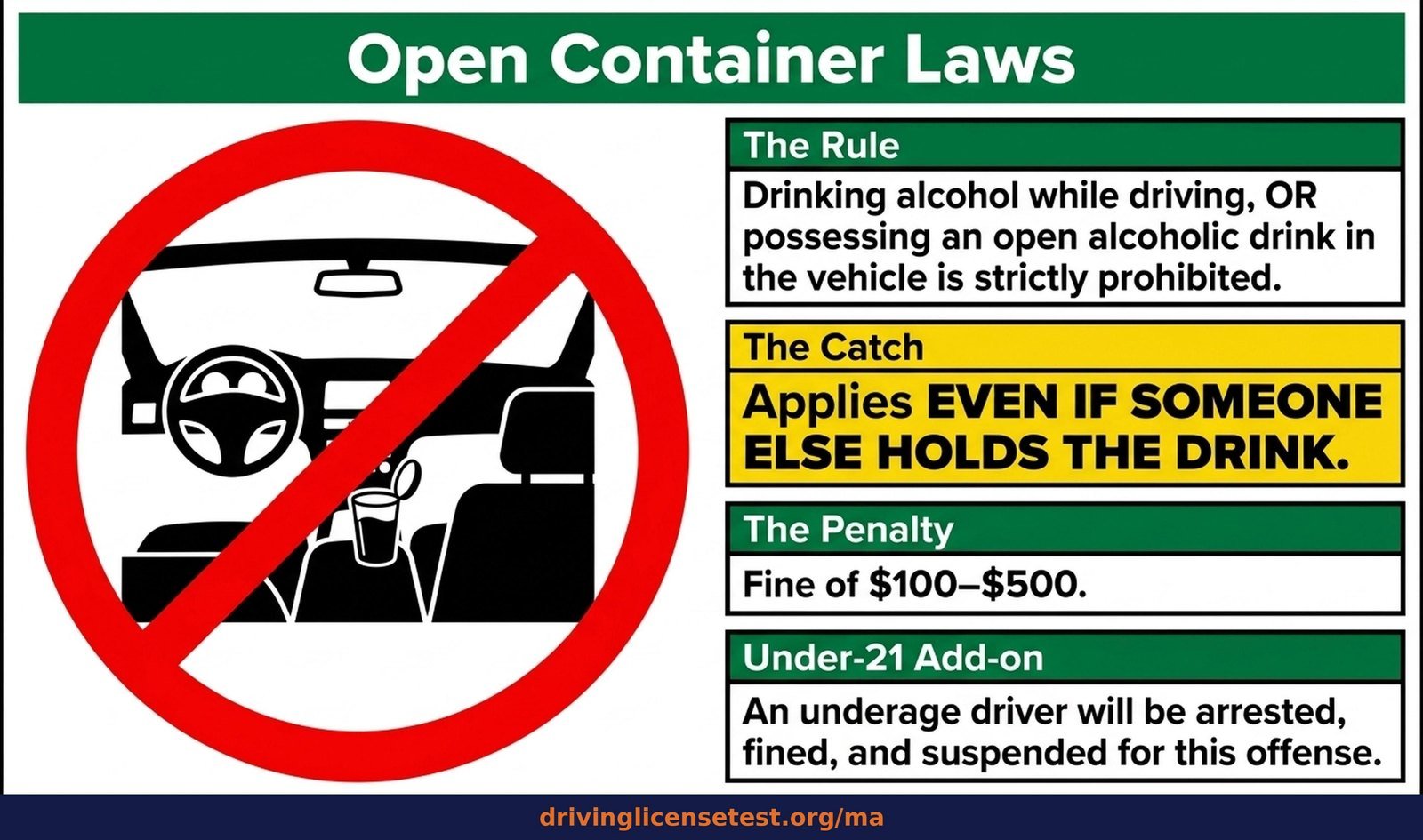
Open containers: drinking alcohol while driving, and possessing an open alcoholic drink in the vehicle — even if someone else holds it — are prohibited; conviction brings a fine of $100–$500, and a driver under 21 will be arrested, fined, and suspended.
Check yourself: A driver’s OUI priors are 9 and 14 years old, one from another state. A friend says both are “too old to count.” What does Melanie’s Law say?
Part 5: The § 24D first-offender alternative — both tracks, always
A first-offense “1 year” figure is only half the law, and this guide never prints it alone. Under MGL c. 90, § 24D, an eligible first offender may consent to probation with assignment to a Driver Alcohol Education Program, reducing the license suspension to 45–90 days if over 21, or 210 days if under 21. An under-21 offender with a BAC of 0.02 or higher must also complete a 2-week in-house (residential) program. The standard track (1 year) and the 24D track (45–90 / 210 days) are both real; which one applies depends on eligibility and the court’s disposition — and a 24D assignment still counts as a prior forever under the lifetime lookback if it happens again.
Memory aid: First offense: 1 year standard, or 24D at 45–90 days over 21 and 210 under 21. Either way, it counts for life.
Check yourself: A website says a Massachusetts first-offense OUI “costs your license for exactly one year, no exceptions.” Using Part 5, correct it.
Part 6: Ignition interlock and getting a license back
Ignition interlock (MGL c. 90, § 24½): a driver with 2 or more OUI convictions or program assignments must have an Ignition Interlock Device installed at their own expense before a new license or reinstatement. On a hardship license, the device must be used for the entire hardship period plus 2 additional years after full reinstatement. Interlock is not required after a standard first offense.
Reinstatement: the Criminal Offenses chart sets reinstatement fees at $500 (first), $700 (second), $1,200 (third), $1,200 (fourth), and reinstatement after a 2nd, 3rd, or 4th offense also requires passing a new learner’s permit exam and a new road test. The road back is deliberately long — which is the entire point of learning this ladder before, not after, a first offense.
Check yourself: A driver with two OUI assignments seeks reinstatement and asks whether the interlock can be skipped because the offenses were years apart. What does § 24½ require?
Key numbers to memorize
| The offense | OUI — Operating Under the Influence (MGL c. 90, § 24) · liquor, marijuana, narcotic drugs, depressants/stimulants, inhalants |
| BAC figures | 0.08 per se (21+) · 0.02 administrative trigger under 21 · 0.04 commercial (CDL disqualification) |
| Refusal (21+) | 180 days · 3 years · 5 years · lifetime by priors · vehicle impounded 12 hours |
| Conviction suspensions | 1 · 2 · 8 · 10 years · lifetime (1st–5th) · lifetime lookback under Melanie’s Law |
| § 24D alternative | 45–90 days (over 21) · 210 days (under 21) with the Driver Alcohol Education Program |
| Ignition interlock | Required at 2+ convictions/assignments · hardship: whole period + 2 years after reinstatement |
| Open container | Fine $100–$500 — even if someone else holds the drink |
5-question self-check
- What does OUI stand for, why does Massachusetts say “operating,” and what substances does it cover?
- Distinguish 0.08, 0.02, and 0.04 — precisely.
- A driver with two prior OUIs refuses a chemical test. What suspension follows, and does the refusal itself add a criminal charge?
- State the conviction suspension ladder, and the rule that makes old priors count.
- Correct this claim: “A first OUI in Massachusetts always means one year without a license.”
Answer key
- Operating Under the Influence. “Operating” reaches conduct broader than driving — operating on any way the public can access. It covers intoxicating liquor, marijuana, narcotic drugs, depressants and stimulants, and toxic-vapor inhalants.
- 0.08 is the criminal per se limit at 21 and older. 0.02 is the administrative trigger for drivers under 21 — it sets license action in motion but is not the criminal per se standard. 0.04 is the CDL-disqualifying alcohol concentration for operating a commercial motor vehicle.
- A 5-year refusal suspension (two priors), running consecutively with any conviction suspension. Refusal is not a criminal offense; the suspension is administrative, and the vehicle is impounded for 12 hours.
- 1 year, 2 years, 8 years, 10 years, lifetime. Melanie’s Law imposes a lifetime lookback: all convictions and program assignments count, including out-of-state ones, however old.
- Eligible first offenders may resolve under § 24D with probation and the Driver Alcohol Education Program, reducing the suspension to 45–90 days if over 21 or 210 days if under 21. The 1-year figure is the standard track only.
Keep practicing
- Take the Alcohol & Drugs practice quiz
- Flip through the Alcohol & Drugs flashcards
- Run the full Massachusetts practice test
More study guides: Signs & Signals Study Guide · Traffic Laws Study Guide · Right of Way Study Guide · Safe Driving Study Guide · Licensing & Registration Study Guide