
Your complete Michigan study guide — plain language, no jargon.
📘 Prefer pictures? Flip through the visual deck
This whole guide as 14 slides — swipe or scroll sideways through them. Michigan calls it OWI, not DUI — the penalties, the super-drunk tier and the refusal trap, drawn out.





Take it with you: Download the deck as a PDF (8.3 MB) → — free to share.
Why this matters
Michigan does not call it DUI. The offense is OWI — Operating While Intoxicated — and Michigan’s penalties stack in tiers that the knowledge test examines closely: the charge, the high-BAC tier, the license sanctions, the points, and the rules that follow you even when drugs are involved and no driving occurred. Licensing in Michigan belongs to the Michigan Department of State, headed by the Secretary of State (Michigan has no “DMV”), and the official manual is What Every Driver Must Know. This guide walks the whole system: what counts as a drink, the two charges, the numbers for each offense level, zero tolerance for young drivers, implied consent, and marijuana.
Part 1: Alcohol itself — what the test assumes you know
A standard drink is the same dose of alcohol in three costumes: 12 ounces of beer, 5 ounces of wine, or 1.5 ounces of whiskey. Judgment is the first ability alcohol takes — which is why “I feel fine” is evidence of nothing. Coffee, cold air, exercise, and food after drinking do not lower your blood alcohol concentration. Only time sobers. And alcohol multiplies: prescription and over-the-counter medicines can multiply the effects of alcohol, and alcohol can multiply theirs.
Michigan’s per se line for adult drivers is a BAC of 0.08%: at 0.08 or higher, operating a vehicle is illegal in itself, no further proof of impairment needed.
Check yourself: A driver has two 12-ounce beers and a 5-ounce glass of wine at dinner, then drinks two coffees. How many standard drinks has he had, and what has the coffee done to his BAC?
Part 2: The two charges — OWI and OWVI
Operating While Intoxicated (OWI), MCL 257.625. Operating with a BAC of 0.08% or higher, or while intoxicated by alcohol, drugs, or any combination of them. This is Michigan’s standard drunk-driving charge.
Operating While Visibly Impaired (OWVI). The lesser charge: your ability to operate the vehicle is visibly impaired by alcohol or drugs — which can be proved even with a BAC below 0.08. A first OWVI conviction brings up to 93 days in jail, a fine of up to $300, and 4 points.
Both charges are misdemeanors at the first offense — and both land on a driving record that, as you will see, does not forget them.
Part 3: Penalties — the tiers
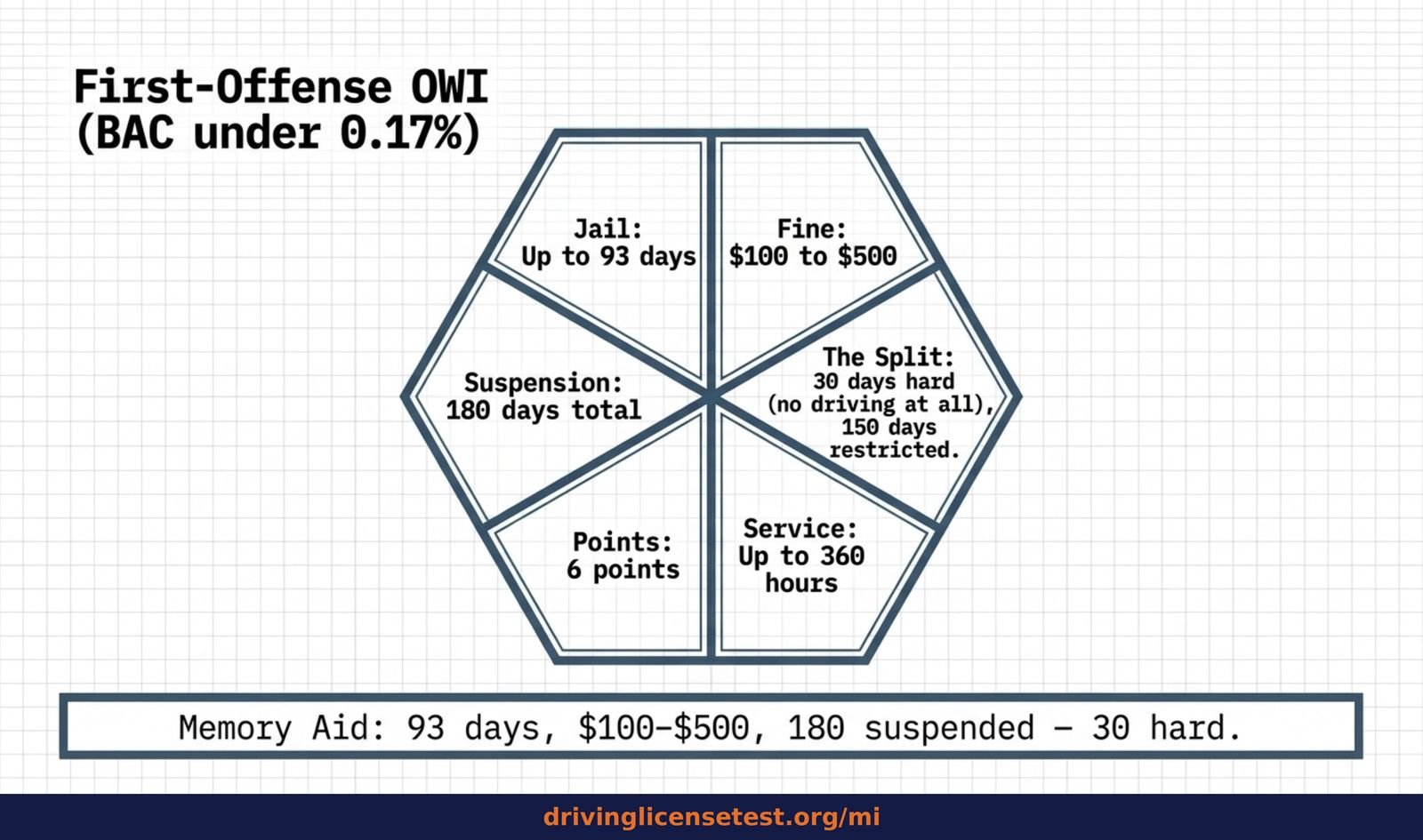
First-offense OWI (BAC under 0.17). Up to 93 days in jail; a fine of $100 to $500; up to 360 hours of community service; 6 points; and a 180-day license suspension — split in two: no driving at all for the first 30 days, then restricted driving for the remaining 150 days.
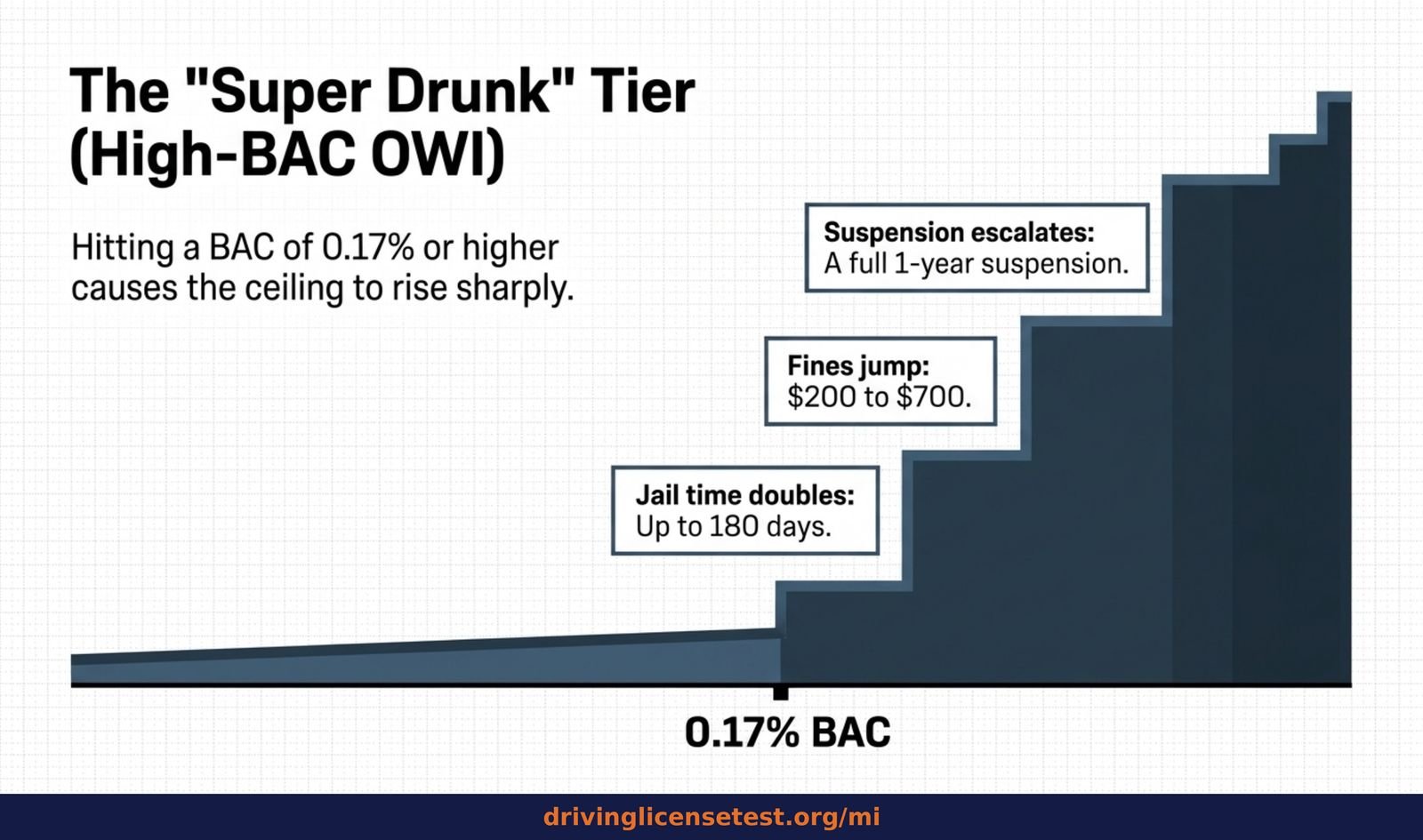
High-BAC OWI — the “super drunk” tier (BAC of 0.17% or higher). The ceiling rises sharply: up to 180 days in jail, a fine of $200 to $700, and a 1-year license suspension.
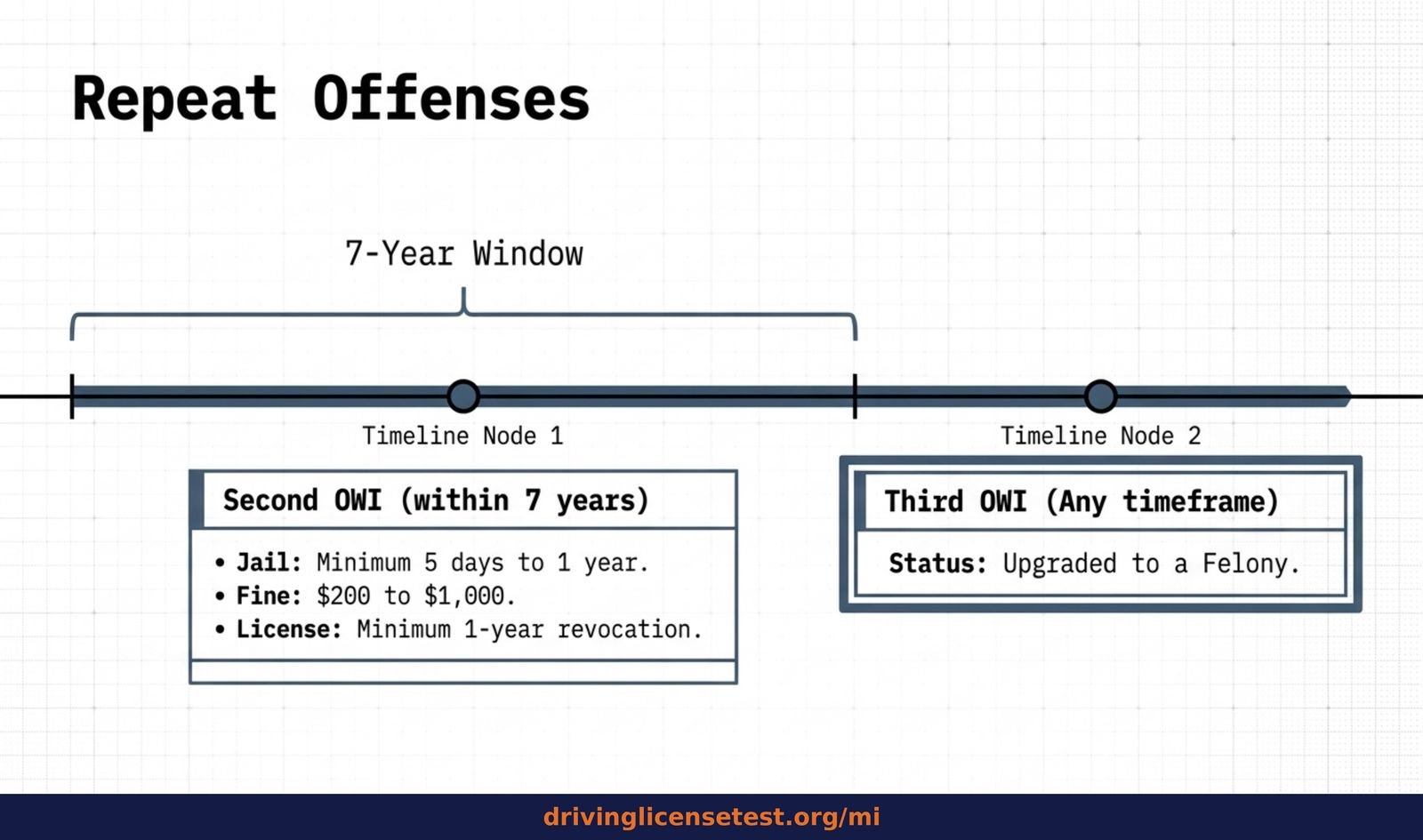
Second OWI within 7 years. Five days to 1 year in jail, a fine of $200 to $1,000, and a minimum 1-year license revocation. A third OWI is a felony.
Two record rules frame all of it. An OWI conviction carries 6 points — the same tier as reckless driving and refusing a chemical test. And impaired-driving convictions are permanent: where ordinary convictions age off the visible record in 7 to 10 years, these never do.
Memory aid: First offense: 93 days, $100–$500, 180 suspended — 30 hard. At .17: 180 days, $200–$700, a full year gone.
Check yourself: A first-time offender blows 0.19. Which tier is he in, and what are his maximum jail time, fine range, and license sanction?
Part 4: Zero tolerance — drivers under 21
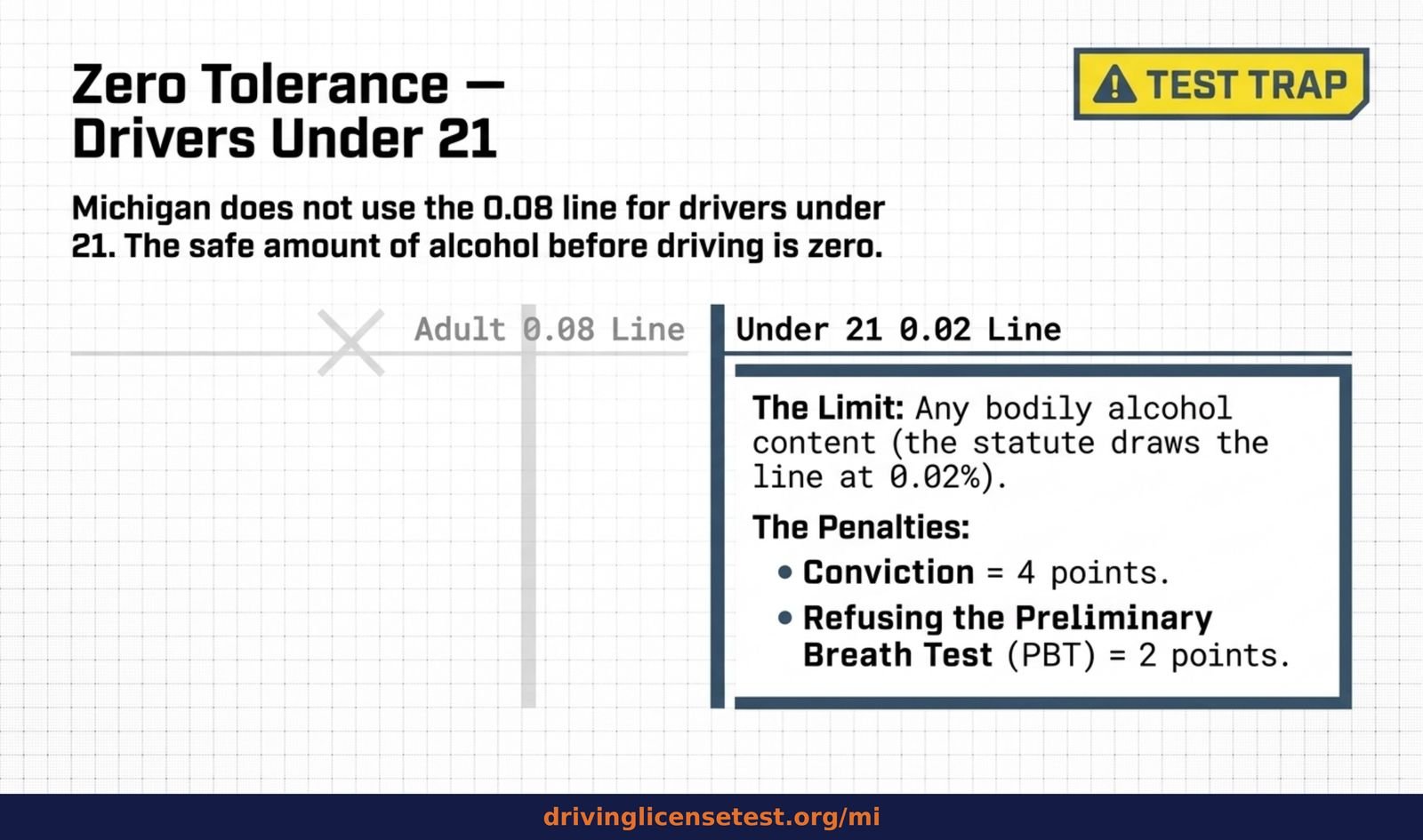
For drivers under 21, Michigan does not use the 0.08 line at all. It is illegal for an under-21 driver to operate a vehicle with any bodily alcohol content — the statute draws the line at a BAC of 0.02%, effectively the smallest measurable amount. The conviction carries 4 points — the same as an adult’s OWVI. An under-21 driver who refuses a Preliminary Breath Test also picks up 2 points for the refusal itself. For young drivers, the safe amount of alcohol before driving is zero, and the law is written so that it means zero.
Part 5: Implied consent — the test you already agreed to
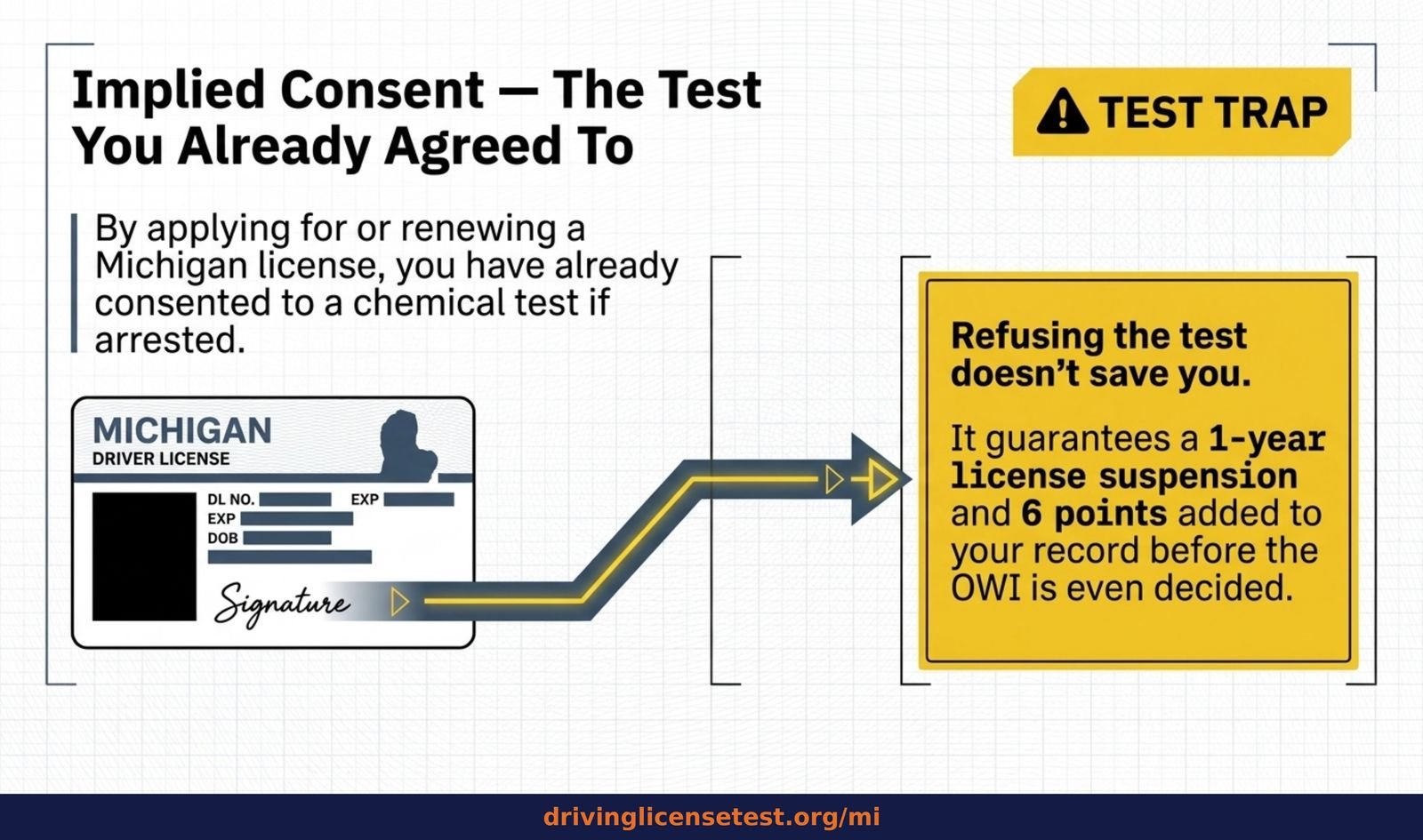
By applying for or renewing a Michigan license, every driver is deemed to have consented to a chemical test if arrested for an alcohol- or drug-related driving offense. That is the implied consent law: the agreement came with the license.
Refusing the test is its own offense with its own sanctions: your license is suspended — one year for a first refusal — and 6 points are added to your record. Notice the trap the test loves: refusing does not avoid punishment; it guarantees a license sanction and the maximum points tier even before the OWI charge itself is decided.
Check yourself: A driver arrested for OWI refuses the chemical test, thinking it protects his license. Itemize what the refusal itself costs him.
Part 6: Drugs — including the conviction that needs no driving at all
Operating with any presence of a Schedule 1 drug or cocaine in your system carries 6 points — the top tier, same as OWI.
Then Michigan adds a rule many drivers never see coming: a drug conviction brings a license suspension even if you were not driving. A first drug conviction with no priors suspends your license for 6 months, with no restricted license during the first 30 days. With one or more priors within 7 years, the suspension is 1 year, with no restricted license during the first 60 days. Getting the license back costs a $125 reinstatement fee.
Marijuana is legal in Michigan for adults 21 and over — and tightly limited in cars. An adult may transport up to 2.5 ounces (up to 15 grams of concentrate). But it is illegal to operate while using or to consume marijuana while driving, passengers may not smoke marijuana in the passenger area of a vehicle on a public way, and the penalties for marijuana-impaired driving are the same as for alcohol OWI.
Check yourself: A 22-year-old legally buys marijuana, keeps it sealed in the trunk, and drives sober. Legal? Now change two facts: it is open on the passenger seat, and his passenger is smoking it as they drive down a public street. What changed?
Key numbers to memorize
| Standard drink | 12 oz beer = 5 oz wine = 1.5 oz whiskey; only time sobers |
| Per se BAC (21+) | 0.08% |
| First OWI | Up to 93 days jail · $100–$500 fine · 360 hours community service · 6 points · 180-day suspension (first 30 days no driving) |
| High-BAC tier | 0.17%+ → up to 180 days jail · $200–$700 fine · 1-year suspension |
| OWVI (first) | Up to 93 days jail · fine up to $300 · 4 points |
| Second OWI (within 7 years) | 5 days–1 year jail · $200–$1,000 · revocation minimum 1 year · third offense = felony |
| Under 21 | Any bodily alcohol content (0.02 line) · 4 points · PBT refusal 2 points |
| Chemical-test refusal | Suspension — 1 year first refusal · 6 points |
| Drug conviction (no driving needed) | 6 months suspension first (no restricted license first 30 days) · 1 year with priors (first 60 days) · $125 reinstatement |
| Marijuana | Transport up to 2.5 oz (15 g concentrate) at 21+; use while driving illegal; penalties mirror OWI |
| Record | Impaired-driving convictions are permanent |
5-question self-check
- Name Michigan’s two impaired-driving charges and the difference between them.
- Give the complete first-offense OWI package: jail, fine, community service, points, and the exact shape of the license suspension.
- At what BAC does the high-BAC tier begin, and how do its three main penalties differ from a standard first offense?
- A 19-year-old with a 0.03 BAC is stopped. Which adult standard does not protect her, and what does her conviction carry?
- Explain implied consent in one sentence, then state the full cost of refusing a chemical test after an OWI arrest.
Answer key
- OWI (Operating While Intoxicated) — BAC of 0.08% or higher, or operating while intoxicated by alcohol or drugs. OWVI (Operating While Visibly Impaired) — driving visibly impaired even below 0.08, carrying up to 93 days, a fine up to $300, and 4 points.
- Up to 93 days in jail; a fine of $100 to $500; up to 360 hours of community service; 6 points; and a 180-day license suspension — the first 30 days with no driving at all, the remaining 150 days on a restricted license.
- 0.17%. Jail doubles to up to 180 days; the fine rises to $200–$700; the license suspension becomes a full year instead of 180 days.
- The 0.08 per se standard is irrelevant under 21: Michigan’s zero-tolerance law makes any bodily alcohol content (0.02% or more) illegal for under-21 drivers. The conviction carries 4 points.
- By applying for or renewing a Michigan license, a driver has already consented to a chemical test if arrested for an alcohol- or drug-related driving offense. Refusing brings a license suspension — one year for a first refusal — plus 6 points, separate from whatever happens with the OWI charge itself.
Keep practicing
- Take the Alcohol & Drugs practice quiz
- Flip through the Alcohol & Drugs flashcards
- Run the full Michigan practice test
More study guides: Signs & Signals Study Guide · Traffic Laws Study Guide · Right of Way Study Guide · Safe Driving Study Guide · Licensing & Registration Study Guide