
Your complete Georgia study guide — plain language, no jargon.
📘 Prefer pictures? Flip through the visual deck
This whole guide as 12 slides — swipe or scroll sideways through them. The CP, D and C ladder, fees and the points system, in pictures.





Take it with you: Download the deck as a PDF (7.1 MB) → — free to share.
Why this matters
In Georgia, licensing runs through the Georgia Department of Driver Services (DDS) and its Customer Service Centers — and its rules are where first-time drivers and new residents get surprised. The real Georgia knowledge exam has two parts — Road Signs (20 questions) and Road Rules (20 questions) — and each part must be passed separately at 15 of 20 (75%). A strong score in one part does not offset the other. The path starts with a permit at 15, runs through Joshua’s Law and the 40 supervised hours, and lands on a points system that suspends at 15 points in 24 months — with much stricter triggers for young drivers. Georgia also requires insurance of at least 25/50/25. This guide walks the whole path in order.
Part 1: The knowledge exam itself
- Agency and manual. Licensing is administered by the Georgia Department of Driver Services (DDS); licenses and permits are issued at DDS Customer Service Centers. The official manual is the Georgia Driver’s Manual, revised July 2025.
- Format: two parts, two passes. Road Signs: 20 questions, 15 of 20 to pass — identifying traffic signs, signals, and pavement markers, given in English only. Road Rules: 20 questions, 15 of 20 to pass — driver responsibility, traffic laws, and safe-driving practices. Forty questions in total, but there is no combined score: each part stands or falls on its own 75%.
- How testing works: knowledge exams are walk-in at every DDS Customer Service Center; testing must begin at least 30 minutes before closing, and no pens, paper, or phones are allowed in the testing area — misconduct is a failure.
- Retakes: after a first failure, you may retake the exam the next day; after a second or subsequent failure, the wait is 7 days.
- Languages: the Road Rules test is offered in some non-English languages, but the Road Signs test and the road test are English only — every Georgia driver must be able to read simple English highway signs.
- Vision standards: 20/60 or better in one eye, with or without corrective lenses, and a horizontal field of vision of at least 140 degrees. Failing the screening means a referral for a DS-274 eye examination report, and needing lenses to pass adds a corrective-lenses restriction. Drivers age 64 and older must pass a vision screening every 8 years.
- New to Georgia: a person who becomes a Georgia resident must obtain a Georgia license or permit within 30 days. And every licensed driver must carry the license and display it on demand to law enforcement.
- Our practice tests mirror the stakes: topic quizzes here run 15 questions at the same 75% standard; the full practice test mirrors the real exam’s two-part structure — 40 questions in two 20-question parts.
Memory aid: Two parts, twenty each, fifteen to pass each. Signs are English only. Fail once: tomorrow. Fail again: seven days.
Check yourself: An applicant scores 19 of 20 on Road Rules and 14 of 20 on Road Signs, and asks why a 33-of-40 total did not pass. Explain the rule that decides his result — and when he may try the Signs part again if this was his first failure.
Part 2: Class CP — the instructional permit at 15
Who gets a permit, and on what terms:
- Age: a Class CP (Class C Instructional Permit) may be obtained at age 15 or anytime thereafter — not 15½.
- Exams and fee: pass the vision screening and the two-part knowledge exam. The $10 fee is paid before testing, is non-refundable, and must be repaid on every attempt.
- Validity: a Class CP permit is valid for up to 2 years.
- Supervision: a Class CP holder may drive only with a person age 21 or older seated beside them who holds a license for Class C vehicles and is fit and capable of exercising control of the vehicle. No supervisor, no driving — at any hour, on any road.
- Under 18: the application needs the signature of a parent, guardian, or responsible adult — who may revoke the permit at any time before the teen turns 18 — plus proof of school enrollment and, for the Class D path, completion of the ADAP (Alcohol and Drug Awareness Program).
Memory aid: Fifteen, ten dollars up front every try, two years of validity, and a licensed 21-year-old in the seat beside you — always.
Check yourself: A 15-year-old permit holder wants to drive to school alone “just this once,” and later that week to practice with his 20-year-old licensed sister. Which trip is allowed?
Part 3: Class D, Joshua’s Law, and TADRA — the teen ladder
Georgia’s graduated licensing program is TADRA — the Teenage and Adult Driver Responsibility Act (1997) — a three-phase program covering drivers ages 15 to 18: permit, provisional license, full license. Its middle step is the Class D Provisional License:
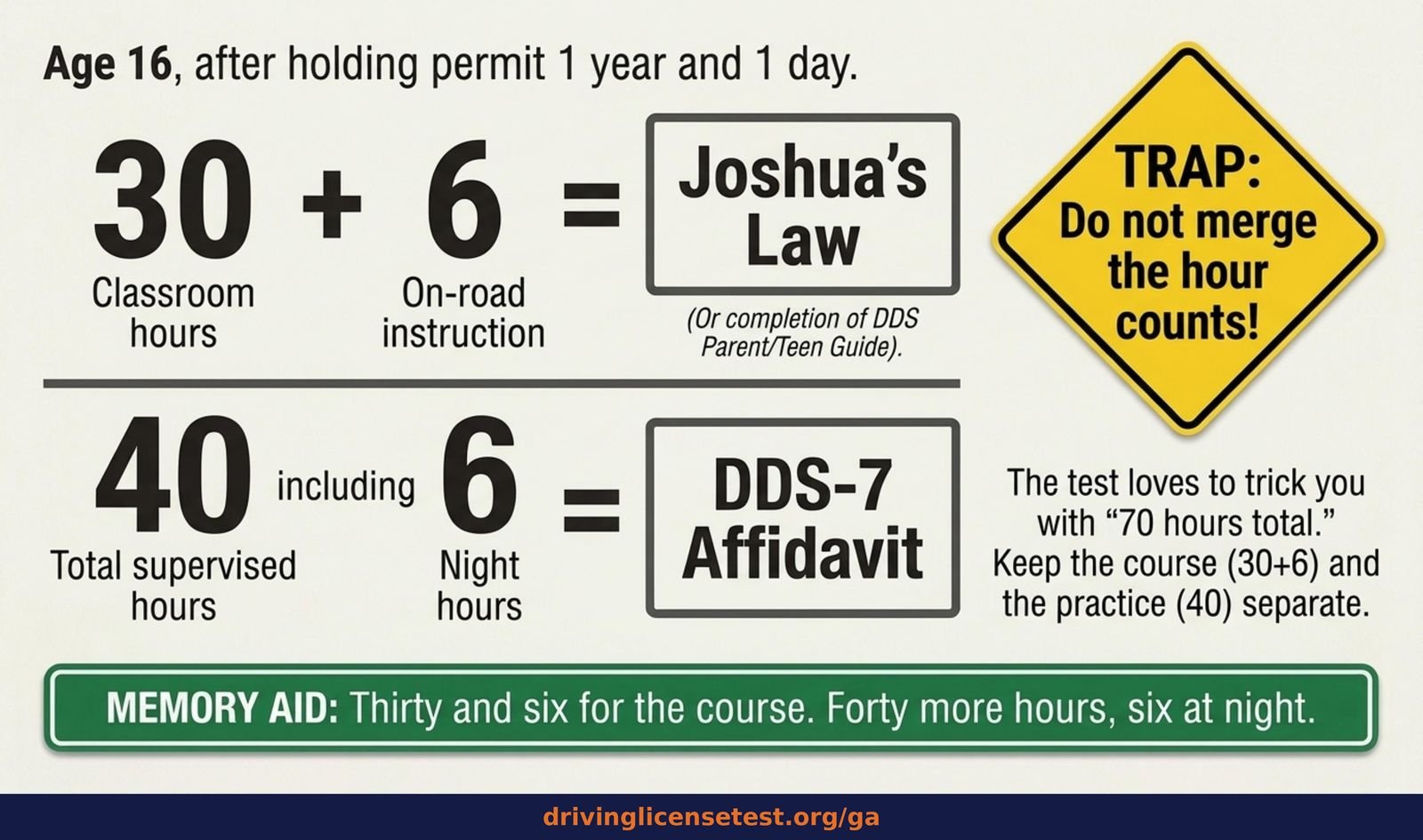
- Age and holding: available at age 16, only after holding a valid instructional permit for 1 year and 1 day.
- Requirements: pass the road test, show school enrollment, complete ADAP, and have a parent, guardian, or responsible-adult signature.
- Joshua’s Law driver education (required at 16–17): 30 hours of classroom instruction (or an equivalent approved online or virtual course) and 6 hours of on-road instruction with a certified instructor — or completion of the DDS Parent/Teen Driving Guide. No 16- or 17-year-old receives a Class D license without meeting this requirement.
- Supervised hours on top: a cumulative total of 40 hours of other supervised driving, including at least 6 hours at night, certified by a parent or guardian affidavit (DDS Form DDS-7).
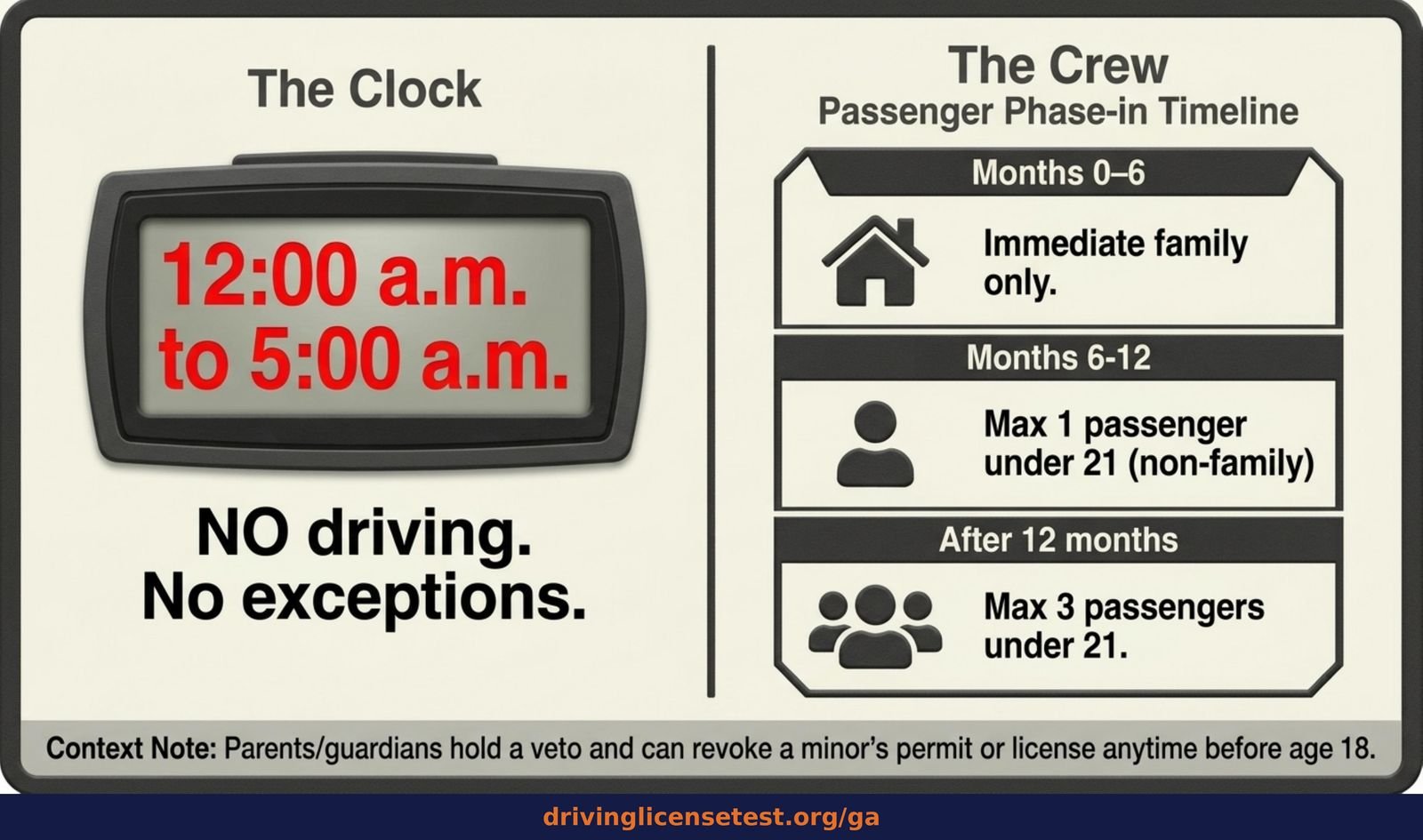
- Curfew: Class D drivers may not drive between 12:00 a.m. and 5:00 a.m. — no exceptions.
- Passenger limits phase in: for the first 6 months, only immediate family may ride (parents and step-parents, grandparents, siblings and step-siblings, children, and anyone residing at the driver’s residence); for the second 6 months, no more than 1 passenger under 21 who is not immediate family; after 12 months, no more than 3 such passengers.
- Parents hold a veto: a parent, guardian, or responsible adult may revoke a minor’s permit or license at any time before age 18 (notarized revocation form, $10 fee).
- Military exception: a 17-year-old who has enlisted is exempt from the 1-year-and-1-day holding requirement and is issued a Class C license after passing the road test.
Trap — the two hour-counts are different counts. The 30 + 6 is driver education: classroom plus instructed road time (or the Parent/Teen Driving Guide instead). The 40 including 6 at night is separate supervised practice, sworn on the DDS-7 affidavit. Answers that merge them — “70 hours total” — are wrong in both directions.
Memory aid: Sixteen, after a year and a day. Thirty and six for the course — or the Parent/Teen Guide. Forty more hours, six of them at night. Home by midnight, family only for six months.
Check yourself: A newly licensed 16-year-old, three months in, wants to drive two friends home at 11:30 p.m. Identify every Class D rule this plan breaks or survives — passengers first, then the clock.
Part 4: Class C, the road test, fees, and renewal
- Class C is the ordinary full license, for drivers age 18 or older (also a 17-year-old new resident holding a valid Class C equivalent from another state). Permit classes are the license letter plus “P”: CP, MP, EP, FP.
- Moving up: a Class D holder moves to Class C at 18 if the Class D was held until 18 or for 1 year and 1 day with no major-traffic-violation convictions in the preceding 12 months — no retest for U.S. citizens. A Class CP holder may obtain a Class C only at 18 or older, after passing the road test and submitting the 40-hour supervised-driving affidavit (including 6 night hours) — and a first-time applicant age 18 or older who never held a permit must pass both tests and submit the same affidavit.
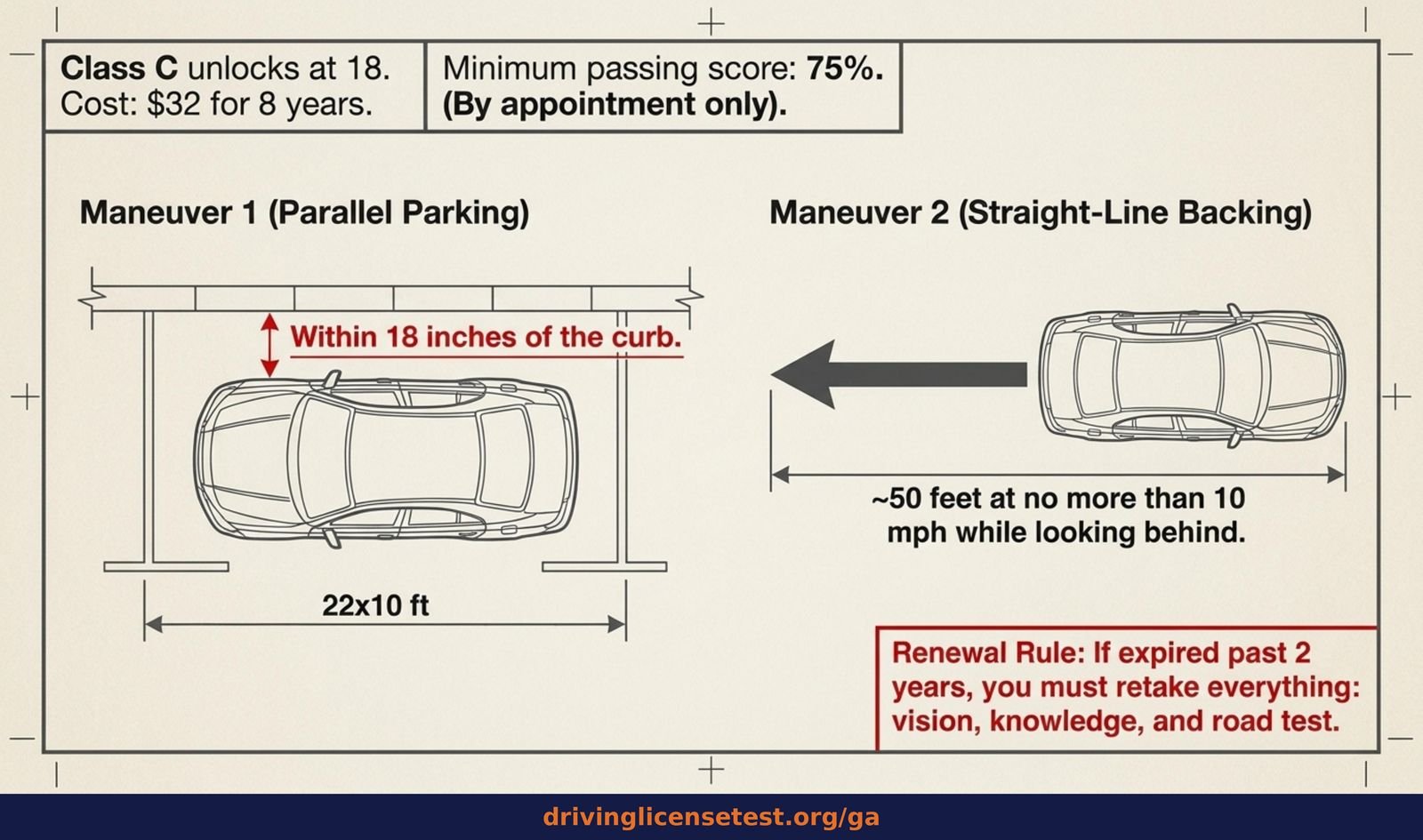
- The road test: given by appointment only, in a properly insured, currently registered vehicle that passes a safety inspection — offered in a traditional format or a virtual format using dual cameras with a responsible adult (21+) riding as passenger. Skills examined include parallel parking within 18 inches of the curb (space 22 feet long by 10 feet wide), straight-line backing for about 50 feet at no more than 10 mph while looking behind, stopping for signs and signals, a three-point turn, intersections, yielding, turning, passing, following distance, and proper posture with both hands on the wheel. The minimum passing score is 75%.
- Fees (DDS-published): regular license (Classes A, B, C, E, F, M): $32 for 8 years · Class D Provisional: $10 for 5 years · replacement or duplicate license, permit, or ID: $10 (keeping the original expiration date) · Georgia ID card: $32 for 8 years, voter ID free, handicapped ID $5 for 8 years · Motor Vehicle Report: 3-year $7 · 7-year $9 · lifetime $9. Eligible online or DDS 2 GO app transactions receive a $5 discount, and one free name or address change is allowed per license term.
- Renewal and REAL ID: licenses run 8-year terms. A license expired more than 2 years can be renewed only after retaking the vision screening, the knowledge exam (signs and rules), and the road test. A REAL ID Georgia license carries a star in the upper right corner and has been required since May 7, 2025 to board domestic flights and enter federal buildings and nuclear plants; issuance requires proof of identity, a Social Security number, and two proofs of Georgia residency dated within the last 6 months.
Memory aid: Class C: 32 dollars, 8 years, at 18. Road test: by appointment, 75 to pass, park within 18 inches. Expired past two years: take everything again.
Check yourself: A driver lets his Class C license expire for three years, then asks to renew by simply paying the fee. What does Georgia require instead — and what will his new license cost when he earns it?
Part 5: Points — 15 in 24 months, and the schedule behind it
Georgia assesses points upon conviction of moving violations, including qualifying out-of-state offenses. No points are assessed for offenses regulating standing, parking, equipment, size, or weight. The schedule, by severity:
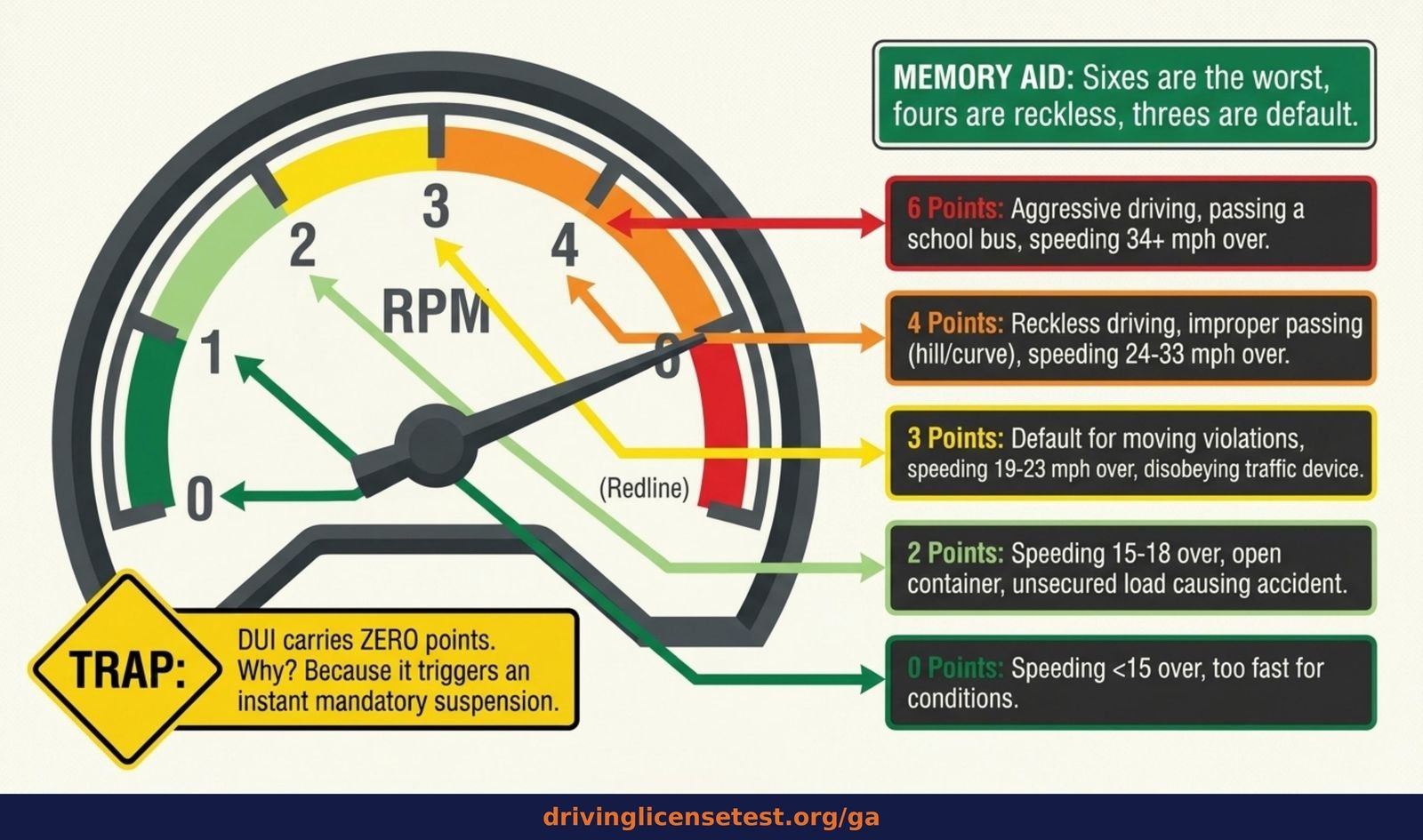
- 6 points each: aggressive driving · unlawful passing of a school bus · speeding 34 mph or more over the limit.
- 4 points each: reckless driving · improper passing on a hill or a curve · speeding 24–33 mph over the limit.
- 3 points each: speeding 19–23 mph over the limit · disobedience of a traffic-control device or traffic officer · all other moving violations not otherwise scheduled.
- 2 points each: speeding 15–18 mph over the limit · possessing an open container of alcohol while driving · failure to adequately secure a load resulting in an accident.
- Escalating offenses: child-restraint violation — 1 point (first) / 2 points (second or subsequent) · Hands-Free violation — 1 / 2 / 3 points across successive convictions.
- 0 points: speeding less than 15 mph over the limit · a conviction for “too fast for conditions” · offenses by non-Georgia residents. And — the warning from the Alcohol & Drugs study guide — DUI carries no points; it carries suspension.
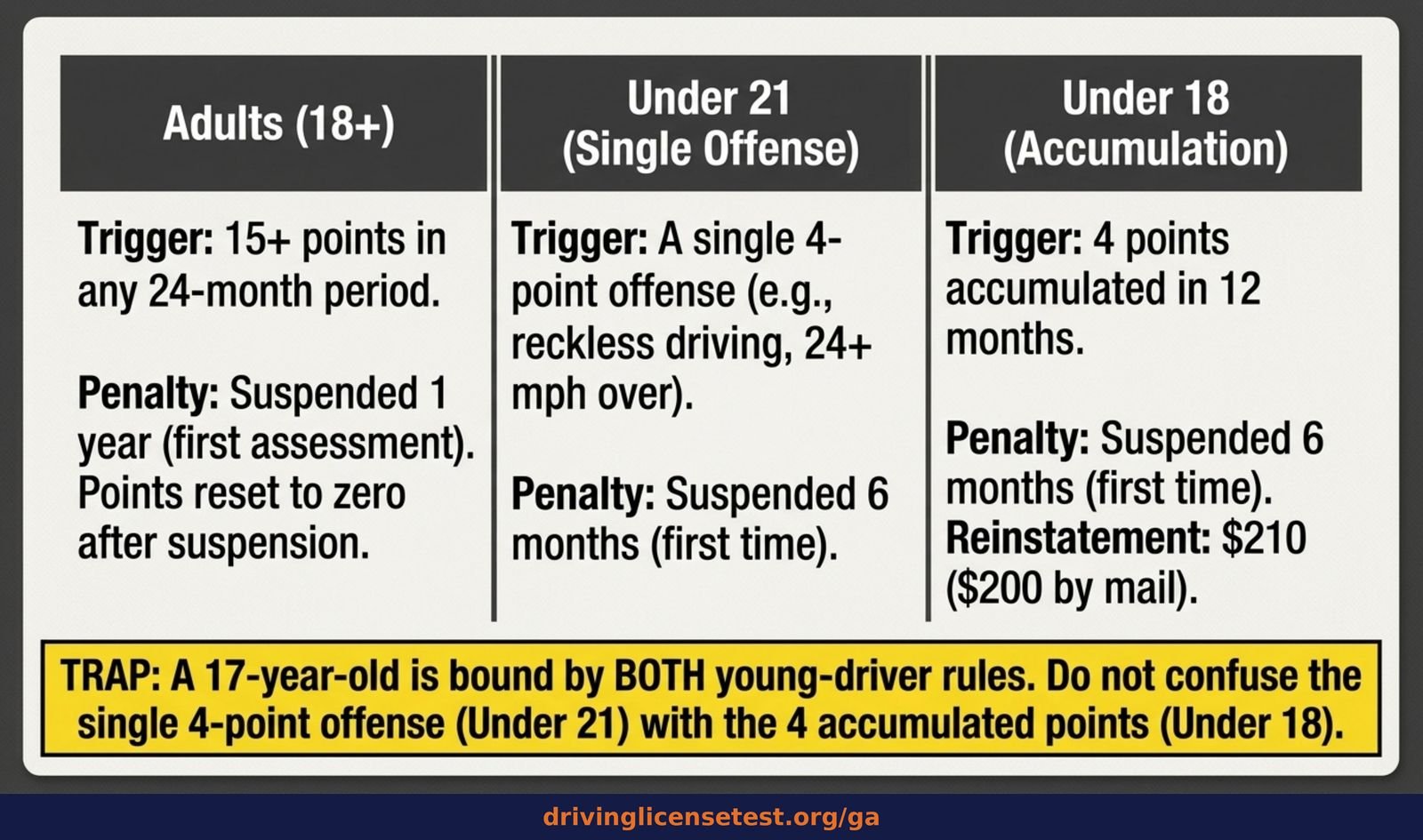
The trigger: DDS must suspend the license of a driver who accumulates 15 or more points in any consecutive 24-month period, measured from arrest date to arrest date. Suspension lengths climb: first assessment — 1 year; second assessment within 5 years — 3 years; third assessment within 5 years — 2 years, with no early return of the license and no limited driving permit during that term. At the end of a suspension, the point count resets to zero. For the 15-point rule, a second or subsequent nolo contendere plea within 5 years counts as a conviction.
Removing points: a driver may reduce up to 7 points, once every 5 years, by completing a DDS-approved Driver Improvement (defensive driving) course and presenting the original certificate in person at a DDS center or by mail to Georgia DDS, P.O. Box 80447, Conyers, GA 30013. Separately, completing an approved defensive-driving course after a citation and before the court date (or as the court orders) reduces the fine by 20% with no points assessed — also usable once every 5 years.
Memory aid: Sixes are the worst driving; fours are reckless class; threes are the default. Fifteen in twenty-four and you are suspended. Seven points off, once in five years, with the course.
Check yourself: A driver earns 6 points for passing a school bus, 4 for reckless driving, and 3 for running a traffic device, all within one year. Where does she stand against the suspension trigger — and what single course could have removed up to 7 of those points?
Part 6: Young drivers — the stricter triggers
Everything in Part 5 tightens for the young. Under the young-driver suspension statute:
- Under 21 — single-offense suspension: the license is suspended upon conviction of hit and run or leaving the scene, racing, fleeing or eluding an officer, reckless driving, any offense worth 4 or more points (including unlawful school-bus passing, improper passing on a hill or curve, and speeding 24+ mph over), or DUI. A nolo plea counts as a conviction here.
- Under 18 — accumulation suspension: the license is suspended upon accumulating 4 or more points in any consecutive 12-month period — a quarter of the adult point allowance, in half the time.
- Lengths: 6 months for a first suspension and 12 months for a second or subsequent.
- Reinstatement: proof of a completed defensive driving course (non-DUI offenses) or a DUI Risk Reduction Program (DUI), plus a reinstatement fee of $210 ($200 by mail) for a first suspension and $310 ($300 by mail) for a second or subsequent.
Trap — do not merge the two young rules. “Under 21” and “under 18” are different triggers in the same statute: the under-21 rule fires on a single 4-point offense; the under-18 rule fires on 4 accumulated points in 12 months. A 20-year-old is judged by the first rule only; a 17-year-old is judged by both.
Memory aid: Under 21: one 4-point offense suspends. Under 18: four points in a year suspends. Six months the first time, twelve the next.
Check yourself: A 17-year-old is convicted of improper passing on a curve (4 points) — her first offense of any kind. Which of the two young-driver triggers has she hit, and for how long is her license suspended?
Part 7: Suspensions, limited permits, and insurance — 25/50/25
Mandatory-suspension convictions include: homicide or serious injury by vehicle, DUI, a felony committed with a vehicle, fleeing or eluding, hit and run, racing, driving on a suspended or cancelled registration, driving without insurance, and driving while suspended, revoked, or cancelled. Suspensions without any conviction include implied-consent refusal, failure to appear, child-support non-payment, Super Speeder non-payment, safety-responsibility default, medical grounds, and a parent’s revocation request for a driver under 18. A driver becomes a habitual violator — license revoked — on a third conviction within 5 years of any combination of the serious offenses; a probationary (habitual violator) license may become available after 2 years.
Limited driving permits ($32, up to 1 year) may allow driving only for defined purposes: work, medical care, school, support or recovery meetings, driver education or Risk Reduction, court, probation, and community service, and transporting unlicensed family members. They are not available when the suspension is for no insurance, driving while suspended, Super Speeder non-payment, child support, failure to appear, medical grounds, safety responsibility, parent-requested revocation, DUI involving drugs, or DUI under 21. Under Safety Responsibility law, an uninsured at-fault driver must satisfy the claim or face suspension — compliance paths include an insurer’s SR-21 filing, a signed release, or posting security with an SR-22A; posted security is held 1 year, and a hearing may be requested within 10 days.
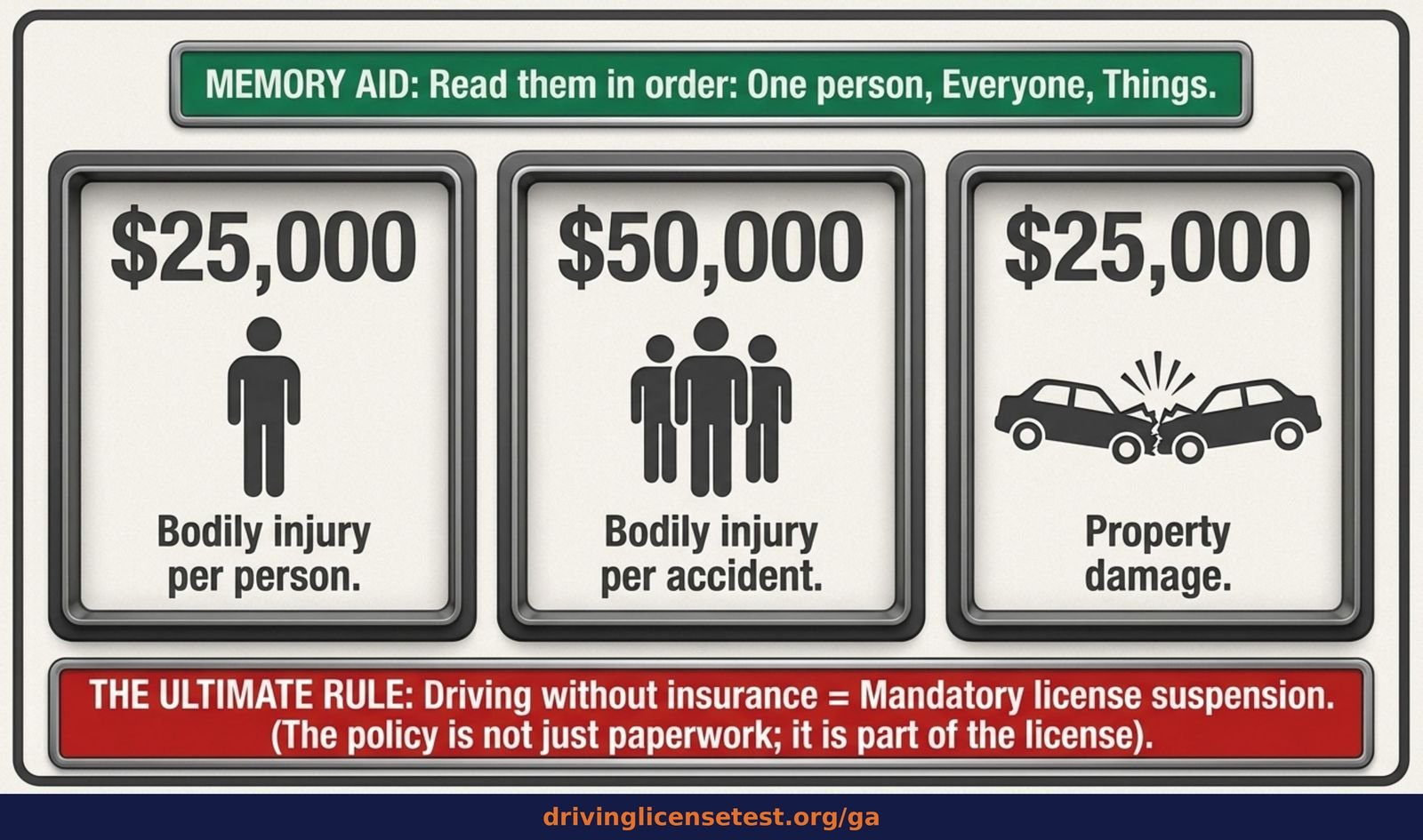
Insurance — the numbers that end this guide: Georgia’s minimum liability limits are 25/50/25: $25,000 bodily injury per person, $50,000 bodily injury per accident, $25,000 property damage. Read them in order: one person, everyone, things. Every Georgia policy must also include uninsured motorist coverage at those minimums (or equal to the policy’s liability limits, if higher) unless a named insured rejects the coverage in writing. And driving without insurance is one of the convictions carrying a mandatory license suspension — the policy is not paperwork; it is part of the license.
Memory aid: 25 for one, 50 for all, 25 for things — and no insurance means no license.
Test day in Georgia — what to expect
A first Georgia license starts at a DDS Customer Service Center with the two-part knowledge exam and a vision screening — that earns the Class CP instructional permit. Here is what the visit asks of you, before you go:
At the knowledge exam
- ✓ Know the test — it has two parts, and you must pass both. Road Signs: 20 questions, 15 correct to pass. Road Rules: 20 questions, 15 correct to pass. A high score on one part does not make up for the other. The Road Signs part is given in English only.
- ✓ Just walk in — and arrive in time. Knowledge exams are walk-in at every DDS Customer Service Center, but testing must begin at least 30 minutes before closing. No pens, paper, or phones are allowed in the testing area.
- ✓ Your vision is screened at the same visit. The standard is 20/60 or better in one eye, with or without corrective lenses — bring your glasses or contacts if you wear them.
- ✓ Bring your documents. For a first Georgia credential you will show proof of identity, your Social Security number, and two proofs of Georgia residency dated within the last six months (plus name-change documents if your name has changed). Under 18? A parent, guardian, or responsible adult signs for you, and you will also show proof of school enrollment and your ADAP (Alcohol and Drug Awareness Program) completion.
- ✓ Know the fee. The Class CP permit costs $10, paid before testing. The fee is non-refundable and is paid again on every attempt — the permit itself is valid for two years.
- ✓ If you don’t pass, you can retry. After a first failure you may retake the exam the next day; after a second or later failure, the wait is seven days.
- ✓ Know the ages. The Class CP permit is available at 15. At 16, after holding the permit for one year and one day and completing Joshua’s Law driver education, you can test for the Class D provisional license; the full Class C license comes at 18 and costs $32 for eight years.
Before the road test (the next step)
- ✓ The road test is by appointment only. You provide a properly insured, currently registered vehicle that passes a safety inspection.
- ✓ Log your practice. Class D applicants certify 40 hours of supervised driving, including at least 6 hours at night, on top of the Joshua’s Law course requirement.
Key numbers to memorize
| Fact | Remember |
|---|---|
| Agency and manual | Georgia Department of Driver Services (DDS), Customer Service Centers · Georgia Driver’s Manual, revised July 2025 |
| Real knowledge exam | Two parts — Road Signs 20 questions (English only) and Road Rules 20 questions — each passed separately at 15 of 20 (75%) · walk-in, begin at least 30 minutes before closing |
| Retakes | First failure: next day · second or subsequent failure: 7 days |
| Vision standards | 20/60 or better in one eye · horizontal field at least 140 degrees · age 64+: vision screening every 8 years · new residents licensed within 30 days |
| Class CP permit | Age 15 or older · $10 paid before testing, non-refundable, repaid every attempt · valid up to 2 years · drive only with a licensed 21+ supervisor seated beside you |
| Class D provisional | Age 16 after holding the permit 1 year and 1 day · road test, school enrollment, ADAP, adult signature |
| Joshua’s Law | 30 hours classroom + 6 hours on-road instruction, OR the DDS Parent/Teen Driving Guide · plus 40 supervised hours including 6 at night (Form DDS-7) |
| Class D restrictions | No driving 12:00 a.m.–5:00 a.m., no exceptions · passengers: immediate family only for 6 months, then at most 1 under-21 non-family passenger for 6 months, then at most 3 |
| Class C and the road test | Class C at 18 · license $32 for 8 years · road test by appointment only, minimum passing score 75% · parallel park within 18 inches · backing about 50 feet at no more than 10 mph |
| Fees | Class D $10 / 5 years · replacement $10 · ID $32 / 8 years (voter ID free, handicapped ID $5) · MVR $7 (3-year) / $9 (7-year or lifetime) · $5 online or app discount |
| Renewal | 8-year terms · expired more than 2 years: retake vision screening, knowledge exam, and road test · REAL ID star in the upper right corner, required since May 7, 2025 |
| Points trigger (adults) | 15 or more points in any consecutive 24 months = suspension · lengths 1 year, then 3 years, then 2 years with no limited permit · points reset to zero after suspension |
| Point values | 6: aggressive driving, school-bus passing, speeding 34+ over · 4: reckless, improper passing on hill/curve, speeding 24–33 over · 3: speeding 19–23 over, device/officer disobedience, all other moving violations · 2: speeding 15–18 over, open container, unsecured load with accident · 0: under 15 over, “too fast for conditions” — and DUI (suspension instead) |
| Points reduction | Up to 7 points once every 5 years with a DDS-approved Driver Improvement course · course before the court date can cut the fine 20% with no points assessed |
| Young-driver triggers | Under 21: any single 4-point offense (or listed serious offense, or DUI) suspends · under 18: 4 points in 12 months suspends · lengths 6 months first, 12 months later · reinstatement $210 ($200 by mail) first, $310 ($300 by mail) later |
| Habitual violator | Third conviction within 5 years of the serious offenses = revocation · probationary license may be available after 2 years |
| Insurance minimums | 25/50/25 — $25,000 one person / $50,000 per accident / $25,000 property · uninsured motorist coverage required unless rejected in writing · driving without insurance = mandatory suspension |
5-question self-check
- Describe the real knowledge exam: its two parts, the questions and pass mark for each, which part is English only, and the retake waits after a first and a second failure.
- State the Class CP terms — age, fee and when it is paid, validity, and the supervision rule — then the Class D step: age, holding period, and every requirement Joshua’s Law adds.
- List the Class D restrictions: the curfew with its exception count, and the passenger limits across the first year and after it.
- Explain Georgia’s points system in order: three offenses worth 6, 4, and 2 points, the adult suspension trigger and first suspension length, and the two young-driver triggers with their lengths.
- Recite the money: a Class C license, a Class D license, a duplicate, a 3-year driving record — and the insurance minimums in their three parts.
Answer key
- Road Signs: 20 questions, 15 of 20 to pass, testing signs, signals, and pavement markers — given in English only. Road Rules: 20 questions, 15 of 20 to pass, testing driver responsibility, traffic laws, and safe-driving practices. Each part must be passed separately at 75%; neither offsets the other. After a first failure the retake is the next day; after a second or subsequent failure, 7 days.
- Class CP: age 15 or older; the $10 fee is paid before testing, is non-refundable, and is repaid on every attempt; the permit is valid up to 2 years; the holder may drive only with a person age 21 or older seated beside them who holds a Class C license and can exercise control. Class D: age 16, after holding the permit 1 year and 1 day, with the road test, school enrollment, ADAP, and an adult signature — plus Joshua’s Law: 30 hours of classroom and 6 hours of on-road instruction (or the DDS Parent/Teen Driving Guide) and 40 additional supervised hours including 6 at night.
- Curfew: no driving between 12:00 a.m. and 5:00 a.m., with no exceptions. Passengers: first 6 months, immediate family only; second 6 months, at most 1 passenger under 21 who is not immediate family; after 12 months, at most 3 such passengers.
- Six points: aggressive driving (also unlawful school-bus passing and speeding 34+ over). Four points: reckless driving (also improper passing on a hill or curve, speeding 24–33 over). Two points: speeding 15–18 over (also open container while driving, unsecured load causing an accident). Adults: 15 or more points in any consecutive 24 months means suspension — 1 year for a first assessment. Under 21: a single 4-point offense suspends. Under 18: 4 points in 12 months suspends. Young-driver suspensions run 6 months the first time and 12 months after.
- Class C license: $32 for 8 years. Class D license: $10 for 5 years. Replacement or duplicate: $10. A 3-year Motor Vehicle Report: $7. Insurance: 25/50/25 — $25,000 bodily injury per person, $50,000 per accident, $25,000 property damage.
Keep practicing
- Take the Licensing & Registration practice quiz
- Flip through the Licensing & Registration flashcards
- Run the full Georgia practice test
More study guides: Signs & Signals Study Guide · Traffic Laws Study Guide · Right of Way Study Guide · Safe Driving Study Guide · Alcohol, Drugs & Driving Conditions Study Guide