

Your complete Georgia study guide — plain language, no jargon.
📘 Prefer pictures? Flip through the visual deck
This whole guide as 12 slides — swipe or scroll sideways through them. The BAC limits, implied consent and the conviction ladder, in pictures.
Take it with you: Download the deck as a PDF (5.4 MB) → — free to share.
Why this matters
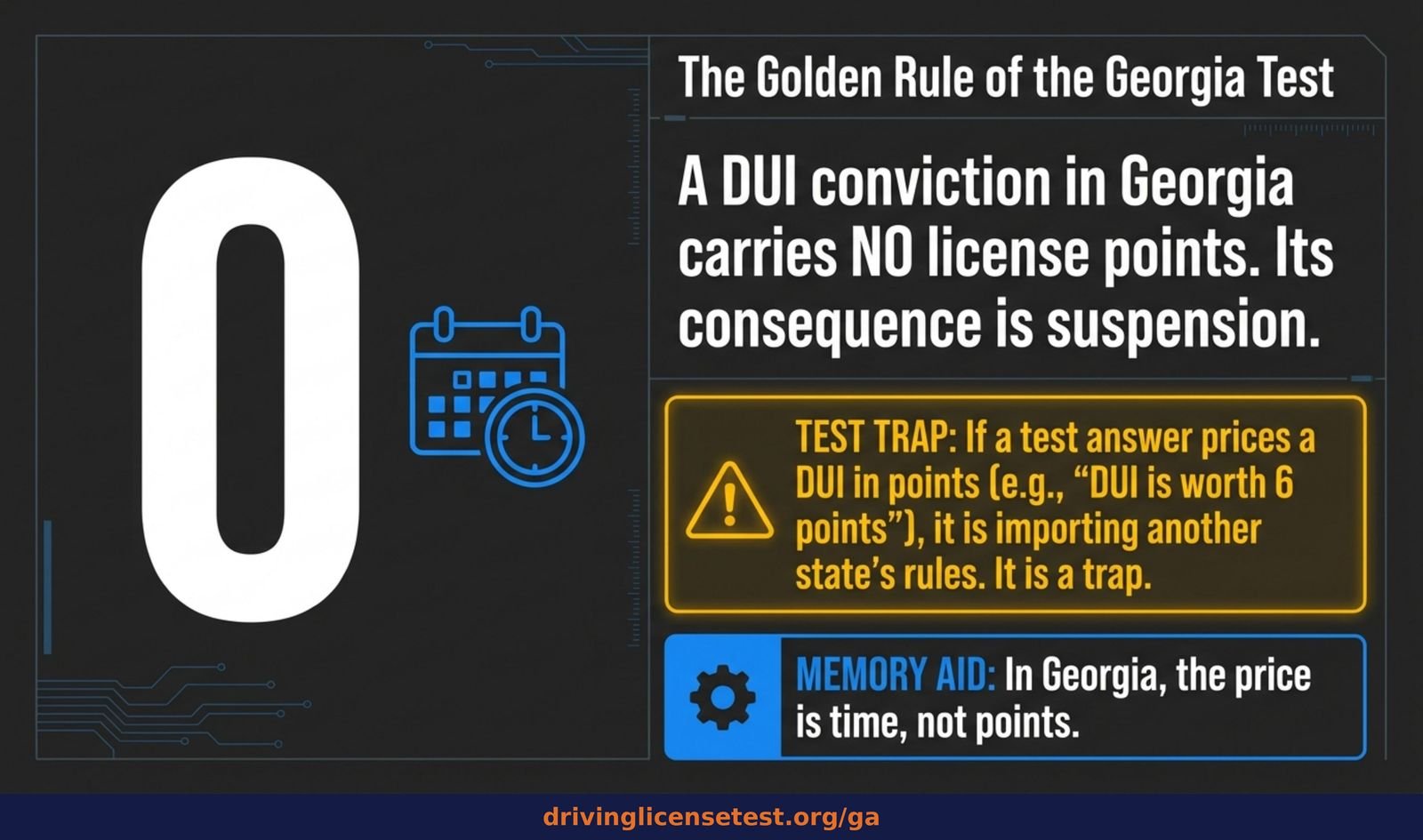
Georgia’s DUI law is a ladder of numbers — blood-alcohol limits by age, suspension lengths by conviction count, deadlines measured in days — and the exam tests every rung. In Georgia, driver licensing is administered by the Georgia Department of Driver Services (DDS), and the official study manual is the Georgia Driver’s Manual (revised July 2025). The real Georgia knowledge exam has two parts — Road Signs (20 questions) and Road Rules (20 questions) — and each part must be passed separately at 15 of 20 (75%). A strong score in one part does not offset the other. One Georgia rule frames this whole guide, because study materials for other states teach the opposite: a DUI conviction in Georgia carries no license points. Its consequence is suspension — learn the suspensions, not a point value that does not exist.
Part 1: What counts as DUI in Georgia
It is illegal to drive or be in actual physical control of a moving vehicle while less safe due to alcohol, any drug, toxic vapors, or any combination of them. Two features of that sentence are tested hard:
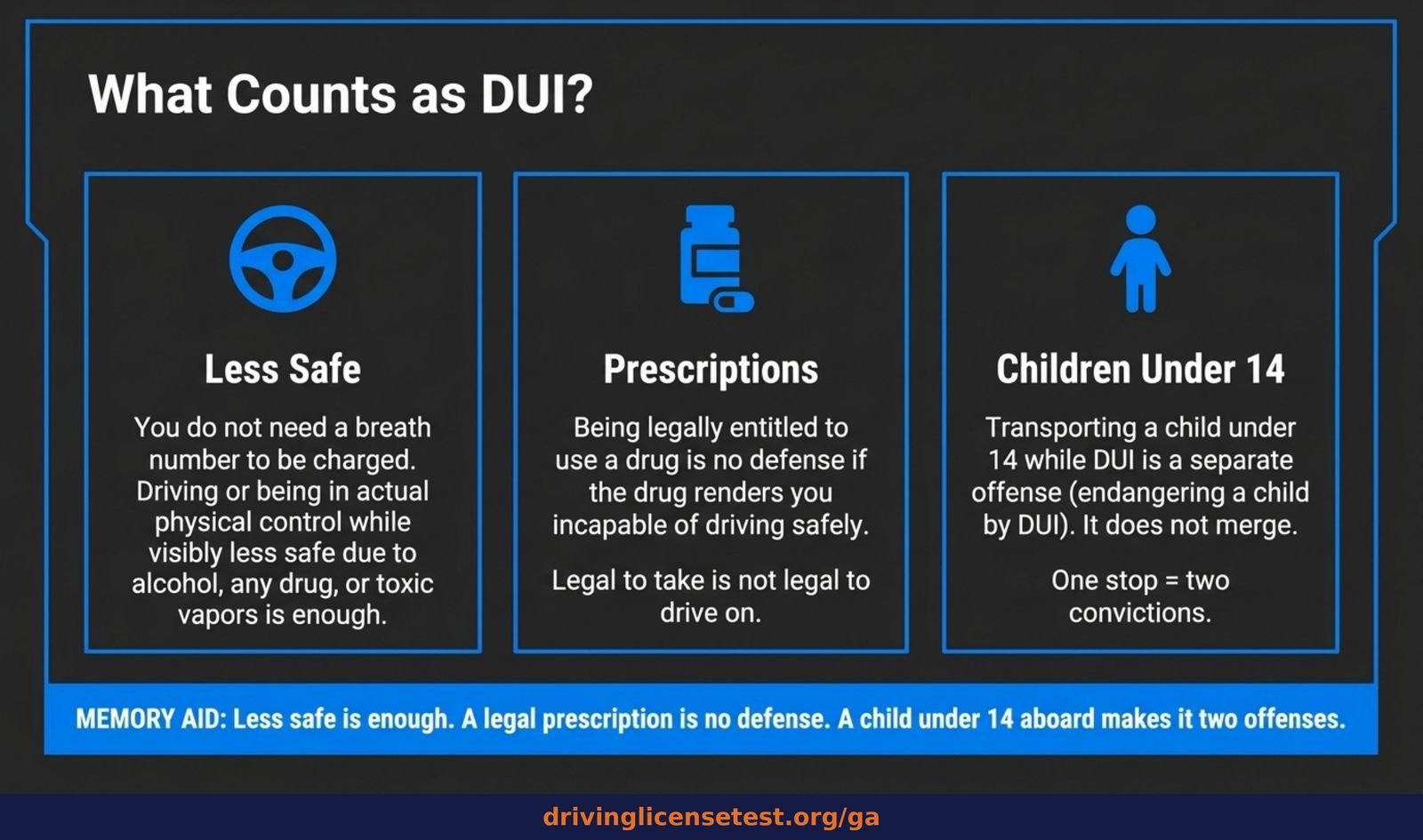
- “Less safe” is its own offense. The state does not need a breath number to charge DUI — driving that is visibly less safe because of alcohol or drugs is enough, alongside the per se limits in Part 2.
- A prescription is no shield. Being legally entitled to use a drug is no defense if the drug renders you incapable of driving safely. Legal to take is not the same as legal to drive on.
Children raise the stakes separately: driving under the influence while transporting a child under age 14 is the separate offense of endangering a child by DUI — it does not merge with the DUI offense for prosecution or sentencing, so one stop can produce two convictions.
Memory aid: Less safe is enough. A legal prescription is no defense. A child under 14 aboard makes it two offenses, not one.
Check yourself: A driver on a lawfully prescribed medication weaves across lanes and fails to maintain speed, but blows below the per se limit. Can Georgia still charge DUI — and which sentence of the law answers it?
Part 2: The thresholds — 0.08, 0.02, and 0.04
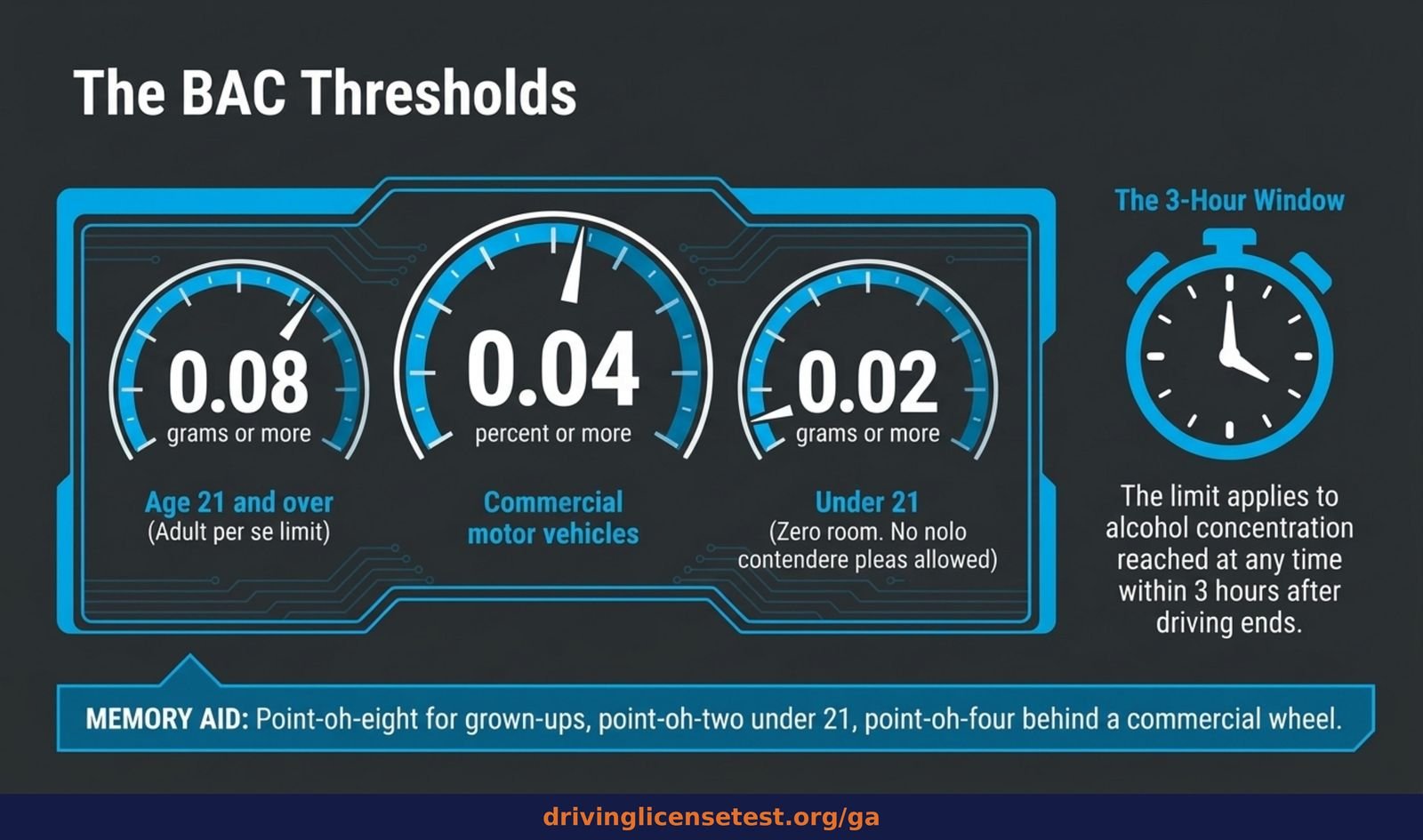
Georgia’s per se limits make the number itself the violation: at or above the limit, no separate proof of bad driving is needed. The measurement window matters too — the limit applies to an alcohol concentration reached at any time within 3 hours after driving, from alcohol consumed before driving ended.
- 0.08 grams or more — age 21 and over. The adult per se limit.
- 0.02 grams or more — under 21. The young-driver per se limit: effectively any measurable drinking. And a driver under 21 charged with DUI may not plead nolo contendere — the plea other drivers sometimes use is closed to them.
- 0.04 percent or more — commercial motor vehicles. A violation in itself, punished as a misdemeanor in addition to commercial disqualification.
Memory aid: Point-oh-eight for grown-ups, point-oh-two under twenty-one, point-oh-four behind a commercial wheel — measured up to three hours after the driving ends.
Check yourself: A 20-year-old tests at 0.03 two hours after driving, and her 24-year-old passenger — who drove earlier — tests at 0.07. Which of them has committed a per se DUI, and why does the same roadside produce two different answers?
Part 3: Implied consent — the consent you gave by driving
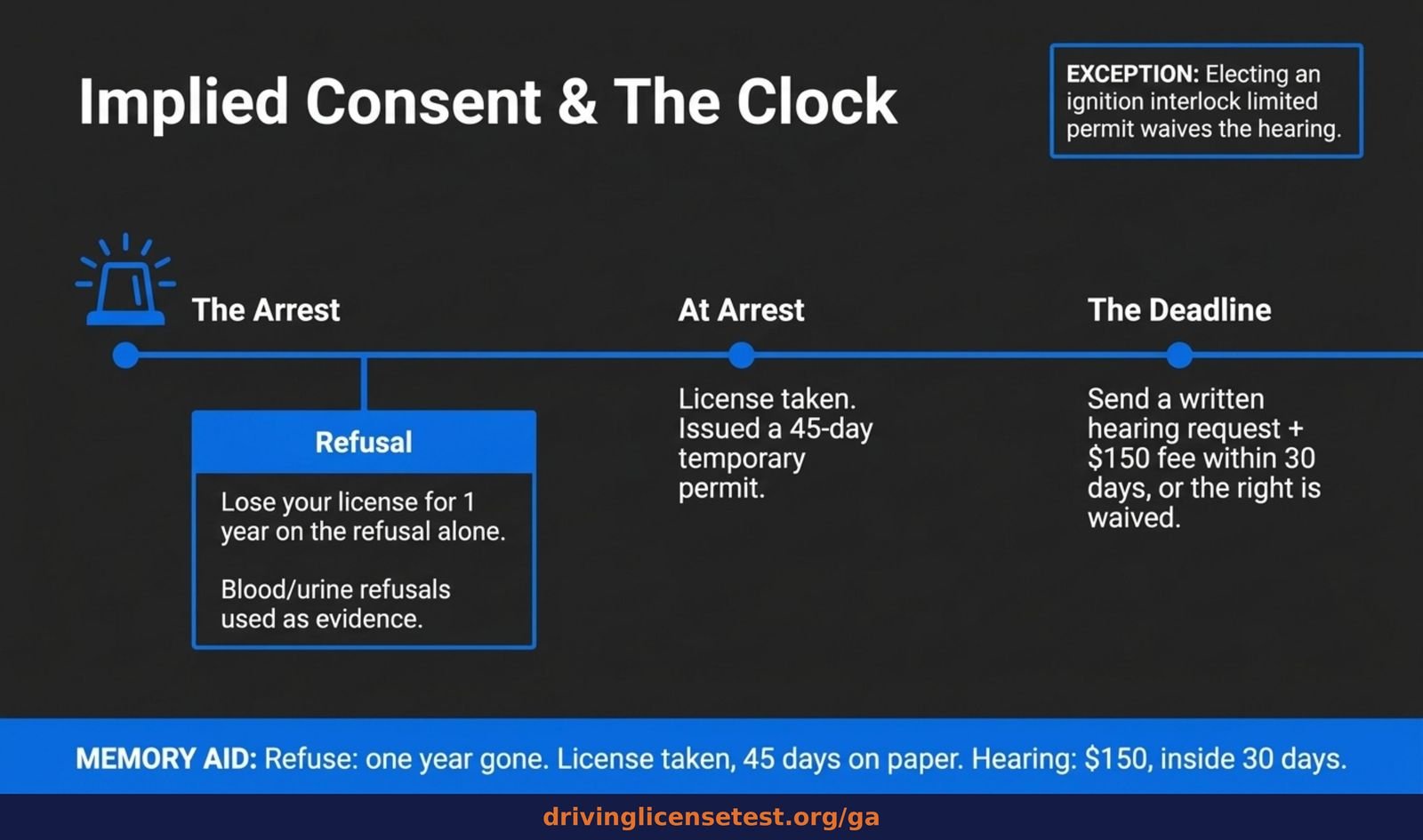
By driving on Georgia highways, you are deemed to have consented to state-administered chemical tests of blood, breath, urine, or other bodily substances when lawfully arrested for DUI. At arrest, the officer reads you the implied consent notice matching your category — under 21, 21 or over, or commercial.
- Refusing costs a year. Refusing the state-administered test results in suspension of your Georgia license or driving privilege for one year — before any trial, on the refusal alone. A refusal of blood or urine testing may also be offered in evidence at trial.
- Testing over the limit suspends too. Submitting and testing at or above your limit (0.08; 0.02 if under 21) also brings an administrative suspension. A commercial driver testing 0.04 or more is disqualified for at least one year, and a commercial driver with any alcohol present is placed out of service for 24 hours.
- Your license is taken at arrest. The officer takes your license and issues a 45-day temporary driving permit.
- The hearing has a price and a clock. To challenge the administrative suspension, send DDS a written hearing request with a $150 filing fee within 30 days of notice, or the right to a hearing is waived; DDS must hold the hearing within 30 days of the request. Electing an ignition interlock limited permit waives the hearing.
- Your own tests are your right. After submitting to the state tests, you are entitled to additional chemical tests at your own expense, by qualified personnel of your own choosing.
Memory aid: Refuse: one year gone. License taken, 45 days on paper. Hearing: 150 dollars, inside 30 days — or waived.
Check yourself: A driver refuses the breath test, keeps her paper permit, and mails a hearing request with the fee on day 34. What has she already lost, and what has she just waived?
Part 4: The first conviction — fines, jail, service, and school
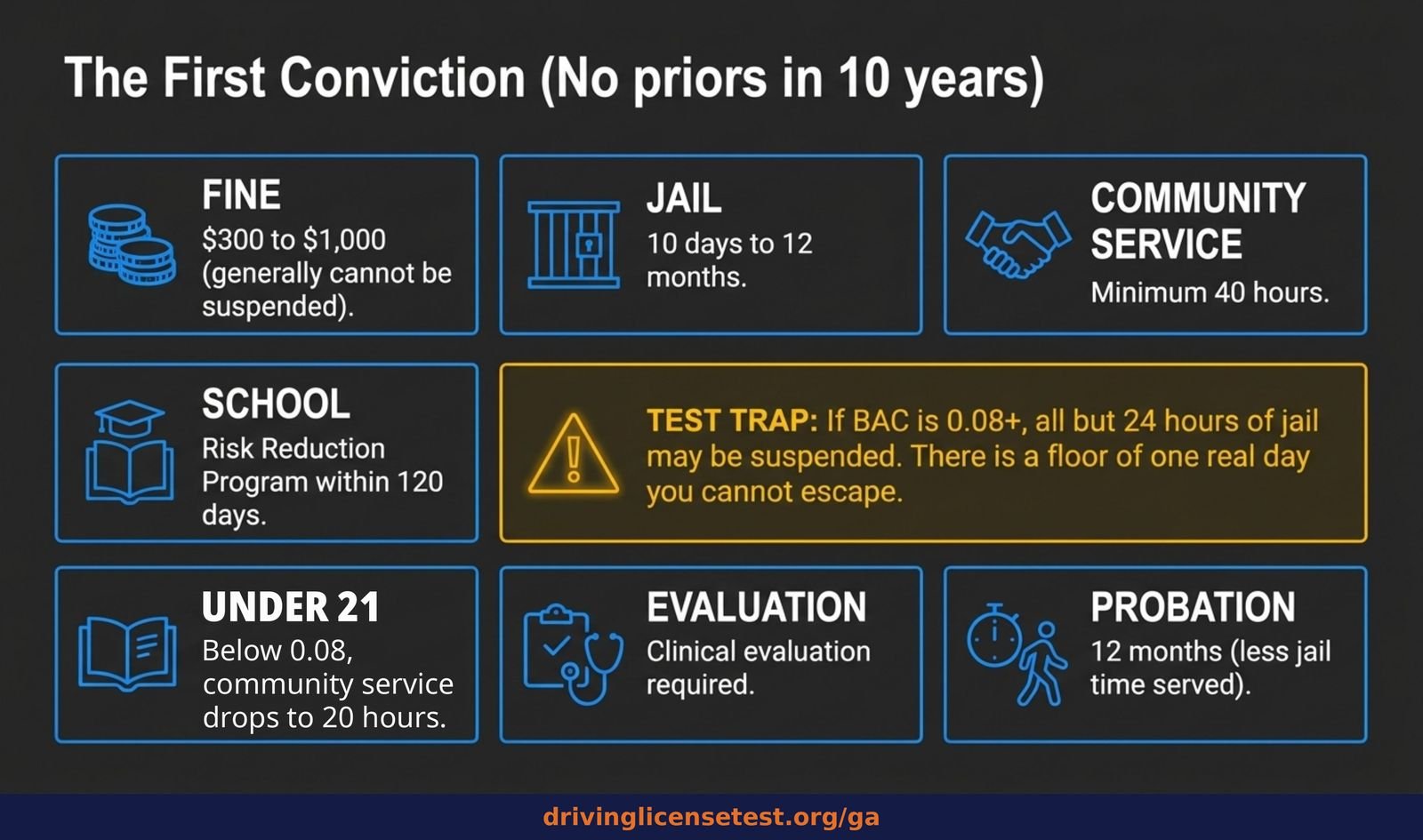
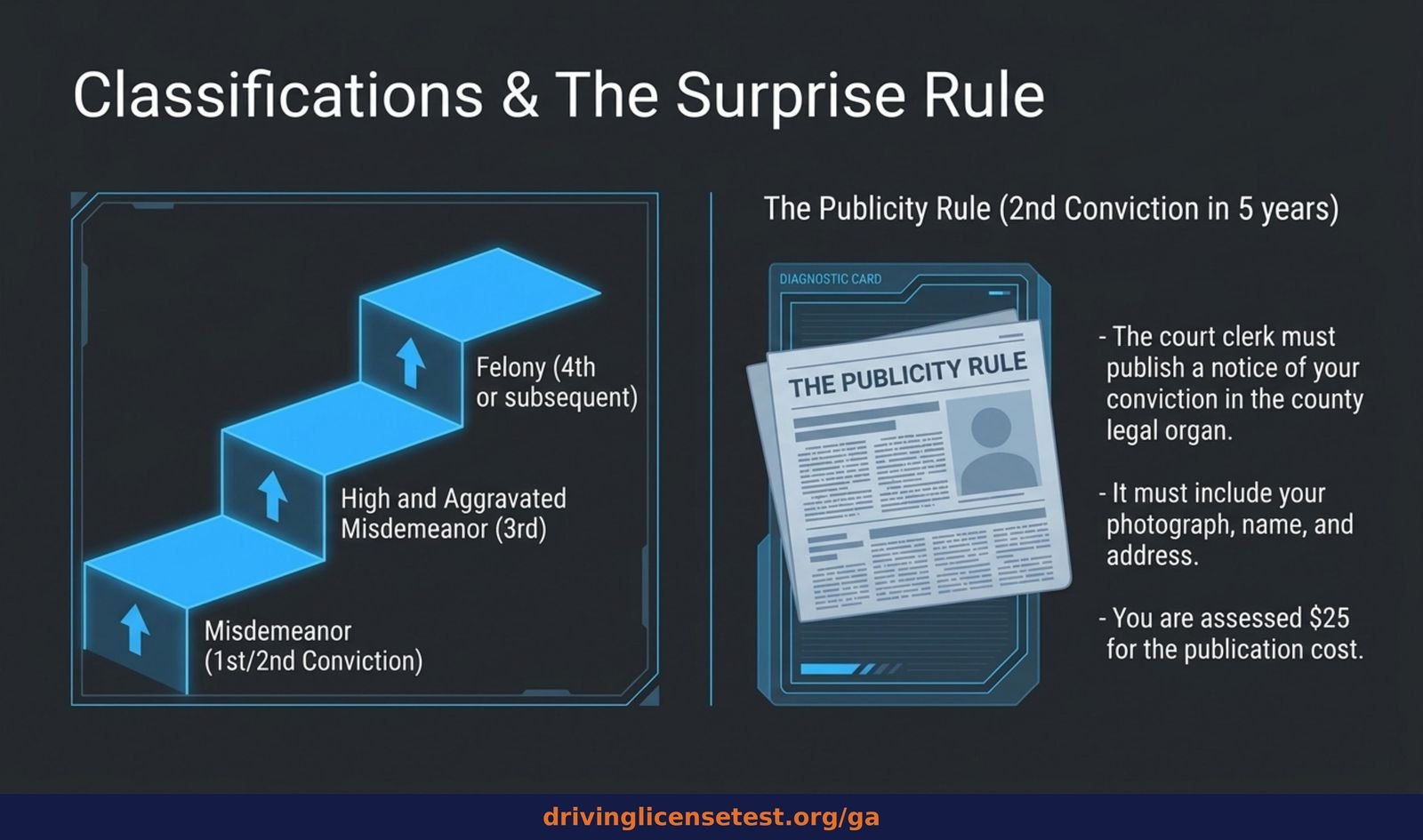
DUI classifications climb with your record: first and second convictions are misdemeanors; a third is a high and aggravated misdemeanor; a fourth or subsequent is a felony. A first conviction — no DUI conviction or nolo plea in the previous 10 years — carries all of these:
- Fine: $300 to $1,000, which generally cannot be suspended, stayed, or probated.
- Jail: 10 days to 12 months, which the judge may suspend, stay, or probate — except that if your alcohol concentration was 0.08 or more, all but 24 hours may be suspended. There is a floor of one real day.
- Community service: not fewer than 40 hours — reduced to 20 hours for an under-21 conviction with an alcohol concentration below 0.08.
- School and evaluation: completion of a DUI Alcohol or Drug Use Risk Reduction Program within 120 days of conviction (within 90 days after release if incarcerated), plus a clinical evaluation, with treatment if recommended.
- Probation: 12 months, less any jail time served.
One publicity rule surprises everyone: upon a second conviction within 5 years, the court clerk must publish a notice of conviction — with the offender’s photograph, name, and address — in the county legal organ, and the offender is assessed $25 for publication costs.
Memory aid: First time: 300 to a thousand, 24 hours you cannot escape at .08, 40 hours of service, Risk Reduction school, a year of probation.
Check yourself: A first-time offender at 0.09 asks the judge to suspend her entire jail term and fine. Which parts of that request can the judge grant, and which parts does the statute protect?
Part 5: License suspensions — where DUI actually lands
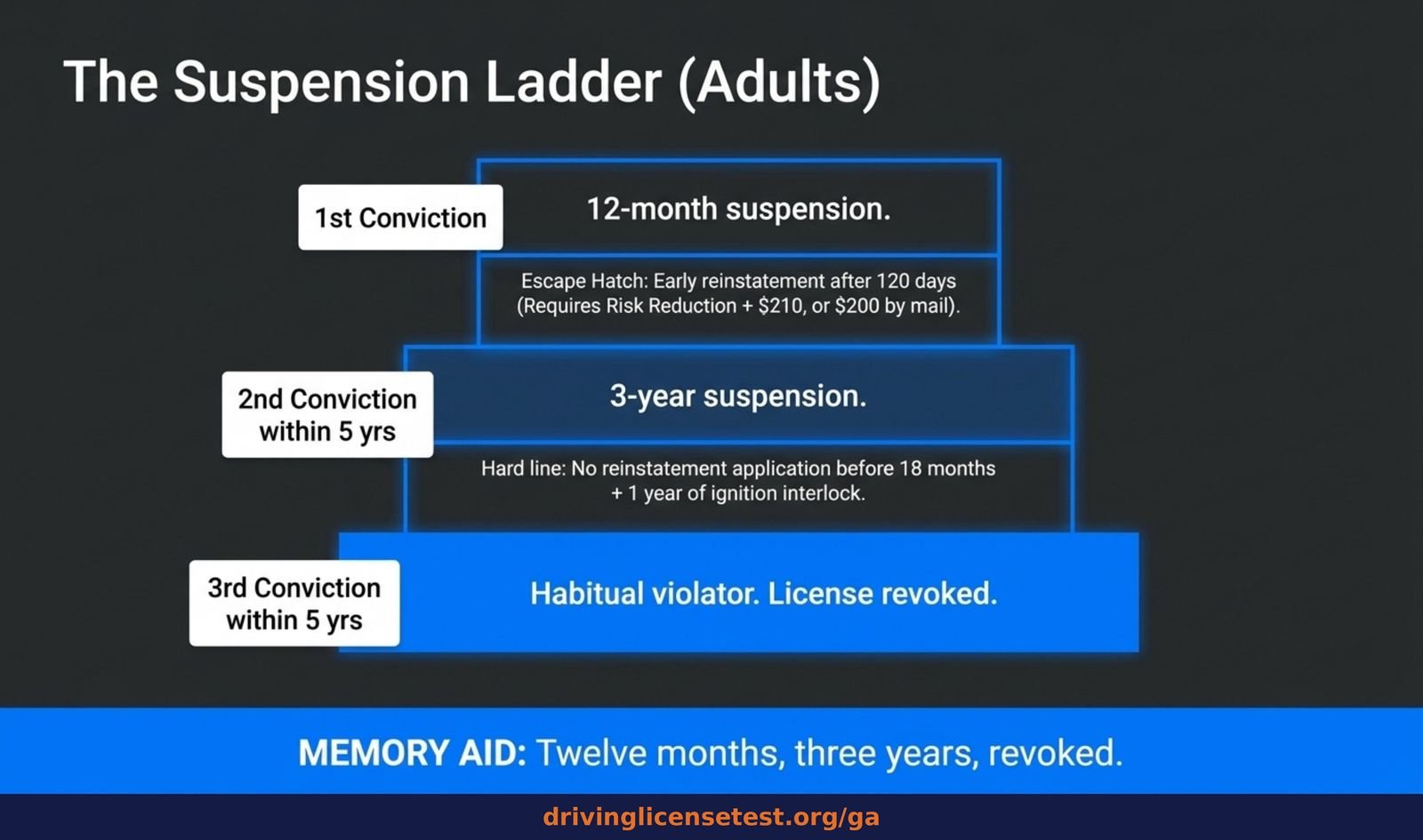
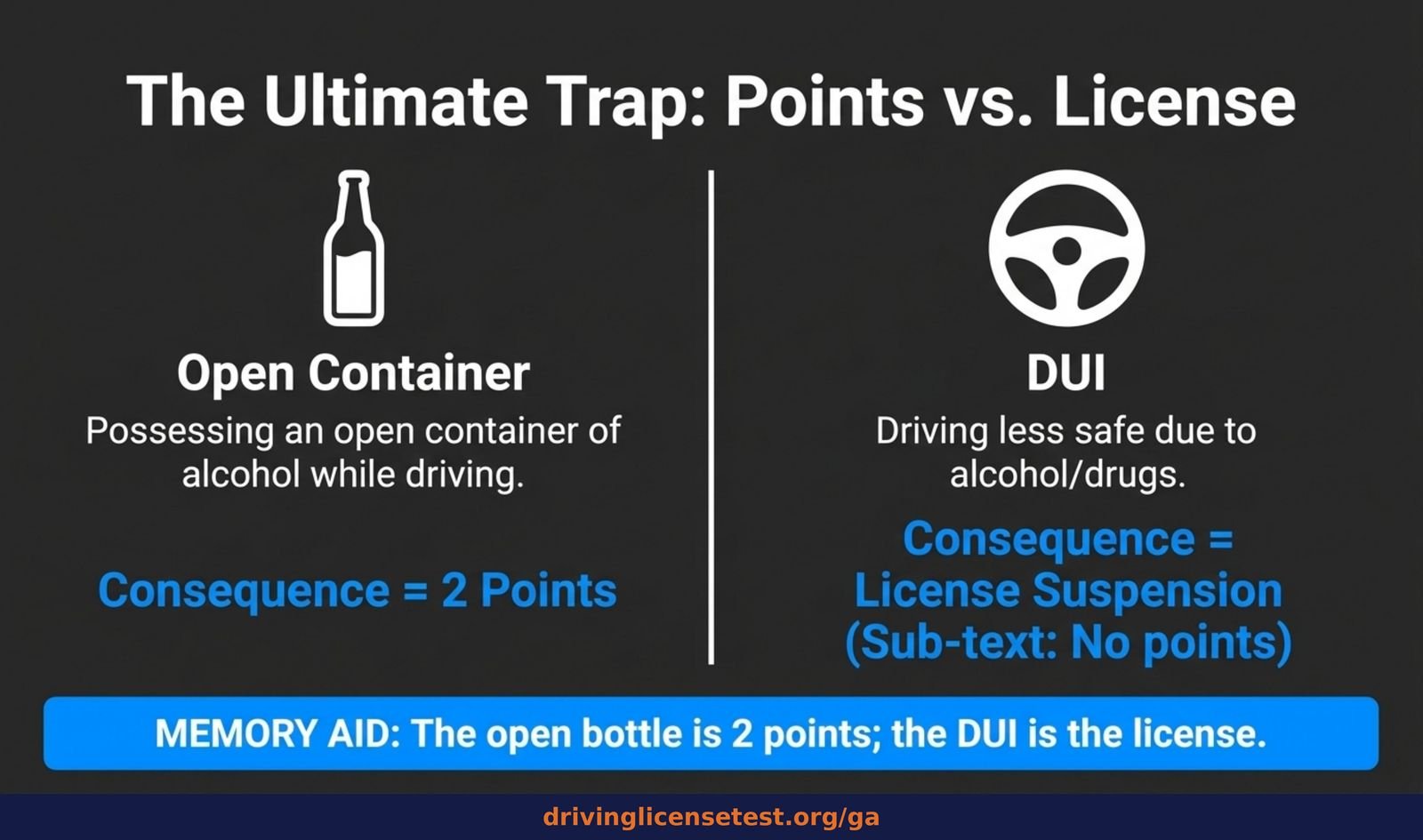
Here is the guide’s framing rule in its working form: a DUI conviction is assessed no license points. The §40-5-57 points schedule contains no DUI entry at all. What DUI carries is suspension, on this ladder:
- First conviction (no prior within 5 years): 12-month suspension, with early reinstatement after 120 days upon proof of Risk Reduction completion and a restoration fee of $210 ($200 by mail).
- Second conviction within 5 years: 3-year suspension. The driver may not apply for reinstatement before 18 months, and reinstatement requires Risk Reduction completion plus installation and maintenance of an ignition interlock device for 1 year under an interlock limited permit, unless waived for financial hardship.
- Third conviction within 5 years: the driver is a habitual violator and the license is revoked.
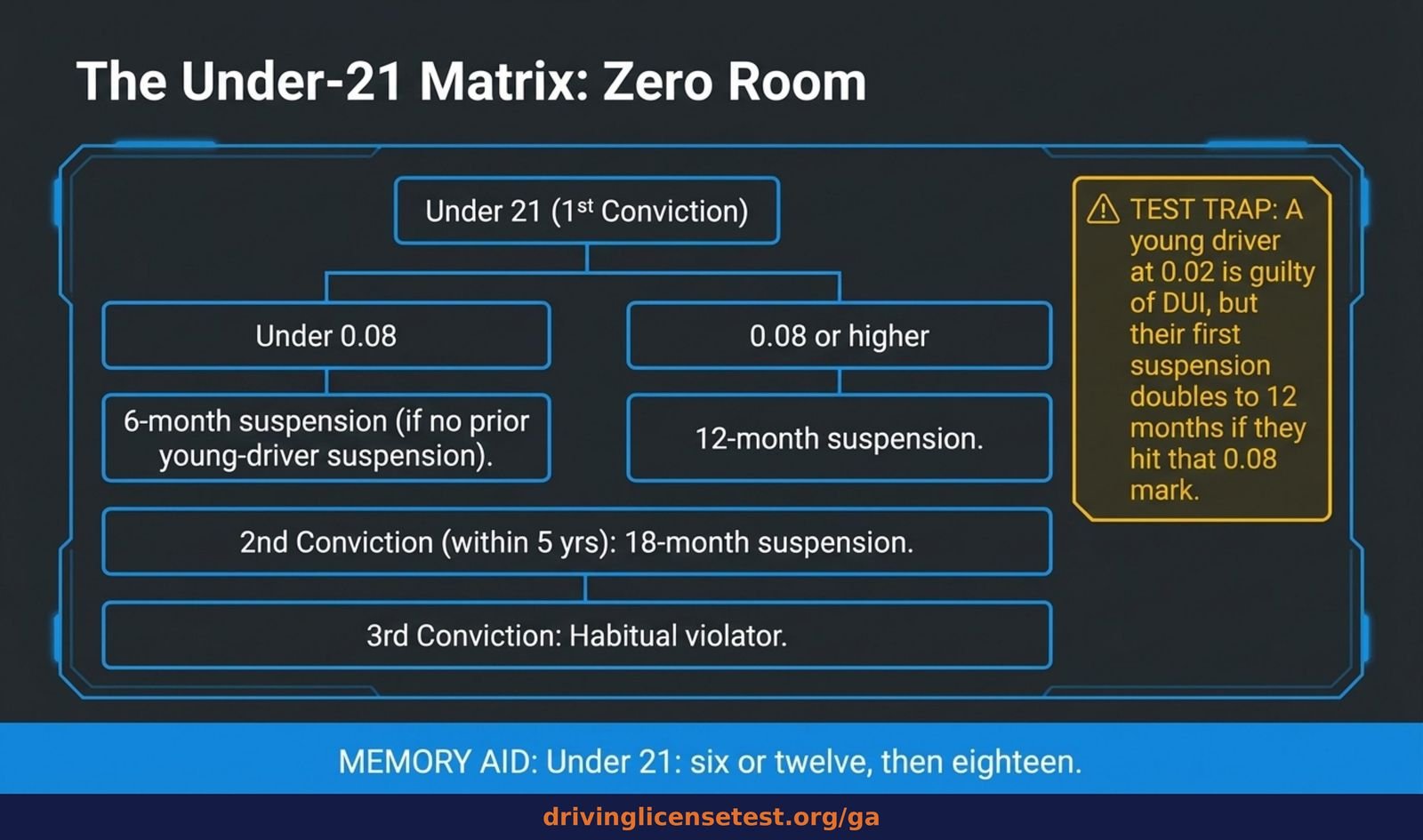
Under-21 DUI suspensions run on their own scale: a first conviction brings 6 months if the alcohol concentration was below 0.08 and the driver has no prior young-driver suspension — otherwise 12 months. A second conviction within 5 years brings 18 months, and a third makes the driver a habitual violator. DUI is also one of the convictions that suspends an under-21 license under the young-driver statute (Licensing & Registration study guide).
Trap: Any study answer that prices a DUI in points — “DUI is worth 6 points” — is importing another state’s schedule. In Georgia the price is time: twelve months the first time, three years the second, revocation the third.
Memory aid: No points for DUI — ever. Twelve months, three years, revoked. Under 21: six or twelve, then eighteen.
Check yourself: A driver with a DUI conviction asks how many points the DUI added and when she can drive again. Correct her first answer, then give her the real one for a first conviction, including the early-reinstatement door and its price.
Part 6: Young drivers, drugs, and the car itself
Zero room under 21. The 0.02 per se limit (Part 2) means a single drink can be a DUI for a young driver, the nolo plea is unavailable, and the license consequences in Part 5 start at 6 months only when the concentration stayed below 0.08 — at or above it, a first young-driver DUI costs 12 months.
Drugs are DUI too. Part 1’s rule deserves repeating here: driving less safe due to any drug — illegal, over-the-counter, or lawfully prescribed — is DUI when the drug renders you incapable of driving safely. Mixing alcohol with medicine compounds impairment, and “my doctor prescribed it” answers a question the court is not asking.
Open containers carry points. Possessing an open container of alcohol while driving is assessed 2 points — one of the few alcohol-adjacent offenses Georgia does price in points, which is exactly why it gets confused with DUI itself. Keep the two apart: the open container costs points; the DUI costs the license.
Memory aid: Under 21, .02 is the line. Any drug that makes you less safe is DUI. The open bottle is 2 points; the DUI is the license.
Check yourself: Two drivers are convicted on the same night: one for DUI, one for driving with an open container. Which one’s record gains points, how many — and which one’s license is suspended?
Key numbers to memorize
| Fact | Remember |
|---|---|
| Real Georgia knowledge exam | Two parts — Road Signs 20 questions and Road Rules 20 questions — each passed separately at 15 of 20 (75%) |
| Per se limits | 0.08 (age 21+) · 0.02 (under 21) · 0.04 (commercial) — measured within 3 hours after driving |
| Less-safe DUI | Driving less safe due to alcohol, any drug, toxic vapors, or a combination is DUI; a legal entitlement to use a drug is no defense |
| Child endangerment | DUI while transporting a child under 14 is a separate offense that does not merge with the DUI |
| Implied consent — refusal | License or privilege suspended for 1 year; blood/urine refusal may be used in evidence |
| At arrest | License taken; 45-day temporary driving permit issued |
| Hearing challenge | Written request plus $150 filing fee within 30 days, or waived; electing an interlock limited permit also waives the hearing |
| Classifications | 1st and 2nd: misdemeanors · 3rd: high and aggravated misdemeanor · 4th or subsequent: felony |
| First conviction penalties | Fine $300–$1,000 · jail 10 days–12 months (at 0.08+, all but 24 hours may be suspended) · 40 hours community service (20 for under-21 below 0.08) · Risk Reduction Program within 120 days · clinical evaluation · 12 months probation |
| Second conviction publicity | Notice with photograph, name, and address published in the county legal organ; $25 publication cost |
| DUI and points | DUI carries NO points — the consequence is suspension |
| DUI suspensions | 1st: 12 months, early reinstatement after 120 days with Risk Reduction proof and $210 ($200 by mail) · 2nd within 5 years: 3 years, no application before 18 months, 1 year of ignition interlock · 3rd within 5 years: habitual violator, revoked |
| Under-21 DUI suspensions | 1st: 6 months if below 0.08 with no prior young-driver suspension, otherwise 12 months · 2nd within 5 years: 18 months · 3rd: habitual violator |
| Open container | Possessing an open container while driving: 2 points |
5-question self-check
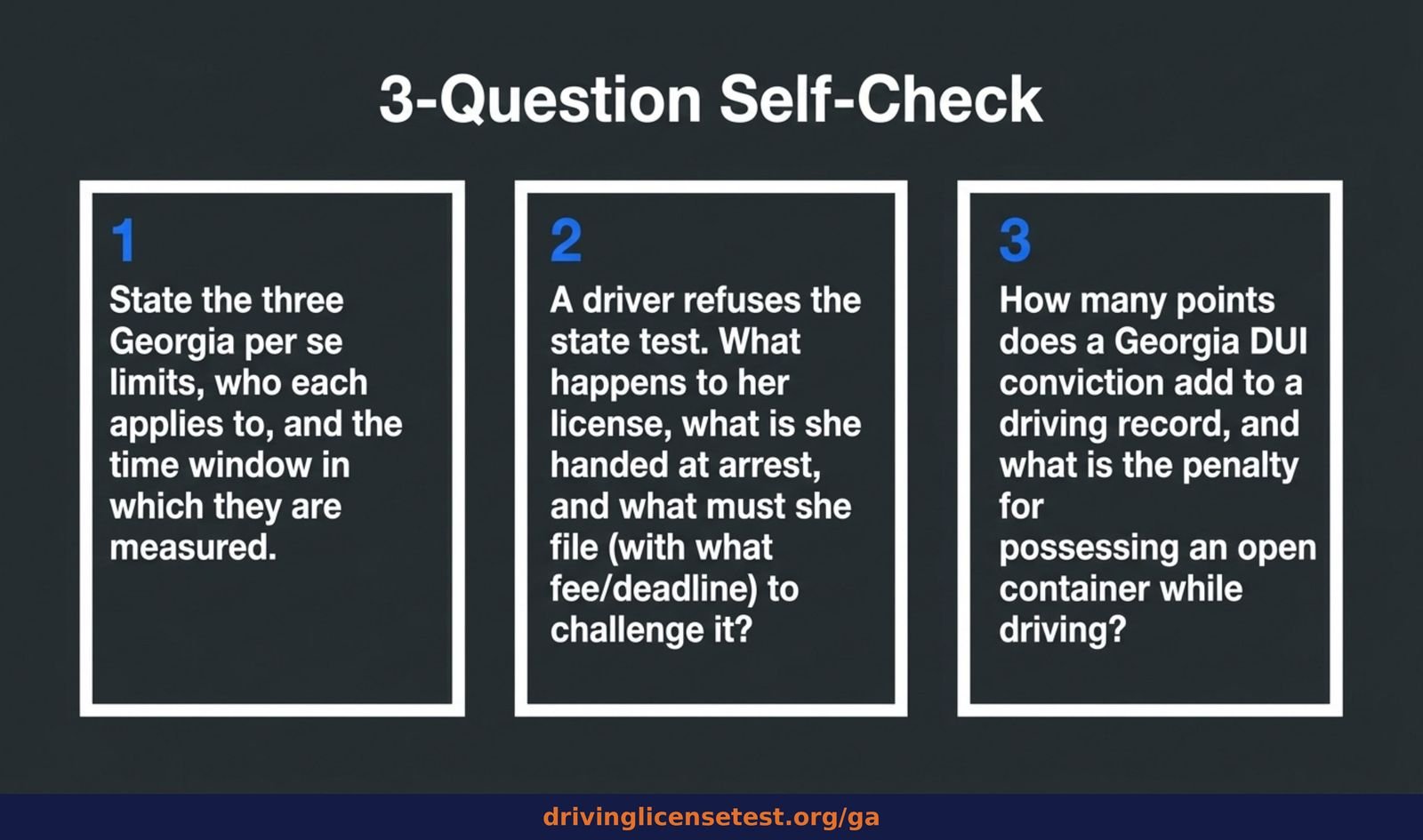
- State the three Georgia per se limits, who each applies to, and the time window in which the concentration is measured.
- A driver refuses the state-administered test after a lawful DUI arrest. What happens to her license, what is she handed at arrest, and what must she file — with what fee, by when — to challenge it?
- List every penalty a first DUI conviction carries: fine, jail (including the 0.08 floor), community service, program, evaluation, and probation.
- How many points does a Georgia DUI conviction add to a driving record? Then give the suspension ladder for a first, second, and third conviction.
- A 19-year-old is convicted of DUI at 0.05 with no priors. How long is her suspension — and how would it change at 0.09, or on a second conviction within 5 years?
Answer key
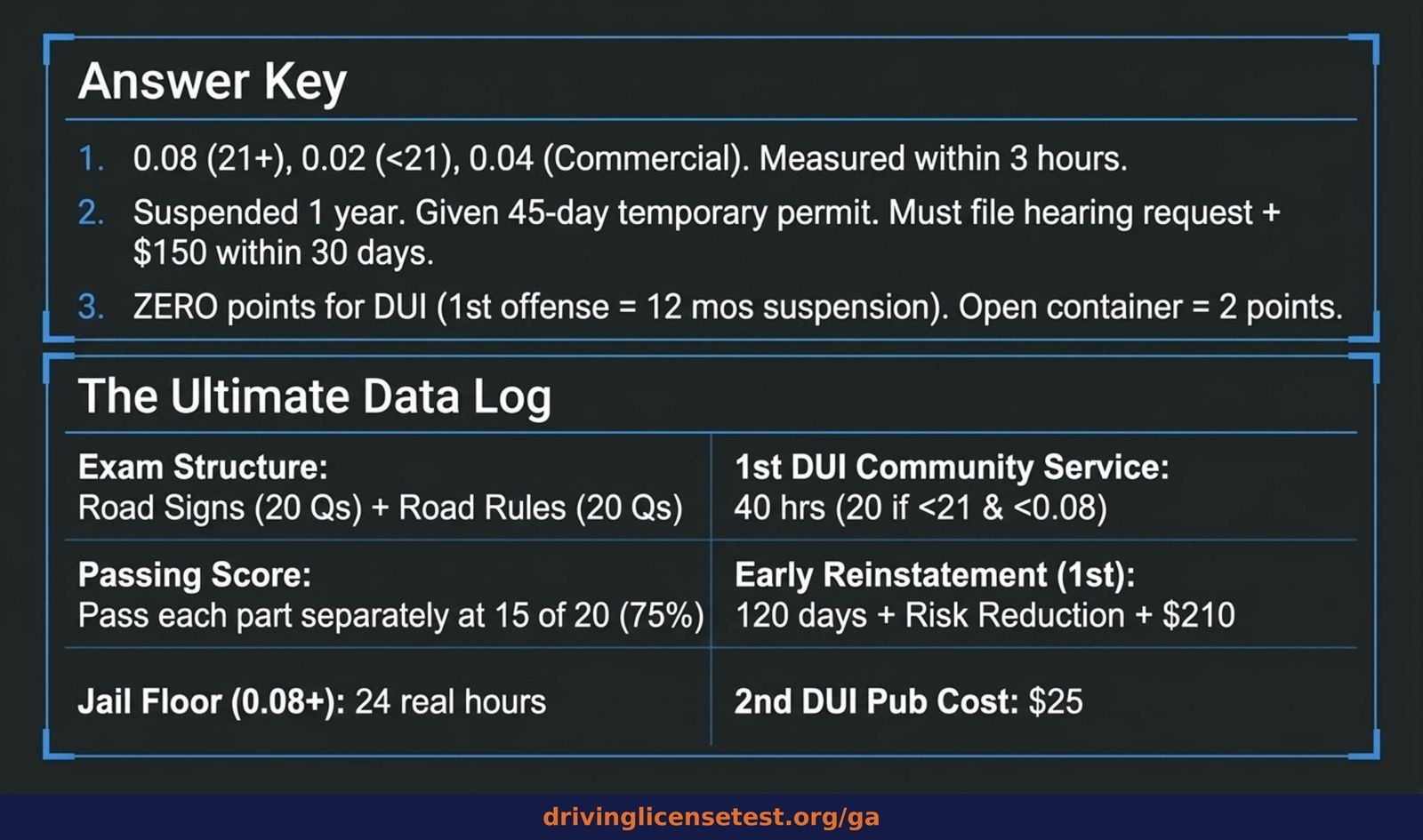
- 0.08 grams or more for drivers 21 and over; 0.02 grams or more for drivers under 21; 0.04 percent or more for commercial motor vehicles. Each applies to an alcohol concentration reached at any time within 3 hours after driving, from alcohol consumed before driving ended.
- Her Georgia license or driving privilege is suspended for one year on the refusal alone. At arrest the officer takes her license and issues a 45-day temporary driving permit. To challenge the administrative suspension she must send DDS a written hearing request with a $150 filing fee within 30 days of notice — later, and the hearing right is waived.
- A fine of $300 to $1,000 (generally not suspendable); imprisonment of 10 days to 12 months, of which all but 24 hours may be suspended if the concentration was 0.08 or more; not fewer than 40 hours of community service; completion of a DUI Alcohol or Drug Use Risk Reduction Program within 120 days of conviction; a clinical evaluation (with treatment if recommended); and probation of 12 months less jail time served.
- None — a DUI conviction is assessed no points in Georgia; its consequence is suspension. First conviction: 12 months, with early reinstatement after 120 days on Risk Reduction proof plus $210 ($200 by mail). Second within 5 years: 3 years, no reinstatement application before 18 months, plus one year of ignition interlock. Third within 5 years: habitual violator — revoked.
- Six months — a first under-21 conviction below 0.08 with no prior young-driver suspension. At 0.09 the first conviction would bring 12 months. A second conviction within 5 years brings 18 months.
Keep practicing
- Take the Alcohol & Drugs practice quiz
- Flip through the Alcohol & Drugs flashcards
- Run the full Georgia practice test
More study guides: Signs & Signals Study Guide · Traffic Laws Study Guide · Right of Way Study Guide · Safe Driving Study Guide · Licensing & Registration Study Guide