
Your complete Georgia study guide — plain language, no jargon.
📘 Prefer pictures? Flip through the visual deck
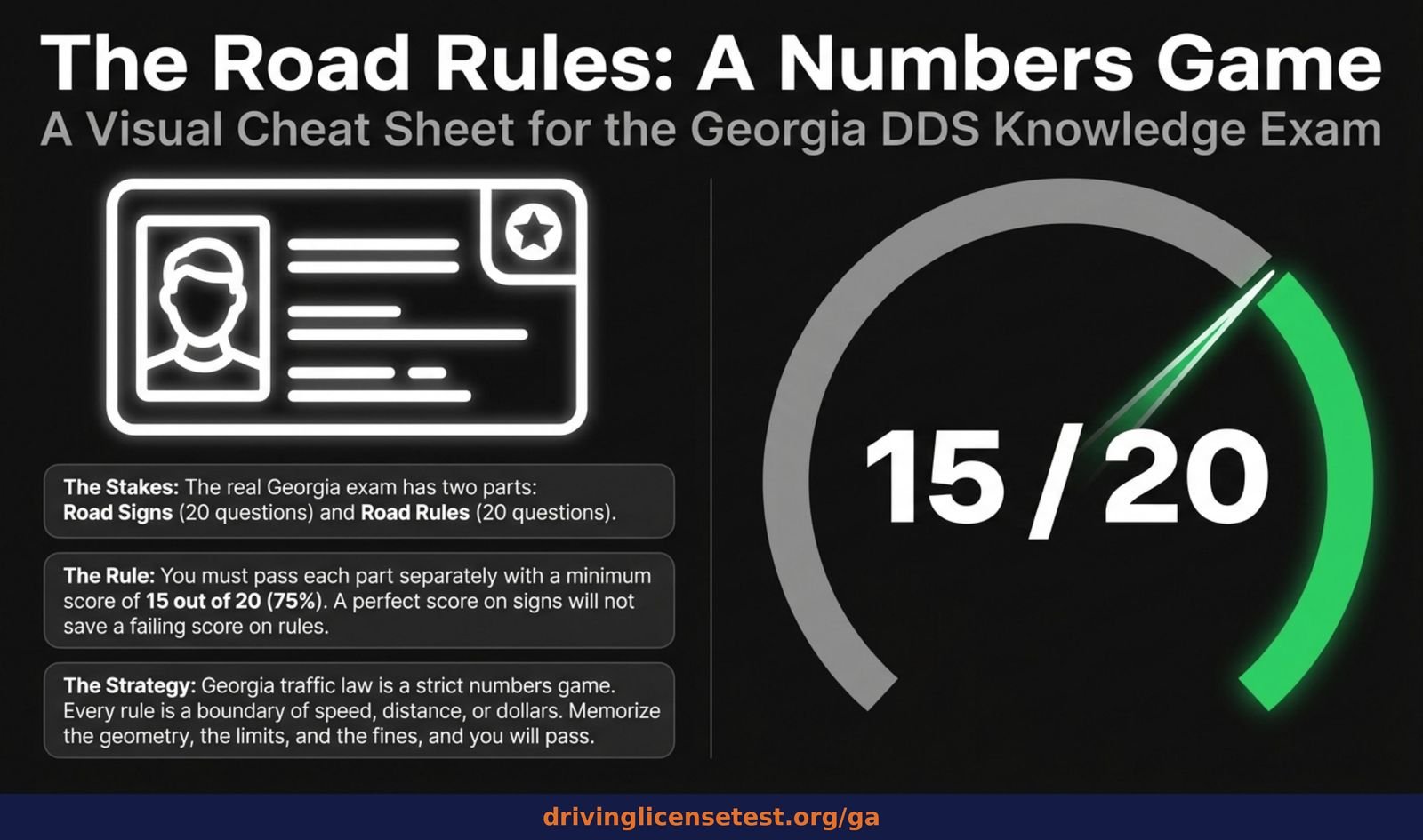
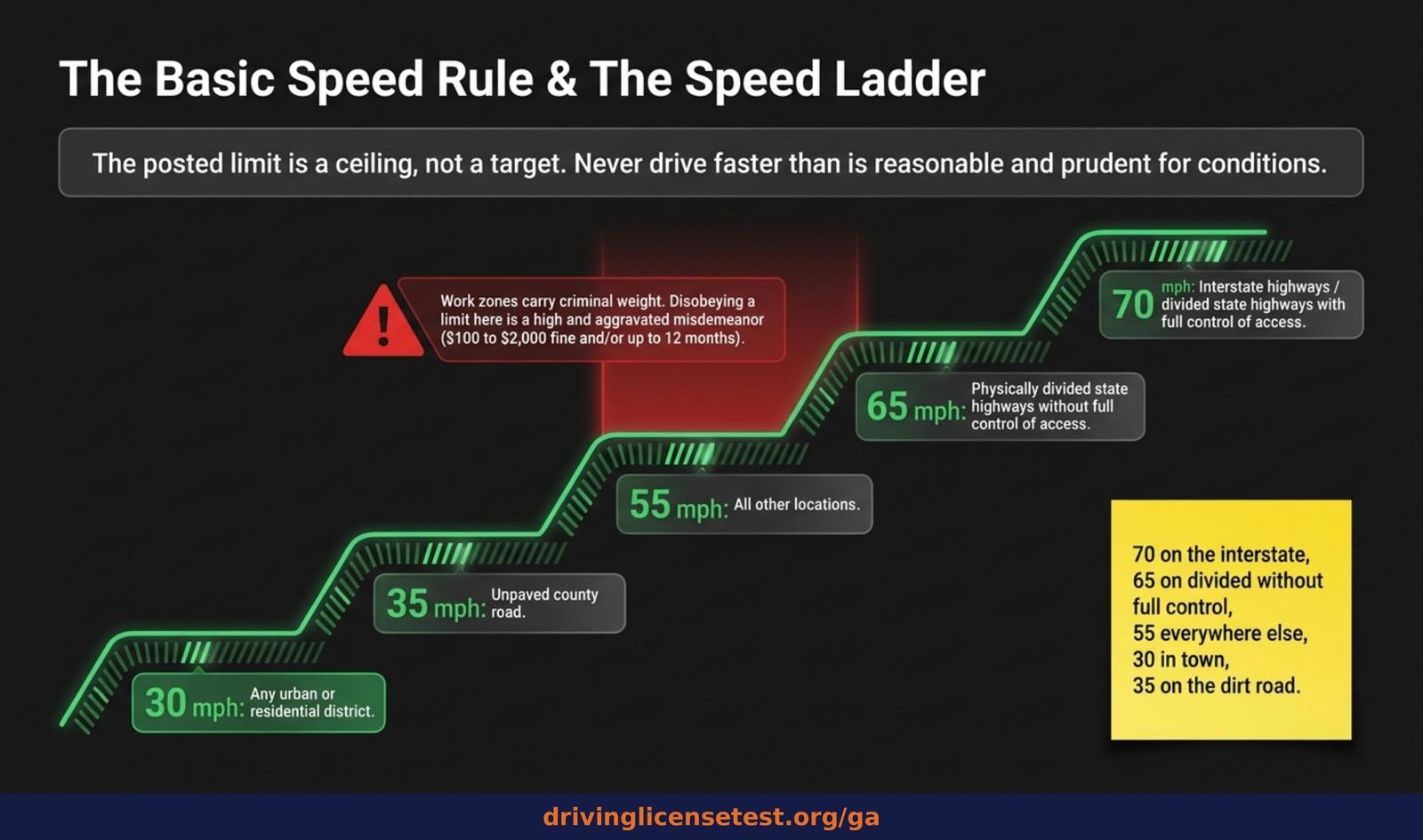
This whole guide as 13 slides — swipe or scroll sideways through them. The speed ladder, Super Speeder, Hands-Free and the points system, in pictures.





Take it with you: Download the deck as a PDF (6.2 MB) → — free to share.
Why this matters
Traffic laws are the numbers and duties that govern every mile: how fast, where to stop, when to move over, what your hands may hold. In Georgia these rules come from the Official Code of Georgia and the Georgia Driver’s Manual, published by the Georgia Department of Driver Services (DDS). The real Georgia knowledge exam has two parts — Road Signs (20 questions) and Road Rules (20 questions) — and each part must be passed separately at 15 of 20 (75%). A strong score in one part does not offset the other. Georgia layers signature duties on top of the basics: the Super Speeder fee, the Hands-Free law that bans even holding your phone, and the Spencer Pass Law on every shoulder. Learn them here, exactly as Georgia writes them.
Part 1: The basic speed rule and Georgia speed limits
The posted limit is a ceiling, not a target: never drive faster than is reasonable and prudent for conditions — traffic, weather, visibility, and the road itself — and never faster than the posted maximum. That basic speed law sits underneath every number below. Unless otherwise posted or designated, Georgia law sets these maximums:
- 70 mph — interstate highways, and physically divided state highways with full control of access, where designated by signs.
- 65 mph — physically divided state highways without full control of access, where designated.
- 55 mph — in all other locations.
- 30 mph — in any urban or residential district.
- 35 mph — on an unpaved county road.
Work zones carry criminal weight: disobeying a regulatory speed limit in a work zone is a high and aggravated misdemeanor, punishable by a fine of $100 to $2,000 and/or up to 12 months.
Memory aid: 70 on the interstate, 65 on the divided highway without full control, 55 everywhere else, 30 in town, 35 on the dirt road.
Check yourself: You are on an unposted highway outside any town, then turn onto an unposted street in a residential district, then onto an unpaved county road. What is the maximum lawful speed in each place — and what rule still applies on top of all three?
Part 2: Super Speeder — Georgia’s extra $200
Georgia adds a state fee on top of the local fine for its fastest convictions. A driver convicted of driving 85 mph or more on any road or highway, or 75 mph or more on any two-lane road or highway, is classified a Super Speeder.
- The fee: an additional $200 state fee, on top of all local fines and penalties.
- The notice: DDS must notify the driver within 30 days after receiving the qualifying conviction.
- The deadline: if the fee is not paid within 90 days after receipt of the notice, the license is suspended and a $50 reinstatement fee is added.
- Where the money goes: Super Speeder fees are deposited in the state general fund with the intent that they fund Georgia’s trauma care system.
Trap: Prep summaries get two Super Speeder details wrong. The two-lane threshold is 75, not 85 — the lower number is the whole point of the two-lane rule. And the pay window is 90 days after you receive the notice. Any answer that gives you a longer window is selling you a suspension.
Memory aid: 85 anywhere, 75 on two lanes, 200 dollars, 90 days — or suspension plus 50 more.
Check yourself: A driver is convicted at 78 mph on a two-lane road. Is she a Super Speeder? What does she owe the state beyond the local fine, and how long does she have to pay it?
Part 3: The Slow Poke law and the left lane
Georgia’s left lane is a passing lane, not a cruising lane. Under the “Slow Poke” law, a driver may not impede the normal flow of traffic and may not remain in the passing (left) lane after being overtaken from behind. The duty yields to real life — exceptions cover traffic conditions, weather or hazards, obeying a law or traffic device, exiting or turning left, paying a toll, and emergency and maintenance vehicles — but “I was doing the speed limit” is not one of the exceptions. The penalty is a fine of up to $1,000 and 3 points.
Memory aid: Pass, then move over. The left lane is borrowed, never owned.
Check yourself: You finish passing a truck on the interstate and settle into the left lane at the speed limit while cars stack up behind you. What does Georgia law require, and what can staying cost you?
Part 4: The Hands-Free Georgia Act — do not hold the phone
Georgia’s device law is built on one physical rule: while operating a motor vehicle on any Georgia highway, you may not physically hold or support, with any part of your body, a wireless telecommunications device or a stand-alone electronic device. Holding it in your hand, propping it on your leg, cradling it on your shoulder — all of it is holding. Using an earpiece, headphone device, or wrist-worn device for a voice communication is allowed.
- No text-based communication: you may not write, send, or read any text-based communication — text message, instant message, e-mail, or Internet data. Voice-to-text is excepted, and so is using the device for navigation and GPS.
- No video: you may not watch a video or movie (other than navigation data) or record or broadcast video. Devices used solely for continuous recording — dash cameras — are excepted.
- Due care underneath it all: independently of the device rules, every driver must exercise due care and must not engage in any action that distracts from safe operation.
The exceptions are narrow: the prohibitions do not apply when you are reporting a traffic accident, medical emergency, fire, crime, or serious road hazard; to utility workers responding to a utility emergency; to law enforcement and first responders performing official duties; or while the vehicle is lawfully parked.
The penalties escalate twice over. Each violation is a separate misdemeanor, fined not more than $50 for a first conviction, $100 for a second, or $150 for a third or subsequent within a 24-month period — with no court costs or surcharges added. And the points escalate with the fines: 1 point for a first violation, 2 for a second, 3 for a third or subsequent.
One mercy, once: a driver charged with a first holding-device violation is not guilty if they produce in court a hands-free device (or proof of its purchase) that will allow future compliance and affirm they have not used this privilege before.
Memory aid: Never hold it, never support it, never read it. Fines 50, 100, 150 — points 1, 2, 3.
Check yourself: A driver props her phone on her thigh and reads a text at a red light, engine running, in traffic. She never lifts the phone. Has she violated the Hands-Free Act — and which two rules has she broken?
Part 5: The Spencer Pass Law — protect the people on the shoulder
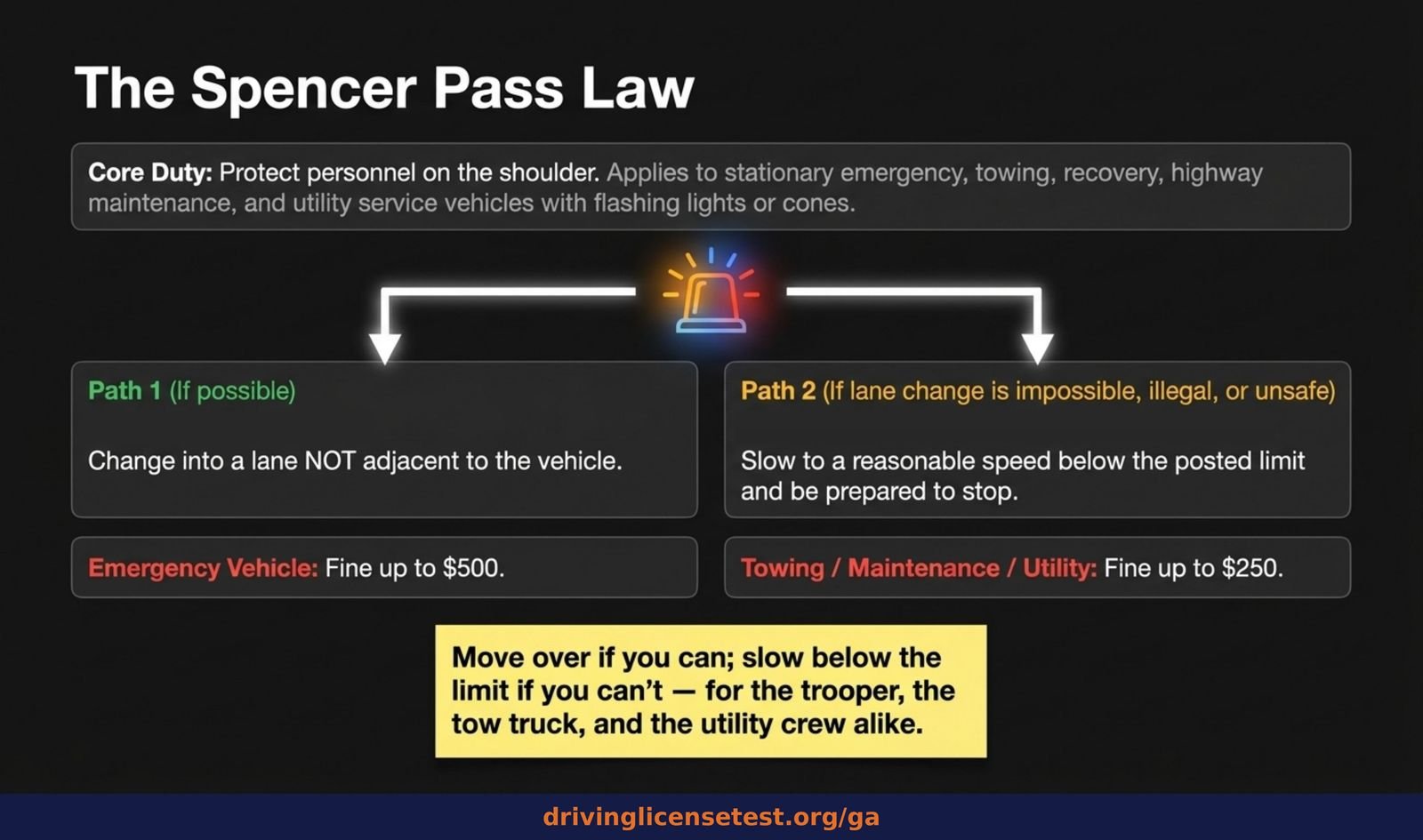
Georgia’s move-over statute is officially the Spencer Pass Law. Approaching a stationary authorized emergency vehicle displaying flashing yellow, amber, white, red, or blue lights, you must:
- Change into a lane not adjacent to the vehicle, if possible; and if a lane change would be impossible, illegal, or unsafe,
- Slow to a reasonable speed below the posted limit and be prepared to stop.
The same duty applies when approaching a stationary towing or recovery vehicle, highway maintenance vehicle, or utility service vehicle using traffic cones or flashing or revolving yellow, amber, or white lights. The fines split by who you endangered: a violation involving an emergency vehicle costs not more than $500; a violation involving a towing, maintenance, or utility vehicle costs not more than $250.
Memory aid: Move over if you can; slow below the limit if you can’t — for the trooper, the tow truck, and the utility crew alike.
Check yourself: A utility truck sits on the shoulder with cones out and amber lights flashing, and traffic is too heavy to change lanes. What does the Spencer Pass Law require of you, and what is the maximum fine if you blow past at full speed?
Part 6: Seat belts and child restraints
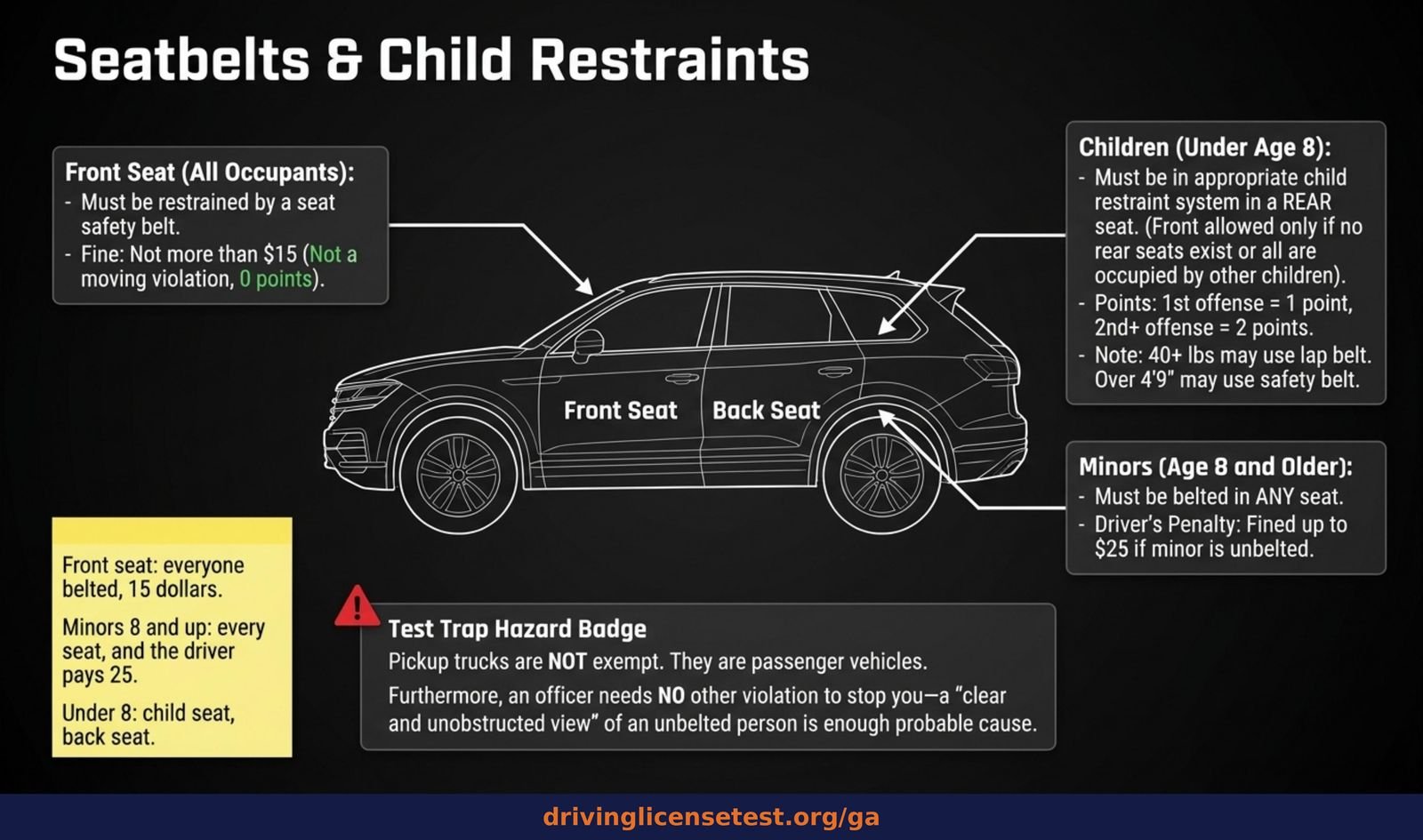
Each occupant of the front seat of a passenger vehicle must be restrained by a seat safety belt while the vehicle is operated on a public road. “Passenger vehicle” includes pickup trucks, vans, and SUVs designed to carry 15 or fewer passengers — the only pickup-truck carve-out is a vehicle being used by an occupant 18 or older in connection with usual farming operations. Older summaries that call pickup trucks exempt are stale.
Failure to wear a belt is the offense of failure to wear a seat safety belt, with a fine of not more than $15 and no added costs or surcharges. It is not a moving violation for points purposes. Georgia enforces the belt law on its own: probable cause rests on an officer’s clear and unobstructed view of the unrestrained person — no other violation needs to come first.
Minors extend the duty to every seat:
- Every minor age 8 or older must be belted in any seat. If such a minor is unbelted, the driver commits “failure to secure a seat safety belt on a minor,” fined not more than $25.
- Children under 8 must ride in a child passenger restraining system appropriate to the child’s height and weight, and must ride in a rear seat — the front seat is allowed only when the vehicle has no appropriate rear seating position or all appropriate rear positions are occupied by other children. A child of 40 pounds or more may use a lap belt in defined seating situations, and a physician’s written statement or a height over 4 feet 9 inches changes the requirement to a safety belt.
- A child-restraint violation carries points: 1 point for a first offense, 2 points for a second or subsequent.
Memory aid: Front seat: everyone belted, 15 dollars. Minors 8 and up: every seat, and the driver pays 25. Under 8: child seat, back seat.
Check yourself: An officer with a clear view watches an unbelted front-seat passenger ride past in an otherwise perfectly driven pickup truck. Can the officer act on the belt alone, and what is the maximum fine?
Part 7: Headlights, signals, and the distance numbers
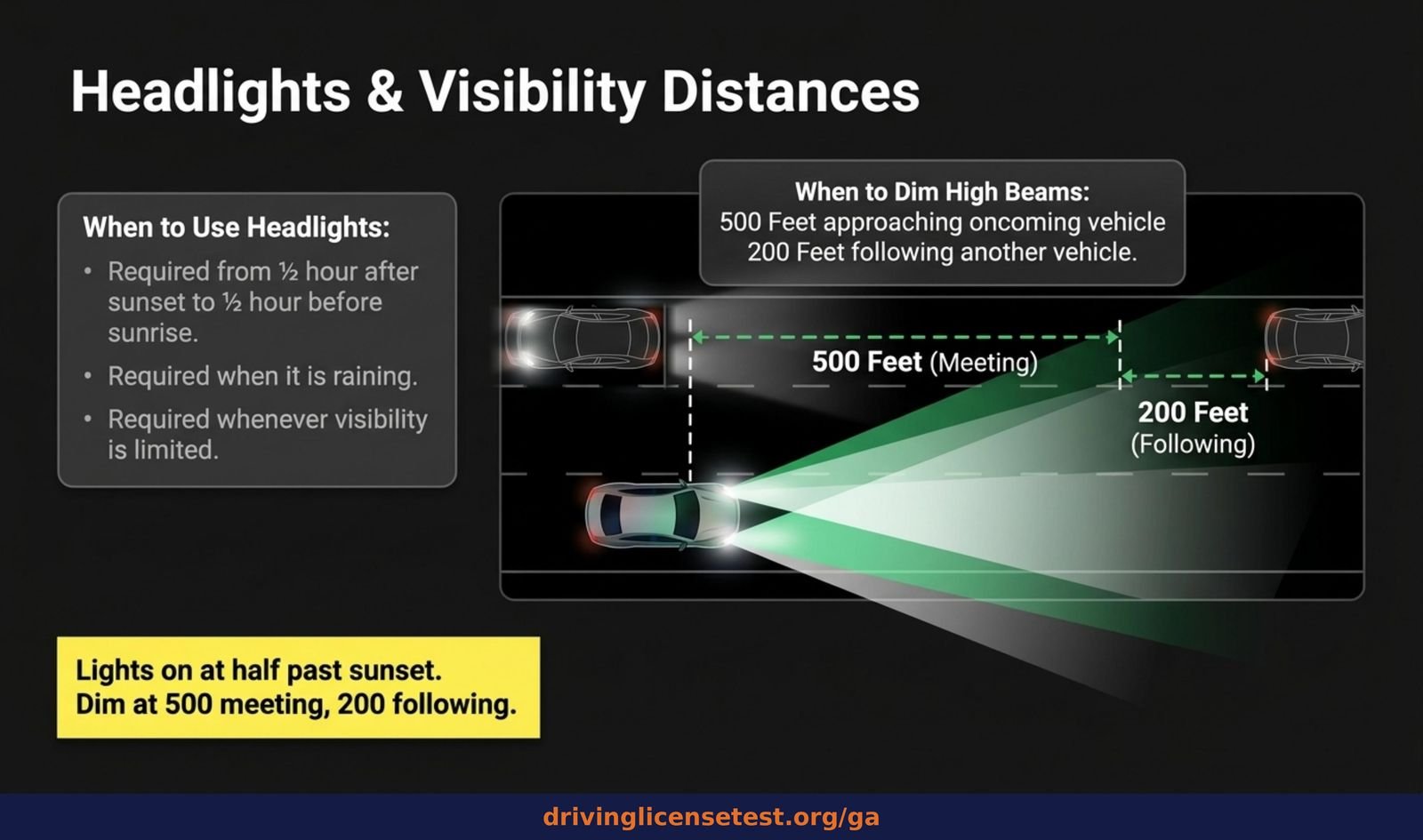
Headlights are required from ½ hour after sunset to ½ hour before sunrise, when it is raining, and whenever visibility is limited. Dim your high beams within 500 feet of an oncoming vehicle and within 200 feet when following another vehicle.
The center left-turn lane has a hard entry limit: you may enter it no more than 300 feet before your turn, and you may use it only for left turns — never for through travel or passing.
HOV lanes require 2 or more occupants — buses, motorcycles, and vehicles with alternative-fuel plates also qualify — and are marked with a diamond. The fines run $75, $100, $150 for successive offenses, and a fourth or subsequent offense adds 1 point. Metro Atlanta also operates Express Lanes using the Peach Pass, including the I-85 HOT lanes and the reversible I-75 South lanes.
Memory aid: Lights on at half past sunset. Dim at 500 meeting, 200 following. Turn lane: 300 feet, turns only.
Check yourself: On a dark road you are closing on a slower car from behind, and another car is approaching in the distance. At what distances must your bright lights go down for each of them?
Part 8: Parking — the distance rules
Parking law is geometry. Georgia’s no-parking distances — memorize them as a ladder:
- Within 15 feet of a fire hydrant;
- Within 20 feet of a crosswalk at an intersection;
- Within 30 feet of a stop sign, yield sign, or traffic signal;
- Within 20 feet of a fire-station driveway;
- Within 75 feet of the entrance opposite a fire station;
- Within 50 feet of a railroad crossing.
And prohibited outright: double parking, and parking on a sidewalk, in an intersection, on a bridge or in a tunnel, or on railroad tracks.
Memory aid: Fifteen from a hydrant, twenty from the crosswalk and the station door, thirty from the sign, fifty from the rail, seventy-five across from the station.
Check yourself: You park 25 feet from a stop sign and 18 feet from a crosswalk at an intersection. Two distance rules are in play. State both, and whether your spot is legal.
Part 9: Georgia extras the test loves
- Littering from a vehicle is a misdemeanor punishable by a fine of up to $1,000 and/or up to 12 months — and the court may order the offender to clean up litter.
- Coasting downhill in neutral is prohibited.
- Wearing headphones that impair hearing while driving is prohibited.
- Riding in a house trailer while it is being moved is prohibited.
- A trailer wider than 8 feet 6 inches may not be operated on Georgia highways.
Georgia points, in brief
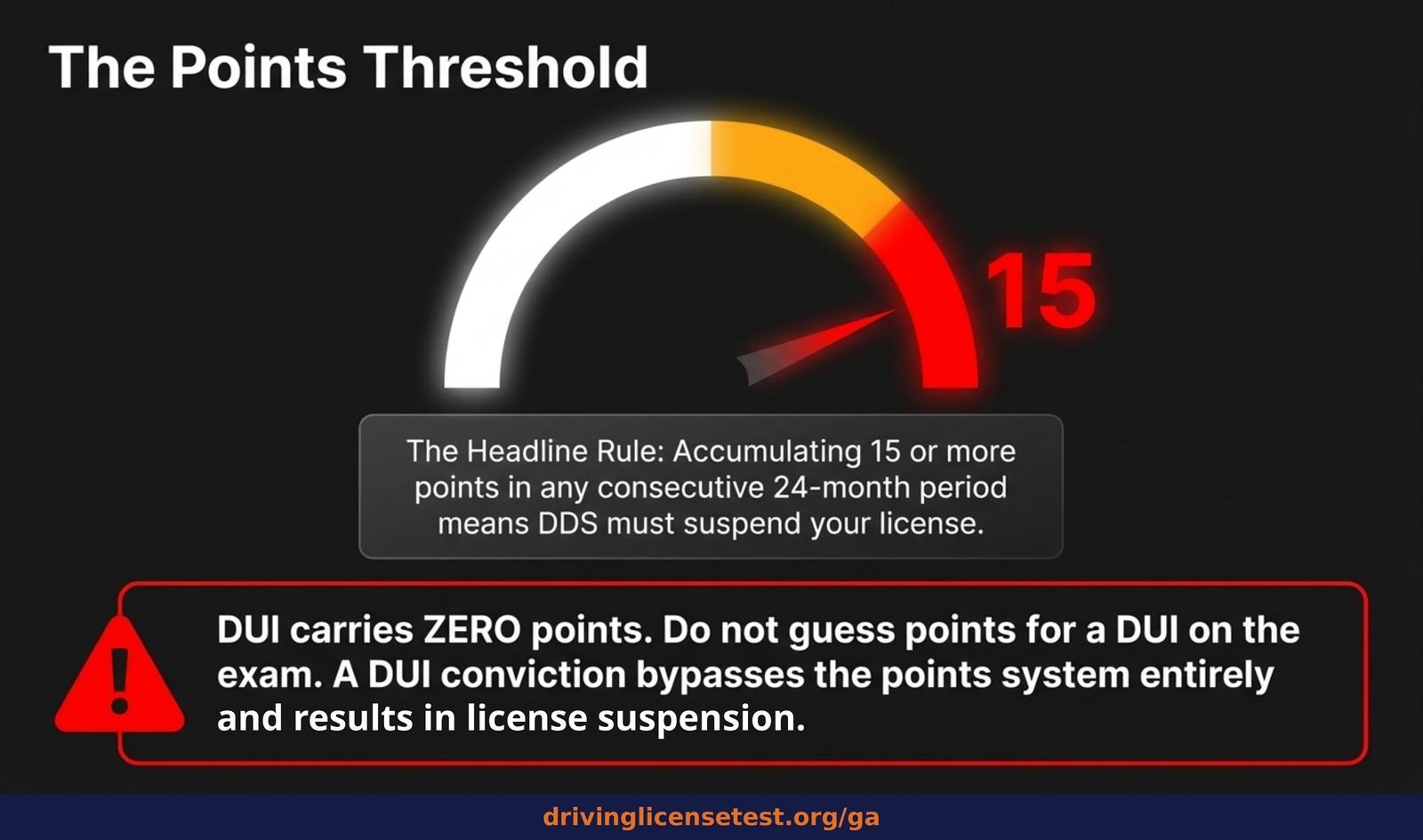
Georgia assesses points on your record upon conviction of moving violations — and the headline rule is 15 or more points in any consecutive 24-month period means DDS must suspend your license. The full schedule, the stricter young-driver triggers, and the way to remove up to 7 points live in the Licensing & Registration study guide. One warning belongs here, because bad study materials get it wrong in both directions: a DUI conviction carries no points at all — its license consequence is suspension, not points.
Key numbers to memorize
| Fact | Remember |
|---|---|
| Speed — interstate and divided highways with full control of access | 70 mph, where designated |
| Speed — divided highways without full control of access | 65 mph, where designated |
| Speed — all other locations / urban or residential / unpaved county road | 55 mph / 30 mph / 35 mph — always under the basic speed law |
| Work-zone speeding | High and aggravated misdemeanor — fine $100 to $2,000 and/or up to 12 months |
| Super Speeder | 85+ mph anywhere or 75+ mph on a two-lane road · extra $200 state fee · notice within 30 days · pay within 90 days of receipt or suspension plus $50 reinstatement |
| Slow Poke law | Do not remain in the left lane after being overtaken · fine up to $1,000 and 3 points |
| Hands-Free Act | Never hold or support a device with any part of the body · no writing, sending, or reading texts · no watching or recording video · earpiece, headphone, and wrist devices allowed for voice |
| Hands-Free penalties | Fines not more than $50 / $100 / $150 (1st/2nd/3rd+ in 24 months), no court costs · points 1 / 2 / 3 |
| Spencer Pass Law | Change to a non-adjacent lane if possible; otherwise slow below the posted limit and be ready to stop · also covers towing, maintenance, and utility vehicles · fines up to $500 (emergency) / $250 (towing, maintenance, utility) |
| Seat belts | Front-seat occupants belted; pickup trucks, vans, and SUVs included · fine not more than $15 · not a moving violation · enforced on an officer’s clear and unobstructed view |
| Children | Minors 8+ belted in any seat (driver’s offense, up to $25) · under 8 in an appropriate child restraint system, rear seat · child-restraint violation: 1 point first, 2 points later |
| Headlights | ½ hour after sunset to ½ hour before sunrise, in rain, and when visibility is limited · dim 500 feet meeting, 200 feet following |
| Center left-turn lane | Enter no more than 300 feet before the turn; left turns only |
| HOV lanes | 2 or more occupants · diamond marking · fines $75 / $100 / $150 · fourth or subsequent offense adds 1 point |
| No-parking distances | 15 ft hydrant · 20 ft crosswalk · 30 ft stop/yield sign or signal · 20 ft fire-station driveway · 75 ft entrance opposite a fire station · 50 ft railroad crossing |
5-question self-check
- State the unposted maximum speed on an interstate, on a divided highway without full control of access, on an ordinary road outside town, in a residential district, and on an unpaved county road.
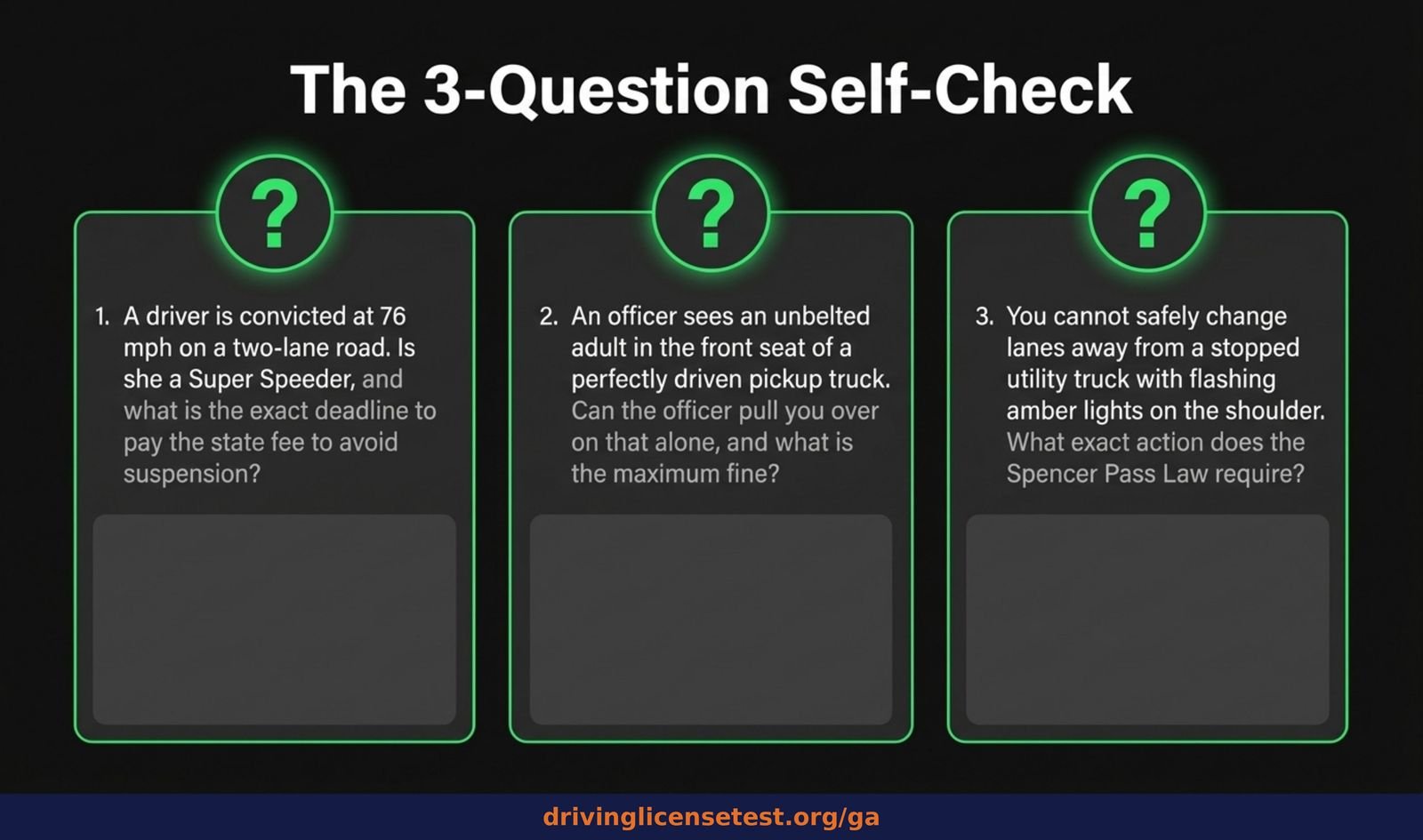
- A driver is convicted at 76 mph on a two-lane road. Is she a Super Speeder, what extra state fee does she owe, and what happens if she has not paid it 90 days after receiving the DDS notice?
- What does the Hands-Free Act forbid your hands and eyes to do, what voice uses are allowed, and how do the fines and points escalate across three convictions?
- What does the Spencer Pass Law require when you cannot change lanes away from a stopped emergency vehicle — and does the same duty reach a utility truck with cones out?
- An officer sees an unbelted adult in the front seat of a pickup truck being driven perfectly. Can the officer act on the belt alone, and what is the maximum fine for the belt offense?
Answer key
- 70 mph; 65 mph; 55 mph; 30 mph; 35 mph — and every figure sits under the basic speed law: never faster than is reasonable and prudent for conditions.
- Yes — 75 mph or more on a two-lane road qualifies. She owes the additional $200 state Super Speeder fee on top of local fines. If it is unpaid 90 days after receipt of the notice, her license is suspended and a $50 reinstatement fee is added.
- Your body may not hold or support the device in any way; you may not write, send, or read text-based communications, watch video or movies, or record or broadcast video. Earpieces, headphone devices, and wrist-worn devices are allowed for voice communication, and voice-to-text and navigation are excepted. Fines: not more than $50, then $100, then $150. Points: 1, then 2, then 3.
- Slow to a reasonable speed below the posted limit and be prepared to stop. Yes — the same duty applies to stationary towing or recovery, highway maintenance, and utility service vehicles using traffic cones or flashing or revolving lights.
- Yes. Probable cause for the belt offense rests on the officer’s clear and unobstructed view, and pickup trucks are covered passenger vehicles. The offense of failure to wear a seat safety belt carries a fine of not more than $15, with no added costs or surcharges, and it is not a moving violation.
Keep practicing
- Take the Traffic Laws practice quiz
- Flip through the Traffic Laws flashcards
- Run the full Georgia practice test
More study guides: Signs & Signals Study Guide · Right of Way Study Guide · Safe Driving Study Guide · Alcohol, Drugs & Driving Conditions Study Guide · Licensing & Registration Study Guide